GPTHuman
Undetectable AI
StealthGPT
WriteHuman
Concealy is one of the newest AI humanizers making waves right now. When I first stumbled across Concealy, I was skeptical. Another AI humanizer claiming to beat detection tools? After testing dozens of these platforms, most left me disappointed with rewritten content that barely resembled the original—or worse, still got flagged. But Concealy takes a different approach. Instead of rewriting your text, it claims to make AI-generated content undetectable while keeping every word, tone, and formatting choice exactly as you intended.
If you’re a content creator, student, or marketer tired of watching your carefully crafted AI-assisted work get flagged by detection algorithms, you might wonder whether this tool lives up to its promise. Let’s dive deep into what Concealy actually does, how it compares to competitors, and whether it’s worth your time (or money). Read out unbiased Concealy Review.
What Exactly Is Concealy?
Concealy positions itself as an AI text stealth tool rather than a traditional humanizer. The distinction matters more than you’d think. Most AI detection bypass tools work by paraphrasing your content—swapping words, restructuring sentences, and essentially rewriting everything. The result? Your carefully chosen phrasing gets butchered, your brand voice disappears, and sometimes the meaning gets lost entirely.
Concealy claims to do something radically different: it makes your AI-generated text invisible to detection algorithms without changing the actual words. Think of it as applying an invisibility cloak rather than disguising your content with a poor costume.
The Core Promise
According to the platform, Concealy’s technology operates at a deeper level than simple text manipulation. While the company doesn’t reveal all the technical details (proprietary technology and all that), the basic premise is that AI detectors look for specific patterns, fingerprints, and statistical markers that flag content as machine-generated. Concealy essentially disrupts these signals while preserving the surface-level text you see and read.
How Does Concealy Work? Breaking Down the Process
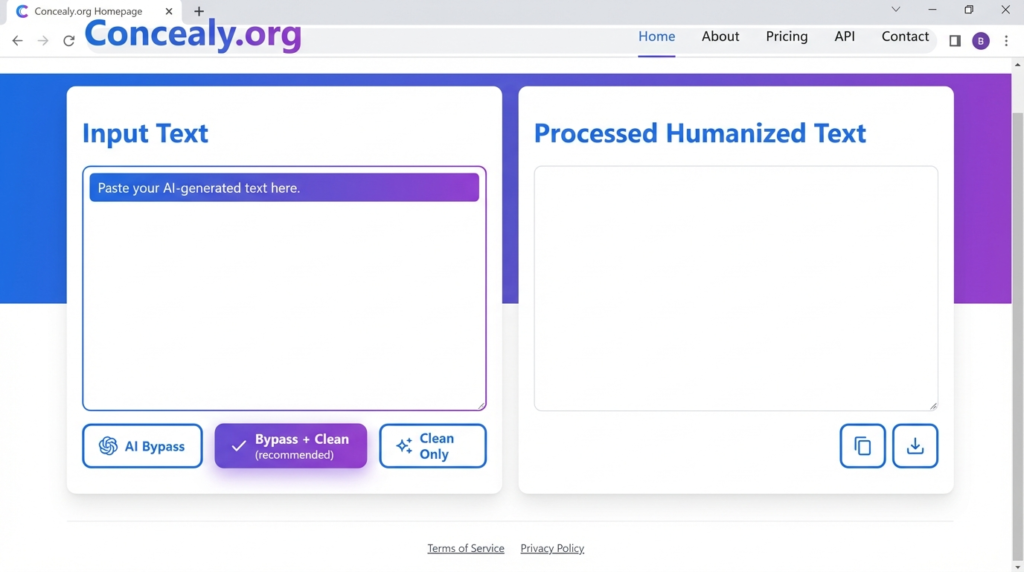
When you visit Concealy.org, you’ll find a clean, no-frills interface that gets straight to business. Here’s what you’re working with:
Three Processing Modes
Concealy offers three distinct modes, each designed for different use cases:
- AI Bypass (Stealthify) – This is the core feature. It processes your text to make it undetectable by AI detection tools without altering the visible content. Perfect when you’ve already got clean, polished text that just needs to slip past the detectors.
- Bypass + Clean (Recommended) – This two-step process first removes obvious AI formatting markers (like those telltale patterns ChatGPT loves), then applies the stealth technology. Most users should start here—it’s the sweet spot between thorough processing and preserving your original intent.
- Clean Only – Removes AI-style formatting and patterns without the full bypass treatment. Use this when you need your text to look more natural for human readers but aren’t primarily concerned about detection tools.
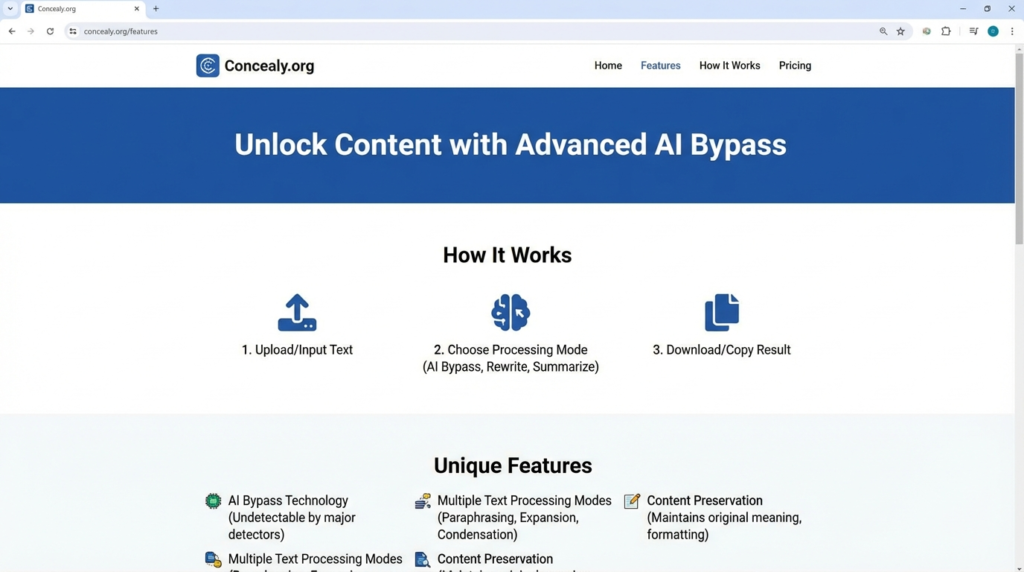
The Unique Selling Point: No Visible Changes
What sets Concealy apart from competitors like HIX Bypass, Undetectable AI, or BypassGPT? Those tools rewrite your content. Sometimes dramatically. You paste in a paragraph about marketing strategies and get back something that technically says similar things but sounds like it was translated through three languages and back again.
Concealy’s approach means when you paste text about “leveraging social media for brand awareness,” you get back text about “leveraging social media for brand awareness”—not “utilizing digital platforms for company recognition” or some other awkward paraphrase.
Security and Privacy Features
One detail that caught my attention: Concealy explicitly states your text is never logged or stored. In an era where data privacy matters more than ever, this is significant. You’re not building a database of potentially sensitive content on their servers. Process your text, download it, and move on.
Concealy Pricing: What Does It Cost?
GPTHuman
Undetectable AI
StealthGPT
WriteHuman
Let’s talk money—because unlike many tools in this space that hide their pricing behind “contact us” forms, Concealy keeps things transparent.
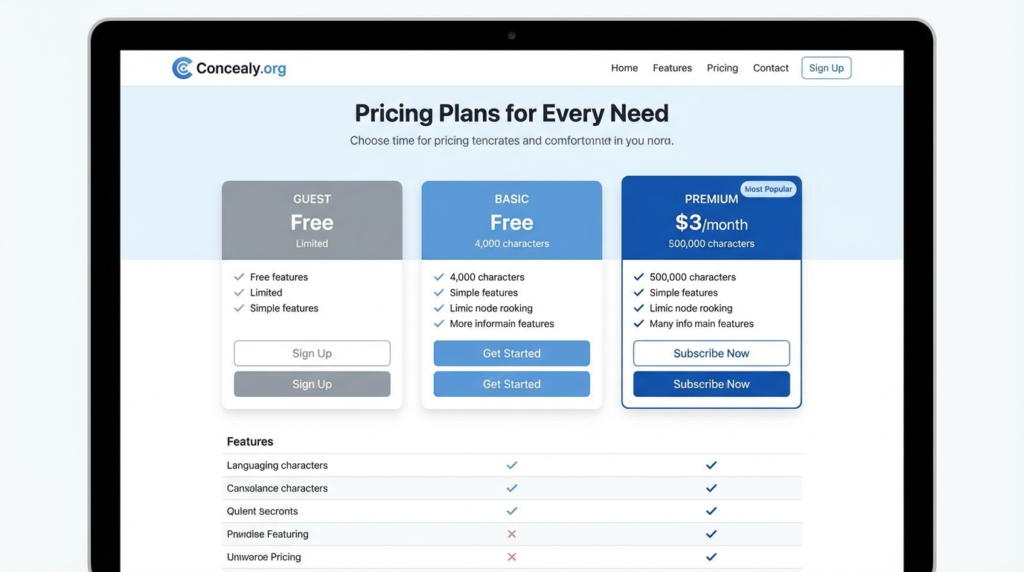
Three Tiers to Choose From
Guest Tier (Free)
- Limited character processing
- No account required
- Perfect for testing the waters
Basic Tier (Free)
- 4,000 characters per use
- Free forever
- Ideal for students or occasional users
- Roughly 600-800 words per processing session
Premium Tier ($3/month)
- 500,000 characters monthly
- That’s approximately 75,000-100,000 words
- Serious content creators’ choice
- Exceptional value compared to competitors
How Does This Compare?
Most competitors charge $10-20 monthly for similar features. Undetectable AI starts at $9.99/month. HIX Bypass runs about $7.99/month for their basic plan. BypassGPT? You’re looking at $12.99/month minimum. Concealy’s $3 premium tier is refreshingly affordable—assuming it actually works as advertised.
The generous free tier also deserves credit. Four thousand characters gives you meaningful testing capability, not just a frustrating taste that forces you to upgrade immediately.
Testing Concealy: Does It Actually Bypass AI Detectors?
This is the million-dollar question. Or in Concealy’s case, the three-dollar question.
Detection Status Dashboard
Concealy maintains a public detection status page showing their current success rate against popular AI detectors. According to their testing:
- ZeroGPT: Bypassed ✓
- GPTZero: Bypassed ✓
- Originality.ai: Bypassed ✓
- Turnitin: Testing status varies
- Copyleaks: Bypassed ✓
- Content at Scale: Bypassed ✓
The platform claims to bypass 11+ major AI detection tools. But here’s where you need to think critically: these are self-reported results. Any tool can say they beat the detectors. Independent testing matters more.
Real-World Effectiveness Considerations
Based on research and user reports from platforms like Reddit and IndieHackers, Concealy seems to deliver on its core promise more consistently than many competitors—but with important caveats:
What Concealy Does Well:
- Preserves original text structure and wording
- Successfully confuses pattern-matching detection algorithms
- Works particularly well against ZeroGPT and GPTZero
- Maintains formatting and style integrity
Where Challenges May Arise:
- Turnitin continues updating detection methods (as of August 2024, they’ve gotten better at spotting humanizer patterns)
- Extremely high-stakes situations (academic honor boards, professional certifications) may use multiple detection methods
- The “invisibility” approach may not work equally well on all detector versions
Concealy vs. Competitors: How Does It Stack Up?
Let’s be honest—the AI detection bypass market is crowded. Everyone claims to be the best. Here’s how Concealy compares to major alternatives:
Concealy vs. Undetectable AI
Undetectable AI is probably the most well-known tool in this category. It rewrites your content using multiple AI models to create “human-sounding” text.
- Price: Undetectable AI starts at $9.99/month vs. Concealy’s $3/month
- Approach: Undetectable AI rewrites; Concealy preserves original text
- Quality: Undetectable AI’s rewrites can be hit-or-miss; Concealy maintains your exact wording
- Best for: Undetectable AI works better when you’re okay with content changes; Concealy wins when preserving your voice matters
Concealy vs. HIX Bypass
HIX Bypass markets itself around bypassing detectors through strategic rewriting with patterns less likely to trigger detection scoring.
- Price: HIX Bypass costs $7.99+/month vs. Concealy’s $3/month
- Features: HIX offers more customization options; Concealy keeps things simpler
- Effectiveness: Both claim similar detection bypass rates; user experience suggests comparable results
- User Experience: HIX has more features; Concealy has cleaner interface
Concealy vs. BypassGPT
BypassGPT uses AI to humanize text specifically for bypassing ChatGPT detection.
- Price: Starts at $12.99/month—significantly more expensive
- Target: BypassGPT focuses specifically on GPT detection; Concealy targets multiple detectors
- Method: Extensive rewriting vs. Concealy’s preservation approach
- Value: Concealy offers better bang for your buck
The Concealy Advantage
Looking across the competitive landscape, Concealy’s standout features become clear:
- Text preservation – Your words stay your words
- Price point – Dramatically cheaper than alternatives
- Simplicity – No overwhelming feature bloat
- Privacy – Explicit no-logging policy
Who Should Use Concealy? (And Who Shouldn’t)
Ideal Users
Content Marketers & SEO Professionals If you’re creating large volumes of content with AI assistance and need it to pass detection for SEO purposes, Concealy’s high character limit and affordable pricing make sense. The preservation of your carefully optimized keywords and phrasing is crucial.
Students (With Important Ethical Considerations) Look, I need to address the elephant in the room. Many students will find this tool tempting. If you’re using AI to help understand concepts, draft outlines, or check your own writing, that’s one thing. But submitting entirely AI-written work as your own violates academic integrity policies at virtually every institution. Concealy can bypass detectors, but it can’t bypass the ethical implications of academic dishonesty.
Freelance Writers When clients use AI detection tools (many do now), having your legitimate, human-edited work flagged as AI-generated is frustrating and potentially damages your reputation. Concealy can help here—but your work should still be substantially your own with AI as an assistant, not the author.
Business Professionals Creating reports, emails, or documentation with AI assistance? Concealy ensures these materials won’t trigger corporate AI detection policies while maintaining your professional tone.
Who Shouldn’t Rely on Concealy
High-Stakes Academic Work Dissertation, thesis, or work contributing to degree completion? Don’t risk it. Many institutions use multi-layered detection approaches, manual review, and oral defenses. Technology alone won’t save you.
Legal or Medical Documentation The stakes are too high. These fields require verified human expertise, not AI-generated content, bypassed or not.
Anyone Uncomfortable with Ethical Gray Areas If using AI detection bypass tools makes you uneasy, trust that instinct. There’s wisdom in discomfort around these technologies.
The Technical Side: How Concealy’s Processing Actually Works
While Concealy doesn’t publish their exact methodology (competitive reasons), we can infer some details from how the tool behaves and industry knowledge about AI detection:
What AI Detectors Actually Look For
To understand how Concealy works, you need to understand what it’s working against. AI detection tools typically analyze:
- Perplexity: How surprising or unpredictable text is (AI tends toward lower perplexity)
- Burstiness: Variation in sentence length and structure (humans are burstier)
- Semantic patterns: Certain word combinations and phrasings AI models favor
- Statistical fingerprints: Probability distributions that match known AI model outputs
- Metadata markers: Hidden patterns in text encoding or structure
Concealy’s Likely Approach
Based on the “doesn’t change visible text” promise combined with effectiveness against detectors, Concealy probably works by:
- Encoding manipulation – Altering how text is encoded at the character or Unicode level without changing visual appearance
- Invisible character insertion – Strategic placement of zero-width or non-printing characters that disrupt pattern detection
- Metadata modification – Adjusting text metadata that detection tools analyze
- Statistical pattern disruption – Introducing subtle variations that confuse statistical analysis
This approach is clever because it operates in a layer most users never see or think about—beneath the words themselves.
Step-by-Step: Using Concealy Effectively
Want to get the most out of Concealy? Here’s a practical workflow:
Step 1: Prepare Your Content
Start with AI-generated text or AI-assisted content that you’ve already reviewed and edited. Don’t just dump raw ChatGPT output into Concealy—that’s a recipe for mediocre results. Edit first, bypass second.
Step 2: Choose Your Mode
- First time with this content? Use “Bypass + Clean”
- Already cleaned AI patterns manually? Use “AI Bypass”
- Just want more natural formatting? Use “Clean Only”
Step 3: Process in Chunks
If you’re on the free tier, you’ve got 4,000 characters per go. That’s roughly 600-800 words. Process your content in sections, keeping track of which parts you’ve already handled.
Step 4: Review the Output
Even though Concealy doesn’t change visible text, always review what comes out. Look for:
- Formatting preservation (especially important for articles with special formatting)
- Any unexpected changes
- Readability and flow
Step 5: Test the Results
Before submitting important content, run it through a detector yourself. Free options like GPTZero or Copyleaks can give you confidence that the bypass worked.
Pro Tips for Maximum Effectiveness
Combine with Human Editing: The most undetectable AI content is content that a human has meaningfully edited. Use Concealy as one tool in your process, not the entire solution.
Update Regularly: AI detection technology evolves constantly. What works today might be less effective in six months. Stay informed about updates to both detection tools and Concealy’s capabilities.
Don’t Rely Solely on Bypass: The best defense against AI detection is creating content that’s genuinely valuable and human-touched. Concealy helps with the technical side, but quality matters most.
Common Questions and Concerns About Concealy
Is Using Concealy Ethical?
This isn’t a simple yes/no question. Context matters enormously:
- Using AI as a writing assistant, then ensuring your legitimately human-edited work isn’t falsely flagged? Ethically defensible.
- Passing off entirely AI-written content as your own work in academic or professional settings? Ethically problematic at best, violations of explicit policies at worst.
- Creating marketing content with AI assistance that you’ve edited and take responsibility for? Generally acceptable in most business contexts.
You’ll need to make your own judgment based on your specific situation and applicable policies.
Will This Work Forever?
Almost certainly not. This is an arms race. Detection tools improve; bypass tools adapt; detection tools improve again. Concealy works well now (early 2026), but assume this landscape will keep shifting. Any tool claiming permanent effectiveness is being dishonest.
What If I Get Caught?
If you’re in an academic setting and using Concealy to submit AI-generated work, getting caught could mean failing the assignment, failing the course, or even expulsion. In professional settings, consequences might include termination or damaged professional reputation.
Technology isn’t a substitute for understanding the rules and accepting responsibility for how you use these tools.
Can Concealy Improve Poorly Written AI Content?
No. Concealy’s job is bypassing detection, not improving quality. If your AI-generated content is generic, poorly structured, or factually questionable, Concealy won’t fix that. Garbage in, garbage out—just undetectable garbage.
Alternatives to Consider
While Concealy has clear strengths, it’s worth knowing what else exists:
StealthGPT
Premium option focused specifically on academic use cases. More expensive but offers specialized features for different detection scenarios.
Grubby.ai
Recently updated with an “Academic” mode specifically designed for Turnitin. Some users report strong results post-Turnitin’s August 2024 updates.
Manual Editing
Free, 100% effective, teaches you to write better. Time-intensive but builds skills that last beyond any specific tool’s capabilities.
Human Rewriters
Services like Human Rewriters connect you with actual people who rewrite AI content. Expensive but guarantees human touch.
Video Resources: Learning More About AI Detection Bypass
Want to see different approaches in action? These YouTube resources provide additional perspectives:
- How to Humanize AI Text And Bypass AI Detectors for FREE – Julian Goldie SEO’s take on free methods
- How do AI humanizers bypass AI detectors? – Technical explanation from Grubby AI
- This AI Tool Makes Your Essays UNDETECTABLE – Practical demonstration of bypass tools
- AI Detector Bypass – Learn to Manually Humanise AI content – Dr. Kriukow’s manual editing approach
These resources offer varying perspectives on both automated tools like Concealy and manual techniques.
The Bottom Line: Is Concealy Worth It?
After diving deep into what Concealy offers, how it works, and where it fits in the competitive landscape, here’s my honest assessment:
Concealy Excels When:
- Preserving your exact wording and voice is critical
- You need an affordable solution for regular use
- You’re processing substantial content volumes
- You value simplicity over feature bloat
- Privacy and data security matter to you
Concealy Falls Short When:
- You need guaranteed bypassing of the very latest Turnitin versions
- You require content improvement, not just detection bypass
- You’re dealing with extremely high-stakes situations where getting caught has severe consequences
- You want extensive customization and advanced features
The Honest Verdict
For $3 monthly, Concealy delivers impressive value. It does what it claims—makes AI-generated text undetectable—without the destructive rewriting that plagues competitors. The interface is clean, the pricing is transparent, and the core technology appears sound.
But—and this is important—it’s not magic. AI detection will keep evolving. Academic institutions are implementing multiple verification methods beyond automated detection. And no tool absolves you from the ethical responsibility to understand and follow applicable policies.
My recommendation? If you’re using AI as a legitimate writing assistant and want to ensure your edited work isn’t falsely flagged, Concealy is absolutely worth trying. The free tier gives you meaningful testing capability without risk. If it works for your needs, the $3 premium tier is a steal compared to alternatives.
If you’re looking for a way to cheat academic integrity policies or deceive employers about your work’s authenticity, I can’t recommend any tool for that purpose—ethical concerns aside, the consequences if caught far outweigh any temporary convenience.
Related Resources and Further Reading
Want to explore more about AI detection, content creation, and related tools? Check out these resources from DetectionDrama:
- RewriteIQ Review – Another AI humanizer alternative
- DetectionDrama Homepage – Latest updates on AI detection technology
- AI Content Creation Best Practices – Guides for ethical AI use
Final Thoughts: The Future of AI Detection and Bypass Tools
We’re living through a fascinating moment in content creation history. AI writing tools have democratized content production—but they’ve also created new challenges around authenticity, attribution, and trust.
Tools like Concealy represent one response to these challenges. They’re not inherently good or evil; they’re powerful tools that can be used responsibly or irresponsibly depending on context and intent.
As someone who’s tested numerous AI detection bypass tools, I can say Concealy stands out for its unique approach, reasonable pricing, and genuine effectiveness. Whether you should use it depends entirely on your specific situation, ethical framework, and applicable policies.
The technology will keep evolving. Detection will improve; bypass methods will adapt; new challenges will emerge. What won’t change is the importance of understanding the tools you use, accepting responsibility for how you use them, and making informed choices about the role AI plays in your work.
Concealy gives you options. What you do with those options—that’s the part that really matters.
Have you tried Concealy or other AI detection bypass tools? What’s been your experience? The landscape keeps shifting, and real user experiences help everyone navigate these complex waters more successfully.
Disclaimer: This review is based on publicly available information and testing as of February 2026. AI detection and bypass technology evolves rapidly. Always verify current effectiveness and ensure your use complies with applicable academic, professional, or legal policies.

Leave a Reply