
Turnitin’s AI indicator can feel like a verdict, especially when you wrote the work yourself. But an AI score is not proof of misconduct, it’s a probabilistic signal based on patterns, and patterns can collide with totally normal academic writing.
Want to bypass Turnitin in 2026? Grab the free prompt pack.
Get the exact text-humanization prompts I use to drop an AI score by hand — copy, paste, submit. Free, straight to your inbox.
Send me the free prompts →This checklist is designed for one situation: you believe Turnitin flagged your writing incorrectly (or overestimated AI assistance) and you need a clear, defensible way to show your process, sources, and authorship.
First, ground yourself in what Turnitin is (and isn’t) saying — Turnitin AI False Positives A Checklist to Defend Your Work
Turnitin’s AI writing detection is an automated classification system. Like all detectors, it can produce false positives, especially on polished, template-like, or non-native English writing. Independent research has repeatedly shown detector error rates can be non-trivial, and some detectors have struggled badly on specific populations (such as ESL writers).
Two useful references for context:
- OpenAI retired its own AI text classifier after acknowledging reliability limitations.
- Stanford HAI has discussed risks and limitations of AI detection in education contexts (Detection Drama also summarizes detector bias evidence in its research coverage).
If you want the most important conceptual distinction before you do anything else, read: Turnitin AI % vs Similarity %: What’s Actually Different?
Turnitin AI false positives, common “innocent” triggers
You don’t need to memorize detector theory to defend yourself, but it helps to recognize common triggers that look “AI-ish” even when they’re human:
- Highly standardized academic structure (thesis, topic sentences, predictable transitions).
- Overly uniform sentence rhythm (similar sentence lengths across paragraphs).
- Heavily edited prose (especially after grammar tools or intensive proofreading).
- Low-specificity writing (general statements without concrete examples, course references, or personal research trail).
- ESL writing patterns (non-native phrasing can be misread by detectors).
- Short passages (small samples can be noisier for classification).
For more on this angle, see: Normal Writing Habits That Can Trigger Turnitin AI Flags
The core idea: win with process evidence, not arguments about “the score”
When a dispute happens, many students focus on debating the percentage. In practice, the most persuasive defense is boring and concrete: timestamps, drafts, notes, and traceable decision-making.
Your goal is to assemble an authorship packet that answers three questions:
- Did you create this work through a credible writing process?
- Can you show how it evolved over time?
- Can you explain and defend the ideas, sources, and choices inside it?
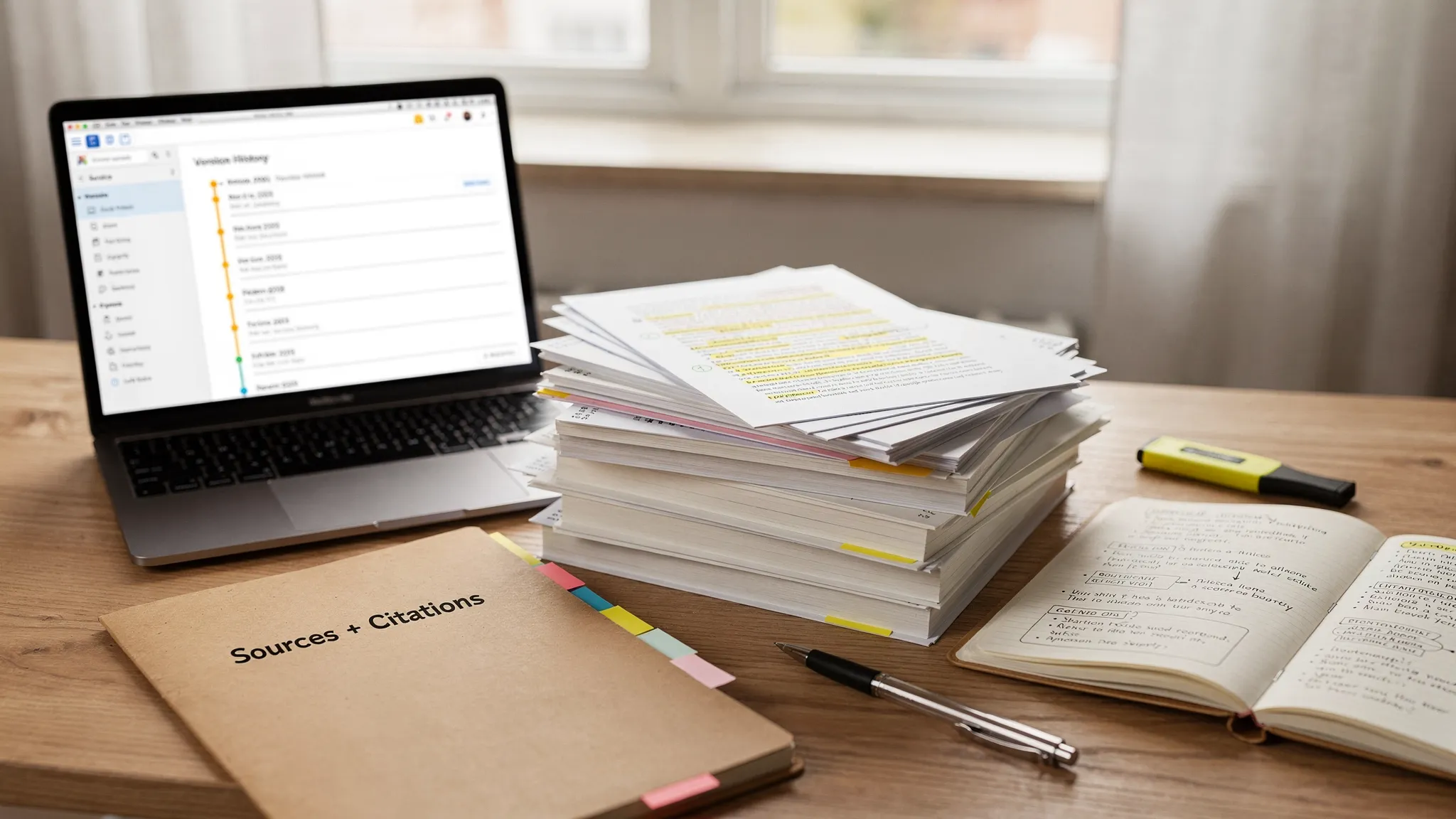
Checklist A: Preserve evidence (before you change a single word)
Do this before you revise, re-upload, or run anything through a “humanizer.” The moment you overwrite your trail, your strongest proof can disappear.
- Save a copy of the submitted file (export PDF and the original doc format).
- Duplicate your working document (create a “READ ONLY” copy).
- Export version history evidence.
- Collect your research trail (PDFs, links, database exports, citations manager library).
- Save writing artifacts (outlines, scratch drafts, brainstorming notes, voice memos).
- Document allowed tooling (spellcheck, Grammarly, citation tools, accessibility tools) if your institution permits them.
If you’re unsure how persuasive your edit history is, this deep dive helps: Is Google Docs or Word Version History Enough as Proof?
Checklist B: Read the report like an investigator
Before you respond, you need clarity on what Turnitin actually flagged.
Confirm which metric you’re dealing with
Turnitin commonly shows:
- Similarity (text overlap with sources in its database).
- AI writing indicator (likelihood that some portions match patterns associated with AI-generated text).
These are different systems with different failure modes.
Identify what exactly is highlighted
Ask yourself:
- Is Turnitin highlighting the whole document or specific sections?
- Are the highlighted parts generic academic phrasing (definitions, standard transitions) or your unique analysis?
- Are there chunks that came from templates (lab report format, SOP format, literature review scaffolds)?
Check for “unfair” sections that often confuse detectors
These sections can be high-risk for false positives and also less meaningful for authorship judgments:
- Bibliography or reference list formatting
- Standard assignment boilerplate (course headers, honor code statements)
- Quotes (especially if formatted inconsistently)
- Methods sections with conventional phrasing
If a large share of the highlight is “structural” text, it strengthens your case that the signal is not a reliable measure of who authored the ideas.
Checklist C: Build an authorship packet (use this table)
A strong packet is short, navigable, and verifiable. Think “auditor-friendly.”
| Evidence item | What it demonstrates | What to include (minimum viable) |
|---|---|---|
| Version history export | Real-time evolution of the document | 5 to 15 meaningful snapshots across multiple days, showing additions and edits |
| Draft progression | You wrote iteratively, not one paste | Early rough draft, mid draft, near-final, submitted version |
| Outline + thesis evolution | Idea development and planning | Outline files, bullet notes, handwritten pages, mind-map photo |
| Source trail | Real research happened | PDFs, library links, citation manager export, annotated sources |
| “Process memo” (1 page) | You can narrate your workflow credibly | Dates, sessions, what changed each session, why you changed it |
| Content mastery proof | You understand the material | A short explanation of your argument, methods, and 2 to 3 key citations |
| Tool usage disclosure (if allowed) | Transparency about assistive tools | What tool, what you used it for, what you did manually |
The one-page process memo (template)
Keep it simple:
- Assignment prompt in one sentence
- Your thesis/goal in one sentence
- Your writing timeline (date, duration, what you did)
- How you used sources (where they appear in the text)
- What editing tools you used (only if permitted)
- Offer: “I’m happy to discuss the work live and walk through drafts.”
Checklist D: Prepare a calm, high-leverage response
Your first message should be cooperative, evidence-forward, and brief. Avoid arguing that detectors are “stupid.” Even when true, it can read as defensive.
Key points to hit:
- You take academic integrity seriously.
- You understand an AI indicator is not conclusive.
- You can provide drafts and version history.
- You’re willing to do an oral review or live explanation.
If you need a time-boxed plan for the first day, see: Accused of AI Use: What to Do in the Next 24 Hours
Checklist E: Offer verification options that are hard to fake
If the situation escalates, suggest verification methods that directly test authorship.
Oral defense (best overall)
Ask to walk through:
- Your thesis and why you chose it
- How each source supports a specific claim
- Why you structured the argument the way you did
- What you would change if you had more time
Live writing or timed rewrite of a small section
A short, supervised rewrite (even 20 to 30 minutes) can demonstrate voice continuity and content understanding.
Source-and-claim mapping
Offer a quick map showing:
- Claim
- Evidence/source
- Your interpretation
This is especially persuasive in literature reviews and research papers.
Checklist F: If you used AI legally, defend yourself the right way
Many schools allow limited AI use (brainstorming, grammar correction, outlining) with disclosure. If that’s your case, your defense should be policy-aligned, not “I didn’t use anything.”
Do this:
- Quote the course or institutional policy.
- State exactly what you used AI for.
- Provide your own work trail (drafts, revisions, sources).
- Show what you contributed that is clearly human: personal analysis, assignment-specific reasoning, original synthesis.
Do not do this:
- Claim “no AI” if you did use it. Credibility loss is hard to recover.
Checklist G: Avoid the 5 actions that make false positives worse
These moves commonly backfire, even for innocent students:
- Do not rewrite solely to lower the AI score before preserving evidence.
- Do not run the whole paper through multiple rewriters to “clean it up,” it can destroy version history logic.
- Do not delete and recreate the doc (it can make your timeline look suspicious).
- Do not spam multiple detectors and send screenshots as your main proof. Different tools disagree, and screenshots are easy to dismiss.
- Do not escalate emotionally in email (save the frustration for private notes, not the record).
Quick reference: “signal” vs “best response”
Use this to choose the right defense path.
| What you’re seeing | What it might mean | Best next move |
|---|---|---|
| AI highlights mostly generic transitions and definitions | Detector pattern matching, not authorship proof | Provide drafts + process memo, offer oral defense |
| AI highlights your original analysis section | Could be false positive, or could reflect AI-assisted phrasing | Provide version history showing development, explain reasoning live |
| You used Grammarly heavily | Polishing can change surface patterns | Disclose tool use if allowed, show pre-edit drafts and edit timeline |
| You are an ESL writer and got flagged | Known risk area for false positives | Provide process evidence, reference bias concerns, request human review |
Related: Grammarly Triggered Turnitin AI: How to Prove Authorship
Frequently Asked Questions
Is Turnitin AI detection proof I used AI? No. It’s an indicator based on statistical patterns. Schools should treat it as a lead for review, not standalone proof.
What is the strongest evidence for a Turnitin AI false positive? A credible writing trail: version history across multiple days, drafts, outline notes, and a clear source trail, combined with your ability to explain the work.
Should I try to “lower” the Turnitin AI percentage before appealing? Not before you preserve evidence. Changing the text first can destroy the very proof you need. Focus on documentation and a human review.
Can ESL students be falsely flagged more often? Yes, multiple independent evaluations have raised concerns that detectors can misclassify non-native patterns. A process-based defense is especially important.
What if my school allows limited AI use? Align with the policy, disclose what you used, and show your contributions through drafts, citations, and explanation of your reasoning.
Need a second opinion on what looks “AI-like” in your writing?
If you’re dealing with a suspected Turnitin AI false positive, the fastest way to reduce stress is to analyze your text the way a detector might, then build a clean evidence packet that a human can evaluate.
Detection Drama provides free methods and tools to review AI-authenticity signals, plus a free humanizer tool and resources designed for high-stakes situations (no email required, instant access). Start here: DetectionDrama.com and use the site’s reports and guides to prepare your defense clearly and responsibly.
