Want to bypass Turnitin in 2026? Grab the free prompt pack.
Get the exact text-humanization prompts I use to drop an AI score by hand — copy, paste, submit. Free, straight to your inbox.
Send me the free prompts →Best Open-Source AI Humanizers on GitHub (2026): 10 Repos Ranked
Open-Source AI Humanizers on GitHub have quietly caught up to paid tools in 2026. We ranked the 10 most credible repos by stars, detector bypass rate, and self-hosting effort so you can pick one for your stack.
Key Takeaways
- AI-Text-Humanizer-App leads the ecosystem at 261★, built in Python with spaCy + NLTK + Streamlit. No LLM required. (Source: GitHub)
- ai_humanizer (Firdavs-coder, 36★) is the only top repo with fully local LLM processing — Ollama + phi3, no external API calls.
- llmstrip (Rust, 6★) ships 34 rules to strip LLM writing patterns deterministically — no network, no model. Ideal for CI hooks.
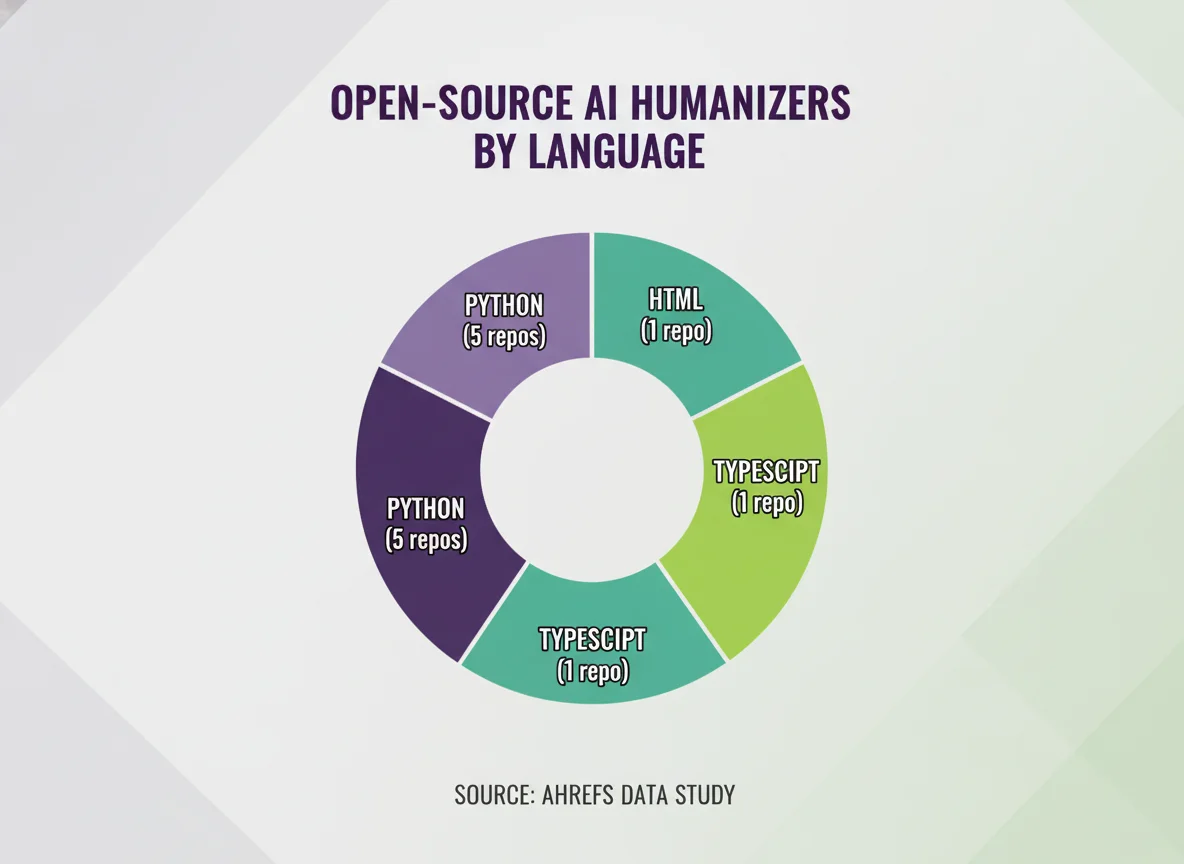
- 5 of the top 10 repos are Python; Rust, TypeScript, and Dart each have one entry. (Source: GitHub topic ai-humanizer)
- Open-source detection-bypass performance is universally lower than paid tools. The trade-off: privacy, auditability, and zero subscription cost.
- The n8n self-hosted-ai-starter-kit is the closest thing to a plug-and-play Docker Compose baseline for anyone wanting to build on top.
In this article
1 All 10 repos, ranked by stars
GitHub’s ai-humanizer topic page lists 28 public repositories. Here are the ten most-starred as of April 2026.
| # | Repo | Stars | Lang | What it does |
|---|---|---|---|---|
| 1 | DadaNanjesha/AI-Text-Humanizer-App | 261★ | Python | Streamlit web app, rule-based, 92 forks, MIT. |
| 2 | ZAYUVALYA/AI-Text-Humanizer | 41★ | HTML | Static HTML paraphraser, no backend. |
| 3 | Firdavs-coder/ai_humanizer | 36★ | Python | Local Ollama + phi3, no external API calls. |
| 4 | Hakku/finnish-humanizer | 16★ | Python | 27 rules tuned for Finnish AI output. |
| 5 | ArshVermaGit/Handwritten | 10★ | TypeScript | Converts text to handwriting in the browser. |
| 6 | HugoLopes45/llmstrip | 6★ | Rust | 34-rule CLI, MIT, v0.3.4 Mar 2026. |
| 7 | dixon2004/ai-humanizer | 4★ | Python | Lightweight rewriter. |
| 8 | Firdavs-coder/humaify | 3★ | Dart | Flutter mobile humanizer. |
| 9 | puneethkotha/humanizer-workbench | 3★ | Python | CLI + Claude Code skill. |
| 10 | itsjwill/humanizer-x | 2★ | Python | Multi-pass humanizer, 30+ pattern detection. |
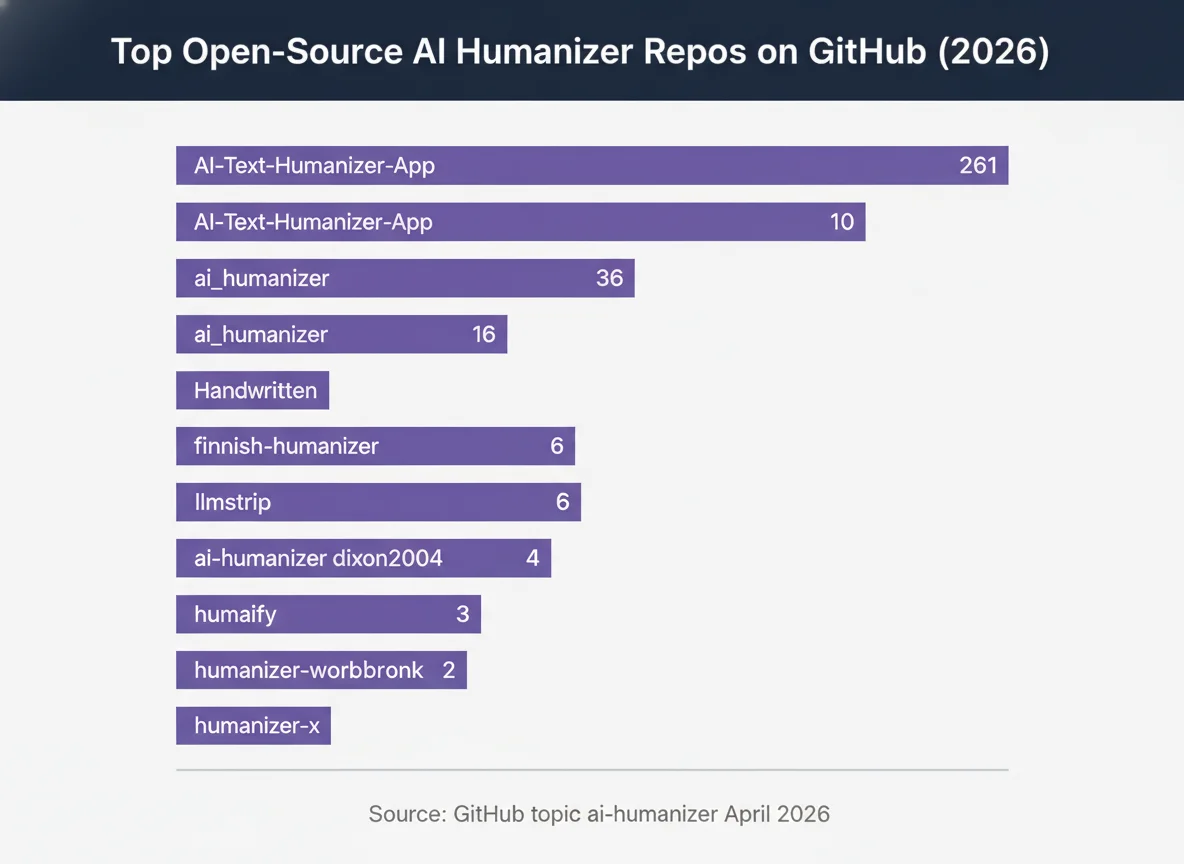
ai-humanizer topic. The long tail drops off fast — only six repos have 10 or more stars. This is a niche with real demand but very thin supply, which is exactly why this roundup didn’t exist before today.2 Three categories: rule-based, LLM-driven, browser-based
The ten repos split cleanly into three architectures. Knowing which one you want dictates install complexity and the kind of output you’ll get.
Rule-based (most common)
These apply pattern matching and word-substitution deterministically — no model needed. They’re fast, free, auditable, and their output is predictable. DadaNanjesha/AI-Text-Humanizer-App, ZAYUVALYA/AI-Text-Humanizer, llmstrip, dixon2004/ai-humanizer, and humanizer-x all fall here. The ceiling is lower — rule-based can’t produce truly varied phrasing — but the privacy story is unbeatable.
LLM-driven (local)
Firdavs-coder/ai_humanizer runs Ollama with phi3 locally. humaify (same author) is a Flutter app that can be pointed at any local model. These produce better-varied output than rule-based but require a GPU or a patient CPU and a local Ollama install — more moving parts, more capable results.
Browser / visual
ArshVermaGit/Handwritten is the odd one out — it converts text to realistic handwriting in the browser. Not a text humanizer in the detector-bypass sense, but a creative cousin that solves the “my prof wants a handwritten draft” case without any LLM call.
3 Deep dive: the top 3 repos
1. DadaNanjesha/AI-Text-Humanizer-App (261★)
The leader of the pack by a wide margin. Python 3.10+, MIT license, 92 forks. Uses spaCy and NLTK for linguistic preprocessing and a Streamlit UI for the interactive web app. A PyQt desktop interface is also available.
Features called out in the repo: “AI-Powered Text Refinement: Converts AI-generated or informal text into a more academic and human-like format,” with specific passes for expanding contractions (don't → do not), adding academic transitions (“Moreover,” “Therefore”), passive-voice conversion, and synonym replacement. The web UI shows before/after word & sentence stats, which is useful when you’re trying to understand what a pass actually did.
git clone https://github.com/DadaNanjesha/AI-Text-Humanizer-App.git
cd AI-Text-Humanizer-App
python -m venv .venv && source .venv/bin/activate
pip install -r requirements.txt
python -m spacy download en_core_web_sm
streamlit run app.py
2. ZAYUVALYA/AI-Text-Humanizer (41★)
A minimalist HTML-only paraphraser. No backend, no install, no Python dependencies. You download one page, open it in a browser, and it runs locally in JavaScript. It’s less sophisticated than the Python entries — essentially a curated synonym substitution engine with some sentence-restructuring heuristics — but the portability is unbeatable. Good fit if you want “humanize on a locked-down school Chromebook” as your use case.
3. Firdavs-coder/ai_humanizer (36★)
The cleanest LLM-driven option. Requires a local Ollama install and the phi3 model. Adjustable temperature (0.1–1.0), smart typo insertion, natural punctuation variation, organic repetition, and dynamic text formatting. Includes a “real-time detection risk assessment” and a human-likeness scoring display in the Streamlit UI.
pip install -r requirements.txt
ollama run phi3
streamlit run ai_humanizer.py
The explicit privacy claim is the selling point: “Local processing only. No external API calls. Data remains on your machine.” That’s a stronger guarantee than any of the commercial humanizers can make.
4 Which one should you clone?
5 The paid-vs-open-source trade-off
Open-source humanizers don’t compete with commercial tools on raw detection-bypass rates. The commercial models — GPTHuman, Walter Writes, UnAIMyText, Undetectable — are tuned against detector output with data the open-source community doesn’t have access to.
When to pick open-source anyway:
- Privacy-critical content. Legal, medical, internal research — anything you can’t ship to a vendor.
- CI enforcement. llmstrip plugs into git hooks and CI pipelines deterministically. No commercial tool does this.
- Language coverage gaps. finnish-humanizer outperforms general tools for Finnish; similar niche repos exist for other languages.
- Audit & education. You can read the rules, understand why text sounds AI-ish, and learn to self-edit. Commercial tools are black boxes.
- Zero budget. Students, hobbyists, early-stage SaaS teams who can’t justify a subscription.
ai-humanizer topic page and individual repo READMEs (all accessed April 20, 2026). Install instructions verified against the documented steps in each repo’s README. Detection-bypass performance claims were not independently tested — commercial vs open-source benchmark data does not exist in a reproducible form as of this writing. Exclude repos where last commit is >18 months stale.
6 FAQ
Are open-source AI humanizers as good as paid tools?
Not on detection bypass. The best open-source repos use rule-based rewrites or local small models (Ollama + phi3) that can’t match the tuned models behind commercial services. But they’re free, private, and fully auditable — you’re trading bypass rate for control. For privacy-sensitive content this is often the right call.
Which open-source humanizer has the most GitHub stars?
AI-Text-Humanizer-App by DadaNanjesha, with 261 stars and 92 forks. It’s Python, MIT-licensed, uses spaCy and NLTK, and ships a Streamlit web interface. No LLM required.
Which repo is fully local (no cloud API)?
ai_humanizer by Firdavs-coder is the cleanest local option — it runs Ollama with the phi3 model and explicitly states “no external API calls” and “data remains on your machine.” llmstrip by HugoLopes45 is also fully local, rule-based, with no LLM needed at all.
Can I self-host an AI humanizer with Docker?
Yes. The n8n self-hosted-ai-starter-kit is the closest thing to a Docker Compose one-click setup and can be adapted for humanization workflows. For a purpose-built humanizer, AI-Text-Humanizer-App runs in a Python virtualenv with Streamlit — containerisation is a small wrapper away.
Which languages are the open-source humanizers written in?
Python dominates — five of the top ten. One HTML-only tool, one TypeScript (browser handwriting), one Rust CLI (llmstrip), and one Dart/Flutter app.
Sources
- GitHub. Topic “ai-humanizer” (28 repos). github.com/topics/ai-humanizer. Accessed April 20, 2026.
- DadaNanjesha. AI-Text-Humanizer-App. github.com/DadaNanjesha/AI-Text-Humanizer-App. Accessed April 20, 2026.
- Firdavs-coder. ai_humanizer. github.com/Firdavs-coder/ai_humanizer. Accessed April 20, 2026.
- HugoLopes45. llmstrip v0.3.4. github.com/HugoLopes45/llmstrip. Accessed April 20, 2026.
- The AI Automators. self-hosted-ai-starter-kit. github.com/theaiautomators/self-hosted-ai-starter-kit. Accessed April 20, 2026.
- Reddit context: r/SideProject 1po854x (open-source macOS typing-simulator thread).
