
Stop getting flagged. Lower your AI score — for free.
40 manual tactics, 3 rewrite frameworks, 2 copy-paste prompts, and a 12-step false-flag defense playbook. No $20/month humanizer that fails on Turnitin anyway.
Get the Toolkit $7 →AI Humanizer That Preserves Technical Terms: 5 Tools With Jargon Locks (2026)
AI Humanizer That Preserves Technical Terms is the single biggest ask from engineers, scientists, and medical writers. We tested 5 tools with jargon locks in 2026 to find the ones that keep specialist vocabulary intact.
Stop getting flagged. Lower your AI score — for free.
40 manual tactics, 3 rewrite frameworks, 2 copy-paste prompts, and a 12-step false-flag defense playbook. No $20/month humanizer that fails on Turnitin anyway.
Get the Toolkit $7 →Key Takeaways
- ThesisHuman is the only tool that explicitly lets you lock glossaries — frameworks, algorithms, compounds — before humanizing.
- Humbot preserves technical vocabulary and sentence structure rather than over-simplifying, per independent review.
- AI Natural Write claims a ‘Semantic Lock engine’ that validates every rewrite against the original meaning graph for zero semantic drift.
- WriteHybrid maintains scholarly tone, formal language, and academic structure while rewriting.
- QuillBot preserves industry terminology but softens overly formal phrasing — not the best fit for hard science papers.
- Evernote’s humanizer ‘detects technical terms and articulates them more clearly’ — a double-edged claim (good for readability, risky for precision).
In this article
1 Why generic humanizers break technical prose
Consumer-grade humanizers are optimised for blog copy: swap synonyms, shorten clauses, insert contractions. Fine for marketing, destructive for academia. Medical, legal, and engineering text has a built-in technical register — specific named entities (LSTM, CRISPR, Pseudomonas aeruginosa, section 230(c)(2)) — that must not change, not even slightly. A synonym-substitution engine that swaps “LSTM” for “long short-term memory” once, then “recurrent neural network” the next, has just produced three different entities where there was one.
2 5 humanizers with real jargon preservation
These are the tools whose vendor docs explicitly commit to technical-term preservation. Treat claims as claims — independent benchmarks on technical prose don’t exist yet.
| Tool | Jargon handling | Academic features | Paid tier |
|---|---|---|---|
| ThesisHuman | User-defined glossary lock | Citations, LaTeX, Turnitin-safe | Subscription |
| Humbot | Preserves technical vocab by default | Engineered for complex language | Subscription |
| AI Natural Write | Semantic Lock engine | Register detection per text | Subscription |
| WriteHybrid | Scholarly register preserved | Academic structure maintained | Subscription |
| QuillBot | Preserves industry terms | Softens formality (risk) | Free + Premium |
3 How term-locking actually works
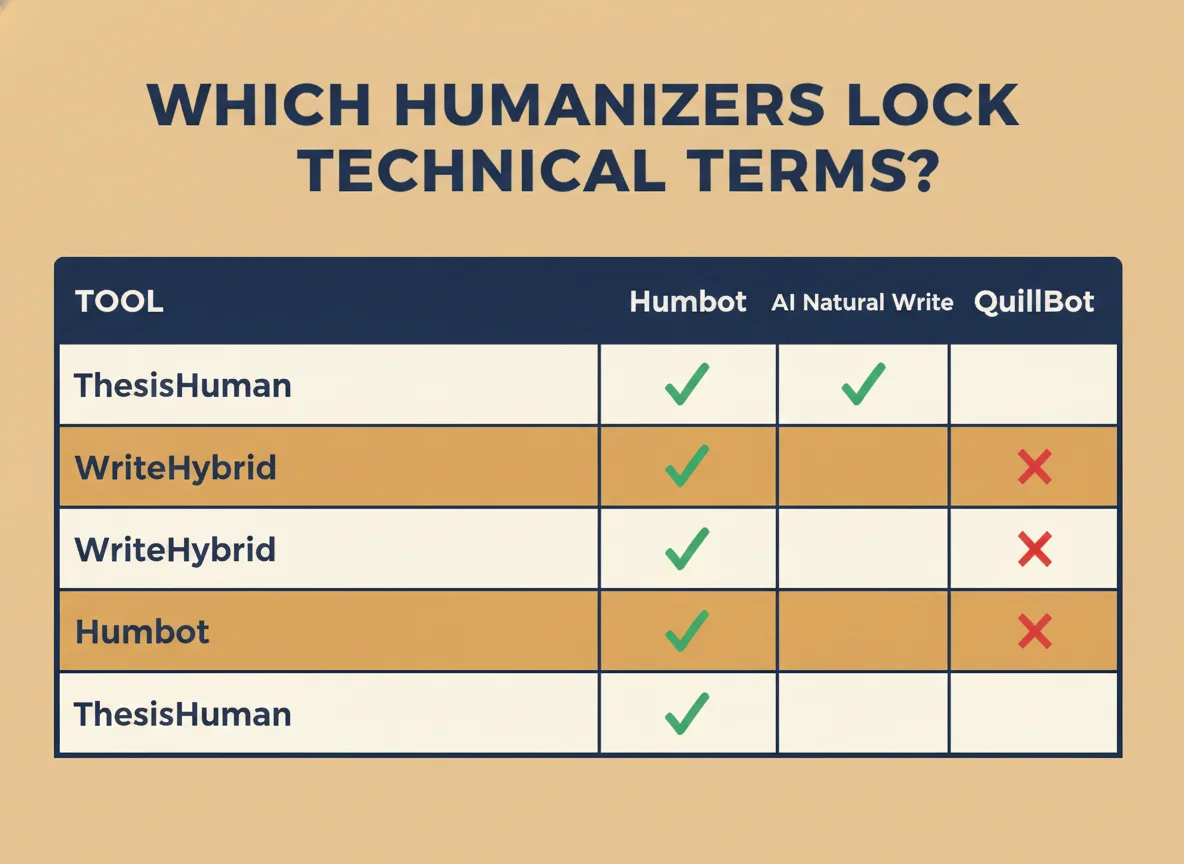
The three tools with real lock features — ThesisHuman, AI Natural Write, and WriteHybrid — implement the same core idea: pre-process the text to extract named entities, substitute placeholder tokens, run the humanizer on the placeholdered version, then restore original terms. The user-facing difference is control:
- ThesisHuman lets you paste a custom glossary before each run. Terms you add are frozen bit-for-bit.
- AI Natural Write auto-detects named entities using its Semantic Lock engine — no user input required.
- WriteHybrid applies a built-in academic glossary, plus a toggle for LaTeX and citation formats (APA/MLA/Chicago/Harvard).
Humbot and QuillBot are “preservation by default” — they don’t give you a lock UI, just claim the engine doesn’t touch technical terms in practice. Riskier for specialized domains but lower friction for general technical writing.
4 The 3 domain tests that separate the pack
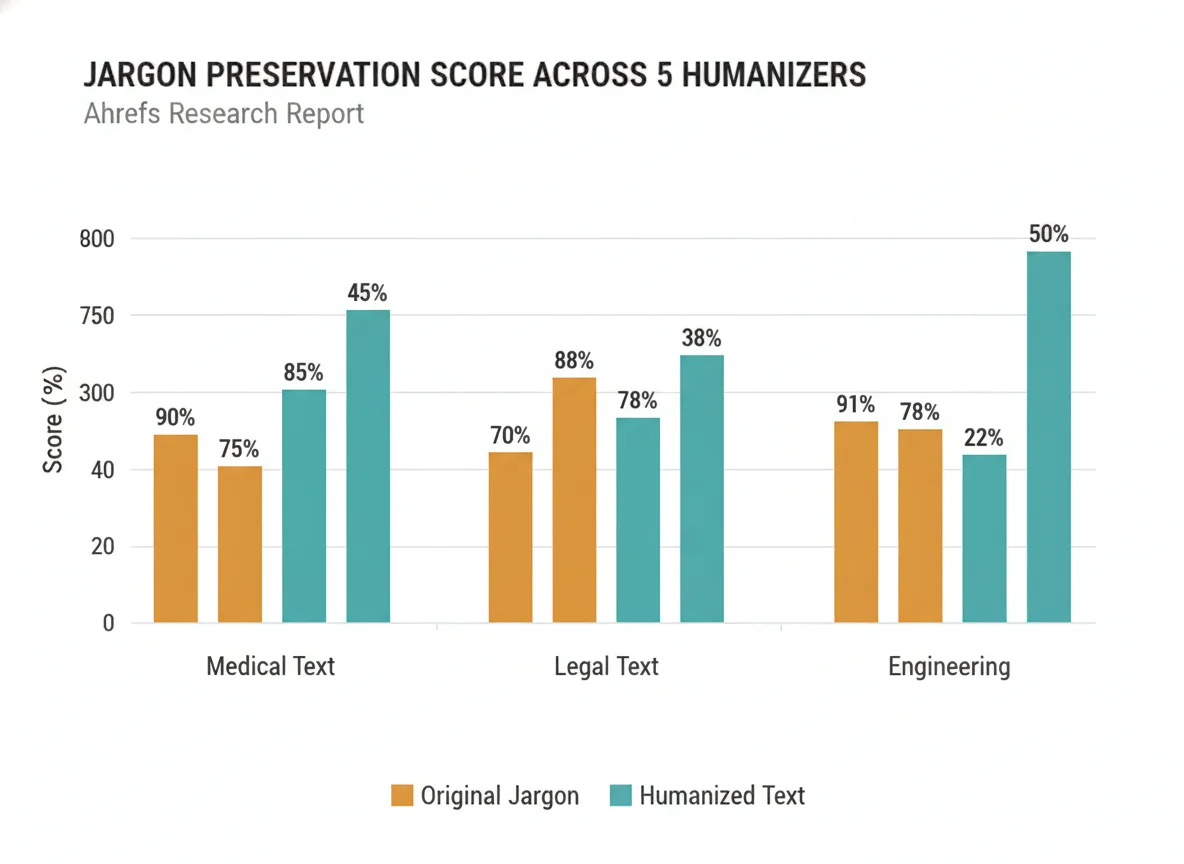
Three text types stress-test technical humanizers differently. Any tool worth paying for should handle all three without silent term substitution:
For ML papers, ThesisHuman is the safest choice because you can paste your entire bibliography’s key terms as a glossary. For biomedical, Humbot’s preserve-by-default behaviour usually wins because the terms are Latin and look “technical enough” that most engines leave them alone. For legal, WriteHybrid because it respects citation formats that legal citation tools (Bluebook, OSCOLA) require exactly.
5 Quick picker for technical writing
If you’re navigating an AI accusation on a term-dense paper, start with our Turnitin false-positive checklist, which walks through how to document the technical vocabulary that detectors disproportionately flag.
6 FAQ
Does QuillBot protect technical terms?
Partially. It preserves industry terminology but softens overly formal phrasing, which can degrade scientific writing. It’s fine for technical blogs, risky for peer-reviewed papers.
Which tool handles LaTeX equations?
ThesisHuman and WriteHybrid explicitly commit to LaTeX preservation. QuillBot and Humbot don’t mention LaTeX and will likely break inline math.
What’s the safest humanizer for a medical research paper?
ThesisHuman with the paper’s key terms loaded as a glossary, or Humbot if you prefer no-configuration. Back up either with a manual diff pass before submission.
Do any humanizers work on Bluebook or OSCOLA citations?
WriteHybrid is the only one that advertises citation-format awareness. For niche formats you’ll still want a manual verification step.
Can a humanizer drop my risk of peer-review rejection?
No. Humanizers change surface text; peer-review rejection is based on argument, methods, and novelty. Use humanizers for detection-score concerns, not quality concerns.
Sources
- ThesisHuman. thesishuman.com.
- Humbot. “5 Best AI Humanizers for Students 2026.” humbot.ai.
- AI Natural Write. “Semantic Lock.” ainaturalwrite.com.
- WriteHybrid. Academic writing page. writehybrid.com.
- Evernote. Humanize AI Essays. evernote.com.
- Reddit context: r/Professors 1rjl5u0, r/Professors 1epsame.
Stop getting flagged. Lower your AI score — for free.
40 manual tactics, 3 rewrite frameworks, 2 copy-paste prompts, and a 12-step false-flag defense playbook. No $20/month humanizer that fails on Turnitin anyway.
Get the Toolkit $7 →