
Most “AI text” doesn’t fail because it’s ungrammatical. It fails because it reads like it was written for no one in particular, with smooth but empty paragraphs that don’t show real thinking.
A human read-through (a teacher, editor, client, or supervisor) is basically a credibility test: does this sound like a real person with a point of view, specific knowledge, and defensible claims? The good news is that you can often turn an AI draft into something that holds up, without resorting to gimmicks.
What a human read-through is really checking
Humans rarely “detect AI” by vibe alone. They notice writing behaviors that are unusual for a real assignment, a real workplace doc, or a real article.
A typical read-through is checking for:
- Specificity: clear details, constraints, examples, and context that match the situation
- Reasoning: conclusions that follow from evidence, not just confident statements
- Voice: natural variation in rhythm, phrasing, and emphasis, not uniform “perfect” prose
- Source reality: claims that can be verified and citations that make sense
- Ownership: signs you actually made choices (what you included, what you cut, what you argued against)
If you optimize for those five, you usually improve both human trust and how “AI-like” the text appears to automated detectors.
The most common “AI tells” humans spot (and how to fix them)
Here are the patterns that trigger skeptical readers, plus practical edits that make your draft feel authored.
| Human read-through red flag | What it signals to a reader | What to change (fast) |
|---|---|---|
| Overly general intro (“Since the beginning of time…”) | You are stalling before saying anything real | Replace with the assignment context, a real problem, or a specific claim in the first 2 to 3 sentences |
| Paragraphs with identical shape and length | Template writing rather than thinking | Combine two short paragraphs, split one long one, and vary topic sentence styles |
| Too many transitions (“Moreover,” “Furthermore,” “In conclusion,” every paragraph) | “Essay mode” automation | Cut 30 to 60% of transitions, keep only the ones that clarify logic |
| Confident claims with no anchors | Hallucination risk or shallow knowledge | Add evidence, a citation, or a concrete example, or soften the claim |
| No tradeoffs, no counterargument | The text is trying to sound correct, not be correct | Add one paragraph that challenges your own claim and resolves it |
| Perfectly smooth grammar with no personality | The voice is generic | Add controlled imperfections: natural phrasing, selective contractions, and sentence length variety |
| “List of facts” with no point | It summarizes but does not argue | Add a clear “so what” after key facts: why it matters, to whom, and what changes |
If you want a benchmark: after revision, a reader should be able to highlight at least 5 to 10 lines and say, “Only someone who understood this assignment (or this job) would write it this way.”
A 7-pass editing workflow that reliably upgrades AI drafts
Think of this like editing in layers. Each pass has a single job, so you do not get lost.
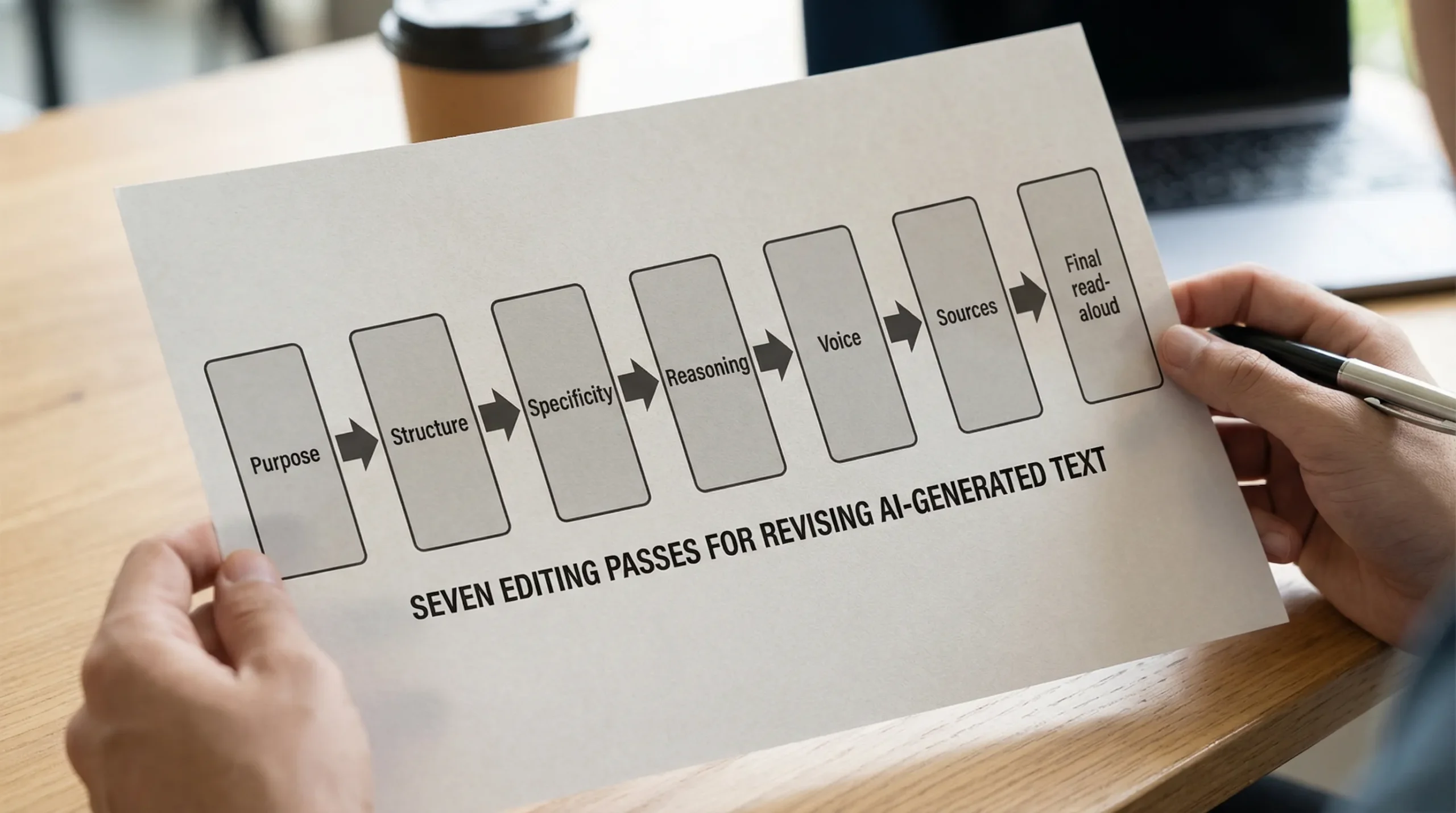
Pass 1: State the purpose in one sentence
Before you edit paragraphs, write one sentence that answers:
What is this document trying to do, and for whom?
Examples:
- “Convince my instructor that I understand how supply shocks affect inflation, using our Week 6 model.”
- “Help a customer choose between two plans based on budget and usage.”
- “Rank three tools for a busy marketing team and explain the tradeoffs honestly.”
Now compare that sentence to your intro. If your intro does not match it, rewrite the intro.
Pass 2: Rebuild the structure (do not just “rephrase”)
AI drafts often have the illusion of structure (headings, neat paragraphs) without a real argument.
Do this:
- Write the main claim at the top of the document.
- Under it, write 3 to 5 supporting points.
- Under each point, write what evidence you will use (example, source, data, or reasoning).
Then reorganize your sections to match that outline. This step alone makes a draft feel “human-authored” because the logic becomes visible.
Pass 3: Inject specificity that AI cannot guess
Specificity is the fastest way to make AI text pass a human read-through.
Add:
- Proper nouns that actually belong (course readings, company context, project constraints)
- Small numbers when relevant (time, cost, scale), but only if you can defend them
- Concrete examples (a real scenario, a mini case study, a brief quote you can cite)
A quick method is the “3 anchors per section” rule: every major section should contain at least three anchors, such as a real example, a real term from the prompt, and a real consequence.
Pass 4: Add one real moment of reasoning (and one objection)
Readers trust writing that shows decision-making.
Add one paragraph that does at least one of these:
- Makes a causal claim and explains the mechanism
- Compares two options and explains why one wins under certain constraints
- Anticipates an objection and responds with evidence
This is where AI-generated content usually feels weakest, and where you can make it strongest.
Pass 5: Tune voice and rhythm (keep it professional, not robotic)
You do not need to add slang or jokes. You need the text to sound like a person made choices.
Practical edits:
- Vary sentence length (mix short clarifiers with longer explanations)
- Replace repeated “safe” verbs (“demonstrates,” “highlights,” “indicates”) with precise ones (“limits,” “causes,” “measures,” “reduces”)
- Remove filler intensifiers (“very,” “extremely,” “it is important to note that”)
- Use contractions sparingly if the context allows (many business and blog contexts do, some academic contexts do not)
A useful test: highlight any paragraph where every sentence could be swapped with another paragraph and nothing would change. Rewrite until it cannot be swapped.
Pass 6: Fact-check and source-check (this is non-negotiable)
AI text can fabricate sources, dates, and confident-sounding details. Humans notice.
At minimum:
- Verify every named study, statistic, or policy claim
- Replace fake citations with real ones or remove them
- Make sure quotes are exact and attributed
If you are writing for academic submission, keep in mind that AI detection is not the same as plagiarism detection. Similarity tools look for overlap with existing sources, while AI detectors look for writing patterns. Both can cause trouble for different reasons. (Related: Turnitin AI % vs Similarity %: what’s actually different?)
For context on why detectors are not definitive proof, OpenAI retired its own AI text classifier in 2023, citing low accuracy, especially as models improved and writing got shorter or more edited (OpenAI announcement). Research has also found bias risks, including higher false positives for non-native English writing (see Stanford HAI coverage).
Pass 7: Do the “read it like a grader” final pass
Do not skim silently. Use one of these:
- Read it out loud
- Use text-to-speech
- Print it or change the font to break familiarity
On this pass, look for:
- Over-explaining (cut 10 to 20% without losing meaning)
- Repeated phrases and repeated sentence starters
- Conclusions that do not actually conclude (they restate instead of deciding)
If the document is high-stakes, save your drafts and version history. In disputes, process evidence is often more persuasive than arguing about a percentage. (Related: Is Google Docs or Word version history enough as proof?)
Prompting tips: use AI as a collaborator without producing “AI voice”
If you generate a full draft in one go, you tend to get the default assistant tone. A better workflow is to generate components, then write the connective tissue yourself.
Try prompt patterns like these:
You are my writing assistant. Ask me 8 clarifying questions before you write anything.
My audience is ____. My goal is ____. The constraints are ____.
After the questions, propose 2 different outlines with different argumentative angles.
Here is my rough outline and notes:
[paste]
Write ONLY the section titled “____” using my notes.
Requirements:
- Include 2 concrete examples tied to my context
- Include one counterargument and response
- Avoid generic transitions like “Moreover”
- Keep a natural mix of short and long sentences
Take this paragraph and rewrite it to sound like a real person who has done the work.
Keep meaning, but:
- Replace vague claims with specific ones where possible
- Add one sentence explaining the mechanism (why the claim is true)
- Remove filler and over-polished phrasing
Paragraph:
[paste]
This approach produces text that is more “owned” because you are steering decisions rather than accepting a one-shot essay.
What “human” looks like in different contexts
A human read-through depends on where the text will be judged. “Human-sounding” in marketing is not the same as “human-sounding” in academia.
| Context | What readers reward | What triggers suspicion | Best revision focus |
|---|---|---|---|
| Academic essays | Clear thesis, accurate citations, course-specific concepts, original analysis | Generic definitions, over-smoothed paragraphs, source mistakes, lack of process evidence | Add course anchors, tighten argument, verify sources, keep drafts |
| Workplace writing | Decisions, constraints, next steps, clarity | Buzzwords, vague recommendations, no owner, no tradeoffs | Add specifics (cost, timeline, owners), make recommendations explicit |
| SEO/blog content | Helpful framing, examples, scannability, trustworthy sourcing | Fluffy intros, repetitive phrasing, content that says nothing new | Add unique examples, simplify, cite credible sources |
| Applications (SOPs, cover letters) | Real experience, reflective detail, specificity | Generic “I am passionate about…” statements | Add concrete moments, motivations, and outcomes you can prove |
Where a “humanizer” tool can fit (without replacing real editing)
Sometimes you have a draft that is structurally fine, but the phrasing is consistently “too even” and you need help breaking patterns quickly. That’s the narrow use case where a text humanizer can help.
On Detection Drama, you can use the free tools and guides to:
- Run an AI authenticity analysis and view detailed detection reports
- Rewrite sections with the free humanizer tool (with instant access and no email required)
- Cross-check how edits might affect common detectors, including Turnitin-style indicators
Start here: Detection Drama.
Important: do not treat any tool output as a guarantee. The only reliable way to “pass a human read-through” is to make the writing meaningfully yours (structure, examples, reasoning, and sources).
A final quality bar you can use in 3 minutes
Before you submit or publish, answer these out loud:
- What is my main claim in one sentence? If you cannot say it, the draft is not ready.
- What is the strongest piece of evidence I used? If it is “common knowledge,” add something verifiable.
- Where do I disagree with a reasonable critic? If nowhere, add a counterpoint.
- Which sentence could only be written by someone in my situation? If you cannot find one, add a specific example.
If you can answer all four, your generated AI text is no longer “just AI text.” It will read like authored work, which is exactly what human reviewers are looking for.