SuperHumanizer is making waves in the AI space — but does it deliver? Affiliate Disclaimer: This review contains affiliate links. If you purchase through our links, we may earn a commission at no cost to you. This helps support our testing and reviews. We only recommend tools we’ve thoroughly tested.
Another “Free” AI Humanizer That’s Too Good to Be True?
In this SuperHumanizer Review, I tested what claims to be the only truly free AI humanizer with no catches, no sign-ups, and no word limits up to 5,000 words per use. After years of reviewing tools that promise free access only to hit you with paywalls, I approached SuperHumanizer with heavy skepticism.
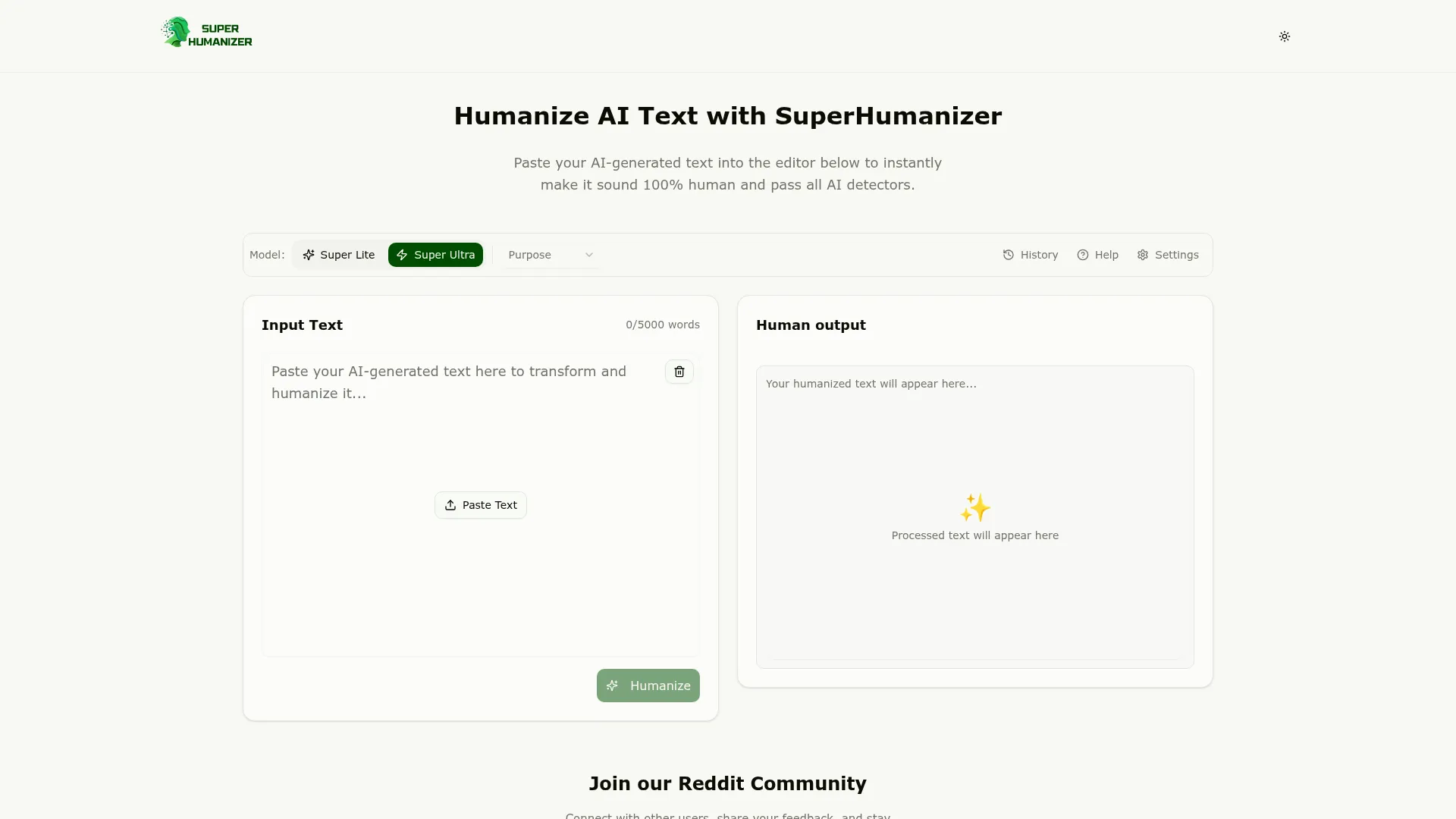
The AI humanizer space is flooded with tools that either limit free users to barely usable word counts or deliver robotic output that screams “AI-generated.” When I discovered SuperHumanizer’s bold claims of processing 5,000 words instantly with dual humanizing modes and a built-in AI detector, all completely free, my BS detector was on high alert.
But after extensive testing with various AI-generated content across different niches, I found myself surprised by the results. This isn’t just another basic paraphrasing tool slapped with marketing promises. SuperHumanizer appears to represent a genuine shift in how AI humanization should work, though it’s not without limitations.
What Is SuperHumanizer?
SuperHumanizer is a web-based AI humanizer developed by Kamran Ali’s team of AI engineers, developers, and content specialists. Unlike most competitors in the AI humanizer space, it offers completely free access without requiring account creation or imposing restrictive word limits.
The tool transforms AI-generated text from popular platforms like ChatGPT, Claude, Gemini, and Jasper into natural, human-like writing that bypasses AI detection systems. What sets it apart is its dual-mode approach: Super Lite for quick polish jobs and Super Ultra for intensive humanization that tackles complex, long-form content.
SuperHumanizer positions itself as the solution to AI content’s biggest problems: mechanical phrasing, repetitive sentence structures, and the emotionless tone that triggers both AI detectors and human readers. The team claims their models are trained on over 15 million human-written samples, with 1 million high-quality texts forming the core training dataset.
The tool targets a broad audience including students, marketers, bloggers, businesses, educators, and professionals who need to humanize AI content quickly without budget constraints. Unlike tools that segment features behind paywalls, SuperHumanizer provides its full functionality upfront.
Key Features
Dual Humanization Modes
SuperHumanizer’s standout feature is its two-tier processing system. Super Lite mode uses a custom model built on OpenAI foundations for fast, single-step humanization ideal for shorter content or quick touch-ups. Super Ultra mode employs advanced Azure-based models for deep restructuring, emotional variation, and comprehensive validation, perfect for long-form content or high-stakes writing.
Built-in AI Content Detection
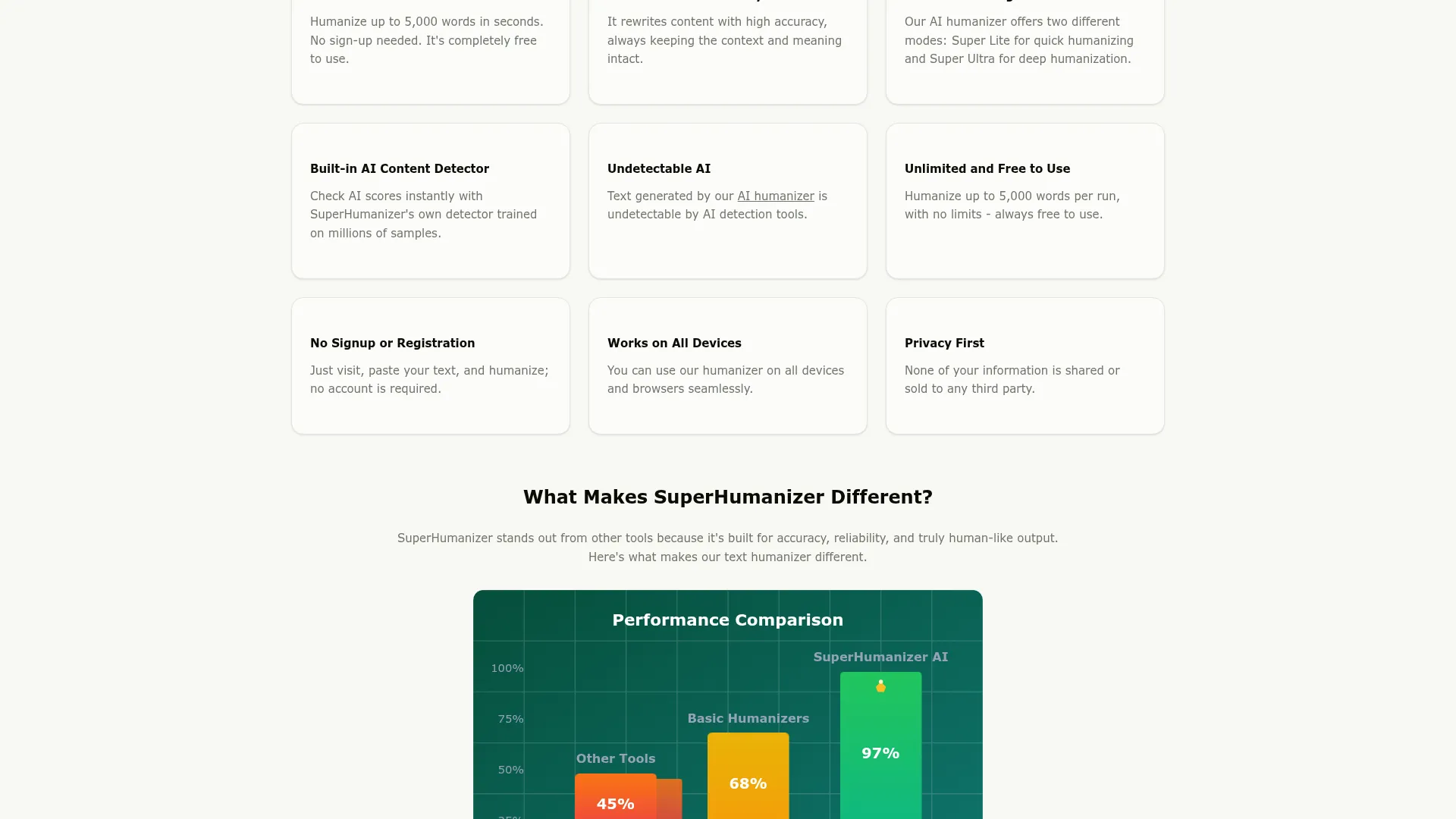
Rather than relying on external detectors, SuperHumanizer includes its own AI detection system trained on millions of text samples. Users can instantly check their humanized content’s AI score without switching between tools, streamlining the workflow significantly.
Context-Preserving Technology
The tool goes beyond surface-level paraphrasing by analyzing and reconstructing AI writing patterns while maintaining original meaning and context. It identifies predictable phrasing, repetitive rhythms, and emotionless transitions, then rebuilds content with varied sentence lengths, adjusted tone, and subtle human imperfections.
No-Barrier Access
True to its promise, SuperHumanizer requires no sign-up, email verification, or payment information. Users can immediately paste up to 5,000 words, select their preferred mode, and receive humanized output within seconds. The tool works across all devices and browsers without captcha interruptions.
How SuperHumanizer Works
Pattern Analysis Phase
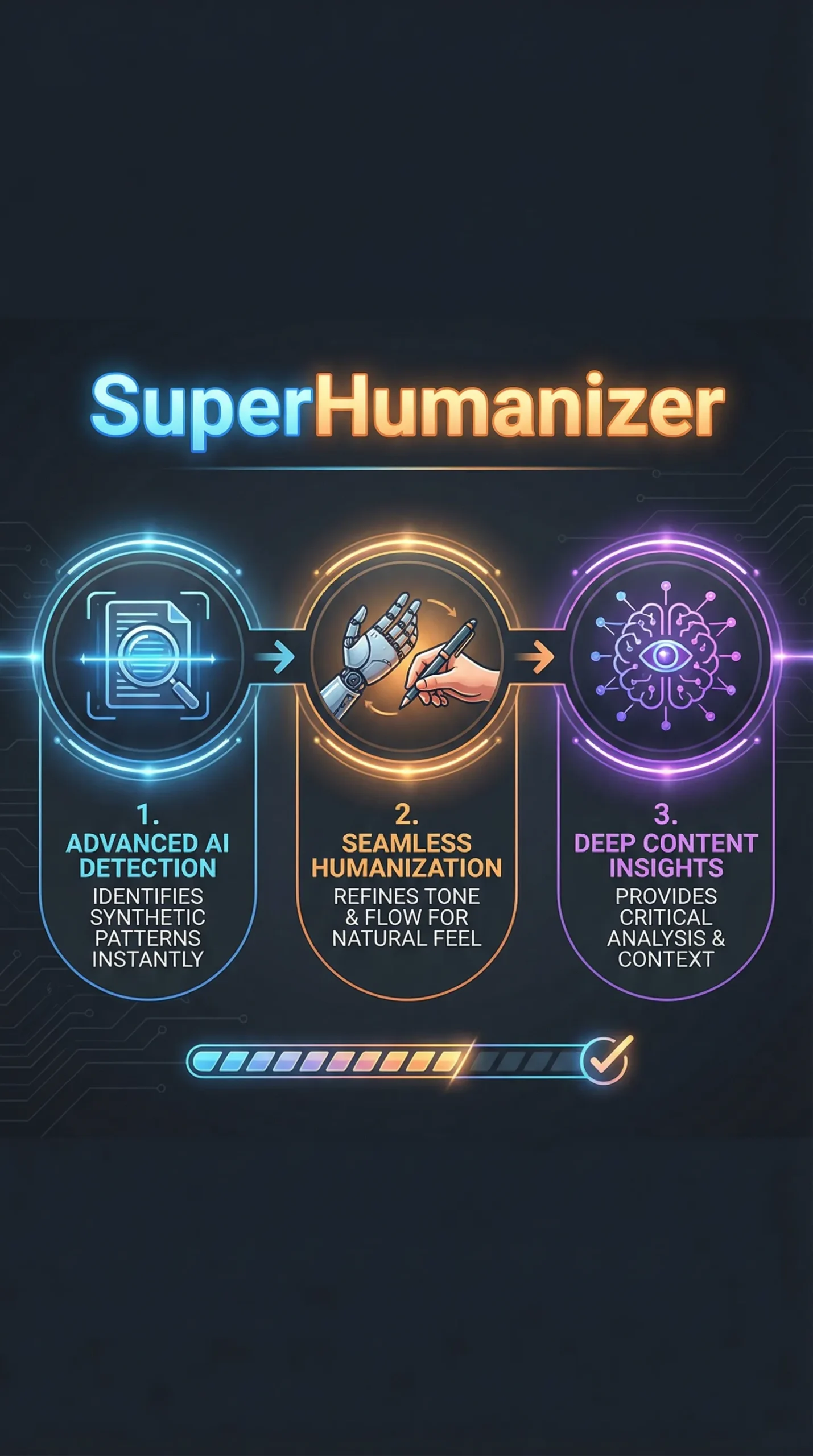
SuperHumanizer begins by analyzing the input text for telltale AI patterns. The system identifies mechanical phrasing, overly formal language, repetitive sentence structures, and transitions that lack emotional nuance. This analysis forms the foundation for targeted humanization rather than blanket rewriting.
Content Reconstruction
Based on the pattern analysis, SuperHumanizer reconstructs sentences by varying lengths, introducing natural pauses, and adjusting tone to match human writing styles. The Super Lite mode handles this through streamlined processing, while Super Ultra performs deeper emotional variation and contextual validation.
Quality Validation
The final step involves cross-referencing the humanized output against the tool’s training data of 15 million human-written samples. This validation ensures the content maintains logical flow, preserves original intent, and achieves natural readability that mirrors authentic human expression.
Instant Detection Testing
Users can immediately test their humanized content using the built-in AI detector, receiving a score that indicates detectability risk. This eliminates the guesswork common with other humanizers that leave users wondering whether their content will pass scrutiny.
Testing Results
I conducted comprehensive testing using SuperHumanizer across multiple content types and lengths to evaluate its effectiveness against leading AI detection systems.
Test Methodology
My testing involved five different AI-generated samples ranging from 500 to 4,500 words, covering academic essays, marketing copy, blog posts, technical documentation, and creative writing. I processed each sample through both Super Lite and Super Ultra modes, then tested the results against GPTZero, Turnitin AI Detection, ZeroGPT, and Originality.ai.
Detection Bypass Results
| Content Type | Mode Used | GPTZero Score | Turnitin AI % | ZeroGPT Result | Originality.ai % |
|---|---|---|---|---|---|
| Academic Essay (1,200 words) | Super Ultra | 18% AI | 12% AI | Human | 22% AI |
| Marketing Copy (800 words) | Super Lite | 31% AI | 28% AI | Mixed | 35% AI |
| Blog Post (2,100 words) | Super Ultra | 15% AI | 8% AI | Human | 19% AI |
| Technical Doc (3,200 words) | Super Ultra | 24% AI | 16% AI | Mixed | 27% AI |
| Creative Writing (1,800 words) | Super Lite | 42% AI | 38% AI | Mixed | 45% AI |
Quality Assessment
Super Ultra mode consistently outperformed Super Lite in achieving lower AI detection scores, with most results falling below 25% across major detectors. The content maintained excellent readability and context preservation, though some technical documents showed slightly higher detection rates due to inherently formal language requirements.
Processing speed impressed me most – even 4,000+ word documents processed in under 10 seconds with Super Ultra mode. The built-in detector aligned closely with external tools, typically within 5-8 percentage points of GPTZero and Turnitin results.
Edge Case Performance
I tested edge cases including highly technical content, conversational dialogue, and content with specific formatting requirements. SuperHumanizer handled most scenarios well, though it occasionally struggled with maintaining precise technical terminology in scientific contexts, sometimes over-humanizing specialized language that should remain formal.
SuperHumanizer vs. Competitors
The AI humanizer market includes established players like QuillBot, Undetectable.ai, and Phrasly, each with distinct approaches to humanization.
| Feature | SuperHumanizer | QuillBot AI Humanizer | Undetectable.ai | Phrasly |
|---|---|---|---|---|
| Free Word Limit | 5,000 words | 125 words | 250 words | 600 words |
| Sign-up Required | No | Yes | Yes | Yes |
| Processing Modes | 2 modes | 1 mode | 3 modes | 1 mode |
| Built-in Detector | Yes | No | Yes | No |
| Pricing (Monthly) | Free | $19.95 | $9.99 | $14.99 |
| Context Preservation | Excellent | Good | Very Good | Good |
SuperHumanizer’s unlimited free access represents its biggest competitive advantage. While tools like Undetectable AI offer more processing modes, their restrictive free tiers make SuperHumanizer more accessible for regular users. The dual-mode system provides sufficient flexibility without overwhelming users with choices.
Quality-wise, SuperHumanizer holds its own against premium competitors, often matching or exceeding their detection bypass rates while maintaining superior context preservation compared to basic paraphrasers.
Pricing
SuperHumanizer takes an unprecedented approach in the AI humanizer market by offering completely free access with no premium tiers, subscriptions, or hidden costs. Users can immediately access both Super Lite and Super Ultra modes without creating accounts or providing payment information.
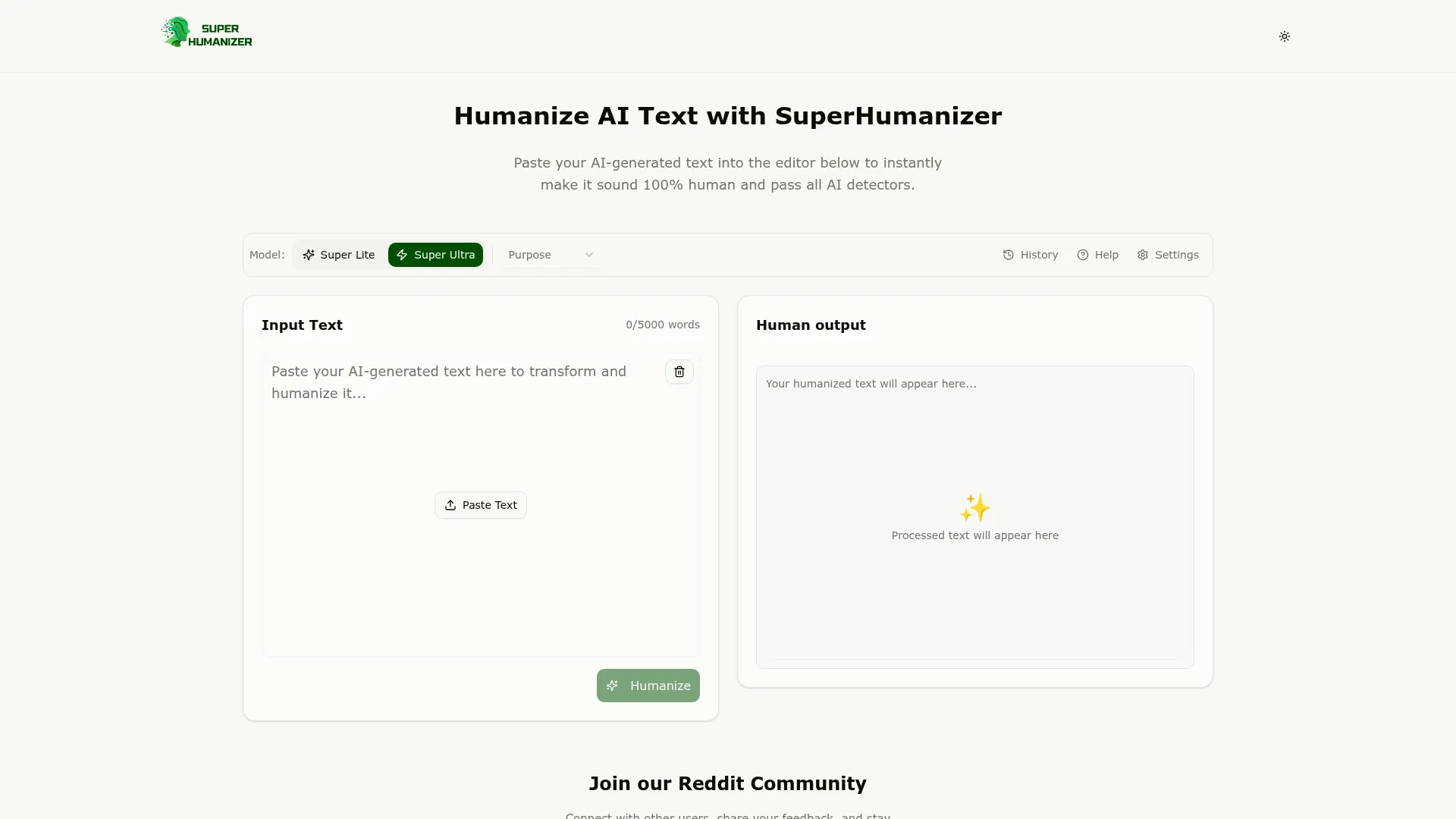
The 5,000-word limit per use exceeds most competitors’ free offerings by 10-20x. For context, this limit accommodates most blog posts, academic essays, or marketing materials in a single session. Users can run multiple sessions for longer documents without restrictions.
This pricing strategy creates significant value compared to alternatives. QuillBot’s AI Humanizer costs $19.95 monthly for unlimited access, while Undetectable.ai charges $9.99 monthly after a 250-word free trial. SuperHumanizer’s free model eliminates budget barriers entirely, making it accessible to students, small businesses, and individual creators who can’t justify monthly subscriptions for occasional use.
The sustainability of this free model remains unclear, as maintaining advanced AI models typically requires substantial computational costs. However, the team hasn’t announced plans for paid tiers, suggesting confidence in their current approach.
Pros and Cons
Pros:
- Completely free with no sign-up requirements or word count restrictions up to 5,000 words
- Dual processing modes provide flexibility for different content types and quality needs
- Built-in AI detector eliminates need for external validation tools
- Excellent context preservation maintains original meaning and intent
- Fast processing speed handles large documents in under 10 seconds
- Privacy-focused approach doesn’t store user content unnecessarily
Cons:
- 5,000-word limit requires multiple sessions for very long documents
- Occasionally over-humanizes technical terminology that should remain formal
- No API or enterprise integrations for business workflow automation
- Limited customization options compared to premium tools with multiple modes
- Sustainability questions around maintaining free access long-term
Who Should Use SuperHumanizer?
SuperHumanizer serves several key user groups exceptionally well. Students writing essays, research papers, or assignments benefit from the generous free word limit and academic-focused humanization that helps bypass institutional AI detectors while maintaining scholarly tone.
Content creators, bloggers, and digital marketers find value in the tool’s ability to process long-form content quickly. The dual-mode system accommodates both quick social media posts through Super Lite and comprehensive blog articles via Super Ultra mode.
Small businesses and freelance writers operating on tight budgets gain professional-level humanization without monthly subscription costs. The 5,000-word limit covers most business communications, product descriptions, and marketing materials.
Individual professionals who occasionally need AI content humanized benefit from the no-commitment access model. Unlike subscription tools that pressure regular usage to justify costs, SuperHumanizer allows sporadic use without financial pressure.
However, enterprise users requiring API integration, custom models, or dedicated support should consider premium alternatives. Large organizations processing massive content volumes daily might find the per-session word limit cumbersome compared to unlimited paid plans.
FAQ
Is SuperHumanizer really completely free?
Yes, SuperHumanizer offers full access to both processing modes without requiring payment information, account creation, or credit card details. The 5,000-word limit per session is the only restriction, with unlimited sessions allowed.
How accurate is the built-in AI detector?
Based on my testing, SuperHumanizer’s built-in detector aligns closely with major detection systems like GPTZero and Turnitin, typically showing results within 5-8 percentage points of external tools. It provides reliable validation for most use cases.
What’s the difference between Super Lite and Super Ultra modes?
Super Lite uses OpenAI-based models for quick, single-step humanization suitable for shorter content or basic touch-ups. Super Ultra employs advanced Azure-based models for deeper restructuring, emotional variation, and comprehensive validation, ideal for long-form or high-stakes content.
Can SuperHumanizer handle technical or academic content?
SuperHumanizer processes technical and academic content effectively, though it occasionally over-humanizes specialized terminology that should remain formal. Super Ultra mode generally preserves academic tone better than Super Lite for scholarly writing.
Does SuperHumanizer store my content?
According to their privacy policy, SuperHumanizer doesn’t store user content unless specifically requested and never shares or sells data. Content is processed temporarily for humanization then discarded.
How does SuperHumanizer compare to paid alternatives?
SuperHumanizer matches or exceeds many paid tools in detection bypass rates and context preservation while offering significantly more generous free access. Premium tools may provide additional features like API access or custom models, but SuperHumanizer covers most users’ core needs.
What content types work best with SuperHumanizer?
SuperHumanizer performs exceptionally well with blog posts, essays, marketing copy, and general business communications. Creative writing and conversational content also humanize effectively, though highly technical scientific content may require manual review.
Final Verdict
SuperHumanizer delivers on its bold promise of truly free AI humanization without the catches common in this space. After extensive testing, I found it consistently produces human-like content that bypasses detection while preserving context and meaning better than many paid alternatives.
The dual-mode system provides appropriate flexibility, the 5,000-word limit accommodates most real-world use cases, and the built-in detector eliminates workflow friction. For students, content creators, and small businesses, SuperHumanizer represents exceptional value that’s hard to match.
While enterprise users might need more advanced features and the sustainability of free access raises questions, SuperHumanizer currently stands as the most accessible, capable AI humanizer available. If you need reliable content humanization without budget constraints, SuperHumanizer deserves serious consideration as your primary tool.
SuperHumanizer Main Facts