Want to bypass Turnitin in 2026? Grab the free prompt pack.
Get the exact text-humanization prompts I use to drop an AI score by hand — copy, paste, submit. Free, straight to your inbox.
Send me the free prompts →AI Detection · Analysis
Published June 22, 2026
GPTZero just shipped the first detector update aimed squarely at the people its product has hurt most: non-native English writers. That is worth noticing. It is not worth trusting on the vendor’s word alone.
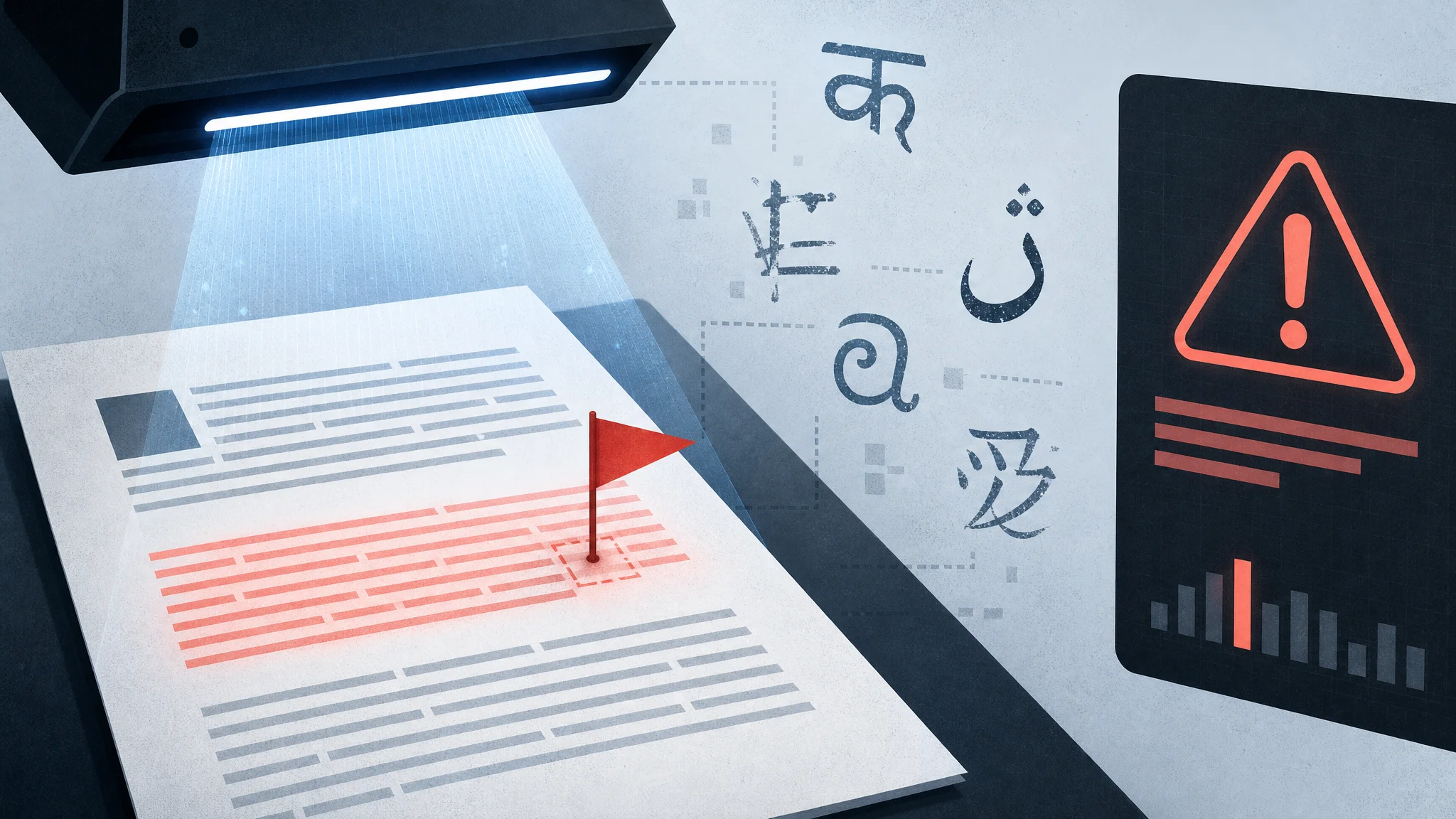
On June 10, GPTZero released a new multilingual classifier, Model 4.1m, that it says “reduced false positive rates on formally written multilingual documents” and added support for Turkish, Hindi, Dutch, Vietnamese and Indonesian. In plain terms: the company is admitting its detector wrongly flags careful second-language writing, and is selling the fix in the same breath.
This matters because the false flag was never a rounding error. It was the central scandal of AI detection. A student who learned English as a second language could write every word themselves and still be accused of cheating by a machine.
That gap is not a bug you patch with more training data. The Stanford team showed detectors score on “perplexity” — roughly, how predictable the writing is — and second-language writers use simpler, more predictable phrasing, so the model reads their restraint as a robot’s. A multilingual refresh can soften that. It cannot change what the scanner is actually measuring.
Here is the honest counter-case, because it’s a real one: if 4.1m genuinely cuts false positives for the students most likely to be wrongly accused, that is a good outcome, full stop. GPTZero also markets itself as the most accurate detector on the market, claiming 99.5% accuracy on a 2026 benchmark. Fewer wrong accusations is the right direction.
But notice the trap inside the fix. The same Stanford paper found that the trick which lowers false positives for ESL writers — prompting the text to sound a little more elaborate — is also the trick that lets anyone bypass the detector entirely. A model tuned to stop flagging plain writing is, by construction, a model that’s easier to slip past. You cannot quietly fix the bias without widening the hole.
And the number itself is a press release, not a finding. “Reduced false positive rate” has no denominator, no dataset, no independent replication attached. The ESL bias problem took peer review and a Stanford lab to surface; the fix is asserted by the company that has every reason to assert it. Until someone outside GPTZero runs 4.1m against a real corpus of second-language essays, “fewer false flags” is a claim, not a result.
So here is what I’d tell an ESL student staring at a syllabus that still cites a detector score: nothing changed for you this week. A better model is still a probability machine, and a probability is not proof you cheated. Keep your drafts, your version history, your notes — the evidence of how you actually wrote.
