Falsely Accused of AI Cheating? Fight It — and Win.
You wrote it yourself. A detector said otherwise. This is the step-by-step playbook to prove your innocence, appeal the grade, and protect your record — built from real appeals students actually won.
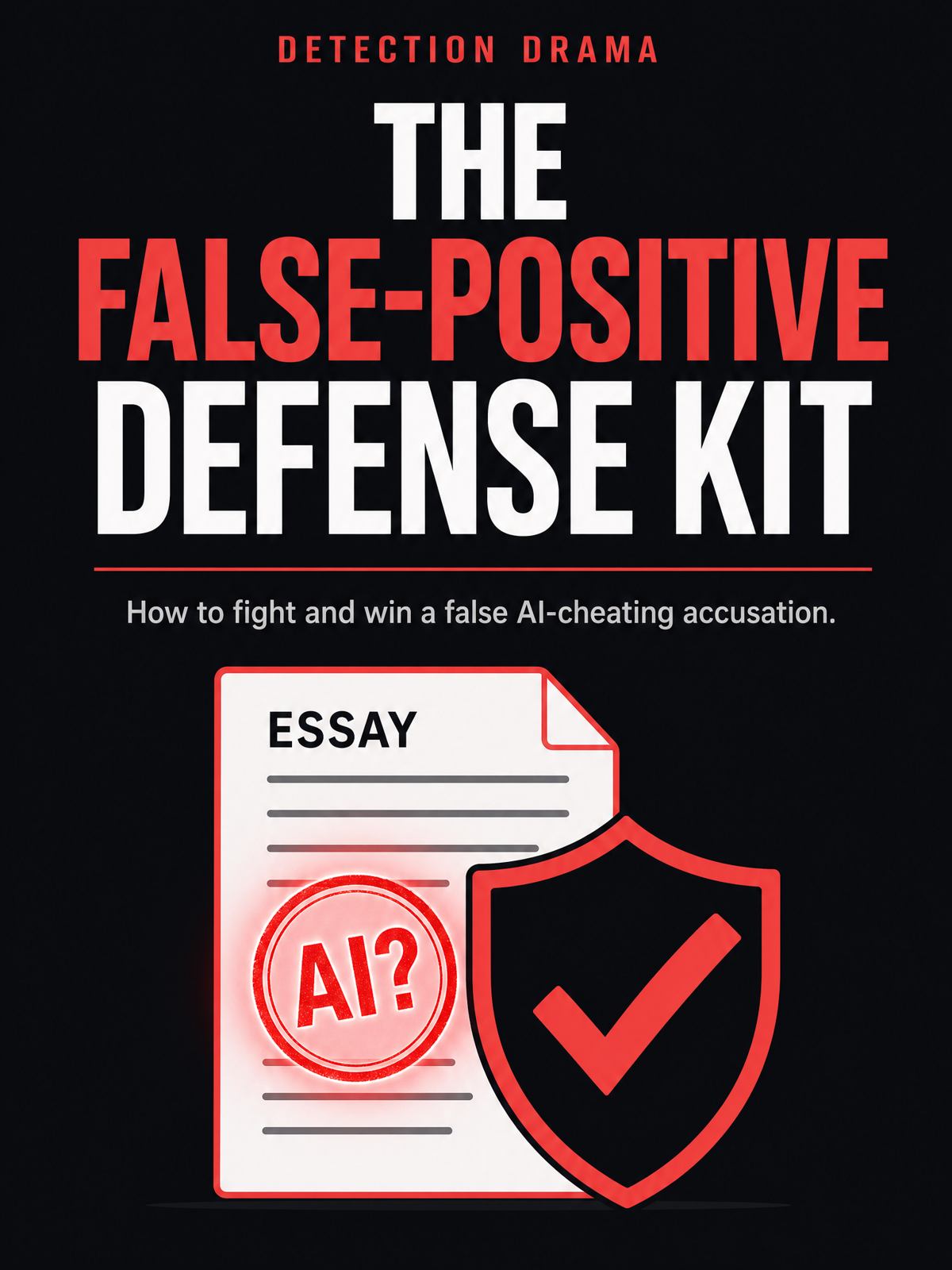
You didn’t cheat. Now you have to prove it.
A detector spit out a number, your professor read it as a confession, and suddenly the burden is on you — the innocent one — to prove a negative. You’re staring down a zero, a misconduct note on your record, maybe a scholarship. The panic is real. But these accusations get overturned every week — by students who do the right things in the right order.
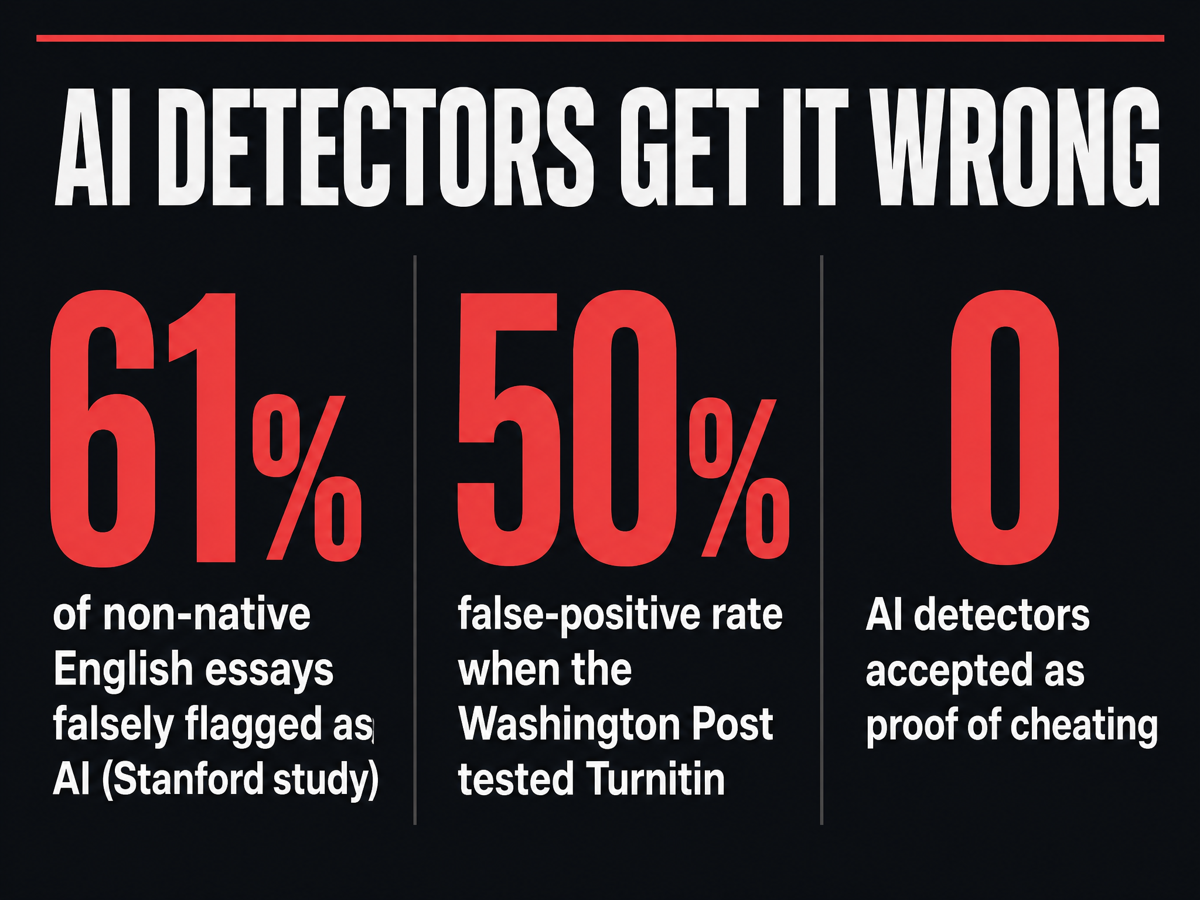
Sources: Stanford HAI · The Washington Post · vendor & accreditor guidance
The machine that flagged you is wrong constantly.
AI detectors are probability guesses, not lie detectors — and the companies behind them quietly admit it. These are the facts the kit shows you how to put in front of a committee:
| The claim against you | What the evidence actually shows |
|---|---|
| “Turnitin says it’s AI.” | Up to 50% false positives in independent testing |
| “The detector doesn’t lie.” | Stanford: 61% of ESL essays wrongly flagged |
| “The score is proof.” | Vendors say it’s an indicator, not proof |
| “Case closed.” | Your version history clears most students |
The kit turns each of these into a clean, sourced argument — and shows you exactly how to back it with evidence you already have.
Everything you need to fight back — and not freeze.
⏱️ The first 24 hours
Exactly what to do — and what never to do — the moment you’re accused. The mistakes that sink innocent students.
📊 Why it happens
The false-positive facts (with sources) you’ll cite to a professor or committee — including the ESL bias argument.
🗂️ Evidence checklist
Every piece of proof ranked from strongest to weakest — and how to capture it before it disappears.
🪜 The escalation ladder
Who to contact, in what order — professor → integrity office → chair → dean → ombudsperson.
✉️ Copy-paste email scripts
The exact, calm, fill-in-the-blank emails to your professor and the integrity office. Never freeze on wording again.
📝 The appeal letter template
A fill-in-the-blank formal appeal — modeled on a real case that overturned a zero.
🔁 If your appeal is denied
The next rungs — written rationale, dean, ombudsperson, accreditor — so a first “no” isn’t the end.
🛡️ Never again
The 2-minute audit-trail habit that makes any future false flag dead on arrival.
✅ Emergency checklist
A one-page, print-and-work-it list for the moment you’re panicking. Top to bottom, don’t skip.
A lost grade can cost you a class. A misconduct note can cost you a scholarship. This is 15 pages, instant PDF, yours forever — for less than the price of two coffees.
Get Instant Access →Before you grab it
Is this for cheating?
No — the opposite. This kit is for students who wrote their own work and got falsely flagged. It’s a due-process and self-defense guide. Nothing in it asks you to admit to something you didn’t do.
Will it actually get my grade back?
No one can promise an outcome — but the kit is built from real appeals that overturned zeros. Most cases turn on document version history and following the right process, which is exactly what it walks you through.
What if I was flagged but didn’t use AI, and English is my second language?
That’s the strongest case of all. Non-native English writers are falsely flagged at far higher rates (Stanford found 61%), and the kit shows you how to make that argument cleanly with sources.
What if my first appeal gets denied?
There’s a whole section for it — how to get the written rationale, and how to escalate to the dean, the ombudsperson, and the accreditor. A first “no” is not the end.
What format is it?
A 15-page PDF with email scripts, the appeal-letter template, and a print-it-now checklist. Instant download after checkout. Works on any device.
What if it’s not for me?
7-day money-back guarantee. If it doesn’t help, email us and get a refund — no hassle.
Don’t let a broken detector decide your future.
Get the evidence checklist, the email scripts, the appeal-letter template, and the full escalation playbook — for the price of two coffees.
Get the KitFor educational and academic-integrity-protection use. This kit provides general information to help wrongly-accused students respond to false AI-detection flags; it is not legal advice. Academic-integrity policies and appeal rights vary by institution — always follow your own school’s official process and deadlines. AI detectors are probabilistic and frequently produce false positives.