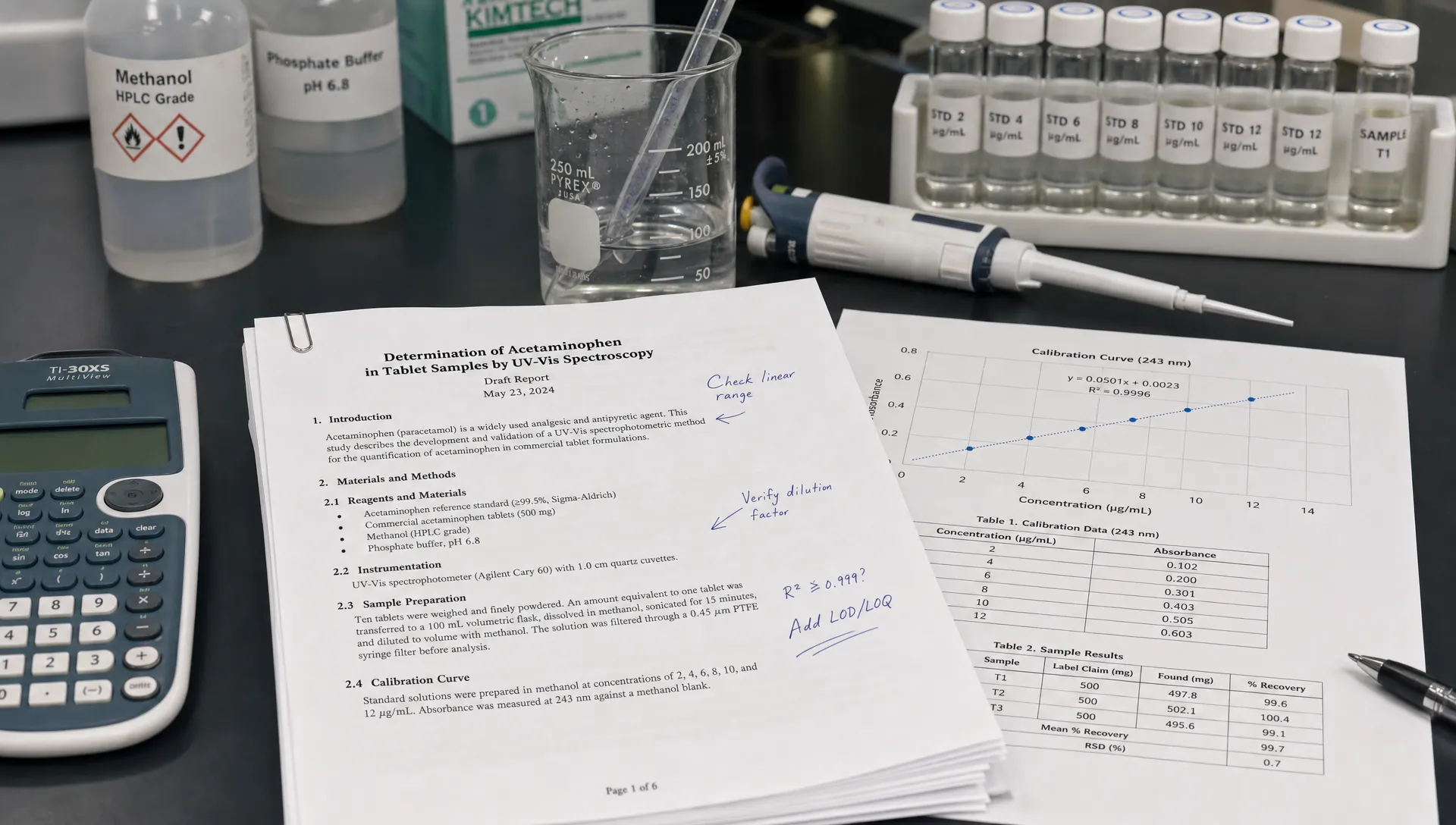
AI can help turn rough notes into readable lab prose, but lab reports are not ordinary essays. A careless rewrite can change a concentration, drop a unit, soften an uncertainty, or make a conclusion sound stronger than the data allows. That is how a “more human” report becomes a worse scientific document.
The right goal is not simply to bypass AI detection or make every sentence sound casual. The goal is to humanize AI lab reports while preserving the scientific record: your raw measurements, calculations, units, methods, observations, figures, citations, and limits.
If your class, department, journal, or workplace has rules about AI assistance, follow them. Humanizing should mean editing for clarity, voice, and readability, not disguising fabricated results or submitting work you were not allowed to use AI for.
The only tool that bypassed Pangram and Turnitin in 2026.
Most humanizers clear one detector and get caught by the other. StealthWriter is the one that gets past both — run Ghost 5.2 Pro at level 7–8, section by section, and re-check before you submit.
Try StealthWriter →What “humanizing” means for a lab report
In a lab report, human-sounding writing usually comes from specificity. A real report names what was actually done, describes what was observed, and explains how the author interpreted the result. AI-generated content often feels generic because it uses broad scientific phrasing without enough connection to the experiment.
For example, an AI draft might say, “The results indicate a successful reaction and demonstrate the expected scientific principle.” That sounds polished, but it is weak. A more human and more useful version would say, “The solution changed from pale blue to colorless after the final drops of thiosulfate, which matched the expected endpoint for the iodine titration.”
That edit does not add drama. It adds evidence. It keeps the data grounded in the actual procedure.
Humanizing a lab report should improve:
- Sentence rhythm and readability
- Specific references to your actual observations
- Clear transitions between methods, results, and interpretation
- Honest uncertainty and limitations
- Consistent tone that sounds like a student, researcher, or technician explaining real work
It should not change the underlying science.
The data you must protect before rewriting
Before using a text humanizer or rewriting manually, identify the information that cannot change. This is the “data lock” for your report. Anything inside the data lock should be copied exactly from your notebook, spreadsheet, instrument output, approved calculations, or source material.
| Protected item | Example | Why it matters |
|---|---|---|
| Raw measurements | 23.4 mL, 0.152 g, 7.81 pH | Small changes can alter results and conclusions |
| Units | mol/L, °C, mm, absorbance at 600 nm | Missing or changed units can make data meaningless |
| Sample labels | Trial 1, Control B, Unknown 3 | Labels connect results to the correct condition |
| Conditions | 37 °C, 10-minute incubation, 0.1 M HCl | Conditions affect reproducibility |
| Instrument settings | 540 nm wavelength, 1000 rpm centrifuge speed | Settings explain how values were obtained |
| Calculated values | Mean, standard deviation, percent yield | These must match formulas and raw data |
| Statistical results | p-value, confidence interval, error bars | Rewording can change significance or uncertainty |
| Citations | Author names, dates, DOIs, page numbers | Source accuracy is part of academic integrity |
| Figure and table references | Figure 2, Table 1 | Wrong references confuse the reader |
If you want a deeper workflow for avoiding factual drift, Detection Drama’s guide on AI humanizers that ruin facts explains how to build a fact map before rewriting.
Build a “data lock” in 10 minutes
A data lock does not need to be complicated. Open your lab report draft and highlight every number, unit, sample name, reagent, citation, and calculated result. Then copy those protected items into a separate table or checklist.
For a short undergraduate lab report, your data lock might fit on one page. For a longer report, separate it by section: Methods, Results, Discussion, References, and Figures.
A simple data lock entry might look like this:
| Section | Locked detail | Source to verify against |
|---|---|---|
| Methods | 5.00 mL of 0.100 M NaOH | Lab notebook, page 4 |
| Results | Average absorbance = 0.642 | Spreadsheet, cell D12 |
| Discussion | Percent yield = 78.6% | Calculation sheet |
| Figure | Figure 1 shows calibration curve | Final graph file |
| Citation | Smith et al., 2024 | Reference manager |
This gives you a fast way to check whether a humanizer or manual rewrite altered something important. It also keeps you from relying on memory, which is risky when reports include multiple trials, concentrations, and units.
Rewrite by section, not all at once
The biggest mistake is pasting an entire lab report into a humanizer and accepting the output. Lab reports contain mixed-risk content. A background paragraph can usually be rewritten more freely. A results paragraph cannot.
Treat each section differently.
Abstract
The abstract is short, so every word carries weight. Keep the research question, method, key result, and conclusion intact. Avoid turning cautious findings into sweeping claims.
Weak AI-style sentence: “The experiment successfully confirmed the hypothesis and showed a strong relationship between the variables.”
Better humanized sentence: “The data supported the hypothesis that reaction rate increases with temperature, although the 60 °C trial showed more variation than the lower-temperature trials.”
The second version sounds more human because it includes the actual pattern and a limitation. It is also more scientifically honest.
Introduction
The introduction is one of the safer places to improve flow and voice. You can vary sentence length, define terms more naturally, and connect the scientific concept to the experiment.
Still, protect citations and established facts. If the draft includes APA, MLA, ACS, CSE, or another citation style, do not let a rewrite change author names, dates, titles, DOIs, or reference order. If citations are a major concern, use a citation-specific process like the one in Detection Drama’s article on how to humanize AI text while keeping citations intact.
Methods
The methods section should prioritize reproducibility over style. Humanizing does not mean making the procedure sound conversational. It means making it clear enough that someone else could repeat it.
Keep exact volumes, masses, times, temperatures, equipment names, and sequence of steps. Be careful with synonyms. In everyday writing, “mixed,” “combined,” “stirred,” and “vortexed” may seem close. In a lab report, they may describe different actions.
A safe methods rewrite changes awkward phrasing without altering procedure:
| AI-like draft | Safer humanized version | What stayed protected |
|---|---|---|
| “The sample was subjected to heating for a period of ten minutes.” | “The sample was heated for 10 minutes.” | Action and time |
| “A measurement of the liquid was performed using a pipette.” | “A pipette was used to measure the liquid.” | Tool and action |
| “The reaction vessel was placed in an environment of elevated temperature.” | “The reaction tube was placed in a 37 °C water bath.” | Equipment and temperature |
Notice that the improved versions are not more decorative. They are shorter and clearer.
Results
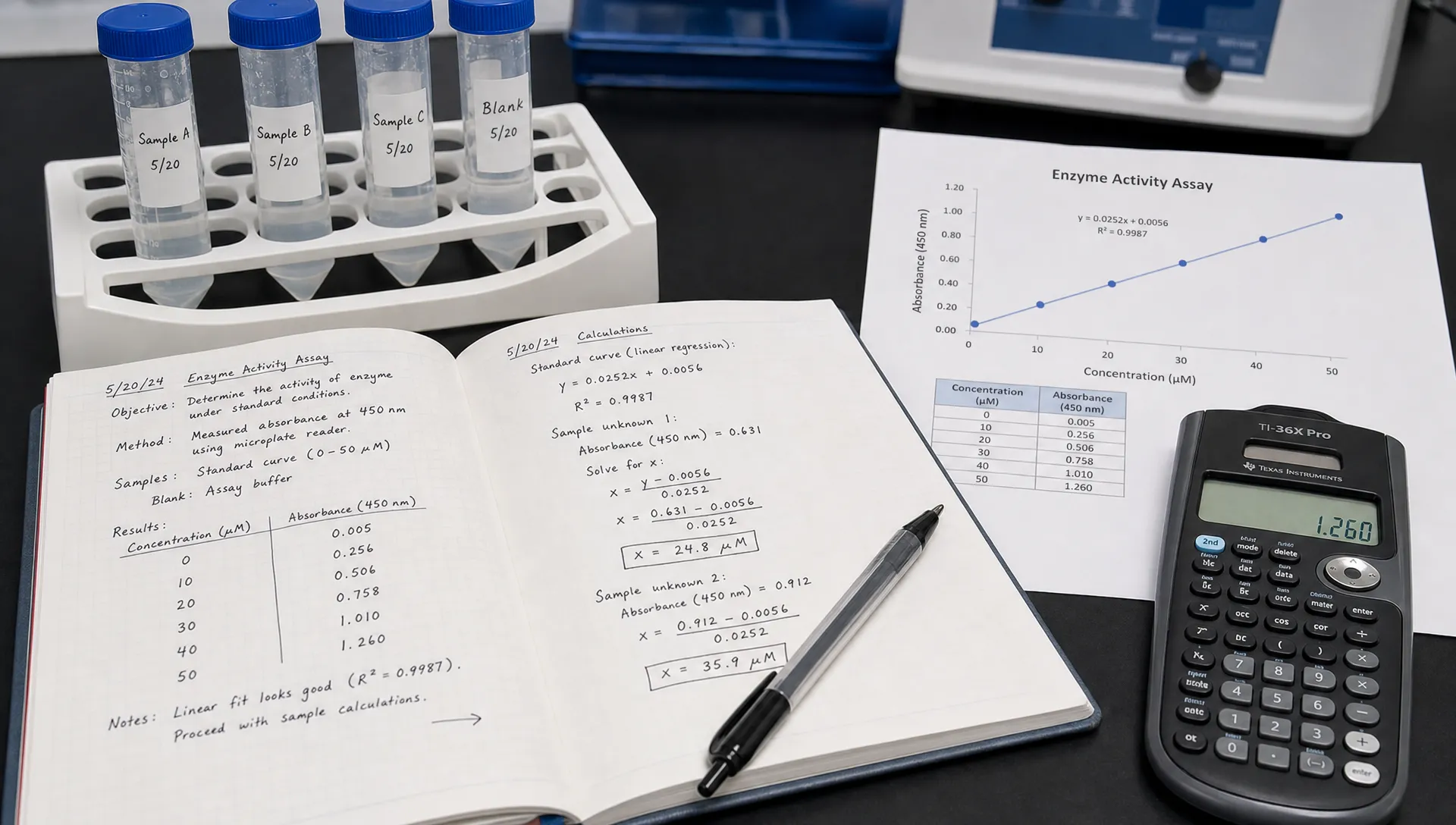
The results section is the most dangerous place to over-humanize. Do not add interpretations that belong in the discussion. Do not replace exact values with vague phrases like “significantly higher” unless you actually performed a statistical test that supports that wording.
Instead, use natural phrasing around locked numbers.
For example: “The absorbance increased from 0.214 in Trial 1 to 0.689 in Trial 4, showing a consistent upward trend across the tested concentrations.”
That sentence is readable, but it still gives the reader the actual values.
Discussion
The discussion is where your own reasoning matters most. This is also where AI drafts often sound vague. Humanize this section by explaining why the results make sense, where they differ from expectations, and what limitations affected the experiment.
A generic AI discussion might say, “Possible sources of error may have affected the results.” A better human version would identify the actual source of error: “One likely source of error was the delay between adding the indicator and recording the endpoint color, especially in Trial 3, where the color change was less distinct.”
That sentence feels human because it reflects judgment. It also helps a reader trust that the report is connected to a real experiment.
Use a text humanizer carefully
A text humanizer can help reduce repetitive AI phrasing, but it should not be treated as a final editor for scientific work. Use it on controlled sections, then compare the output against your data lock.
A safe workflow looks like this:
- Save a copy of the original draft.
- Highlight locked data before rewriting.
- Humanize one paragraph at a time.
- Compare the rewritten paragraph against your lab notebook or spreadsheet.
- Restore any changed values, units, labels, citations, or qualifiers.
- Read the paragraph aloud to check whether it sounds natural and accurate.
The key is control. If a tool turns “0.050 M” into “about 0.05 molar,” that may be acceptable in some informal contexts but risky in a formal report. If it turns “no statistically significant difference” into “a clear difference,” reject the output.
For a broader editing process, Detection Drama’s guide on using an AI humanizer without changing meaning is useful because lab reports are especially sensitive to meaning drift.
Human edits that make lab reports sound real
AI lab reports often get flagged by readers because they are too smooth, too broad, and too detached from the experiment. You do not need to make the writing messy. You need to make it specific.
| Instead of this AI-style habit | Do this instead |
|---|---|
| “The experiment was successful.” | State what result supported the objective |
| “The data clearly proves…” | Use cautious language like “suggests,” “supports,” or “is consistent with” |
| “There were some errors.” | Name the likely error and explain its effect |
| “The results were analyzed.” | Say which calculation, comparison, or graph was used |
| “This is important in science.” | Connect the concept to the lab’s actual purpose |
Good lab writing sounds human because it shows decisions. Why did you exclude an outlier? Why might one trial differ? Why does the graph curve instead of forming a straight line? What does the control prove? Those details are difficult for a generic AI draft to invent accurately, and they are exactly what a real reader looks for.
Preserve uncertainty and qualifiers
One of the easiest ways to lose data integrity is to change the strength of a claim. Scientific writing depends on qualifiers.
These words are not filler:
- Suggests
- Supports
- Indicates
- Is consistent with
- May have contributed
- Within the tested range
- Under these conditions
- No statistically significant difference
A humanizer may remove qualifiers to make the prose sound more confident. That can damage the report. If your data only supports a limited conclusion, keep that limit.
For example, “The enzyme activity increased under the tested temperature range” is not the same as “Temperature increases enzyme activity.” The first claim is tied to your experiment. The second sounds universal and may be false outside your conditions.
Check units and formatting after every rewrite
Lab reports often depend on formatting standards. A changed superscript, missing decimal, or altered unit can create real confusion. After humanizing, scan specifically for formatting errors.
The NIST Guide for the Use of the International System of Units is a useful reference for SI unit conventions, especially if you are unsure about spacing, symbols, or capitalization.
Pay close attention to:
- Spaces between numbers and units, such as 25 °C rather than 25°C if your style guide requires it
- Capitalization of units and symbols, such as mL, L, mol, and K
- Significant figures and decimal places
- Subscripts and superscripts in chemical formulas
- Italics for variables if required by your formatting style
- Figure titles, axis labels, captions, and legends
Do not assume a grammar tool or humanizer understands scientific notation. Many tools are built for general prose, not lab documentation.
Run a final data audit
Before submitting or sharing the report, do a final audit that focuses only on accuracy. This is separate from proofreading for grammar.
| Audit question | What to check |
|---|---|
| Do all results match the raw data? | Compare each value against your notebook or spreadsheet |
| Are units consistent? | Check tables, figures, and paragraph text |
| Do calculations match formulas? | Recalculate key values manually or in your spreadsheet |
| Are claims supported by results? | Remove claims that go beyond the data |
| Are limitations specific? | Replace generic error statements with experiment-specific issues |
| Do citations still match the reference list? | Verify author, year, title, DOI, and order |
| Do figures and tables match the text? | Confirm every reference points to the right visual |
If your school or organization uses Turnitin or another AI content detector, remember that detector scores are not the same as scientific accuracy. A low-risk score does not prove a report is correct, and a high-risk score does not prove misconduct. Detection Drama’s explainer on AI detection reports and what the scores really mean can help you interpret those reports more realistically.
A simple before-and-after example
Here is a short example of humanizing without losing data.
| Draft | Problem | Improved version |
|---|---|---|
| “The experiment demonstrated that the concentration had an effect on absorbance.” | Too vague | “Absorbance increased from 0.118 at 0.02 M to 0.743 at 0.10 M, showing a positive relationship between concentration and absorbance.” |
| “Errors may have occurred during the experiment.” | Generic | “The largest source of uncertainty was likely the meniscus reading during the 10.00 mL transfer, which could have affected the calculated concentration.” |
| “The hypothesis was proven correct.” | Too absolute | “The results supported the hypothesis within the tested concentration range.” |
The improved versions are not trying to hide that AI was involved. They are better because they are specific, accurate, and cautious.
Frequently Asked Questions
Can I use AI to rewrite my lab report? You can use AI as an editing aid if your instructor, institution, or workplace allows it. Keep your data, calculations, citations, and conclusions accurate, and do not use AI to fabricate observations or disguise unauthorized work.
How do I humanize AI lab reports without changing numbers? Create a data lock before rewriting. Highlight all measurements, units, sample labels, calculations, and citations, then compare every humanized paragraph against your original notebook or spreadsheet.
Should I put my results section into a humanizer? Be cautious. Results sections contain high-risk information, including values, units, trends, and figure references. If you use a humanizer, process one paragraph at a time and verify every value afterward.
What is the safest section to humanize? The introduction and discussion are usually safer than methods and results, but they still need fact-checking. The discussion is a good place to add your own reasoning, limitations, and interpretation.
Will humanizing a lab report help with AI detection? It may reduce generic AI patterns, but detector scores are probabilistic and imperfect. Focus first on making the report accurate, specific, and genuinely connected to your experiment.
Final takeaway
The safest way to humanize an AI lab report is to separate style from science. Let the prose become clearer, more specific, and more natural, but keep the data locked.
If you need help checking whether your writing still sounds overly AI-generated, Detection Drama offers free AI detection bypass resources, a humanizer tool, and authenticity analysis with instant access and no email required. Use those tools as part of a careful editing workflow, not as a replacement for verifying your lab data.
