Do Law Schools Use AI Detectors? Every Published Number (2026)
Source: GradPilot (2026)
KEY TAKEAWAYS
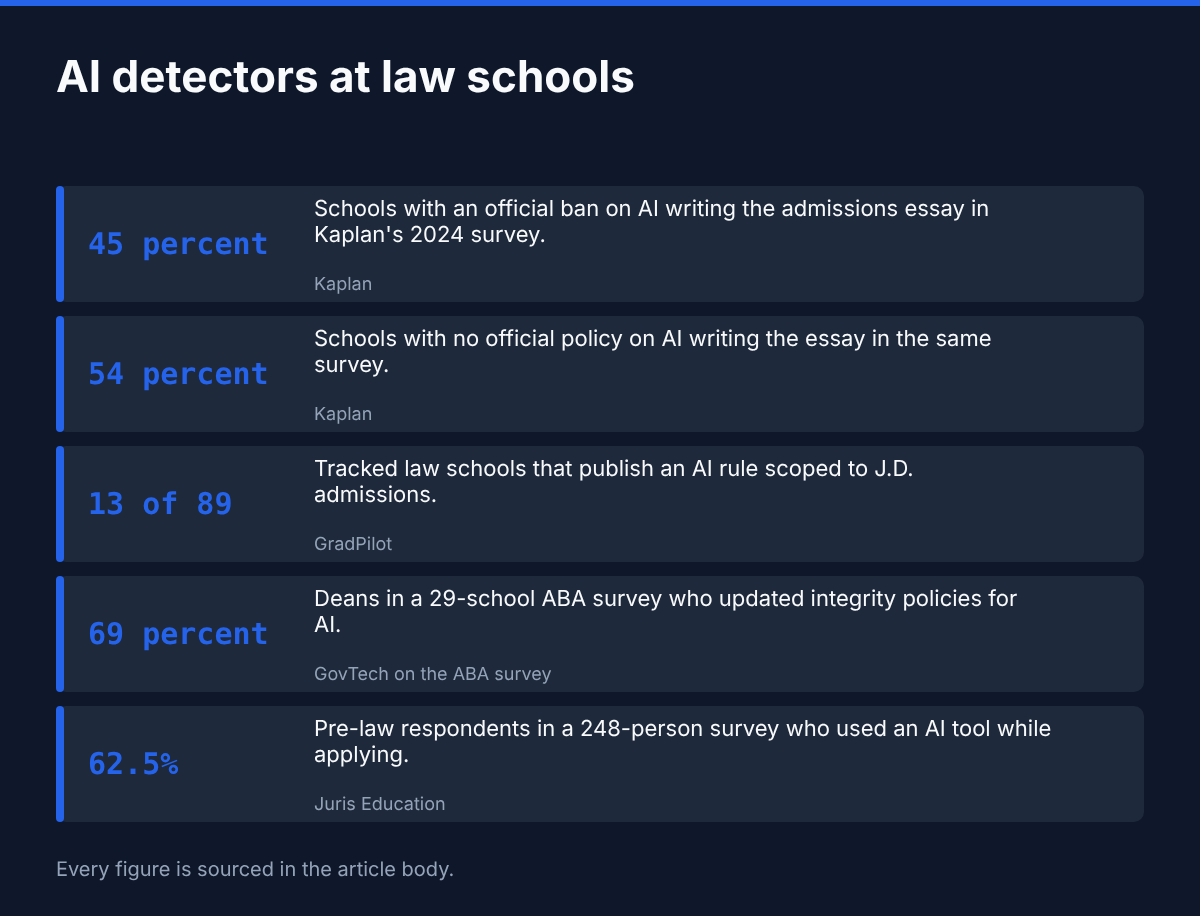
- → 13 of 89 Law schools in GradPilot's sample that publish an AI rule scoped to J.D. admissions. (GradPilot, 2026)
- → 45 percent Law schools in Kaplan's 2024 survey with an official policy prohibiting AI to write the admissions essay. (Kaplan, 2024)
- → 54 percent Law schools in the same survey with no official policy at all on AI writing the essay. (Kaplan, 2024)
- → 69 percent Deans in the ABA's small 2024 survey who updated academic integrity policies because of generative AI. (GovTech on the ABA survey, 2024)
- → 62.5% Pre-law respondents to a 248-person Juris Education survey who used an AI tool while applying. (Juris Education, 2025)
- → three Integrity breaches Purdue Global found before dismissing a student who is now suing in federal court. (The Indiana Lawyer, 2026)
Ask whether law schools run AI detectors on personal statements and you get two confident answers that cannot both be complete. A company that sells a detector says Yes. A consulting firm that talks to admissions offices says it has not heard from any admissions office actively using detection measures. (Pangram, 2026) (Spivey Consulting, 2026)
This page collects every published number we could trace on the question, for applications and for enrolled students, and marks where each one comes from and who benefits from it. The short version: law schools have written many rules about AI, far fewer have said how they would enforce those rules, and we found no source in which a named law school confirms it runs applications through detector software. That is a finding about the public record. It is not proof that nobody does it.
The stakes are unusual. A flagged undergraduate has a bad week and a meeting to prepare for. A law applicant signs a certification, and a law student is entering a profession that examines character. So the gap between what schools prohibit and what they can detect matters more here than almost anywhere else in higher education.
1 Do Law Schools Actually Run Detectors on Applications?
Nobody has published a count. Pangram answers Yes, without naming a school. Spivey Consulting has not heard from any admissions office using detection measures, and reports officers who considered but declined detector software over accuracy doubts. GradPilot tags some schools as screening, yet its definition only says a school may use AI-detection software. (Spivey Consulting, 2026)
| CLAIM | WHAT THE SOURCE SAYS | SOURCE |
|---|---|---|
| Detector vendor’s answer on admissions essays | Yes | Pangram |
| Consultancy on offices actively detecting | not heard from any admissions office | Spivey Consulting |
| Officers’ stated decision on detector software | considered but declined | Spivey Consulting |
| Tracker’s label for Columbia Law | Uses screening tools | GradPilot |
| Same tracker on Columbia’s method | has not indicated how they check | GradPilot |
| Tracker’s definition of that label | may use AI-detection software | GradPilot |
| LSAC technology officer’s advice | especially cautious | LSAC |
The most useful evidence here is the disagreement inside a single source. GradPilot’s table marks Columbia Law with the label Uses screening tools. Its Columbia page quotes a certification that no artificial intelligence tool has written or modified any component, then says the school has not indicated how they check in admissions essays. The label covers forensic checks, timed samples and draft requests as well as software, so it cannot carry the weight some readers will put on it. (GradPilot, 2026)
Commercial interests run through this whole record, and readers should weigh them. Pangram sells detection. GradPilot, the fullest tracker of these rules, says partner with Pangram Labs, which means the best dataset in this field comes from a firm with a detector partner. Spivey sells admissions consulting. None of that makes their statements false. It does mean the question has no neutral survey behind it, unlike undergraduate admissions, where more numbers exist. (Pangram, 2026)
The body closest to the applications is sceptical. LSAC runs the application system nearly every American law school uses, and its technology officer tested detectors personally, then advised everyone to be especially cautious about relying on them. That advice dates from 2023, so it predates current models, but we found no later LSAC statement replacing it. (LSAC, 2023)
2 How Many Law Schools Prohibit AI in the Admissions Essay?
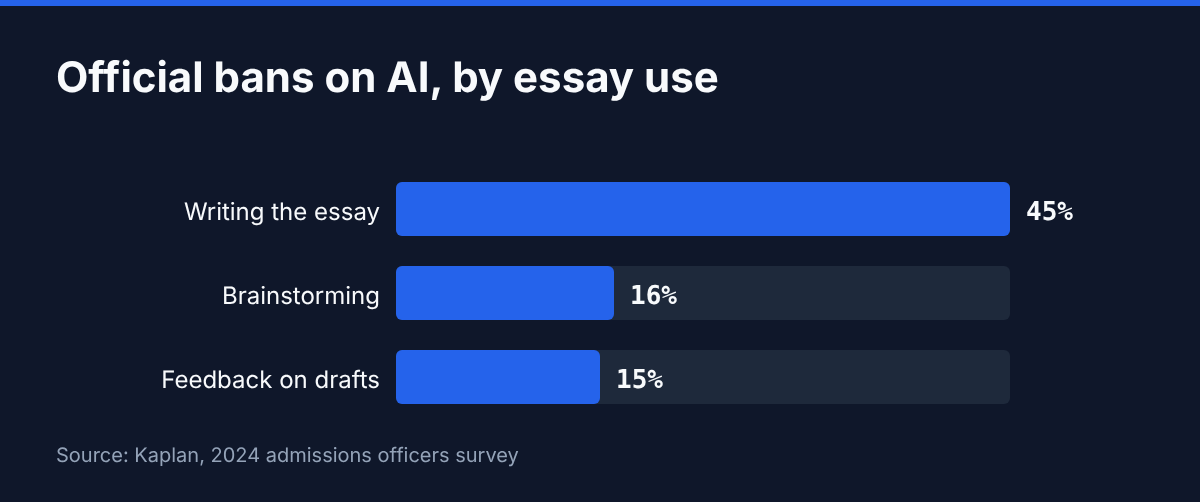
The largest survey we found is Kaplan’s, covering 97 schools in 2024: 45 percent officially prohibited AI writing the essay, 1 percent allowed it, and 54 percent had no official policy. Bans drop sharply for lighter uses, with 16 percent banning brainstorming and 15 percent banning feedback on drafts. (Kaplan, 2024)
| USE OF AI IN THE ESSAY | SHARE OF SCHOOLS | SOURCE |
|---|---|---|
| Writing: official policy prohibiting | 45 percent | Kaplan |
| Writing: official policy allowing | 1 percent | Kaplan |
| Writing: no official policy | 54 percent | Kaplan |
| Brainstorming: official ban | 16 percent | Kaplan |
| Brainstorming: no official policy | 68 percent | Kaplan |
| Draft feedback: official ban | 15 percent | Kaplan |
| Draft feedback: no official policy | 70 percent | Kaplan |
| ABA survey deans still deciding | 62 percent | GovTech on the ABA survey |
These figures are two years old and were self-reported by admissions officers, so treat them as a floor on how fast policy was moving, not a current census. They still show the pattern that matters. Nearly half of offices had a written position on AI writing the essay, and about seven in ten had none on lighter uses, which is where most applicant use sits. Kaplan’s own executive warned that no policy may be read by applicants as a de facto policy of allowing it.
An earlier American Bar Association survey points the same way, with 62 percent of responding deans still undecided on applications. Its sample was only 29 deans, and its authors cautioned against leaning on it, so it is direction rather than measurement. (GovTech on the ABA survey, 2024)
3 What Do Law Schools Actually Publish?
GradPilot read 89 schools’ public pages and found 13 with an AI rule scoped to J.D. admissions and 76 with none. Its closer wording review of Sixteen schools shows the rules regulate different acts: the whole application, drafting and authorship, or editing, with some permitting named uses. (GradPilot, 2026)
| MEASURE | VALUE | SOURCE |
|---|---|---|
| Schools tracked | 89 | GradPilot |
| With a published J.D. AI rule | 13 | GradPilot |
| With no published law school rule | 76 | GradPilot |
| Schools quoted in the wording review | Sixteen | GradPilot |
| UCLA Law on AI tools in the application | prohibited | GradPilot |
Set this beside Kaplan and an apparent contradiction appears. Nearly half of surveyed officers reported an official ban on AI writing, yet only about one tracked school in seven publishes a J.D. rule. Both can be true, because a certification inside the application is invisible to anyone reading the public requirements page. GradPilot makes this point itself: silence on a public page is not permission. That is the single most practical sentence for an applicant on this topic.
The wording varies more than a strict-to-lenient scale suggests. UCLA says any AI tool used to assist in completing the application is prohibited. Georgetown allows feedback but reserves the writing to the applicant. Richmond permits defined editing and requires disclosure. Harvard, Yale, Berkeley and Texas publish no first-year J.D. essay rule, as GradPilot checked them in July. Read the sentence your school actually wrote, then read the certification you are about to sign. (GradPilot, 2026)
4 What Are the Rules Once You Are Enrolled?
In the ABA’s 29-dean survey, 69 percent had updated academic integrity policies for AI. Current defaults on exams are strict: Columbia says use of AI during any examination is prohibited without written permission, and Chicago says absolutely prohibited. Backer’s study of twelve schools and programs found most ABA schools lack retrievable, law-specific policy texts. (GovTech on the ABA survey, 2024)
| RULE OR MEASURE | VALUE | SOURCE |
|---|---|---|
| Deans who updated integrity policies | 69 percent | GovTech on the ABA survey |
| Deans surveyed | 29 | GovTech on the ABA survey |
| Schools and programs in Backer’s sample | twelve | Backer, SSRN |
| Columbia Law on exams | use of AI during any examination is prohibited | Columbia Law School |
| Chicago Law default on exams | absolutely prohibited | University of Chicago Law School |
| Berkeley Law on invented citations | presumption of prohibited AI use | Berkeley Law |
| San Diego Law when AI is suspected | may choose to use an AI detector | University of San Diego Legal Research Center |
The blind spot in most writing on this topic sits here. Law schools have a form of evidence other departments lack: a citation either exists or it does not. Berkeley Law states that citations to sources that do not exist raise a presumption of prohibited AI use. No probability score is involved, and the student carries the burden from that point. For a law student, an invented case is a more dangerous trace than any percentage, and it is the same error that has followed AI use into professional settings. (Berkeley Law, 2026)
Detectors do still appear, with caveats attached. San Diego Law’s research guide says a suspicious faculty member may choose to use an AI detector, and the same guide says detectors are not recommended as a sole indicator. That is the most candid statement we found from a law school, and it is rare because Backer’s study describes policy text that is often absent, gated or oral. He argues this sits in tension with the fair notice that integrity enforcement requires. Applicants to a program should expect to ask, because the university-wide tool list may not settle what the law faculty does. (University of San Diego Legal Research Center, 2026) (Backer, SSRN, 2026)
5 How Accurate Are the Detectors Law Schools Are Told About?
The numbers conflict. Turnitin has stated a false positive rate of less than 1% on documents and about 4 percent per sentence, while San Diego Law’s guide cites a small Washington Post test at 50%. Pangram claims 1 in 10,000. Vanderbilt calculated that a one percent rate could mean 750 wrongly labelled papers a year. (University of San Diego Legal Research Center, 2026)
| MEASURE | VALUE | SOURCE |
|---|---|---|
| Turnitin stated rate, documents | less than 1% | University of San Diego Legal Research Center |
| Turnitin stated rate, sentences | 4 percent | LSAC |
| Washington Post test, small sample | 50% | University of San Diego Legal Research Center |
| Pangram stated rate | 1 in 10,000 | Pangram |
| AI text Turnitin can miss | 15 percent | University of San Diego Legal Research Center |
| Vanderbilt papers submitted in one year | 75,000 | Vanderbilt University |
| Vanderbilt estimate of wrongly labelled papers | 750 | Vanderbilt University |
Vendor claims and independent results are not measuring the same thing, and we cover that at length in our false positive data by tool and our Turnitin statistics. What matters for law school is arithmetic rather than a tool ranking. Vanderbilt’s sum was 75,000 papers and roughly 750 wrong labels at the vendor’s own stated rate, which is why it disabled the tool. Law school cohorts are small, so a school sees few errors and has little means of noticing them. (Vanderbilt University, 2023)
No published study we found tests detectors on legal writing specifically. Legal prose is formal, formulaic and full of quoted authority, and that is a reasonable place to worry about false positives, but worry is not data. LSAC’s own experiment is the nearest thing: AI comparing personal statements with writing samples got authorship right better than two-thirds of the time, and LSAC decided that was not good enough for applicants, partly because a 35-minute timed essay and a months-long statement differ so much in tone. (LSAC, 2023)
6 What Has Actually Happened to Applicants and Students?
Use is common and documented cases are few. Juris Education’s 248-person survey found 62.5% of applicants used AI, mostly for editing at 27.7% and only 9.6% for essay drafting and brainstorming. The clearest American law school dispute is Purdue Global, which found three integrity breaches and dismissed a student who is now suing. (The Indiana Lawyer, 2026)
| MEASURE | VALUE | SOURCE |
|---|---|---|
| Pre-law survey respondents | 248 | Juris Education |
| Used an AI tool while applying | 62.5% | Juris Education |
| Of AI use: proofreading and editing | 27.7% | Juris Education |
| Of AI use: essay drafting and brainstorming | 9.6% | Juris Education |
| Purdue Global breaches found | three | The Indiana Lawyer |
| Court sealed the school’s opposition | April 27 | The Indiana Lawyer |
The Juris sample comes from an anonymous Google Form run by an admissions consultancy, so its percentages describe its respondents and not all applicants. Its breakdown is still instructive, because most reported use falls in exactly the territory that Kaplan found most schools had not addressed. (Juris Education, 2025)
The Purdue Global case is worth reading for what the accusation rested on. According to The Indiana Lawyer, it rested in part on the speed and appearance of the student’s writing, along with citation concerns. The school’s policy says faculty cannot rely solely on detection tools, and the article names no detector and no score. The court had ruled on a sealing motion by April 27 and the reporting shows no ruling on the merits, so nothing here establishes who is right. It does show a law school dismissal can proceed with no detector score reported at all, which is why other AI lawsuits are only a partial guide, and why keeping a record of your drafts matters more than checking a score. (The Indiana Lawyer, 2026)
We found no published count of AI honor cases at American law schools, and no reliable figure for how such a finding affects bar admission. Anyone quoting one should be asked for the source. What is certain is narrower. A certification is a signed statement, Michigan’s warns that false statements may cost an offer or a degree according to GradPilot’s quotation, and an integrity finding can follow you in ways a detector percentage alone does not.
Explore every figure in this article
Methodology
We read each source directly in November 2026 and every source URL was fetched by script. The SSRN abstract page refused scripted fetches and was read through a rendering fetch. Stage 2 SERP checks and Stage 3 competitor analysis ran through DataForSEO without failures, and Reddit demand came through ScrapeCreators. No research stage ran in a degraded mode. This topic was cleared by a human editor after the automated overlap check against our own pages returned NEAR on word collisions. Reddit threads informed the topic only and supply no facts here. No survey measures detector use at law schools, so the statement that we found no named school confirming it describes our search of published sources, not the practice itself. Kaplan and the ABA date from 2024 and LSAC from 2023. Pangram, GradPilot, Spivey and Juris Education all have commercial interests in this subject.
- Sources consulted: 30
- Sources cited: 20
- Data freshness: current year: 14, last year: 1, older: 5
- Data range: 2023-04-01 to 2026-11-02
- Research date: 2026-11-02
- Update schedule: Quarterly
- Limitations: No census of detector use at law schools exists. Vendor and consultant sources have commercial interests, disclosed in the text. The ABA survey had 29 respondents and its authors cautioned on method.
Frequently Asked Questions
Do law schools use AI detectors on personal statements?
The public record does not settle it. Pangram, which sells a detector, answers yes. Spivey Consulting says it has not heard from any admissions office actively using detection measures, and that some officers considered detectors and declined. No source reviewed here names a law school confirming the practice. (Spivey Consulting, 2026)
How many law schools have an AI policy for applications?
GradPilot found 13 of the 89 law schools it tracks publish an AI rule scoped to J.D. admissions. Kaplan's 2024 survey of 97 schools found 45 percent officially prohibit AI writing the essay and 54 percent had no official policy. The two measure different things: published pages versus what officers reported. (GradPilot, 2026)
Does LSAC check applications for AI?
LSAC's technology officer wrote in 2023 that detector results were unreliable and advised people to be especially cautious about them. LSAC instead points to the proctored LSAT writing sample, a 35-minute essay. Its own test comparing statements with samples was right better than two-thirds of the time, which it said was not good enough. (LSAC, 2023)
Can a law school use an AI detector on coursework?
Some allow it. San Diego Law's guide says a faculty member who suspects unapproved use may choose to use an AI detector, while warning detectors are not recommended as a sole indicator. Purdue Global's policy, per The Indiana Lawyer, says faculty cannot rely solely on detection tools. (University of San Diego Legal Research Center, 2026)
Is AI allowed on law school exams?
Usually not by default. Columbia Law's current policy says use of AI during any examination is prohibited unless the instructor grants written advance permission. Chicago's default says it is absolutely prohibited, and Berkeley Law says AI is prohibited in any exam situation. (Columbia Law School, 2026)
What counts as evidence of AI use in law school?
Often not a detector score. Berkeley Law says citations to sources that do not exist raise a presumption of prohibited AI use. In the Purdue Global dispute, The Indiana Lawyer reports accusations based in part on the speed and appearance of the student's writing, along with citation concerns. (Berkeley Law, 2026)
Sources & References
- Spivey Consulting. “Generative AI and the Law School Personal Statement.” spiveyconsulting.com/blog-post/generative-ai-and-the-law-school-personal-stateme. Accessed 2026-11-02.
- Pangram. “Do Law Schools Use AI Detectors?.” pangram.com/blog/do-law-schools-use-ai-detectors. Accessed 2026-11-02.
- LSAC. “ChatGPT Detectors Revisited.” lsac.org/blog/chatgpt-detectors-revisited. Accessed 2026-11-02.
- LSAC. “ChatGPT, Law School Application Personal Statements, and the LSAT Writing Sample.” lsac.org/blog/chatgpt-law-school-application-personal-statements-and-lsat-writin. Accessed 2026-11-02.
- Kaplan. “Kaplan Survey: Law Schools Lag on Official Policies on AI in Admissions Essays.” kaplan.com/about/press-media/kaplan-survey-law-schools-lag-official-policies-ai-. Accessed 2026-11-02.
- GovTech on the ABA survey. “How Are Law Schools Adapting Curricula and Policies for AI?.” govtech.com/education/higher-ed/how-are-law-schools-adapting-curricula-and-polic. Accessed 2026-11-02.
- GradPilot. “Law School AI Policies.” gradpilot.com/ai-policies/law-schools. Accessed 2026-11-02.
- GradPilot. “Can You Use AI on a Law School Essay? It Depends on the Verb.” gradpilot.com/news/law-school-application-ai-policies. Accessed 2026-11-02.
- Pangram. “How Gradpilot uses Pangram.” pangram.com/blog/gradpilot. Accessed 2026-11-02.
- Backer, SSRN. “Structure, Opacity, and Convergence.” papers.ssrn.com/sol3/papers.cfm?abstract_id=7105978. Accessed 2026-11-02.
- Berkeley Law. “Artificial Intelligence Policy.” law.berkeley.edu/academics/registrar/academic-rules/artificial-intelligence-poli. Accessed 2026-11-02.
- Columbia Law School. “2026-2027 Default Academic Policy on Student Use of Artificial Intelligence.” law.columbia.edu/academics/registration-services/resources/ai-policy. Accessed 2026-11-02.
- University of Chicago Law School. “4.9 Law School Policy on Generative AI.” law.uchicago.edu/students/handbook/academicmatters/generative-ai. Accessed 2026-11-02.
- University of San Diego Legal Research Center. “Generative AI Detection Tools.” lawlibguides.sandiego.edu/generative-AI-detectors. Accessed 2026-11-02.
- University of San Diego Legal Research Center. “The Problems with AI Detectors.” lawlibguides.sandiego.edu/c.php?g=1443311&p=10721367. Accessed 2026-11-02.
- Vanderbilt University. “Guidance on AI Detection and Why We're Disabling Turnitin's AI Detector.” vanderbilt.edu/brightspace/2023/08/16/guidance-on-ai-detection-and-why-were-disa. Accessed 2026-11-02.
- The Indiana Lawyer. “Case spotlights challenges in detecting AI in student work.” theindianalawyer.com/articles/case-spotlights-challenges-in-detecting-ai-in-stud. Accessed 2026-11-02.
- Juris Education. “ChatGPT Helps 2 in 3 Law School Applicants.” juriseducation.com/blog/chatgpt-dominates-ai-use-in-law-school-admissions. Accessed 2026-11-02.
- GradPilot. “Columbia University AI policy.” gradpilot.com/ai-policies/columbia-university. Accessed 2026-11-02.
- GradPilot. “AI policy methodology.” gradpilot.com/ai-policies/methodology. Accessed 2026-11-02.
Last updated:
