Do humanizers remove ChatGPT’s watermark? Heavy rewriting should weaken it, but no humanizer has shown removal against OpenAI’s own detector, because that detector is not open to the public or to the vendors making the claim.

Written by Vlad Ivanov
Runs Detection Drama, stress-testing AI detectors and humanizers. I have no access to the textGrain detector and ran no removal test for this piece, so nothing here is my own measurement. OpenAI’s post would not load in my research tools, so its test numbers come from TechCrunch, BleepingComputer, ActuIA, VKTR and Let’s Data Science. I read OpenAI’s forum announcement and the vendor pages below directly on 3 November 2026.
Want to bypass Turnitin in 2026? Grab the free prompt pack.
Get the exact text-humanization prompts I use to drop an AI score by hand — copy, paste, submit. Free, straight to your inbox.
Send me the free prompts →Last updated: 3 November 2026
Key Takeaways
- No one selling a humanizer can test removal. OpenAI limits the detector to approved researchers and expert organizations (BleepingComputer).
- Swapping 10% of words for synonyms cut detection from about 92% to 66%, and 25% cut it to 17%, in OpenAI’s own test (VKTR).
- textGrain adds no hidden characters, so a character cleaner has nothing to remove (TechCrunch).
- The watermark and a Turnitin or GPTZero score are separate checks. Beating one tells you nothing about the other.
- At launch the mark is on by default only for eligible ChatGPT and Codex output in the EU (OpenAI).
- Rewriting through Claude can swap one mark for another, since Anthropic watermarks worldwide (ActuIA).
What is the textGrain watermark, and who gets it?
textGrain is a statistical watermark that nudges ChatGPT’s word choices using a secret key. It adds nothing you can see. A detector holding the key looks for the accumulated pattern, which is why the mark survives copy and paste.
OpenAI announced it on 5 October 2026 to meet the EU AI Act’s marking rules. It applies to eligible ChatGPT and Codex text generated in the EU, and on all plans. In the API it is off by default, and customers anywhere can opt in. Article 50 has applied since 2 August 2026, with existing systems given until 2 December 2026.
The question is arriving from people with real work at stake. One thesis writer in Hungary asked on r/ChatGPT whether having ChatGPT polish their own text leaves a mark and how to fix pages already written. A warning thread in r/WritingWithAI drew 147 comments this week.
We covered the sibling case in whether Claude watermark removers work, and the wider evidence in every published watermarking number. OpenAI’s scheme adds a new set of test figures and a new set of sales pages.
Do AI humanizers actually remove the ChatGPT watermark?
Nobody outside the approved group can say, and that is the honest answer. The logic points one way: the mark lives in word choice, so changing enough words should weaken it. But a logical expectation is not a measurement of any product.
The numbers everyone quotes come from a synonym swap, not a humanizer. OpenAI replaced words in 400-token passages at a 1% false positive target. Detection went from about 92% to 66% at 10% of words, and to 17% at 25%. A real humanizer restructures sentences, so it may do more. It may also leave more of the original word choices than its output suggests. No one has published that test for textGrain.
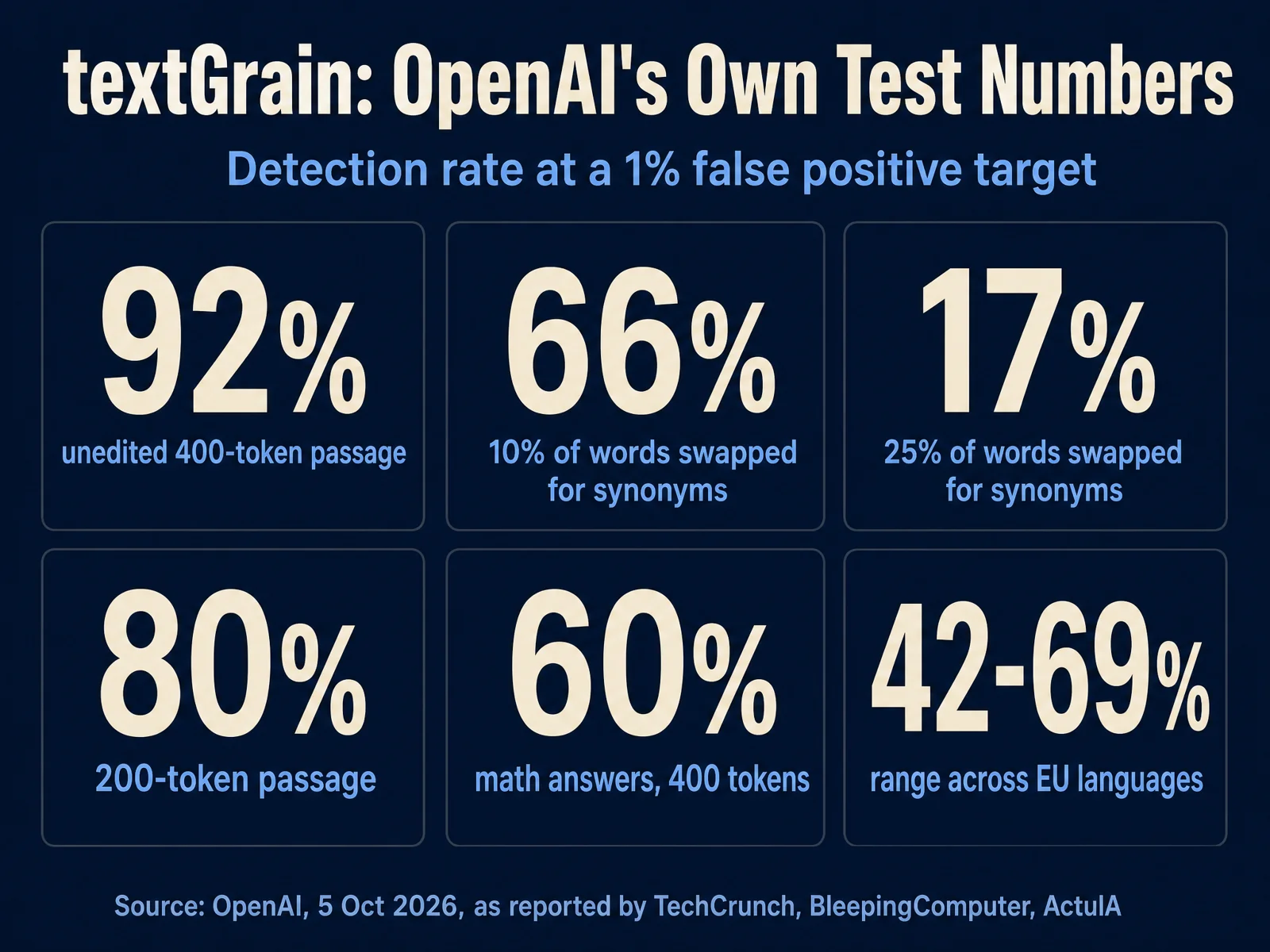
Keep two things in mind when reading that chart. A 17% detection rate still means roughly one in six passages was caught under those test conditions. And OpenAI itself warns that good results in ideal conditions do not guarantee reliable detection in daily use, which cuts both ways.
Why can nobody prove a humanizer removed textGrain?
Because proving removal requires the keyed detector, and vendors do not have it. Access is granted case by case to approved researchers and expert organizations. Cornell, ETH Zurich and the Slovak institute KInIT are named among the first. OpenAI plans to open-source the technology, but has given no date.
So a “0% AI” screenshot proves nothing here. It comes from a tool that holds no key. A valid removal test would need the real detector, watermarked and clean control passages, and recorded settings. WriteBros, a humanizer vendor, sets out that same standard and says it has not met it.
When that test does exist, it will come from a research group first. Treat any earlier “verified” claim as marketing until it names the detector and the access route.
What do the vendors ranking for this actually claim?
Most of the pages ranking for this question are published by companies selling a rewriter, so they deserve a close read. Read closely, most of them stop short of promising removal. I checked each page on 3 November 2026 and found no independent test of textGrain on any of them.
| Page | What it says about removal | Tested against the real detector? |
|---|---|---|
| Rephrasy | “No humanizer can currently prove that it removes textGrain.” Says deeper rewriting removes more. See our Rephrasy review. | No, and it says so |
| WriteBros | Lists what a proof would need. Calls that a proposed method, not results. See our WriteBros review. | No, and it says so |
| HumanizerPRO | Says a thorough rewrite shifts the wording the mark relies on. Reports no test of its own tool. See our HumanizerPRO review. | No test reported |
| WriteHuman | Does not claim removal. Pitches the tool as making text sound like you. See our WriteHuman review. | No test reported |
| StealthGPT | Correctly says there are no hidden characters. Cites OpenAI’s swap numbers. Its 99% human figure is its own claim. See our StealthGPT review. | No test reported |
| AICheckr | Says it significantly reduces detectability and that no method is guaranteed. The page does not mention textGrain. | No test reported |
The credit goes where it is due: Rephrasy and WriteBros both say the limit out loud on pages that sell a humanizer. Our concern is the reader who sees “watermark remover” in a title and assumes a test sits behind it.
Is the watermark the same thing Turnitin or GPTZero checks?
No, and mixing them up is the most expensive mistake here. A watermark check asks whether a keyed pattern is present. A style detector guesses from how the writing reads. A Layer3 Labs guide says the same of Turnitin, and I found no Turnitin statement saying it reads textGrain.
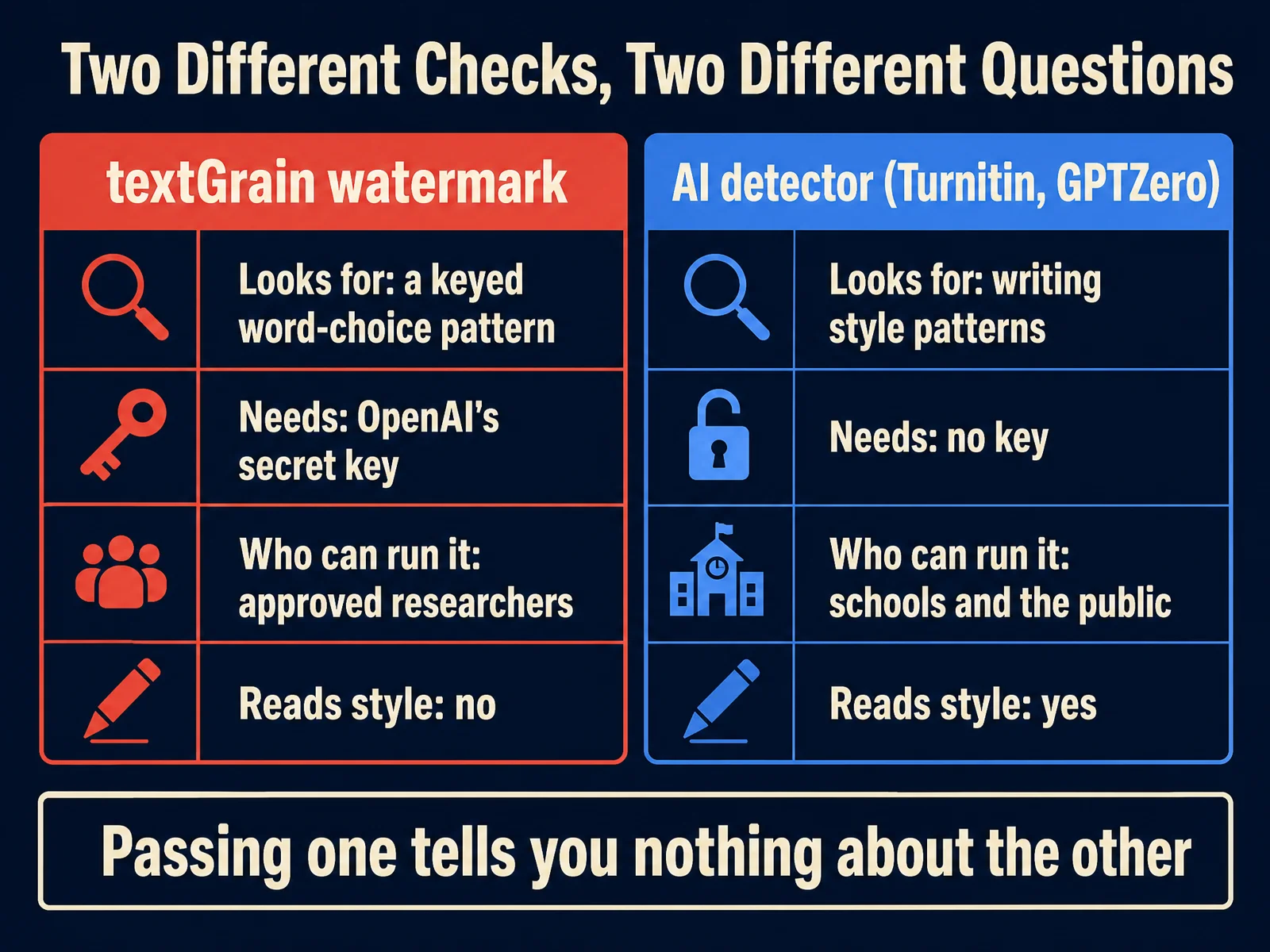
That gives you two independent results. Text could lose the mark and still read as AI to a detector. We have collected the evidence on how far style signals carry in what survives humanization, and the bypass rates after humanization vary widely. Detectors also disagree with each other on the same text.
Could a school ever run the watermark check? Possibly. The EU code’s eligible groups include researchers and educational institutions, while private entities such as HR departments are not listed. So “teachers cannot check this” is true today in practice, but it is not a permanent rule.
Does a hidden character remover do anything to textGrain?
No. textGrain has no hidden characters, so a cleaner has nothing to strip. Removing stray Unicode is still reasonable text hygiene, and we explain what those hidden characters actually are. It is a separate problem, which Layer3 Labs also flags.
What can rewriting cost you besides the watermark?
It can change your meaning, and the mark may simply be replaced. These are the two costs the removal pages rarely dwell on.
Can a rewrite add a different watermark?
Yes. Anthropic applies a SynthID-based mark to Claude text globally, so running ChatGPT output through Claude can trade one mark for another. If a humanizer does not disclose which model sits behind it, you cannot rule that out. For the wider picture, see what Google’s SynthID detector can see.
How much meaning do rewrites lose?
The available evidence is thin and comes from people with a stake in it, so read it as a warning, not a rate. One Reddit tester, who says they build a rewriter, reports models changing 40% to 73% of words on a simple rewrite request, with gross meaning errors ranging from one across six documents to several per document. They also report small shifts such as “should” becoming “must”. These are unverified Reddit claims.
A Pain in the Agent retest, by the builder of a free remover, tried five methods on ten fictional reports. Full paraphrase pushed all ten below the threshold in the original batch, light synonym edits only two. But it used the published SynthID Text method with the author’s own key, and it states that OpenAI’s textGrain was not tested. It does not answer today’s question.
For a thesis or a contract, one changed qualifier can matter more than any detector. We have a checklist for humanizers that ruin facts if you already use one.
What does a watermark result prove, either way?
Less than either side tends to assume. According to OpenAI’s announcement, a detection can show that one of its systems generated or processed part of a text. It cannot show who used the system, how much a person contributed, who owns the text, or whether it is accurate.
| Condition | Reported detection | What it means for you |
|---|---|---|
| 400 tokens, psychology, unedited | About 95% (BleepingComputer) | The best case, at a 1% false positive target |
| 200 tokens | About 80% (BleepingComputer) | Short answers carry less evidence |
| Math, 400 tokens | About 60% (ActuIA, citing The Decoder) | Less freedom in word choice means a weaker mark |
| Other EU languages | 42.2% Romanian to 69.0% Spanish (ActuIA) | OpenAI strengthened the signal for those below 60% |
| Under 200 tokens | Exempt under the EU code (ActuIA) | Very short text may not carry a mark at all |
The reverse holds as well. A missing mark does not prove human authorship. And with a 1% false positive target, human writing can in principle return a positive result, so a single reading should not settle an accusation. If you are facing one, here is what to do in the first 24 hours.
Where does textGrain leave you?
Pick the closest match to see what applies.
Should you pay for a humanizer because of this watermark?
Not on the strength of a removal claim, because that claim cannot currently be checked. If a tool earns its price for tone, editing speed or readability, judge it on those. Our guide to how humanizers work and why detectors still flag text is a better buying filter than any watermark badge.
If your course or contract bans AI text, removing a mark does not change what you agreed to. The safer position is to follow the rule, disclose your use where required, and keep an authorship packet. A real draft history answers questions that no watermark result can.
Frequently asked questions
Do AI humanizers remove the ChatGPT watermark?
Heavy rewriting should weaken it, because the mark lives in word choice. But no humanizer has shown removal against OpenAI’s detector, since that detector is limited to approved researchers and expert organizations.
Can I check my own text for the textGrain watermark?
Not at launch. There is no public textGrain checker. A score from GPTZero, Turnitin or a humanizer’s built-in detector measures writing style and says nothing about the keyed mark.
Does Turnitin detect the ChatGPT watermark?
I found no Turnitin statement saying it reads textGrain. A Layer3 Labs guide says Turnitin scores style and does not read an embedded signal. Educational institutions are among the groups eligible to apply for detector access, according to Let’s Data Science, so this could change.
Is ChatGPT text watermarked outside the EU?
Not by default at launch. OpenAI applies textGrain to eligible ChatGPT and Codex output in the EU, on all plans, over a rollout it described as the coming weeks. API customers anywhere can opt in on supported models.
Does a Unicode or hidden character cleaner remove textGrain?
No. textGrain adds no hidden characters, so there is nothing for a character cleaner to strip. The mark survives copy and paste because it is in the words.
How many words need to change to remove the watermark?
There is no safe number. In OpenAI’s test, swapping 10% of words cut detection from about 92% to 66%, and swapping 25% cut it to 17%. That is not zero, and it is a synonym test, not a test of any humanizer.
Does a watermark prove I cheated?
No. OpenAI says it can show that one of its systems generated or processed part of a text, not who used it, how much a person contributed, or whether the content is accurate.
Does no watermark prove a human wrote the text?
No. OpenAI says the absence of a detected mark does not prove human authorship. The text could be short, edited, translated, or from another company’s model.
Sources
- OpenAI: Our approach to EU text provenance rules (pointer; numbers taken from the reports below)
- OpenAI Developer Community: announcement
- TechCrunch, 5 Oct 2026
- BleepingComputer
- ActuIA
- VKTR
- Let’s Data Science
- Pain in the Agent: text watermark removal retest (author builds a remover; SynthID Text only)
- r/ChatGPT: reading of OpenAI’s post and r/ChatGPT: rewrite test (Reddit claims, unverified)
Choosing a tool anyway? Start with our free versus paid humanizer comparison, then read the review of the one you are considering before you pay.
