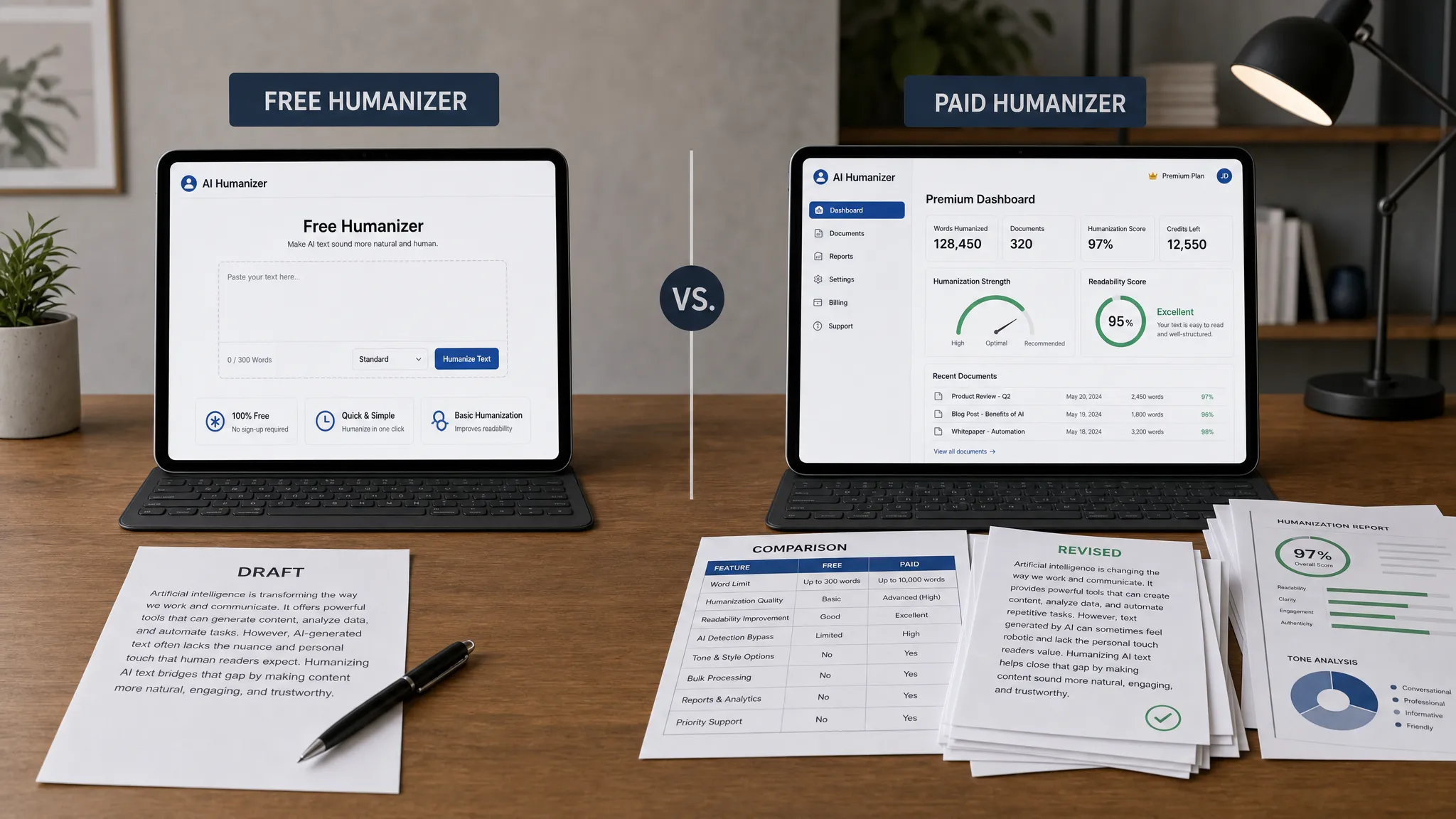
If you are comparing a free AI humanizer with a paid subscription, the honest answer is: sometimes there is a real gap, but it is not always where the sales pages say it is.
The only tool that bypassed Pangram and Turnitin in 2026.
Most humanizers clear one detector and get caught by the other. StealthWriter is the one that gets past both — run Ghost 5.2 Pro at level 7–8, section by section, and re-check before you submit.
Try StealthWriter →Paid tools are not automatically better at AI detection. Free tools are not automatically low quality. In 2026, the meaningful difference is usually a mix of output control, word limits, privacy, reporting, workflow speed, and how consistently the rewritten text still sounds like you.
That matters because an AI content detector is not a magic truth machine. It estimates patterns associated with AI-generated content. A text humanizer, meanwhile, is only useful if it improves the writing without flattening the meaning, inventing facts, or making the piece sound like a thesaurus exploded. The best choice depends on whether you need a quick rewrite, a repeatable editing workflow, a developer API, or documented analysis for your own review process.
The short answer: free is often enough, paid is better for workflow
For one-off use, a free AI humanizer can be surprisingly capable. If you have a short paragraph that sounds robotic, too polished, or repetitive, a no-sign-up tool can usually make it more natural in seconds. That is especially true when you still plan to review the text yourself afterward.
Paid tools become more attractive when the task is larger or more sensitive. If you need to process long documents, compare versions, produce detection reports, preserve a brand voice, or run many checks across a team, the subscription can save time. The gap is less about secret rewriting magic and more about reliability at scale.
A simple way to think about it is this: free tools help you fix a text. Paid tools help you build a process.
What free AI humanizers usually do well
Free humanizers are strongest when the job is narrow. They can reduce obvious AI phrasing, vary sentence rhythm, soften repetitive transitions, and make text feel less templated. Many also give instant access without requiring an email, which is valuable if you are testing tools before committing to anything.
They are also useful for learning what different rewriting styles do to the same input. One tool may shorten sentences aggressively. Another may add informal phrasing. Another may preserve structure but swap wording. Comparing those outputs teaches you what to keep and what to avoid.
If you want a practical starting point, Detection Drama maintains a guide to free AI humanizer tools with no sign-up that is useful when you want to test options quickly without creating accounts across multiple sites.
The downside is that free tools often come with tradeoffs. They may limit word count, offer fewer rewriting modes, show ads, throttle repeated use, or provide little information about how your text is handled. Some free tools also over-edit, which can damage tone or introduce awkward wording.
Where paid tools can be meaningfully better
Paid AI humanizer tools tend to win when consistency matters. A subscription may give you higher character limits, batch processing, stronger privacy terms, faster processing, saved history, premium rewriting modes, or integrations for a regular workflow. These are not cosmetic advantages if you handle a lot of AI-assisted writing.
Paid tools can also offer better review layers. Detection reports, side-by-side comparisons, readability checks, and content scoring can help you understand what changed. That does not mean the detector score is always correct, but it gives you more evidence than a simple before-and-after rewrite box.
For teams and developers, the difference is even clearer. A web tool is fine for manual rewriting, but an API is a different product category. If you need automated processing, rate limits, authentication, and predictable responses, review the technical tradeoffs in an AI humanizer API benchmark before choosing a provider.
Here is the simplest comparison:
| Factor | Free AI humanizer | Paid AI humanizer |
|---|---|---|
| Best for | Short, occasional rewrites | Repeated use, long documents, teams |
| Cost | No upfront payment | Monthly, annual, credit-based, or lifetime plans |
| Word limits | Often restricted | Usually higher or expandable |
| Output control | Basic modes or one-click rewrite | More tone, style, and intensity options |
| Reports | Limited or absent | More likely to include detection and quality reports |
| Privacy clarity | Varies widely | Often clearer, but still requires checking terms |
| Support | Usually minimal | More likely to include support or documentation |
| Risk | Over-editing, inconsistency, hidden limits | Overpaying, exaggerated claims, lock-in |
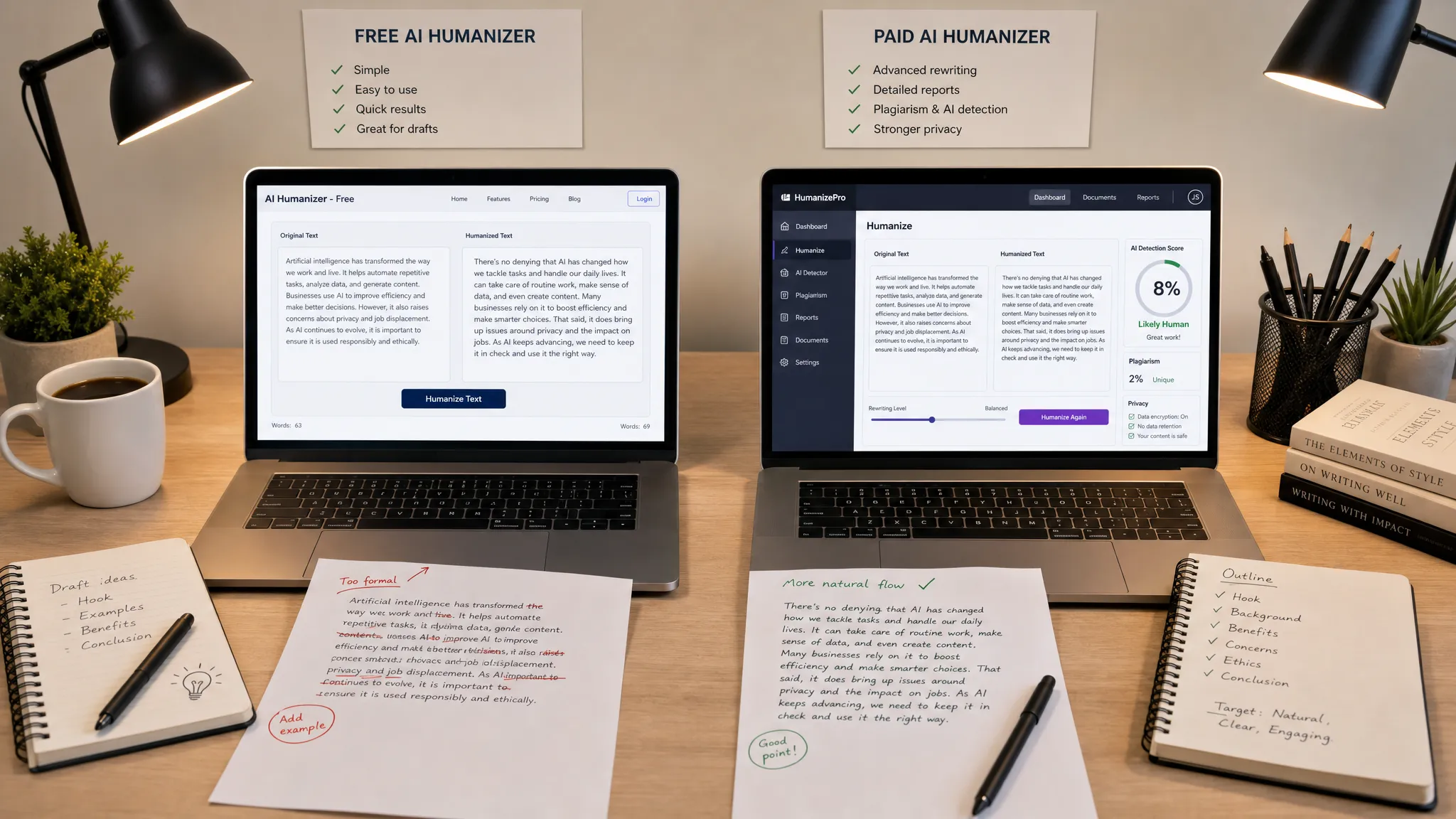
Detection performance: do paid tools actually beat free ones?
This is where marketing often gets slippery. Some paid tools claim they can bypass AI detection with near-perfect reliability. Treat those claims carefully. AI detectors change, writing models change, and even the same text can receive different scores depending on the detector, document length, and context.
OpenAI's own classifier page noted that its AI text classifier was not fully reliable and later became unavailable because of its low accuracy. That does not mean every detector is useless. It means detection is probabilistic, not absolute. Turnitin also provides AI writing detection for institutions, but its results still need human judgment and context rather than blind acceptance.
So, is a paid tool more likely to lower an AI detection score? Sometimes. Paid tools may use more advanced rewriting models, more rewrite passes, or better sentence variation. But a careless paid rewrite can still look generic, and a careful free rewrite plus human editing can outperform a premium output.
The real performance question is not simply whether a tool lowers a score once. A better question is whether it produces readable, accurate text consistently across different topics and lengths.
| Test question | Why it matters |
|---|---|
| Does the meaning stay intact? | A lower detector score is worthless if the text becomes inaccurate. |
| Does the voice sound natural? | Human-like writing includes rhythm, specificity, and intent. |
| Does it survive multiple detectors? | One favorable score does not prove broad reliability. |
| Does it handle long text? | Many tools perform well on short samples but struggle with essays or reports. |
| Does it preserve citations and facts? | Rewriting can distort technical claims, names, dates, and references. |
The hidden gap: writing quality beats detector chasing
The biggest mistake is treating a text humanizer as a detector-score machine. If the output reads like generic internet filler, it may still fail the real test: a reader who knows the subject.
Human writing has choices. It includes concrete examples, uneven sentence lengths, topic-specific vocabulary, and a point of view. It also has restraint. Not every sentence needs a transition phrase. Not every paragraph needs to sound polished. Sometimes the most human edit is removing unnecessary explanation.
Free tools can help with that, but they usually need a final human pass. Paid tools may reduce the amount of manual cleanup, yet they can still produce suspicious patterns. Watch for these red flags:
- Repeated phrases such as in today’s world, it is important to note, or a testament to
- Unnecessary intensifiers that make the text sound promotional
- Synonym swaps that make common ideas sound unnatural
- Added claims that were not in the original draft
- Paragraphs that are technically correct but say very little
If a paid tool creates these problems, it is not a better tool. It is just a more expensive problem.
When a free AI humanizer is enough
A free AI humanizer is usually enough when you are working with low-volume text and can review the output yourself. This includes polishing a short email, making a draft sound less stiff, rewriting a product description, or comparing how different tools handle the same paragraph.
Free is also the right choice when you are still learning what you need. Before paying, test several free options with the same input. Look at how much each tool changes meaning, whether it improves readability, and whether the final draft sounds like something you would actually write.
A free tool is less ideal if you need dependable formatting, long-form consistency, saved reports, or support. It is also risky if you are pasting confidential material into a tool without clear privacy terms.
When paying makes sense
Paying can make sense if the tool saves more time than it costs. That is the practical standard. A paid plan is worth considering when you process a high volume of AI-assisted drafts, need larger word limits, want detection reports, or require more control over tone and structure.
Budget also matters. Some users do not need the most expensive plan, only fewer limits. If price is your main concern, compare free tiers and low-cost plans before subscribing. Detection Drama's breakdown of the cheapest AI humanizers with unlimited words can help you spot the difference between a real bargain and a vague lifetime deal.
Paid tools are also useful when documentation matters. If you need to show your editing process, compare drafts, or keep a record of analysis, reports can be worth more than the rewrite itself. Just remember that a report is evidence, not a guarantee.
How to compare a free tool and a paid tool fairly
Do not judge tools using only the vendor demo. Use your own writing, especially a sample that includes facts, names, citations, or topic-specific language. A weak tool often looks fine on generic content and fails on anything technical.
Run the same original text through each tool and compare the outputs manually before looking at detector scores. Ask whether the final version is clearer, more accurate, and more natural. If a tool lowers a score but makes the prose worse, it is not helping.
For a fair comparison, use the same detector set, the same document length, and the same level of human editing after each rewrite. If you heavily edit one output and not the other, you are testing your own editing more than the tool.
The best comparison also includes privacy and usability. Check whether the tool requires sign-up, stores your text, supports long documents, preserves formatting, and explains its limits. A slightly better rewrite is not always worth a worse workflow.
So, is there a real gap?
Yes, but it is situational.
For casual users, the gap between a strong free AI humanizer and a paid tool can be small. Free tools can be good enough when the text is short, non-confidential, and reviewed by a human afterward.
For power users, the gap becomes more obvious. Paid tools can justify themselves with higher limits, better controls, reports, integrations, and repeatable performance. The key is to pay for workflow value, not for exaggerated promises.
The smartest approach is to start free, test honestly, then upgrade only when you can name the specific limitation you are trying to remove. If the problem is word count, buy capacity. If the problem is documentation, buy reporting. If the problem is quality, compare outputs before assuming price equals better writing.
Frequently Asked Questions
Are paid AI humanizers always better than free ones? No. Paid tools may offer higher limits, more modes, reports, and support, but a strong free AI humanizer can produce better output than a weak paid one. Always test with your own text.
Can a free AI humanizer bypass AI detection? Some free tools can reduce AI detection signals on certain samples, but no tool can honestly guarantee results across every AI content detector or every version of Turnitin. Use detector scores as feedback, not proof.
What is the biggest advantage of a paid AI humanizer? The biggest advantage is usually workflow. Paid tools are more likely to offer longer inputs, batch use, reporting, privacy documentation, integrations, and consistent processing.
Should I use a text humanizer for academic work? Follow your institution's rules. Do not use any tool to misrepresent authorship or violate academic integrity policies. If AI assistance is allowed, keep records, cite sources properly, and make sure the final work reflects your own understanding.
How do I know if a humanizer is damaging my writing? Compare the output against the original for meaning, factual accuracy, tone, and clarity. If the tool adds vague phrasing, changes claims, or makes the text sound unnatural, it is hurting the draft.
Compare tools before you pay
If you are trying to decide between free and paid, start with real tests instead of marketing claims. Detection Drama gives you access to free AI humanizer resources, tool reviews, authenticity analysis, and detection-focused comparisons so you can evaluate what actually works for your writing workflow.
Use free tools first, document the results, and only pay when a specific feature solves a specific problem. That is the difference between buying a useful writing workflow and paying for hype.
