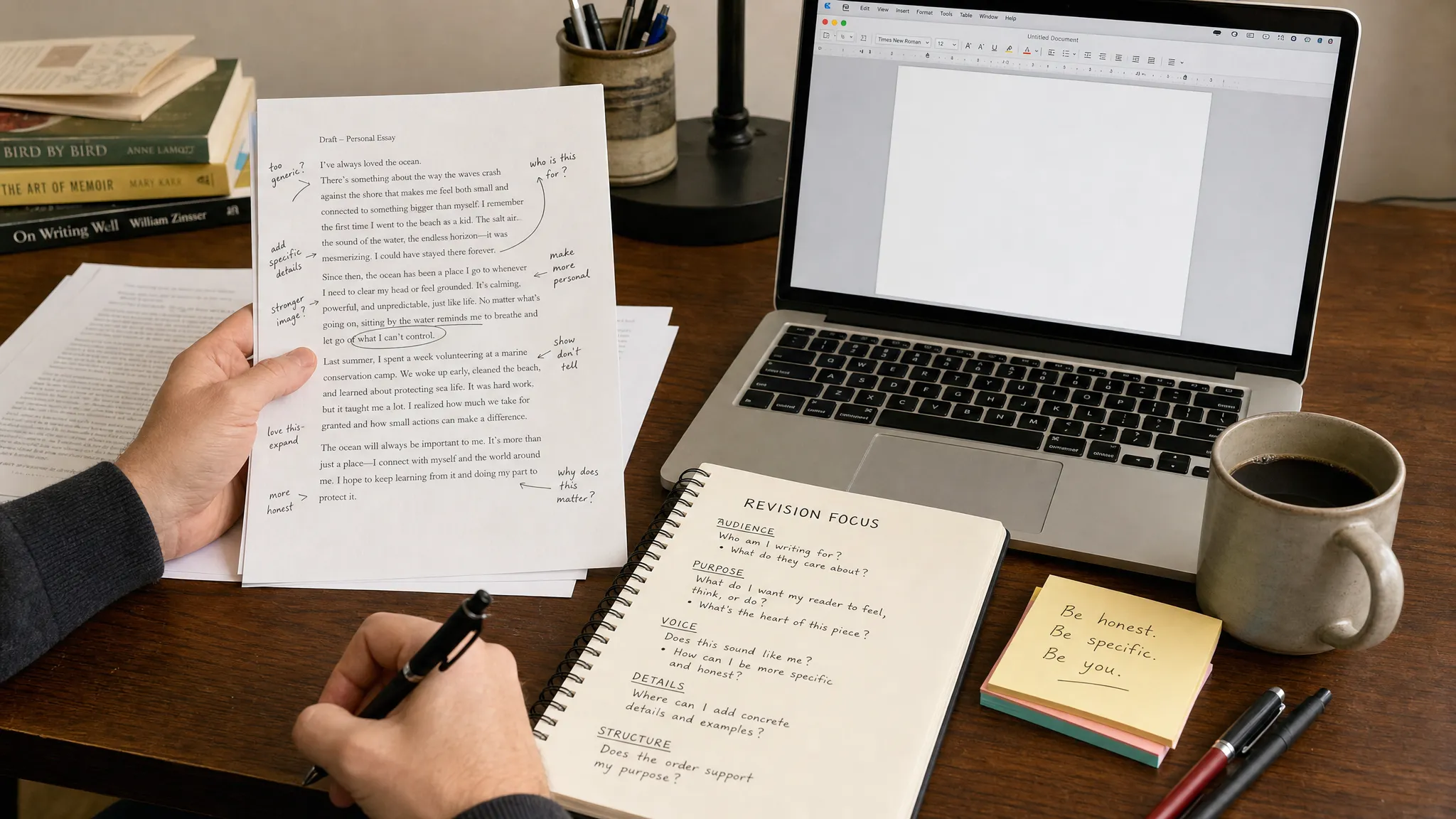
ChatGPT can produce a clean first draft in seconds, but clean is not the same as human. The problem is usually not grammar. It is the tone: too balanced, too smooth, too generic, and strangely disconnected from a real writer’s context.
Want to bypass Turnitin in 2026? Grab the free prompt pack.
Get the exact text-humanization prompts I use to drop an AI score by hand — copy, paste, submit. Free, straight to your inbox.
Send me the free prompts →If you want to rewrite ChatGPT text for a more human tone, do not start by swapping synonyms. Start by making the writing sound like it came from a person with a purpose, a point of view, and a reader in mind. That means adding specificity, adjusting rhythm, cutting filler, and making the logic feel earned rather than auto-generated.
This guide walks through a practical editing process you can use for essays, emails, blog posts, discussion replies, reports, and other AI-assisted drafts. Use it to improve readability, preserve meaning, and make the final version feel more natural.
Why ChatGPT text often sounds less human than it looks
AI-generated content is usually fluent. That is what makes it useful. But it often has patterns that make readers pause, even when every sentence is technically correct.
The most common issue is a lack of lived context. ChatGPT tends to explain topics from above rather than from inside a real situation. It may say something is “important in today’s fast-paced world” without showing who it matters to, what problem is happening, or what tradeoff the writer is dealing with.
Another issue is evenness. Human writing has texture. We emphasize some ideas and move quickly through others. We use short sentences when we want impact. We sometimes choose a plain word instead of a polished one because it feels more direct. ChatGPT drafts often keep the same level of detail and confidence from beginning to end.
Here are the patterns to look for before you begin rewriting:
| AI-like signal | What it feels like to a reader | Human-tone fix |
|---|---|---|
| Generic opening | The draft could apply to almost any topic | Start with a specific situation, problem, or claim |
| Overly balanced phrasing | The writer sounds afraid to take a position | Add a clear stance or priority |
| Repetitive transitions | Paragraphs feel mechanically connected | Use transitions that show cause, contrast, or consequence |
| Abstract claims | The text sounds smart but thin | Add examples, numbers, constraints, or concrete details |
| Uniform sentence length | The rhythm feels flat | Mix short, medium, and longer sentences |
| Polished conclusion | The ending feels like a template | End with a useful takeaway or next step |
The goal is not to make the text messy. Human tone does not mean adding typos or awkward phrasing. It means giving the draft a stronger sense of intention.
Start with the reader, not the sentence
Before changing words, ask who the text is supposed to serve. A paragraph written for a professor should not sound like a sales email. A blog introduction should not sound like a corporate memo. A discussion post should not read like a textbook summary.
A simple “voice map” can help you make better rewrite decisions:
- Audience: Who will read this, and what do they already know?
- Purpose: Are you explaining, persuading, reflecting, summarizing, or asking for action?
- Relationship: Should the tone feel formal, conversational, skeptical, warm, direct, or personal?
- Evidence: What details, examples, or experiences make the point believable?
- Boundaries: What claims should be softened because they are uncertain or context-dependent?
This matters because many people ask ChatGPT to “make this sound human,” then get a version that is just more casual. Casual is not always more human. A human-sounding legal memo may still be formal. A human-sounding essay may still be academic. The key is fit.
If your biggest concern is keeping your own style intact, it helps to build a repeatable editing process around your natural phrasing. Detection Drama has a separate guide on how to rewrite AI text without losing your original voice if you want to go deeper on that part.
Replace generic openings with a real entry point
ChatGPT often starts with broad setup lines because they are safe. You have seen versions of these before:
In today’s digital age, communication is more important than ever.
Throughout history, technology has played a vital role in society.
There are many factors to consider when discussing this issue.
These are not wrong, but they feel empty. A more human opening usually enters through a problem, observation, example, or tension.
Instead of writing, “In today’s digital age, communication is more important than ever,” try something like:
A team can use five communication apps and still miss the one message that matters.
That sentence gives the reader a situation. It creates a reason to keep reading. It also sounds less like a template because it makes a sharper claim.
When rewriting an introduction, ask: “What would make a real person bring this topic up?” Maybe they are frustrated, trying to solve a problem, responding to a debate, or explaining a pattern they have noticed. Lead with that.
Add details that only belong in this draft
One of the fastest ways to humanize AI text is to add details that could not appear in every other answer on the internet. This does not mean inventing facts. It means grounding the draft in the actual assignment, product, reader, company, class, situation, or argument.
For example, a generic ChatGPT sentence might say:
Remote work offers employees flexibility and helps companies improve productivity.
A more specific rewrite might say:
Remote work helps most when employees need quiet blocks for deep work, but it can fall apart when every decision gets pushed into a Slack thread.
The second version is more human because it includes a tradeoff. It sounds like someone has seen the issue in practice.
Specificity can come from many places: a real scenario, a limitation, a comparison, a small example, a timeframe, a personal observation, or a consequence. Even one concrete detail can change the feel of a paragraph.
Make the argument move forward
AI drafts often restate the same point in slightly different language. This creates the illusion of depth without much progression. A human rewrite should make each sentence do a different job.
A useful test is to label the function of each sentence. Does it define the idea, give evidence, explain why it matters, address a counterpoint, or connect back to the main claim? If two sentences do the same job, combine or cut one.
Here is a simple example:
AI writing tools can be useful for students because they help generate ideas. They can also assist students in organizing their thoughts. This makes them valuable tools for academic writing.
The problem is repetition. The rewrite should add movement:
AI writing tools can help students get past the blank page, especially when they are unsure how to structure an argument. The risk comes later. If the student accepts the draft too quickly, the final paper may sound organized but shallow.
Now the paragraph has a turn. It starts with a benefit, then introduces a limitation. That kind of movement feels much more human than simply stacking agreeable statements.
Vary sentence rhythm without forcing it
Human writing usually has rhythm. Some sentences carry detail. Others land quickly. ChatGPT often prefers medium-length sentences with similar structure, which can make the writing feel polished but lifeless.
Read the draft out loud. If every sentence has the same pace, change the shape. Break one long sentence into two. Combine two short sentences if they feel choppy. Move the most important phrase to the end of the sentence when you want it to land harder.
For example:
The company should improve its onboarding process because new employees often struggle to understand internal systems, team expectations, and communication norms during their first few weeks.
A more natural version might be:
The company’s onboarding needs work. New employees are not just learning software in the first few weeks. They are trying to figure out expectations, team habits, and who to ask when something breaks.
The rewrite is not less professional. It is just more readable. It also uses a small phrase, “when something breaks,” that sounds like a person talking about a real workplace.
Replace robotic transitions with real logic
Many ChatGPT drafts lean on predictable transitions: “Moreover,” “Furthermore,” “In conclusion,” “It is important to note,” and “On the other hand.” These phrases are not banned, but they can make the text sound automated when they appear too often.
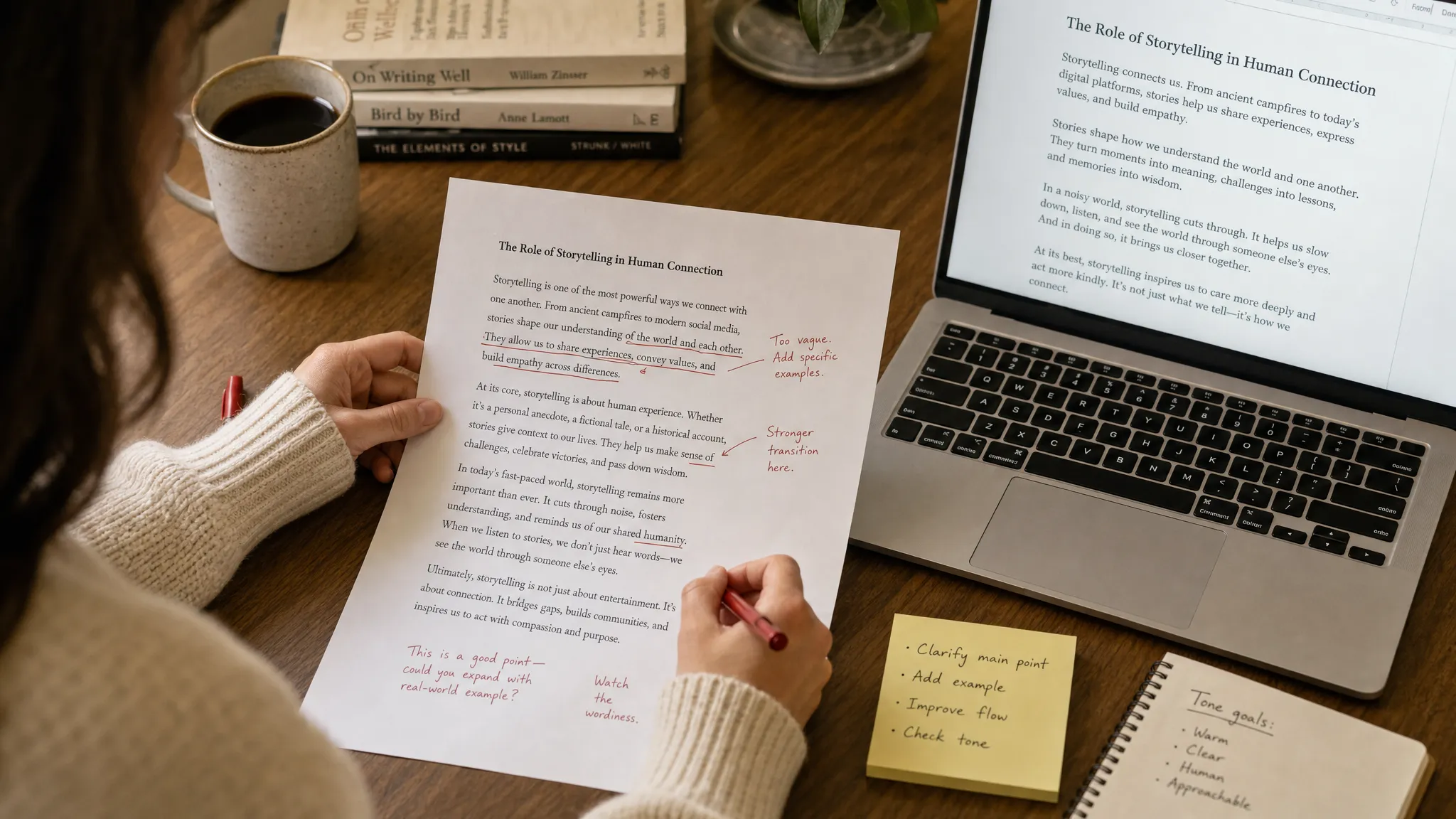
A better transition tells the reader how the ideas relate. Are you adding evidence? Narrowing the claim? Showing a consequence? Admitting a limitation?
Compare these two versions:
| Robotic transition | More human transition |
|---|---|
| Furthermore, this approach saves time. | The time savings matter most during the revision stage. |
| It is important to note that this is not always effective. | That does not mean it works in every case. |
| In conclusion, AI tools should be used responsibly. | The practical takeaway is simple: use AI for support, but do the thinking yourself. |
| On the other hand, there are disadvantages. | The tradeoff is that convenience can hide weak reasoning. |
Notice that the improved versions do more than connect sentences. They clarify the relationship between ideas.
Add a point of view where it belongs
A lot of AI-generated writing avoids commitment. It says things “can be beneficial,” “may play a role,” or “are important to consider.” Those phrases are sometimes useful, especially when the topic requires caution. But if every claim is softened, the writing feels like it has no author.
A human tone often includes a measured point of view. You do not have to sound extreme. You just need to show what you think the reader should do with the information.
Instead of:
Businesses may want to consider adopting automation tools because they can provide several potential advantages.
Try:
Businesses should not adopt automation just because it is available. The best use cases are repetitive tasks where the rules are clear and mistakes are easy to catch.
The second version has judgment. It also narrows the claim, which makes it more credible.
This is especially important for essays and opinion-driven pieces. If you are using AI writing tools to draft, make sure the final argument reflects your actual thinking. For academic or workplace contexts, follow the relevant AI disclosure rules and verify every factual claim before submitting anything.
Cut filler instead of adding “human” fluff
Some people try to make AI text sound human by adding casual phrases like “honestly,” “you know,” or “at the end of the day.” That can work in a conversational email, but it often makes essays and professional writing worse.
A stronger approach is to remove filler. Human readers trust writing that respects their time. The Purdue Online Writing Lab’s guidance on conciseness is useful here: cut unnecessary words, avoid inflated phrases, and keep the sentence focused on the main idea.
Watch for phrases like:
- “It is important to note that”
- “In order to”
- “Due to the fact that”
- “A wide range of”
- “Various different”
- “In today’s society”
- “This essay will discuss”
You do not have to delete every formal phrase. Just ask whether the phrase is helping the reader or padding the sentence.
Example: rewriting a ChatGPT paragraph for a human tone
Here is a typical AI-generated paragraph:
Social media has become an essential part of modern life. It allows people to connect with others, share information, and express themselves. However, it can also have negative effects, such as reducing face-to-face communication and contributing to mental health issues. Therefore, it is important for individuals to use social media responsibly.
The paragraph is clear, but it feels generic. It makes familiar points without adding a specific angle.
Here is a more human rewrite:
Social media is useful, but it is not neutral. A group chat can help friends stay close, while the same phone can turn a quiet evening into an hour of comparing your life to someone else’s highlight reel. The problem is not simply “too much screen time.” It is how easily these platforms blur the line between connection and performance.
Why does this version work better?
| Change | Why it sounds more human |
|---|---|
| “Useful, but not neutral” | Takes a clear position instead of opening broadly |
| Group chat and quiet evening examples | Grounds the claim in recognizable situations |
| “Highlight reel” | Uses natural phrasing without sounding sloppy |
| “Not simply too much screen time” | Pushes past a cliché and refines the argument |
| “Connection and performance” | Ends with a sharper idea than “use responsibly” |
The rewrite does not just disguise the original. It improves the thinking. That is the difference between a shallow paraphrase and a strong human edit.
Use prompts that give ChatGPT constraints, then edit manually
You can use ChatGPT itself to help rewrite, but vague prompts usually produce vague improvements. Instead of saying “make this sound more human,” give specific direction.
Try a prompt like this:
Rewrite the paragraph for a college-level reader. Keep the meaning, but make the tone more direct and less generic. Add one concrete example, vary the sentence length, and avoid phrases like “in today’s world,” “it is important,” and “overall.” Do not add facts that are not already implied.
This prompt works because it defines the audience, tone, editing goals, and boundaries. Still, you should treat the output as another draft. Check whether it preserved your meaning, added unsupported claims, or drifted away from your voice.
If you want a faster workflow after you have strengthened the source draft, a tool-assisted rewrite can help smooth stiff phrasing. Detection Drama’s guide on using GPTHuman for cleaner, more natural rewrites explains how to work in smaller chunks, protect key facts, and review the output instead of accepting it blindly.
Human-tone checklist before you publish or submit
Use this checklist after rewriting ChatGPT text. It is simple, but it catches most tone problems.
- Does the opening sound specific to this topic, or could it introduce almost anything?
- Does each paragraph move the idea forward instead of repeating the same claim?
- Are there concrete examples, constraints, or details that make the writing believable?
- Do the transitions explain the logic between ideas?
- Is there a clear point of view where the topic calls for one?
- Do sentence lengths vary naturally?
- Have you removed filler phrases and generic conclusions?
- Did you verify facts, names, dates, quotes, and sources?
- Does the final version sound like something you would actually stand behind?
If you are short on time, you can also use a focused editing sprint. The process in Detection Drama’s guide to making AI writing sound more natural in 10 minutes pairs well with the deeper rewrite method above.
What about AI detection?
A more human tone can reduce the obvious signs of AI-generated content, but no rewrite can guarantee a specific result in Turnitin, GPTZero, Originality.ai, or any other AI content detector. Detectors use statistical signals, and those signals can be imperfect. They also do not understand your writing process the way a human reviewer can.
The better goal is to create a final draft that is genuinely yours: accurate, specific, revised, and aligned with your intent. If a teacher, editor, manager, or client reads it, the writing should hold up because it makes sense, not because it was mechanically disguised.
That means you should keep notes, drafts, outlines, and sources when the context matters. If someone asks how the work was produced, a clear writing process is more valuable than a last-minute synonym swap.
Frequently Asked Questions
How do I rewrite ChatGPT text so it sounds more human? Start by identifying the audience and purpose, then revise for specificity, sentence rhythm, clearer logic, and a real point of view. Avoid simply swapping words, because that often leaves the original AI-like structure intact.
Can I ask ChatGPT to make its own text sound human? Yes, but give it constraints. Tell it the audience, tone, phrases to avoid, details to preserve, and whether it should add examples. After that, edit the result yourself so it matches your meaning and voice.
What words make ChatGPT writing sound AI-generated? Phrases like “in today’s digital age,” “it is important to note,” “furthermore,” “overall,” and “plays a vital role” can sound generic when overused. The bigger issue, though, is usually vague thinking, not individual words.
Will rewriting ChatGPT text bypass AI detection? It may remove some obvious AI-like patterns, but no method can promise a result from an AI content detector or plagiarism checker. Focus on making the writing authentic, accurate, and compliant with the rules of your school, workplace, or platform.
Should I use a text humanizer or edit manually? The best results usually come from both. Manual editing improves the substance and voice, while a text humanizer can help smooth awkward phrasing. Always review the output before using it.
Make your AI-assisted draft sound more like you
Rewriting ChatGPT text for a human tone is not about hiding the fact that technology helped. It is about refusing to let a generic first draft become the final version.
If you want help spotting stiff AI phrasing and improving the flow of a draft, try Detection Drama’s free text humanizer. You can use it as part of a broader editing process: strengthen the ideas first, humanize the language second, and always give the final version a careful read before you publish or submit it.
