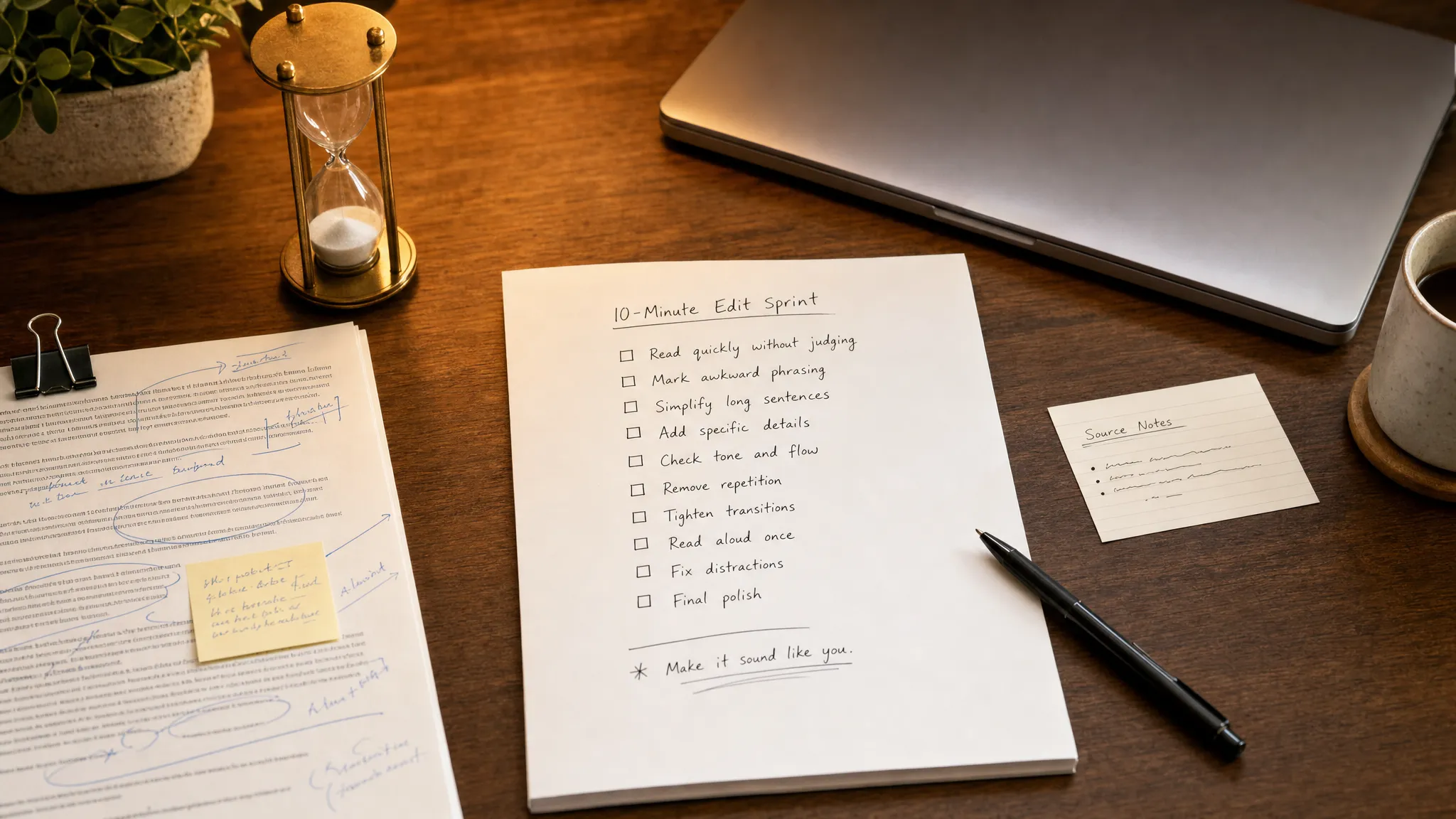
AI-generated drafts often fail in a predictable way: they are clean, complete, and strangely frictionless. The facts may be close, the grammar may be polished, and the structure may look reasonable, but the writing still feels like it came from a template.
Want to bypass Turnitin in 2026? Grab the free prompt pack.
Get the exact text-humanization prompts I use to drop an AI score by hand — copy, paste, submit. Free, straight to your inbox.
Send me the free prompts →The good news: if you only have 10 minutes, you do not need to rewrite every sentence. You need to fix the handful of signals that make AI writing sound generic: vague claims, identical rhythm, overly neat transitions, missing context, and a voice that could belong to anyone.
This guide gives you a fast editing sprint you can use on essays, blog posts, emails, reports, and short discussion posts. It is not about adding random mistakes or trying to trick a reader. It is about making the draft clearer, more specific, and more obviously written by a person who understands the topic.
What natural AI-assisted writing actually looks like
Natural writing is not messy for the sake of being messy. It has a point of view. It makes choices. It explains why a detail matters instead of stacking polished sentences that could apply to any topic.
When human readers say a paragraph sounds AI-generated, they usually mean one of five things is missing.
| Natural writing signal | What it looks like | AI-like version |
|---|---|---|
| Specific context | The writing names the situation, audience, assignment, product, or constraint | Broad statements that fit any topic |
| Decision-making | The author explains why one option is stronger than another | Balanced but empty pros and cons |
| Varied rhythm | Sentence length changes naturally | Every sentence lands at the same pace |
| Real transitions | Ideas move because the logic requires it | Generic connectors like furthermore and moreover |
| Ownership | The writer sounds accountable for the claim | A neutral, floating voice with no stance |
This is why one-click rewriting is rarely enough. A text humanizer can help smooth awkward AI phrasing, but it cannot know what you actually read, what your instructor emphasized, what your client cares about, or what example you personally noticed. Those details have to come from you.
If you want a deeper diagnostic, Detection Drama has a separate guide on what makes writing sound AI-generated to real human readers. The sprint below is the quick version for when the clock is running.
The 10-minute natural writing sprint
Use this process on one section at a time. For a long document, start with the introduction, conclusion, and any paragraph that feels too generic. Those are the parts readers judge fastest.
| Time | Edit to make | What to do |
|---|---|---|
| 0:00-1:00 | Set the target | Write one plain sentence that says who this is for and what they need from it. |
| 1:00-2:00 | Cut the AI opening | Delete throat-clearing phrases and generic scene-setting. Start closer to the actual point. |
| 2:00-4:00 | Add specifics | Insert one real example, constraint, source detail, course concept, product detail, or lived observation. |
| 4:00-5:00 | Break the rhythm | Split one long sentence, combine two short ones, and vary paragraph length. |
| 5:00-6:00 | Replace fake transitions | Swap generic connectors for cause-and-effect transitions that explain the logic. |
| 6:00-7:00 | Add reasoning | Include one because, however, or in practice sentence that shows judgment. |
| 7:00-8:00 | Restore your voice | Replace words you would never say with plainer ones. Read the paragraph out loud. |
| 8:00-9:00 | Protect facts | Check names, numbers, quotes, citations, dates, and technical terms against the original. |
| 9:00-10:00 | Final read-through | Remove weird paraphrases, repeated words, and any sentence that sounds impressive but says little. |
The order matters. Many people start by changing synonyms, which usually makes the text worse. Natural writing comes from stronger thinking first, then cleaner wording.
Minute 1: Replace the generic opening
AI drafts love warm-up sentences. They often begin with broad claims like technology is changing the world, society has always faced challenges, or in today’s fast-paced landscape. Those openings feel safe, but they tell the reader nothing.
A faster fix is to start with the actual tension.
Before: In today’s rapidly evolving digital world, artificial intelligence has become an important tool for students and professionals across many industries.
After: AI can help a student outline a paper in five minutes, but the final draft often sounds too smooth, too general, and too detached from the assignment.
The second version is more natural because it names the user, the task, and the problem. It does not try to sound universal. It tries to be useful.
If you are editing an essay, replace the opening with the specific question the paper answers. If you are editing a blog post, name the reader’s problem. If you are editing a work email, lead with the decision, deadline, or blocker.
Minutes 2-4: Add one detail only you can add
The biggest giveaway in AI-generated content is not grammar. It is replaceability. If the same paragraph could appear in a thousand articles, reports, or essays, it will feel machine-written even when every sentence is correct.
You can fix that quickly by adding one detail from the real context. You do not need a personal confession or a dramatic anecdote. You need evidence that someone engaged with the topic.
Good details include:
- A specific assignment requirement, rubric phrase, or class reading
- A real product feature, user complaint, or workflow constraint
- A local example, date, policy, dataset, case, or industry detail
- A limitation, exception, or trade-off you noticed while researching
- A short sentence explaining why the point matters in this exact situation
The fastest formula is simple: For this audience, this matters because this consequence happens.
Before: Clear communication is important for successful teams because it improves collaboration and productivity.
After: For a remote team handing off client revisions across time zones, clear communication matters because one vague comment can delay the next edit cycle by a full day.
The improved version still makes the same point, but it is harder to mistake for generic filler.
Minute 5: Fix sentence rhythm without adding fake flaws
Some advice tells people to humanize AI text by adding typos, slang, or awkward grammar. That is a bad trade. It can make the writing less credible, and it does not solve the real issue.
Instead, vary rhythm while keeping the prose clean. Human writing usually has a mix of short and long sentences. It also includes occasional emphasis, clarification, and contrast.
Try these three quick rhythm edits:
- Split one sentence that has too many clauses.
- Combine two short sentences that repeat the same subject.
- Move the most important sentence to the end of the paragraph if it deserves emphasis.
Here is a fast example.
Before: The tool provides a convenient solution for users who need to improve their writing quality, and it offers a range of features that can help make the content more effective, readable, and engaging.
After: The tool is useful when the draft is close but still sounds flat. It will not fix weak thinking, but it can help tighten phrasing and make the final version easier to read.
The second version has a shorter first sentence and a more specific caveat. That caveat is important. Human writers often qualify claims because they know where the limits are.
Minute 6: Replace generic transitions with real logic
AI text often uses transitions that sound organized but do not explain anything: furthermore, moreover, additionally, it is important to note, in conclusion. These are not always wrong, but they become suspicious when every paragraph uses them.
Natural transitions show the relationship between ideas. They answer questions like why now, what changed, what is the exception, or what should the reader do next.
| Weak transition | More natural replacement |
|---|---|
| Furthermore | The bigger issue is |
| Moreover | This matters more when |
| It is important to note | The catch is |
| In conclusion | The practical takeaway is |
| Additionally | A second problem shows up when |
| On the other hand | That said |
The goal is not to ban formal transitions. In academic or legal writing, some formal language is expected. The goal is to avoid transitions that merely decorate the paragraph. If the connector does not explain the logic, rewrite it.
Minute 7: Add a sentence of judgment
A lot of AI writing sounds neutral in a strange way. It explains both sides, praises every option, and avoids taking responsibility for the claim. A human editor can usually improve the draft by adding one sentence of judgment.
Use one of these sentence frames:
- The stronger argument is not that X is always true, but that X becomes more likely when Y happens.
- This sounds convincing at first, but it misses one practical constraint.
- I would treat this as a starting point, not a final answer, because the evidence is still limited.
- The safest edit is to keep the claim narrower and support it with a concrete example.
Do not overdo it. One good judgment sentence is better than three paragraphs of opinion. The point is to show that the writing has a mind behind it.
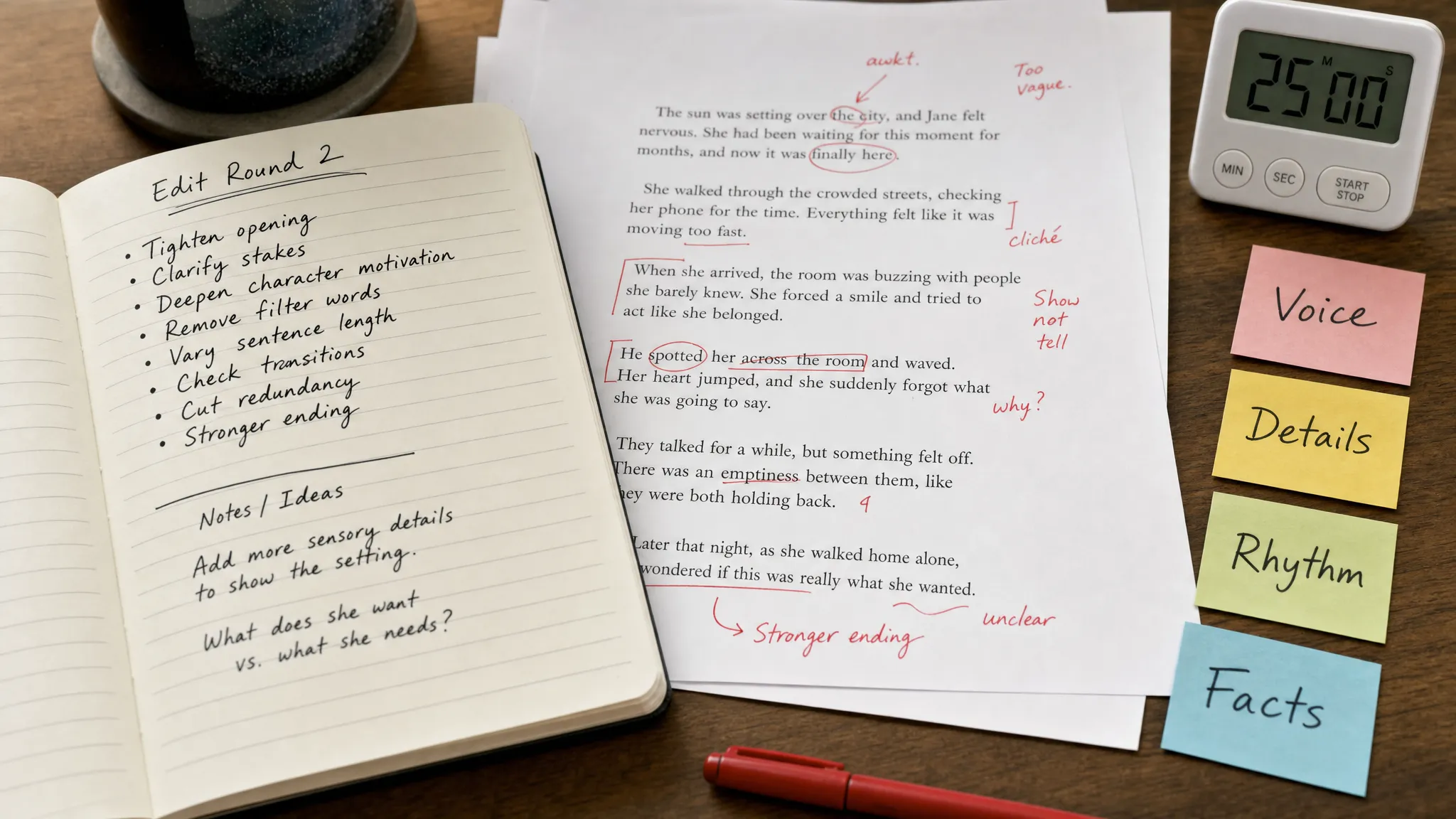
Minute 8: Use a humanizer carefully, not blindly
A text humanizer can be useful when your draft is stiff, repetitive, or obviously patterned. Detection Drama offers free AI writing tools, including instant access to a humanizer with no email required, which can help you get a cleaner first pass.
But the safest workflow is not paste, rewrite, submit. It is paste, compare, edit, verify.
If you use a humanizer, treat it like an editing assistant. Ask whether the new version preserves the meaning, keeps the same level of formality, and avoids changing facts. This matters especially for academic, technical, medical, legal, or financial writing, where one changed term can damage the whole paragraph.
A good quick prompt for AI-assisted editing is:
Prompt: Rewrite this paragraph so it sounds clearer and more natural. Preserve all facts, names, numbers, citations, quotes, and technical terms. Do not add new claims. Keep the tone appropriate for [audience]. After rewriting, list any wording that changed the meaning.
That final instruction is the difference between a safer rewrite and a risky one. You want the tool to help you spot meaning drift, not hide it.
For longer workflows, see Detection Drama’s guide on how to use GPTHuman for cleaner, more natural rewrites. If your draft includes references, use the citation-specific workflow in can you humanize AI text and keep citations intact.
Minute 9: Run a fact and source lock
Natural writing is not useful if it becomes inaccurate. This is where many AI rewrites and humanizer tools fail. They may swap a precise term for a softer synonym, simplify a technical point, or alter a citation sentence just enough to make the source no longer support the claim.
In the ninth minute, stop polishing and check facts.
Look for:
- Numbers, percentages, dates, and dollar amounts
- Names of people, tools, authors, laws, models, and institutions
- Direct quotes and paraphrases from sources
- Citation placement and bibliography details
- Technical terms that should not be simplified
- Claims that became broader than the evidence allows
If you are writing for school, this is also where you check the assignment policy. Some instructors allow AI for brainstorming but not drafting. Others allow grammar tools but require disclosure. A natural-sounding paragraph will not help if it breaks the rules for the task.
For academic work, keep drafts, notes, and version history. AI detectors and plagiarism checkers can be useful signals, but they are not the same thing. Detection Drama explains that difference in AI detector vs plagiarism checker.
Minute 10: Do the read-aloud test
The final minute is simple: read the paragraph out loud, preferably at normal speaking speed. If you stumble, the sentence probably needs trimming. If the paragraph sounds like a presentation script instead of something you would actually write, replace the inflated language.
Watch for phrases like:
- robust framework
- comprehensive approach
- dynamic landscape
- significant impact
- it is essential to recognize
- plays a crucial role
- multifaceted nature
- in the realm of
These phrases are not forbidden, but they are often filler. Replace them with the thing you actually mean.
Before: This comprehensive approach plays a crucial role in enhancing the overall effectiveness of the writing process.
After: This edit helps because it turns a polished draft into one that explains what the writer actually thinks.
Shorter. Clearer. More human.
Quick fixes by format
The same 10-minute process works across formats, but the best naturalness signal changes depending on what you are writing.
| Format | Fastest naturalness fix | What to avoid |
|---|---|---|
| College essay | Add course-specific terms, source reasoning, and a clear claim | Submitting a polished draft with no version history |
| Discussion post | Refer to the exact prompt and add one honest reaction | Generic agreement with no personal thought |
| Blog post | Add reader-specific examples and practical trade-offs | Empty introductions and repeated SEO phrases |
| Work email | Lead with the decision, deadline, or request | Overly formal paragraphs that hide the ask |
| Resume or cover letter | Add concrete results, tools, and role-specific language | Buzzwords with no measurable evidence |
| Technical writing | Protect terminology and explain constraints | Paraphrasing jargon until it becomes wrong |
If you are worried an essay sounds AI-written, do not rely only on a detector score. Read it like a person will read it. Does the draft answer the actual prompt? Does it show your source trail? Can you explain why you made each claim? Detection Drama’s pre-submission essay check walks through that review in more detail.
What not to do when humanizing AI writing
The worst edits are the ones that make the writing look more chaotic but less authentic. Readers can usually tell when awkwardness was added on purpose.
Avoid these shortcuts:
- Adding random typos to seem human
- Replacing every word with a synonym
- Inserting personal stories that are not true
- Removing citations to make the paragraph flow better
- Running the same paragraph through five paraphrasers
- Chasing a detector score while ignoring readability
- Making academic writing casual when the assignment expects formality
The goal is not to make the draft imperfect. The goal is to make it intentional.
A useful rule: if an edit makes the paragraph harder to defend, do not make it. You should be able to explain your wording, your sources, and your reasoning after the edit.
A copy-paste 10-minute checklist
Use this checklist when you are short on time:
- I removed the generic opening and started closer to the point.
- I added at least one specific detail from the real context.
- I varied sentence length without adding fake mistakes.
- I replaced empty transitions with logical ones.
- I added one sentence of reasoning, judgment, or limitation.
- I changed words I would never naturally use.
- I checked that no facts, citations, names, or numbers changed.
- I read the final paragraph out loud.
- I saved my draft history if this is for school or work.
- I followed any AI-use policy that applies to the task.
If you can check those boxes, the writing will usually feel more natural in a way that improves quality, not just surface style.
Frequently Asked Questions
Can I make AI writing sound natural in only 10 minutes? Yes, if you focus on the highest-impact edits: remove generic openings, add specific context, vary sentence rhythm, replace empty transitions, and check facts. A full rewrite may take longer, but 10 minutes is enough to make a stiff draft noticeably better.
Should I add mistakes to make AI text sound human? No. Typos and awkward grammar usually reduce credibility. Human writing sounds natural because it has context, judgment, rhythm, and clear intent, not because it contains random errors.
Will a text humanizer automatically fix AI writing? Sometimes it helps with stiffness and repetition, but it can also change meaning or damage citations. Use a humanizer as a first-pass editor, then compare the rewrite against the original and do a manual fact check.
Can natural-sounding AI writing still be flagged by Turnitin or another AI content detector? Yes. AI detection tools look for statistical patterns, not proof of who wrote the text. If you are writing for school, keep drafts, notes, sources, and version history so you can show your process if questioned.
What is the fastest way to make ChatGPT writing less generic? Add one detail ChatGPT would not know unless you supplied it: a course concept, a client constraint, a personal observation, a source-specific insight, or a practical trade-off from the real situation.
Try a faster first pass with Detection Drama
If you have a draft that sounds too polished, too generic, or too obviously AI-assisted, start with a quick manual pass using the 10-minute checklist above. Then use Detection Drama for instant access to free AI writing tools, including text humanization resources and AI authenticity analysis.
The best results come from combining both approaches: let the tool surface awkward patterns, then add the human details only you can provide. That is how you turn an AI-generated draft into writing that sounds clearer, more specific, and easier to trust.
