
Submitting an essay in 2026 means checking more than spelling, citations, and word count. Even if you wrote the paper yourself, a draft can still sound AI written if it is too smooth, too generic, or too detached from the assignment. That matters because instructors, peer reviewers, and AI content detector tools often react to the same surface signals: predictable structure, vague claims, uniform sentence rhythm, and a missing sense of personal reasoning.
Want to bypass Turnitin in 2026? Grab the free prompt pack.
Get the exact text-humanization prompts I use to drop an AI score by hand — copy, paste, submit. Free, straight to your inbox.
Send me the free prompts →The goal is not to panic over every AI detection score. Detectors are imperfect, and false positives are real, especially for formulaic academic writing and non-native English writing. The better goal is to run a pre-submission check that answers two questions: Does this essay read like a real person making real choices? And can I explain how I created it if someone asks?
What makes an essay sound AI written?
An essay usually sounds AI written when it feels polished but strangely empty. The grammar may be clean, the transitions may be smooth, and the paragraphs may be balanced, yet the writing does not show the specific decisions, hesitations, source engagement, or voice of a real student.
AI content detectors work differently from human readers, but there is overlap. Turnitin describes its AI writing feature as a tool for identifying likely AI-generated text, not as a complete judgment of misconduct. Public detectors such as GPTZero, Copyleaks, and others also estimate likelihood from text patterns rather than proving who typed the essay. Stanford HAI has also summarized research showing that AI detectors can misclassify non-native English writing at concerning rates, which is one reason a detector result should never be treated as the whole story.
A human reader, meanwhile, usually notices simpler things. Does the essay actually answer the prompt? Does it use the assigned readings? Does it sound like the same person from beginning to end? Does the writer make choices, or just summarize the topic in a safe, neutral tone?
| AI-sounding signal | What it looks like in an essay | Better pre-submit fix |
|---|---|---|
| Generic opening | Broad statements like 'In today's world' or 'Throughout history' | Start with the actual text, case, problem, or debate from your assignment |
| Perfectly balanced paragraphs | Every paragraph has the same length and pattern | Let paragraph length follow the complexity of the point |
| Transition overload | Repeated phrases like 'Furthermore,' 'Moreover,' and 'In conclusion' | Use transitions that show your reasoning, not just sequence |
| Vague claims | 'This is important for society' without evidence | Name who is affected, how, and why it matters in your argument |
| Source name-dropping | Citations appear, but the paper does not analyze them | Explain what the source contributes and where you agree or disagree |
| Flat voice | The essay sounds polished but not like your normal writing | Restore your natural phrasing, rhythm, and level of certainty |
| No process trail | One finished draft appears suddenly with no visible development | Keep outlines, notes, drafts, and version history before submitting |
The 20-minute read-through test before you submit
Before using any AI content detector, read the essay like a skeptical instructor. This catches problems that tools miss and helps you revise in a way that improves the paper, not just the score.
Read the introduction and conclusion together
Copy your introduction and conclusion into a separate document and read them back to back. If they sound interchangeable with hundreds of essays on the same topic, your paper may feel AI written even if it is not.
A strong introduction should show your angle, not just the topic. A strong conclusion should return to what your essay proved, not simply repeat that the issue is complex or important. If your opening and ending could fit almost any class, add assignment-specific context.
For example, instead of writing that a novel explores identity in modern society, name the character, the conflict, the chapter or passage, and the interpretive move you are making. Specificity is one of the fastest ways to make writing sound human because it shows that the writer made choices.
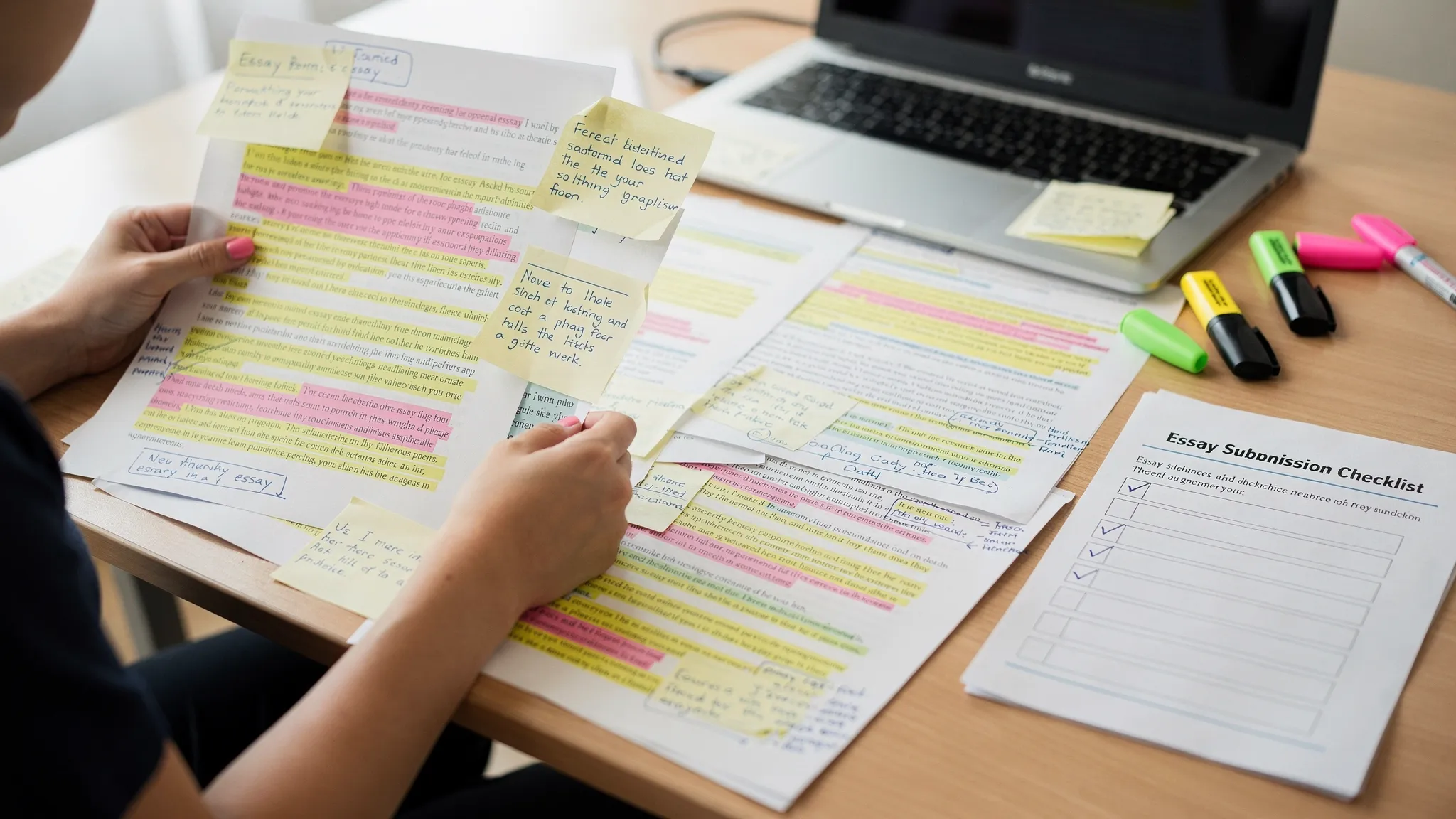
Highlight every sentence that could appear in any essay
Use a highlighter or comments to mark sentences that feel reusable across topics. Common examples include claims like 'This issue has many different perspectives' or 'The author uses language to convey meaning.' These sentences are not always wrong, but too many of them create an AI-like texture.
After highlighting, revise each generic sentence by adding one of three things: a concrete example, a source detail, or your own reasoning. You do not need to make the essay casual. You need to make it accountable to the assignment.
Check whether every paragraph has a job
AI-generated essays often follow a neat but shallow pattern: topic sentence, general explanation, quote, explanation, mini-conclusion. Human academic writing can use that structure too, but each paragraph should still do a distinct job.
Ask yourself: What does this paragraph prove that the previous paragraph did not? If the answer is unclear, merge it, cut it, or rewrite it around a sharper claim. A paragraph that only repeats the thesis in different words is a common reason essays sound machine-generated.
Read aloud for rhythm
AI-like writing often has an unnaturally even rhythm. Sentences are similar in length, paragraphs move at the same pace, and every idea is introduced with a formal transition. Reading aloud makes this obvious.
If you feel like you are reading a brochure, vary the rhythm. Combine short sentences where the logic belongs together. Break long sentences where the argument turns. Replace filler transitions with meaningful connections such as 'This matters because,' 'The exception is,' or 'The evidence complicates this point.'
Ask if you could defend the essay in two minutes
This is the most underrated check. Close the document and explain your thesis, main evidence, and conclusion out loud. If you cannot explain a paragraph without rereading it, the writing may not be fully yours yet, even if you edited it.
That does not automatically mean misconduct. It may mean the argument is too abstract, the source use is weak, or the AI-assisted outline led you away from your own thinking. Revise until you can explain each major section in normal speech.
Use an AI content detector, but do not outsource your judgment
Running a detector can be useful, especially if your school uses Turnitin or another AI content detector. But a detector score is a warning light, not a verdict. Different tools use different models, thresholds, and preprocessing methods, which is why one AI detector may say 'human' while another flags the same essay.
If you use a detector before submitting, follow a consistent process. Test the full essay body first, then test sections separately if the tool gives a high score or highlighted passages. Do not overreact to a single sentence, because short samples are less stable. Also remember that references, quotes, and highly templated academic sections can distort results in some tools.
A simple interpretation framework helps:
| Detector result | What it may mean | What to do next |
|---|---|---|
| Low AI likelihood | The text does not strongly match that detector's AI patterns | Still do a human read-through and save your drafts |
| Mixed or medium score | Some sections may be too generic, polished, or uniform | Inspect highlighted areas and revise for specificity |
| High score on one detector | The essay matches that tool's AI signals | Compare with other tools, then revise the actual writing issues |
| High score across multiple tools | The draft may be heavily AI-shaped or overly formulaic | Rebuild sections from notes, sources, and your own explanation |
| Tools disagree | Normal detector variation | Do not rely on screenshots alone, focus on authorship evidence |
For more detail on detector disagreement, Detection Drama has a guide on what to do when an AI detector says human but Turnitin says AI. If you are specifically worried about Turnitin, it also helps to understand why Turnitin flags AI when other detectors do not.
Compare the essay to your own writing voice
One of the best ways to check if your essay sounds AI written is to compare it against your previous work. Open an older essay, discussion post, or email you wrote without AI help. Look at sentence length, vocabulary, paragraph style, and how you usually express uncertainty.
You are not trying to make every assignment sound identical. Academic writing changes by course and topic. But sudden voice shifts can raise suspicion, especially if the essay is much more polished, formal, or generic than your usual work.
Create a quick voice card from your own writing. Note whether you usually use short or long sentences, how often you use first person if allowed, how you introduce evidence, and which words you naturally overuse. Then compare the current essay. If it sounds like a completely different person, revise toward your real academic voice.
This matters even if AI use is allowed. In many courses, the problem is not that a student used AI for brainstorming. The problem is that the final essay does not show the student's own interpretation. If you used AI writing tools at any stage, your final pass should bring the paper back to your thinking, not just your topic.
Check citations, facts, and plagiarism separately
AI detection and plagiarism checking are not the same thing. A plagiarism checker looks for text overlap with existing sources. An AI detector estimates whether the writing style resembles AI-generated content. Turnitin's Similarity percentage and AI percentage measure different things, and they can create different kinds of concern.
Before submitting, check citations with the same seriousness as style. AI-assisted drafts can introduce fake citations, incorrect page numbers, softened claims, or source summaries that sound plausible but are not accurate. Humanizers and paraphrasing tools can also change facts while making text sound more natural.
Use this citation check:
- Make sure every quote has a page number or required locator if your citation style expects one.
- Confirm that paraphrases are genuinely rewritten and still tied to the correct source.
- Check that every source in the bibliography is cited in the essay, and every in-text citation appears in the bibliography.
- Reopen each key source and verify that it actually supports the claim you attached to it.
- Look at DOI, URL, and reference formatting if your similarity score seems inflated by bibliography matches.
If you are confused about Turnitin's two main report types, read Detection Drama's breakdown of Turnitin AI percentage vs Similarity percentage. If quotes or references are causing similarity problems, the guide on quotes marked as plagiarism in Turnitin is also useful.
Strengthen human authorship signals before submission
A paper sounds more human when it shows intellectual ownership. That does not mean adding slang, jokes, or random personal stories. In academic writing, human authorship usually appears through specific judgment: what you chose to emphasize, how you interpreted evidence, where you noticed a limitation, and why your conclusion follows.
Here are practical ways to strengthen those signals without making the essay less academic:
- Add assignment-specific details from lectures, readings, lab data, class discussion, or the prompt.
- Replace broad claims with narrower claims that name the text, author, period, method, dataset, or case.
- Explain why you selected each major source instead of simply citing it.
- Include a limitation, counterexample, or tension where the evidence is not perfectly clean.
- Use your normal vocabulary where it is accurate instead of forcing formal words you would never say.
- Keep some natural variation in paragraph length and sentence rhythm.
The strongest essays often contain a little friction. They do not glide from point to point as if every issue is obvious. They show the writer working through evidence. If every paragraph sounds equally confident and equally general, add the reasoning steps that led you there.
Keep proof that the essay is yours
Checking whether your essay sounds AI written is only half the job. You should also preserve evidence of your writing process. AI detectors cannot read your Google Docs history or ChatGPT logs automatically, but your version history, notes, outlines, and drafts can help if an instructor questions your work.
A basic authorship packet can include:
- Your outline or planning notes.
- Early drafts with visible changes.
- Google Docs or Word version history.
- Research notes, annotations, or source summaries.
- Feedback from a tutor, classmate, or instructor.
- A short AI usage note if your course requires disclosure.
This does not mean you need to submit all of this with every essay. It means you should keep it until the assignment is safely graded. Detection Drama has a full guide on whether Google Docs or Word version history is enough as proof, and it is worth reading before a high-stakes submission.
Should you use a text humanizer?
A text humanizer can help when your draft is overly polished, repetitive, or stiff, especially if you used AI for outlining, grammar support, or rough drafting and then need to bring the writing closer to your own voice. But a humanizer should not be treated as a magic shield, and it should not replace actual authorship.
The safest way to use any humanize AI text tool is to work in small sections, compare before and after, and verify meaning. Do not accept a rewrite if it changes your thesis, weakens a citation, invents a fact, or makes your essay sound like a different person. If the tool gives multiple modes, choose the lightest rewrite that fixes the issue.
A responsible workflow looks like this: write or rebuild the paragraph from your notes, run a light humanization pass if needed, check it against the source, read it aloud, then save both versions. That way, you are improving readability while preserving your reasoning trail.
Detection Drama offers free AI detection bypass guides, a free text humanizer, AI authenticity analysis, and no-email tool access. Use those resources as part of a broader pre-submission review, not as a substitute for knowing your argument. If a tool output sounds smoother but less like you, revise it again manually.
For a deeper editing workflow, see how to rewrite AI text without losing your original voice. If you are worried about factual drift, read AI humanizers that ruin facts before rewriting citation-heavy sections.
What not to do before submitting
Last-minute panic creates more problems than AI detection itself. Avoid making major changes you cannot explain, especially right before the deadline. A rushed full rewrite can create tone shifts, citation errors, and a version history that looks less natural than your original process.
Do not paste hidden characters, use weird formatting tricks, or rely on invisible text changes. These tricks are unreliable, and they do not improve the essay. They can also create formatting issues that look suspicious. If you want to understand why invisible-character tricks are mostly a dead end, Detection Drama has a guide on whether AI humanizers strip hidden characters.
Also avoid trusting one detector screenshot as proof that everything is fine. A public detector cannot guarantee that Turnitin will agree. Likewise, a high detector score does not automatically prove misconduct. Treat detectors as feedback tools, then revise the essay itself.
A final pre-submission checklist
Use this checklist after your last edit and before uploading the file:
| Check | Pass when… |
|---|---|
| Prompt fit | The thesis directly answers the assignment, not just the topic |
| Specificity | Each body paragraph includes concrete evidence or course-specific context |
| Voice consistency | The essay sounds like a polished version of you, not a new writer entirely |
| Source accuracy | Quotes, paraphrases, page numbers, and bibliography entries are correct |
| AI detector review | Any flagged sections have been reviewed for real writing issues |
| Plagiarism review | Similarity comes from properly cited material, not copied phrasing |
| Version proof | Drafts, notes, and version history are saved |
| Oral defense | You can explain the thesis and main evidence without reading the essay |
If you can pass these checks, your essay is in a much better position. It will not just score better on tools. It will read better to the person grading it.
Frequently Asked Questions
How can I tell if my essay sounds AI written? Look for generic claims, repetitive transitions, uniform paragraph structure, vague source analysis, and a voice that does not match your normal writing. Reading aloud and comparing the draft to past work are two of the fastest checks.
Should I use an AI detector before submitting an essay? It can help, but do not rely on one score. AI detectors are probabilistic and can disagree. Use them to identify sections worth reviewing, then revise for specificity, source accuracy, and your own reasoning.
Can Turnitin flag my essay even if another AI detector says it is human? Yes. Turnitin and public detectors use different systems and thresholds. A clean result from one tool does not guarantee a clean Turnitin result, especially in academic writing.
Does Grammarly or heavy editing make writing sound AI generated? It can, especially if the final draft becomes overly polished, uniform, or unlike your usual voice. Keep drafts, accept edits selectively, and make sure your final version still reflects your own reasoning.
Is using a text humanizer allowed for college essays? It depends on your course policy. Some instructors allow grammar and style help, while others restrict AI rewriting. If you use a humanizer, verify facts, preserve drafts, and disclose AI assistance when required.
What proof should I keep before submitting? Save outlines, notes, early drafts, version history, source annotations, tutor feedback, and any required AI usage log. This process evidence is more useful than detector screenshots if your work is questioned.
Check your essay before you submit
If your essay feels too polished, too generic, or too close to AI-generated content, do not wait until after submission to find out. Run a structured read-through, check detector feedback carefully, verify citations, and keep your authorship evidence.
You can start with Detection Drama's free tools and guides for AI authenticity analysis, text humanization, Turnitin-focused resources, and instant no-email access. Use them to spot weak sections, then make the final judgment yourself: your essay should not only pass a detector, it should sound like work you can confidently defend.
