
Yes, AI humanizers can ruin thesis statements, especially when they rewrite for surface-level naturalness instead of argument clarity. A thesis statement is not just another sentence in an essay. It controls the claim, scope, evidence path, and reader expectations for everything that follows.
That makes it unusually fragile. Change one verb, hedge one claim, remove one key term, or broaden one phrase, and the essay may no longer argue what the writer intended.
The risk is not that every text humanizer is bad. The risk is using one at the wrong stage of revision, then accepting the output without checking whether the core argument survived. If you are using AI writing tools, an AI content detector, or a humanizer as part of your editing process, the thesis needs extra protection.
Want to bypass Turnitin in 2026? Grab the free prompt pack.
Get the exact text-humanization prompts I use to drop an AI score by hand — copy, paste, submit. Free, straight to your inbox.
Send me the free prompts →Why thesis statements are easy to damage
A normal paragraph can survive a little stylistic smoothing. If a sentence about background context becomes more conversational, the essay may still work. A thesis statement is different because it acts like a contract with the reader.
Academic writing centers often describe a strong thesis as specific, arguable, and focused. The UNC Writing Center guide to thesis statements explains that a thesis should tell readers how you interpret the subject and what to expect from the paper. Purdue OWL similarly emphasizes that a thesis should be specific and usually appears near the end of the introduction in many academic essays.
An AI humanizer may not understand that structural role. It sees a sentence to rewrite, not the controlling claim of a paper. As a result, it may improve rhythm while weakening meaning.
For example, a thesis that says a policy caused measurable harm might be softened into a sentence saying the policy had various effects. That sounds safer and more human, but it is no longer the same argument.
The short answer: humanizers can weaken, blur, or shift your claim
AI humanizers usually work by changing sentence structure, replacing predictable phrases, varying rhythm, and making text sound less machine-generated. Those changes can be helpful in body paragraphs, but thesis statements depend on precision.
If a tool replaces a discipline-specific term with a more common synonym, the thesis may lose accuracy. If it removes a contrast word such as although, however, because, or therefore, the logic may flatten. If it adds emotional language, the thesis may sound less academic. If it adds hedging words like may, could, somewhat, or in many ways, the argument may become too vague to guide the paper.
This matters even more when students or researchers are trying to humanize AI text for academic work. A low AI detection score is not useful if the final paper no longer has a clear, defensible thesis.
If you want a deeper explanation of why rewritten text can still look machine-shaped to detectors, the guide on how AI humanizers work and why detectors still flag text breaks down the rewriting patterns behind many tools.
Common ways AI humanizers ruin thesis statements
The most common problem is meaning drift. This happens when the sentence still sounds related to the original, but the claim has quietly changed. Meaning drift can be hard to catch because the rewritten version often sounds polished.
Another issue is over-smoothing. Strong thesis statements sometimes need sharp, direct language. A humanizer may try to make the sentence more fluid by removing the exact terms that make it arguable.
A third problem is false balance. Many academic claims take a position. A humanizer may add neutrality because balanced phrasing sounds less robotic. But if the assignment asks for an argument, too much neutrality can make the thesis non-argumentative.
Here is how that damage can look in practice:
| Original thesis | Risky humanized version | What went wrong | Safer revision |
|---|---|---|---|
| Remote work increases employee retention because it gives workers more control over schedules and reduces commute-related stress. | Remote work can affect employees in several ways, including their schedules and daily routines. | The causal argument disappeared. | Remote work can improve employee retention by giving workers more schedule control and reducing commute-related stress. |
| In Frankenstein, Mary Shelley criticizes scientific ambition when discovery is separated from ethical responsibility. | Frankenstein explores science, ambition, and responsibility in interesting ways. | The literary argument became a topic summary. | Mary Shelley uses Frankenstein to criticize scientific ambition that ignores ethical responsibility. |
| School uniforms do not solve inequality because they address appearance rather than access to academic resources. | School uniforms are connected to inequality and may influence how students experience school. | The stance became vague and noncommittal. | School uniforms fail to solve inequality because they target appearance instead of unequal access to academic resources. |
| Although social media can expand political awareness, its algorithmic incentives often reward outrage over informed civic participation. | Social media helps people learn about politics but also creates some challenges for online conversations. | The specific mechanism, algorithmic incentives, was lost. | Although social media can expand political awareness, platform algorithms often reward outrage more than informed civic participation. |
Notice that the risky versions are not always grammatically bad. Some even sound smoother. The problem is that they stop doing the job of a thesis.
What a thesis statement must preserve during rewriting
Before using any text humanizer on an introduction, identify the non-negotiable parts of the thesis. These are the elements that cannot change without changing the paper.
A strong thesis usually contains five protected parts:
- The topic or object of analysis
- The writer's position or interpretation
- The reason, mechanism, or logic behind that position
- The scope of the claim
- The key terms that match the body paragraphs
If the humanized version changes any of these, it needs revision. A thesis about economic inequality should not become a thesis about social challenges. A thesis about cause should not become a thesis about correlation. A thesis about one novel should not become a general statement about literature.
This is also where factual accuracy matters. Humanizers can change names, numbers, theories, dates, and source claims in subtle ways. If your thesis includes data, historical details, or author names, protect them before rewriting. The Detection Drama guide to AI humanizers that ruin facts explains how to prevent those meaning-critical errors.
Use a thesis checksum before and after humanizing
A thesis checksum is a quick way to compare the original thesis with the humanized version. It is not technical. It simply forces you to verify that the sentence still makes the same promise.
Ask these questions before accepting the rewrite:
- Does the revised thesis make the same claim as the original?
- Is the claim still arguable, or did it become a broad topic statement?
- Did the humanizer remove the reason or cause behind the argument?
- Did any key term change into a weaker synonym?
- Does the thesis still match the body paragraphs?
- Would a reader expect the same essay after reading both versions?
If the answer to the last question is no, the humanizer damaged the thesis.
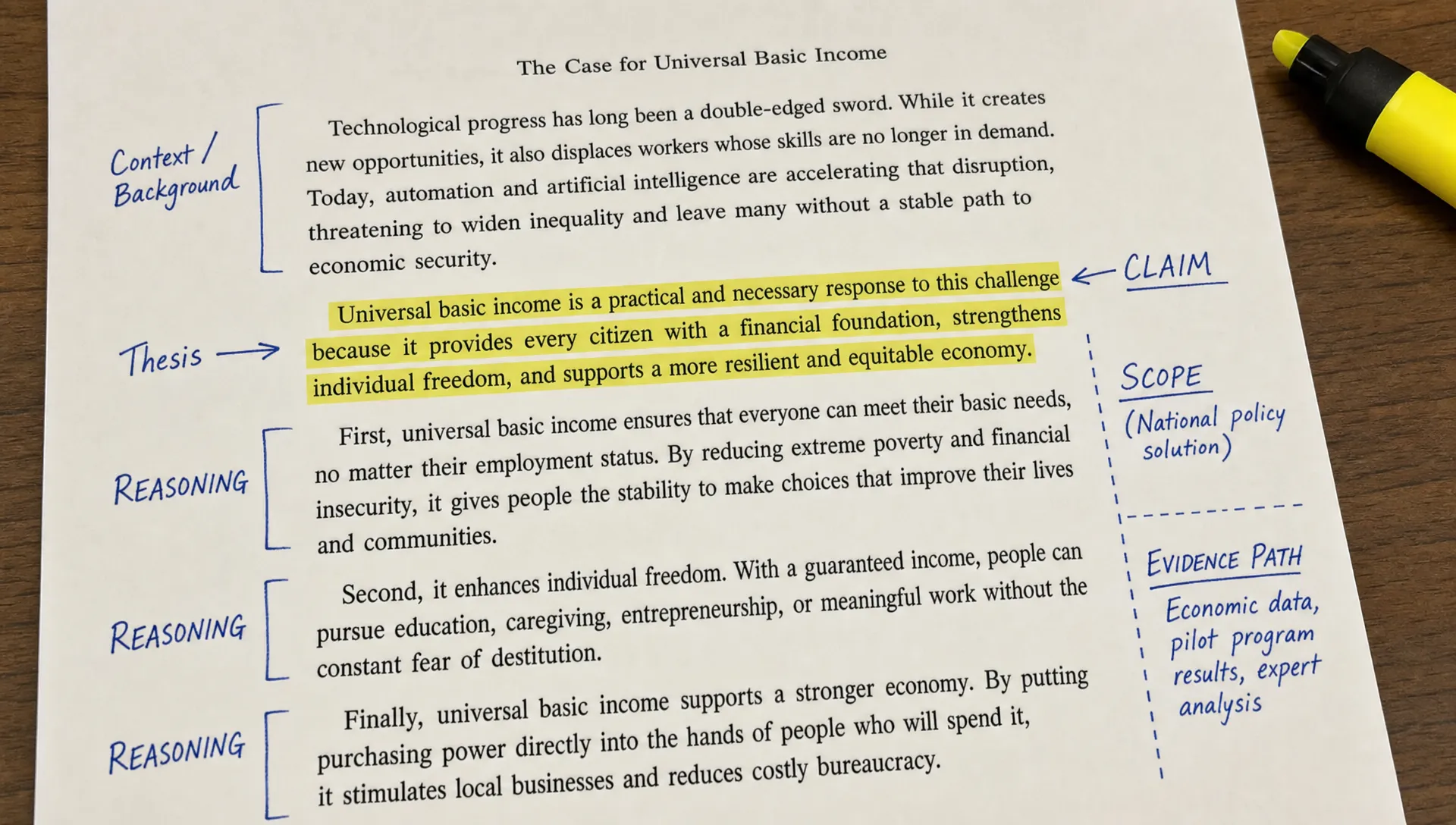
A good humanized thesis should sound natural while still being testable against the rest of the paper. If your body paragraphs discuss algorithmic incentives, the thesis should still mention that concept. If the paper compares two authors, the thesis should not be rewritten as a general statement about literature. If the assignment asks for a persuasive stance, the thesis should not become neutral background.
The safest workflow for thesis statements
The safest approach is to separate argument editing from style editing. Do not ask a humanizer to improve everything at once. First, decide what the thesis must say. Then, if needed, improve readability without changing the argument.
A simple workflow looks like this:
- Write the thesis in plain language first: Do not worry about elegance. State the claim, reason, and scope clearly.
- Mark protected terms: Highlight names, theories, variables, time periods, source concepts, and assignment keywords.
- Humanize surrounding sentences first: The introduction can sound more natural without touching the thesis immediately.
- Rewrite the thesis manually or in small parts: If using a tool, change one clause at a time instead of processing the whole introduction blindly.
- Compare the output to the body paragraphs: Every major body section should still connect back to the revised thesis.
- Run a final academic integrity check: Confirm that the writing reflects your own understanding and follows your institution's policy on AI assistance.
This workflow reduces the chance that a tool will optimize the sentence for AI detection while weakening the paper itself.
Thesis statements by essay type: what can go wrong
Different kinds of academic writing have different thesis risks. A humanizer that works reasonably well for a casual reflection may be risky for a research paper, literature review, or argumentative essay.
| Essay type | What the thesis needs | Common humanizer risk |
|---|---|---|
| Argumentative essay | A clear position with reasons | Turns the stance into a balanced overview |
| Analytical essay | An interpretation of how or why something works | Turns analysis into summary |
| Research paper | A focused claim grounded in evidence | Broadens the claim beyond what sources support |
| Comparative essay | A specific relationship between two or more subjects | Makes the comparison generic |
| Literature review | A pattern, gap, or research direction | Turns the thesis into a list of themes |
| Personal reflection | A specific insight from experience | Adds polished but generic emotional language |
The more specialized the assignment, the more careful you need to be. A thesis in a history paper, for example, may depend on causation, periodization, and evidence limits. A thesis in a scientific paper may depend on variables and measured relationships. A generic rewrite can erase those details quickly.
Should you humanize the thesis at all?
Sometimes the best answer is no. If the thesis is already clear, specific, and natural enough, leave it alone. Humanize the sentences around it instead.
The introduction is often where AI-generated content sounds most formulaic. Phrases like in today's world, it is important to understand, or this essay will explore can make the opening feel generic. You can revise those parts without touching the thesis. In many cases, the better fix is to make the hook more specific, add real context, or tighten the transition into the claim.
If the thesis itself sounds robotic, revise it carefully. Do not ask for a completely new version unless you are prepared to reject outputs that shift the argument. A useful prompt for a writing assistant would focus on clarity, not evasion. For example, ask for a clearer version that preserves the exact claim, key terms, and level of certainty.
AI detection is not the same as thesis quality
A thesis can sound human and still be weak. It can also sound formal and still be strong. AI detection tools and academic quality measure different things.
An AI content detector may look for statistical patterns, predictability, repetition, or other signals. A professor, advisor, or writing tutor reads for argument, evidence, structure, and insight. If you revise only for the detector, you may accidentally create a thesis that passes a surface test but fails the assignment.
This is why human read-through matters. A real reader asks whether the claim is worth arguing, whether the body supports it, and whether the wording matches the evidence. If you are revising generated text more broadly, the guide on making generated AI text pass a human read-through is a useful companion because it focuses on reader expectations, not just detector behavior.
A practical before-and-after method
When editing a thesis after using a humanizer, try a three-column comparison. Put the original thesis in one column, the humanized thesis in the second, and your final edited thesis in the third.
Then label the claim, reason, and scope in each version. If you cannot label those parts in the humanized version, the sentence probably became too vague.
For example:
| Version | Thesis | Quick diagnosis |
|---|---|---|
| Original | Because fast fashion relies on low-cost labor and rapid production cycles, sustainability campaigns by major brands often function more as reputation management than meaningful reform. | Specific, arguable, causal |
| Humanized | Fast fashion brands have started focusing on sustainability, but their efforts can sometimes raise questions about reputation and reform. | Softer, less specific, weaker claim |
| Final | Because fast fashion depends on low-cost labor and rapid production cycles, many brand sustainability campaigns function more as reputation management than meaningful reform. | Clear, natural, and still arguable |
The final version is smoother than the original, but it preserves the argument. That is the goal.
When a humanizer improves a thesis
AI humanizers are not always harmful. They can help when a thesis is wordy, repetitive, stiff, or overloaded with abstract phrasing. A tool can suggest simpler syntax, reduce awkward repetition, or make a sentence easier to read.
The key is control. The writer should decide which version is accurate, not the tool. A good edit makes the thesis clearer without making it broader. It improves readability without removing the position. It may shorten a sentence, but it should not shrink the argument.
A humanizer is most useful when you already know what the thesis means. If you are still discovering your argument, use outlining, source review, and manual revision first. A humanizer cannot decide what your paper should prove.
Frequently Asked Questions
Can AI humanizers completely change the meaning of a thesis statement? Yes. They can replace key terms, soften claims, remove causal logic, or make the sentence more generic. The revised thesis may sound fluent while pointing to a different essay.
Is it safe to run an entire introduction through a text humanizer? It is safer to humanize the introduction in sections. Protect the thesis first, then compare the output against the original claim and the body paragraphs.
What is the biggest warning sign that a thesis was ruined? The biggest warning sign is that the revised version becomes a topic statement instead of an argument. If it says the essay will discuss an issue but no longer takes a position, it needs revision.
Can a humanized thesis still be flagged by AI detection tools? Yes. Humanizers do not guarantee that an AI content detector will read the text as human-written. Detection systems may still flag predictable structure, generic phrasing, or other patterns.
Should I disclose AI use in academic writing? Follow your school, instructor, publisher, or institution's policy. Some allow AI for editing, some require disclosure, and some restrict it. The final thesis should reflect your own understanding and authorship.
Protect the argument before you polish the wording
AI humanizers can help make writing smoother, but thesis statements need more than smoothness. They need precision, stance, scope, and a clear evidence path. Before you humanize AI text, decide which parts of the thesis cannot change. Afterward, compare the rewrite against the original argument line by line.
If you want to test wording while staying alert to meaning changes, you can use the free humanizer tool from Detection Drama and review the result manually before submitting or publishing. The safest version is not the one that merely sounds human. It is the one that still says exactly what your paper is prepared to prove.
