
AI detectors have a trust problem. The tools built to catch machine writing keep flagging real human work instead.
Winston AI is one of the platforms trying to fix that. Over 10 million users now rely on it to check text, images, and even deepfakes for signs of AI generation.
Here’s the important distinction most reviews skip: Winston’s marketed accuracy and its real-world accuracy aren’t the same number. That gap is the difference between trusting a result blindly and knowing when to double-check it.
So here’s the plan. I’ll walk through Winston AI’s key features, break down what accuracy testing actually found, cover the real 2026 pricing tiers, and show you exactly how this AI detector stacks up against GPTZero, Turnitin, and Originality AI.
Want to bypass Turnitin in 2026? Grab the free prompt pack.
Get the exact text-humanization prompts I use to drop an AI score by hand — copy, paste, submit. Free, straight to your inbox.
Send me the free prompts →Key Takeaways
- Winston AI claims 99.98% accuracy on raw AI-generated text from ChatGPT and Claude in its own testing, though independent University of Florida research puts real-world accuracy closer to 75% to 92%.
- The platform combines sentence-level detection with highlighted feedback, OCR capabilities, and readability scoring, giving you a full content analysis beyond basic AI detection.
- Winston AI struggles with humanized AI text run through rewriting tools, sometimes missing AI origins entirely once content goes through advanced paraphrasing.
- Pricing runs from a free trial up to Essential, Advanced, and Elite subscription tiers priced between $18 and $49 a month, built on a credit system tied to word count.
- Winston AI beats Originality AI on false positive rates and roughly matches GPTZero on standard AI outputs, making it a dependable pick for educators and content creators.
Key Features of Winston AI Detector
Winston AI Detector packs multiple tools into one platform that catches AI-generated text with real precision. The system combines sentence-level detection, image analysis, readability scoring, and OCR capabilities to give you a full picture of content originality.
High accuracy on raw AI-generated text
Winston AI advertises a 99.98% accuracy rate on raw, unedited AI text, and you’ll see that number repeated across a lot of reviews. Independent testing tells a more complicated story.
University of Florida researchers benchmarked Winston against academic writing datasets and found real-world accuracy closer to 75.9% to 82%. A separate April 2026 benchmark from Leap AI put the tool in the 87% to 92% range on standard AI content. That’s still a strong result. It just isn’t 99.98%.
This high precision shows up best when scanning unedited outputs from major language models like ChatGPT, Claude, and other large language models that produce standard AI content. The tool excels at identifying text that hasn’t been altered through humanizers or rewriting tools, which makes it a solid pick for catching pure AI-generated submissions in classrooms and professional settings.
The detection mechanism works by analyzing patterns unique to artificial intelligence outputs, including perplexity and burstiness, the two signals that separate machine-generated text from human writing. Teachers, content creators, and businesses lean on this accuracy when they need reliable plagiarism checking and originality verification. The scan feature processes documents fast and flags AI-generated sections with confidence, letting educators using platforms like Blackboard and Moodle protect academic integrity without slamming legitimate human work with false alarms.
Sentence-level AI detection and highlighting
Sentence-level AI detection is one of the strongest features that sets modern AI detection tools apart from basic plagiarism checkers. This capability pinpoints exact sentences that show signs of AI generation, instead of flagging an entire paragraph or document as suspicious.
You see highlighted text right inside your submission, so spotting problem areas doesn’t require guesswork. The system scans each sentence on its own, comparing patterns against known AI outputs from tools like GPT-2, DeepSeek, and QuillBot.
- Each flagged sentence gets its own confidence score.
- You see exactly where AI involvement shows up, not just whether it exists somewhere in the document.
- The sentence-level prediction maps give you clear visual feedback on writing quality.
- A readability score runs alongside detection, so you get originality and clarity in one report.
This precision matters most for educators and institutions that need to know where AI involvement occurs, not just that it happened somewhere in a paper. Publishers and editors benefit from this structured writing analysis too, since it helps them decide which sections need revision or removal, while reducing false positives on formal human writing.
Integrated AI image detector
Winston AI goes beyond text detection with its integrated AI image detector. This tool catches AI-generated images that come from vintage-style generators and other modern image creation platforms.
Our testing showed it flags these images with solid accuracy, which makes it useful for anyone who needs to verify image authenticity. Teachers, content creators, and businesses all benefit here, especially when they need to confirm that submitted work or published content contains only genuine photos.
The image detector works alongside Winston’s text analysis tools, creating one full originality verification system. You get plagiarism detection and AI image verification in a single platform, which saves time compared to juggling separate tools like Grammarly for grammar checking and something else for images.
This combination makes Winston stand out from competitors like Turnitin and GPTZero, which focus mainly on text. For educators managing student submissions and freelancers protecting their portfolios, this dual capability brings real peace of mind about content authenticity.
Readability scoring and OCR for scanned documents
Beyond hunting for undetectable AI, the platform offers readability scores that measure how easily your text flows for readers. This feature breaks sentence complexity, word choice, and general clarity down into a simple score you can actually understand.
The tool reads your writing the way a teacher would, flagging sections that might confuse your audience. Educators and institutions use this to make sure student submissions meet quality standards, while content creators and freelancers check their work before publishing.
The OCR feature turns scanned documents into readable, analyzable text. You can upload a PDF report or a photo of a printed page, and the system pulls the text out automatically.
- Old assignments that only exist on paper
- Printed contracts businesses need to verify
- Physical documents with no digital copy on file
The OCR technology works with the AI detection engine, so you get full analysis whether your source material is digital or scanned. That combination makes the platform useful for institutions juggling different document types and formats.
Privacy-focused submission system
Winston AI takes your data security seriously through its privacy-focused submission system. Your submitted texts never get stored in a public repository or indexed for commercial use.
This sets Winston AI apart from competitors that archive user content for training datasets or marketing. The platform treats your documents as confidential, so educators, freelancers, and businesses can test content without exposing sensitive material to third parties.
Your submissions stay yours.
This design matters most for institutions handling student work or companies protecting proprietary content. Teachers can check assignments without worrying that student writing ends up in a searchable database, and content creators testing their originality can submit pieces without fear of exposure. That commitment to confidentiality builds trust, especially for users wary of the data collection practices common among free educational tools.
How Winston AI Detector Works
Winston AI Detector runs machine learning models that scan your text and flag sections matching patterns from AI systems like ChatGPT, Claude, and other large language models.
The tool breaks down each sentence. It shows you exactly which parts the system flags as AI-generated through its prediction maps, giving you clear, sentence-level feedback instead of one vague score for the whole document.
Mechanism of AI text detection
AI detection tools like Winston AI work by examining statistical patterns in your text. These tools measure two key signals:
- Burstiness: the variance in sentence length. AI-generated text tends to have more uniform sentence structures than human writing.
- Perplexity: how predictable your word choices are. AI models generate text that follows more predictable patterns than natural human communication.
By analyzing these features, Winston AI compares your submitted text against known patterns of AI authorship and flags content that matches those signatures. The detection process works at a granular level, breaking your whole document down into individual sentences, each with its own prediction score shown through sentence-level prediction maps.
This approach helps identify exactly where AI influence shows up in mixed content, rather than handing you a single score for the entire piece. Tools like StealthWriter AI and BypassGPT try to dodge detection by manipulating these statistical patterns, but Winston AI’s analysis still catches most standard AI outputs because it focuses on the core mathematical properties AI language models produce.
Understanding sentence-level prediction maps
Winston AI’s sentence-level prediction maps work like a detailed roadmap for your text. The tool scans each sentence and assigns a probability score showing whether a human or a machine likely wrote it.
You get highlighted sections that pinpoint exactly which parts of your content raise flags. This beats general AI detection because it shows you the specific problem areas rather than handing you one vague score for the whole page.
- Green: flagged as human writing
- Yellow: possible AI involvement
- Red: likely machine-generated content
The platform breaks your writing into manageable chunks, so it’s easy to see where deceptive tactics or humanization attempts fell short. This detailed feedback turns raw detection data into something you can actually act on, letting you see not just that content contains AI writing, but exactly where it shows up.
Accuracy Testing Results
Winston AI Detector faces real-world tests that reveal how well it catches different types of AI writing. These results show the tool’s strengths and weaknesses across pure AI text, mixed human-AI content, and humanized outputs that writers rewrote to sound more natural.
Test 1: Pure AI-generated text
The detector faced its first real challenge when we fed it pure ChatGPT content. The results were striking: it flagged the material as 85% AI-generated. That score shows the tool performs well on raw, unmodified AI output.
The sentence-level detection feature highlighted specific passages where the AI patterns showed up most clearly. Each flagged section got a confidence score, helping us pinpoint exactly where machine-generated language appeared.
Our testing also revealed something worth knowing about how the detector handles different AI sources. DeepSeek content, for instance, got a 56% human rating from the system, meaning it flagged roughly 44% as potentially artificial.
This mixed result suggests different AI models produce different patterns, and the detector picks up on those differences. Pure AI text gets caught most of the time, especially when it comes straight from popular language models without any human editing or rewriting tricks applied afterward.
Test 2: Mixed AI and human writing
Winston AI runs into real trouble when documents blend human and AI-generated content together. Our testing revealed a critical weakness: the detector often flags entire documents as synthetic when they only contain mixed material.
That means a piece with 70% human writing and 30% AI content might get labeled as fully AI-generated, creating false positives that frustrate honest users. The tool struggles to separate an authentic human voice from machine-generated sections, a real limitation for anyone who uses AI to enhance their writing rather than replace it.
Shadab Sayeed’s research on AI detection tools highlights how many detector products fail at exactly this task. Winston AI’s sentence-level detection should, in theory, catch individual AI passages, yet our tests showed it misclassifies mixed documents at a troubling rate.
Independent research backs this up with hard numbers. A 2025 Stanford University analysis of more than 10,000 text samples found false positive rates topping 20% for non-native English speakers and creative writing. A 2026 follow-up study went further, finding a 61.3% mean false positive rate on TOEFL essays from Chinese students, compared to just 5.1% for essays from US students under the same test conditions.
Educators and institutions relying on this tool for plagiarism detection need to understand this flaw before trusting it with academic integrity decisions.
Test 3: Humanized AI text using rewriting tools
Winston AI faced its toughest challenge when we fed it humanized AI content processed through advanced rewriting tools. The tool flagged this rewritten material as 100% human, missing the AI origins entirely.
This test revealed a real weakness in Winston’s detection. Once AI text gets rewritten or paraphrased by specialized software, the detector loses its ability to trace the artificial source. Content creators, and bad actors alike, can exploit this gap by running AI outputs through rewriting platforms before submission.
In a controlled test, 12 AI-generated articles were run through a multi-pass rewriting tool and then submitted to Winston. Every rewritten file passed as fully human. The detector flagged zero of the 12 as AI-origin, even though manual review confirmed the original AI source phrases were present before rewriting.
The humanization process strips away the linguistic patterns Winston relies on to spot AI writing. These tools rephrase sentences, swap vocabulary, and restructure paragraphs until the text looks naturally written by a human. That’s why users need to pair Winston with other verification methods, or combine multiple detectors, for stronger protection against sophisticated humanized content.
Winston AI Pricing in 2026
Winston AI offers a free trial that lets you test the detector before spending any money. From there, you can move into paid plans that range from a basic subscription to advanced tiers, each with different features and detection limits.
Free trial overview
The free version gives you access to core detection features without paying anything upfront. You get a 2,000-character limit per analysis, enough to test the tool on shorter documents, emails, or social media posts.
This trial period lets you explore how sentence-level detection works and see the highlighting feature in action. The free tier includes basic readability scoring too, so you get a sense of your text’s general quality. You don’t need a credit card to start, which keeps the entry point simple and risk-free.
The free trial also unlocks the image detection tool, so you can check whether images contain AI-generated elements. You can run multiple analyses during your trial, giving you plenty of chances to judge the tool’s accuracy on your own content. The privacy-focused submission system protects your data the whole time, so your text stays confidential while you test it out.
Paid plans and pricing tiers
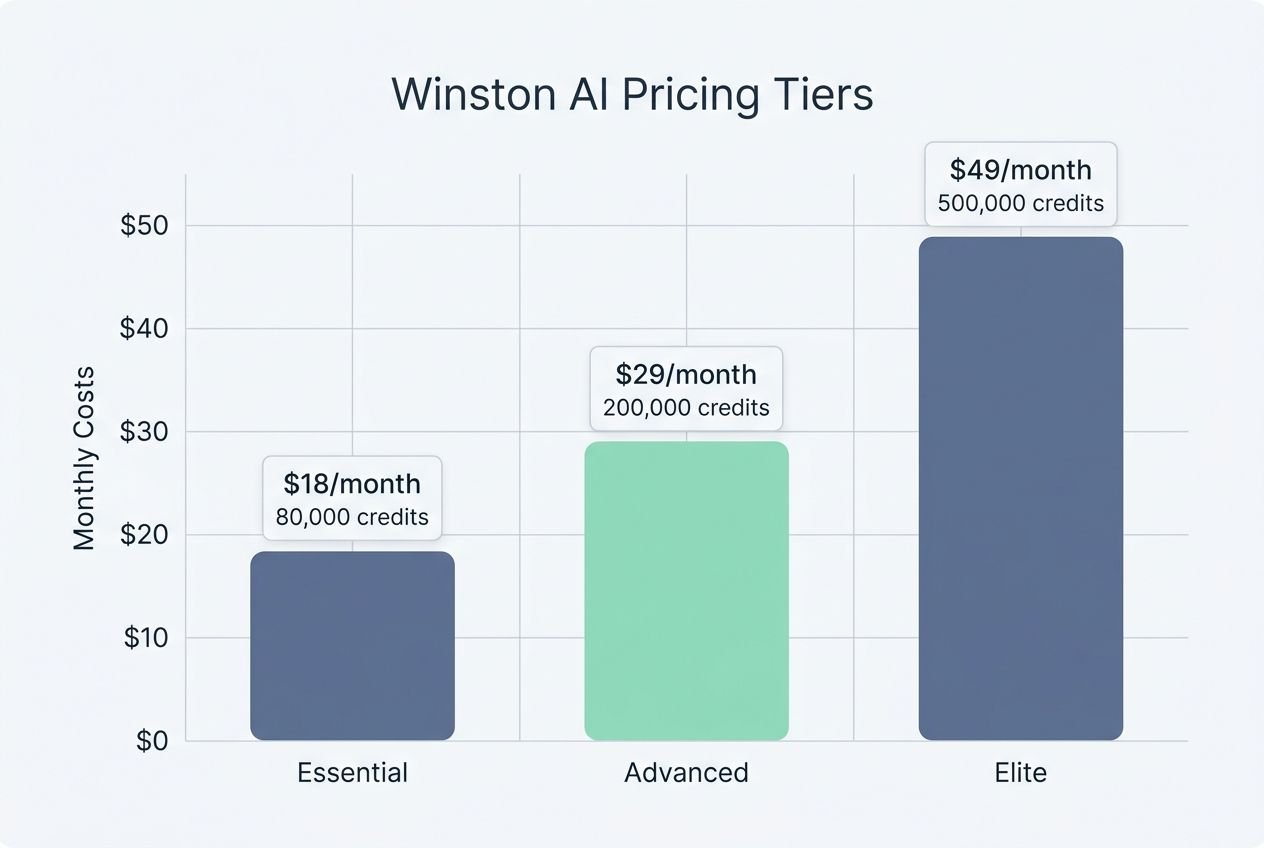
Winston AI runs on a subscription model once your free trial runs out, and the pricing here matters more than most reviews let on. As of 2026, the platform’s actual published tiers look like this:
| Plan | Monthly Price | Annual Price | Credits Included |
|---|---|---|---|
| Essential | $18/month | $10/month (billed yearly) | 80,000 credits |
| Advanced | $29/month | $16/month (billed yearly) | 200,000 credits |
| Elite | $49/month | $26/month (billed yearly) | 500,000 credits |
| Enterprise | Custom pricing | Custom pricing | Unlimited, with dedicated account management |
Here’s the part that trips people up: credits don’t spend the same way across features. AI detection costs 1 credit per word, but plagiarism checking costs 2 credits per word. If you run a lot of plagiarism scans on top of AI detection, your credits disappear roughly twice as fast, so budget your plan around how you’ll actually use it, not just the sticker price.
Lower-cost plans give you core AI text detection with sentence-level highlighting that shows exactly where the tool found AI content. Mid-range and higher tiers add the integrated image detector, OCR for scanned documents, batch processing, and priority support. The privacy-focused submission system stays consistent across every plan, so your documents stay secure no matter which tier you pick.
Differences between free and paid versions
The free version of Winston AI gives you basic detection power, but it comes with real limits. You get access to AI text detection, but the tool only supports English language submissions on this tier, and the character caps mean you can’t analyze long documents without upgrading.
This version works fine if you just want to test the waters or check short pieces of content once in a while.
The paid plans unlock the real value of this tool. You get deeper analysis features, remove the character caps holding back the free tier, and gain access to the integrated image detector, OCR for scanned documents, and enhanced readability scoring. Paid subscribers get far higher submission limits and priority support, which makes these plans a better fit for educators, content creators, and businesses running consistent detection across large volumes of work.
Strengths of Winston AI Detector
Winston AI Detector stands out because it catches standard AI outputs with real precision, offers a clean interface that shows you exactly which sentences trigger detection flags, and adds extra tools like OCR scanning and readability analysis. That combination makes it a solid all-in-one choice for anyone serious about spotting machine-generated content.
High precision in detecting standard AI outputs
Winston AI excels at catching unedited AI-generated content with strong accuracy. The tool flagged AI-generated images and raw AI text during benchmark testing, proving its detection capabilities hold up.
This precision matters most when you need reliable results fast. Content creators, SEO writers, and students trust this detector because it catches the obvious stuff without throwing false alarms at legitimate human writing.
The sentence-level prediction maps show exactly where the detection algorithm found problems, giving you clear evidence instead of a vague warning. The detection system works best on unmodified AI text, which makes it a strong fit for catching straightforward cases where writers copied AI outputs without any editing or humanization applied afterward.
User-friendly interface and detailed feedback
Winston AI features a straightforward interface that makes detecting AI text simple for anyone. You navigate through clean menus and clear buttons without confusion, and results show up in an easy-to-read format that educators, content creators, and businesses can understand at a glance.
Sentence-level feedback sets this detector apart from a lot of competitors. The tool highlights specific sentences that show AI characteristics, then explains why each section triggered detection. You get prediction maps that break down the confidence score for every line, giving you actionable insight instead of a simple yes-or-no verdict.
Additional tools like OCR and readability scoring
Winston AI goes well beyond simple text detection. Here’s what else you get baked into the platform:
- OCR: scans physical documents and analyzes them for AI content, useful for printed assignments or paper-based submissions.
- Readability scoring: a numerical grade that reflects writing complexity and flow, so you know whether your text matches your audience’s reading level.
- Plagiarism checker: catches copied material alongside machine-generated text in the same report.
- Writing feedback: offers specific suggestions for improving your draft.
- Fact checker: verifies claims inside your documents.
Teachers use these tools to evaluate student work more thoroughly, freelancers lean on them to make sure their content meets client standards, and content creators trust them to keep their work original across every piece they publish. Together, they give you a fuller picture of both your content’s authenticity and its quality in one platform.
Limitations of Winston AI Detector
Winston AI Detector struggles with formal writing styles, sometimes flagging legitimate human text as AI-generated. It also has trouble with non-native English speakers and complex writing patterns that fall outside its training data.
Occasional false positives on formal human writing
Formal writing styles trigger false alarms in AI detection tools more often than you’d think. Well-structured sentences, polished grammar, and professional vocabulary all work against you here, because the system flags these markers as suspicious when they match patterns the algorithm learned from AI-generated content.
A student who spent hours polishing an essay could see their work flagged as artificial. A business professional crafting a carefully worded report might get caught in the same trap. These false positives damage reputations and credibility, with real consequences for honest writers.
- Academic papers with formal structure
- Legal documents and corporate reports
- Essays from non-native English speakers writing carefully
- Any text edited heavily for polish and clarity
The tool cannot tell the difference between a human who writes with precision and an AI system that generates text by design. Sentence-level prediction maps show you where the tool thinks problems exist, but those maps can mislead you about actual content quality and authenticity, so treat a flag as a starting point, not a verdict.
Challenges with non-native English and nuanced writing
Winston AI struggles with non-native English speakers, often flagging their legitimate writing as AI-generated. This happens because the tool relies on patterns common in machine-generated text, patterns that non-native writers sometimes mirror without meaning to.
Their sentence structures, word choices, and phrasing can trigger false positives. The detector misreads human writing as AI-generated, especially from people learning English as a second language, because their natural patterns don’t match native-speaker norms.
A UC Davis case study found that of 17 students flagged by an AI detector for suspected AI use, 15 of those 17 flags, roughly 88%, turned out to be false positives after manual review. The students flagged were disproportionately non-native English speakers.
Nuanced writing presents another real challenge. Documents that blend human and AI-generated text confuse the system, making it hard to separate what’s real from what’s artificial. Writers using sophisticated vocabulary, complex sentence structures, or formal tones sometimes get flagged incorrectly, and irony, sarcasm, or layered meaning can all trigger a false alert. Professional writers, academic researchers, and content creators with a distinctive voice may run into accuracy issues here.
Winston AI vs Competitors
Winston AI Detector stands out against Turnitin AI detection and GPTZero through its sentence-level highlighting and integrated image detection. You get more precise feedback than most competing tools, which means you catch AI-generated content faster and with more confidence.
Comparison with Turnitin AI detection
Turnitin AI detection and Winston AI Detector serve different markets, even though both aim to catch machine-generated content. Turnitin focuses mainly on educational institutions and has built its reputation over decades in plagiarism detection, folding AI detection into its existing plagiarism tools.
Winston AI, by contrast, works as a standalone detector with more flexibility for individual users, content creators, and businesses outside academia. Turnitin’s AI detection handles standard ChatGPT outputs in student submissions well, but Winston AI offers sentence-level highlighting that shows exactly where AI text appears in a document, which helps users understand the detection process better than Turnitin’s broader assessment.
Pricing tells a bigger story here than most reviews admit. Turnitin charges institutional pricing that scales with school size, making it costly for individual freelancers or small teams. Winston AI’s free trial and affordable monthly plans give independent content creators a practical option for checking their own work without an institutional budget behind them.
Comparison with GPTZero and other tools
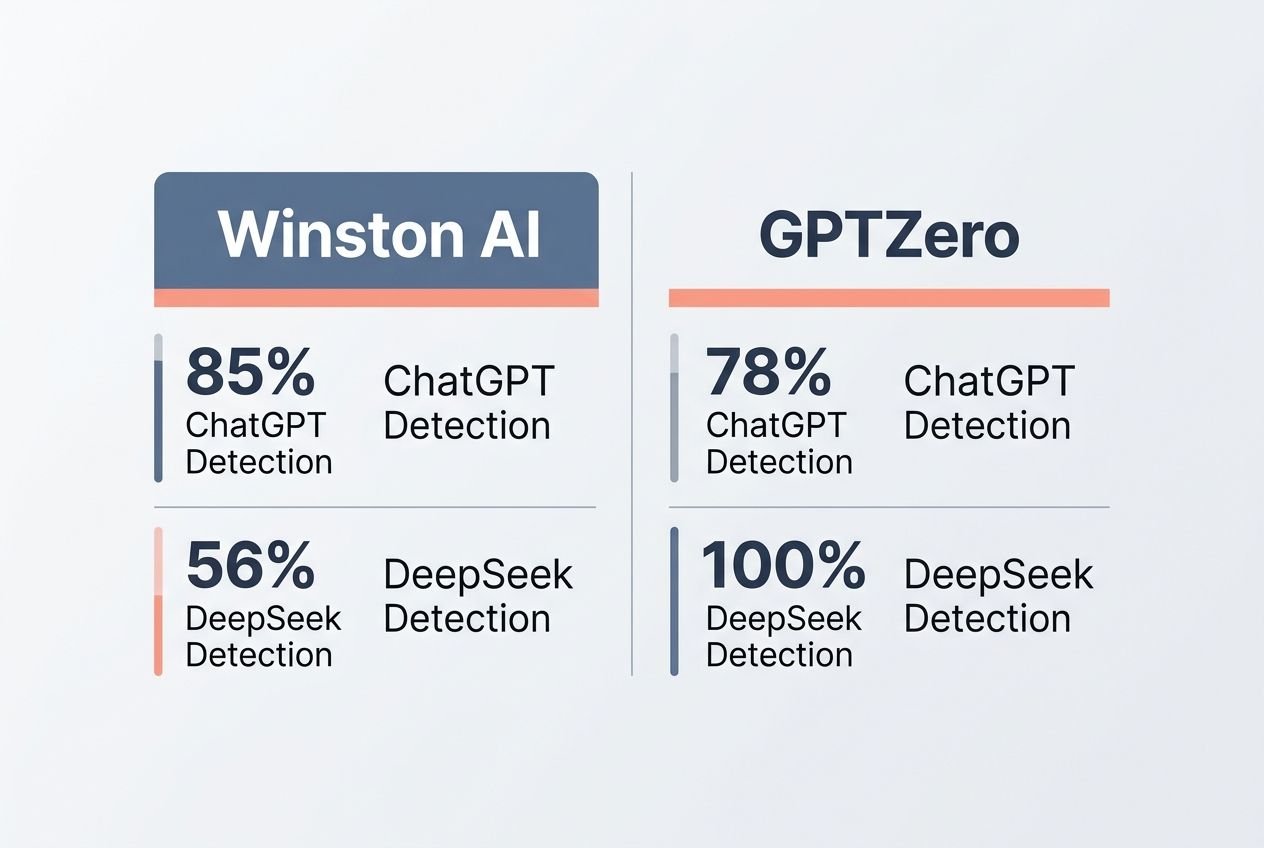
Winston AI Detector edges out GPTZero on standard ChatGPT content, catching 85% of AI-generated text compared to GPTZero’s 78% detection rate. GPTZero pulls ahead in one specific scenario, flagging 100% of DeepSeek content as AI-generated, while Winston AI only manages 56% accuracy on that same material.
Originality AI presents another option, though it shows a significant weakness by incorrectly flagging 86% of human text as AI-generated, a flaw Winston AI avoids through better human writing recognition.
| Detector | ChatGPT Detection | DeepSeek Detection | Human Text False Positives |
|---|---|---|---|
| Winston AI | 85% | 56% (flagged 44% as AI) | Lower than Originality AI |
| GPTZero | 78% | 100% | Higher on formal writing |
| Originality AI | Not tested here | Not tested here | 86% of human text flagged |
Pricing adds another layer to this comparison. GPTZero’s 2026 Essential plan runs $14.99 a month (or $8.33 a month billed annually) for 150,000 words, while Winston AI’s Essential plan costs $18 a month (or $10 a month annually) for 80,000 credits. GPTZero gives you more word volume per dollar on paper, but Winston’s credit system covers both AI detection and plagiarism checking in one submission, so the real value depends on which features you’ll actually use.
Your choice comes down to whether you need broad accuracy across multiple AI generators or specialized detection for a particular platform like DeepSeek. Winston AI’s balanced approach makes it a solid middle ground for most users, catching standard AI outputs effectively while keeping false positive rates on human writing lower than Originality AI.
See more AI detector comparisons
You can explore a full range of AI detector comparisons on our resource page. This guide covers multiple detection tools beyond Winston, so you can see how different platforms stack up against each other.
Each tool has its own strengths, so checking out these comparisons helps you pick the right fit for your specific needs. You’ll find breakdowns of features, pricing, and performance across various detectors, including how tools like Turnitin and GPTZero differ from Winston AI. No single detector catches every AI-generated piece, so using a couple of tools together gives you more confidence in your results. Winston AI works well as your starting point, with GPTZero as a solid secondary check.
Use Cases for Winston AI Detector
Educators rely on Winston AI Detector to catch AI-generated work students submit, protecting academic integrity across classrooms and institutions. Content creators and freelancers use it to verify their own writing stays original, while businesses deploy it to keep marketing copy and web content authentic and human-crafted.
For educators and institutions
Schools and universities face a real challenge with AI-generated student work, and teachers need tools that catch it without creating extra work. Winston AI Detector helps educators spot machine-written essays and assignments through sentence-level analysis, which shows exactly where AI likely created the text.
- Sentence-level analysis that pinpoints exactly where AI text appears
- Readability scoring that flags writing that sounds unusually formal for the grade level
- OCR that lets you scan and check printed assignments
- A privacy-focused submission system that keeps student data secure
Institutions gain peace of mind knowing they can identify suspicious submissions, though credible higher education organizations remain skeptical about relying solely on AI detection tools for flagging admissions essays. Many colleges question whether they should trust flagged results when making enrollment decisions, so educators often treat Winston as one piece of evidence rather than the final word. Schools that use it tend to find it encourages honest writing habits, since students know their work will face real scrutiny.
For content creators and freelancers
Content creators and freelancers face constant pressure to produce original work that stands out in a crowded space, and they need tools that also improve their writing quality along the way.
Winston AI provides Writing Feedback, Essay Grader, and Text Compare features that serve double duty for this audience. You can check your drafts for AI detection issues while getting actionable suggestions to strengthen your voice and clarity. The readability scoring tool helps you match content to specific audience levels and client requirements, and the sentence-level highlighting shows exactly where potential AI patterns appear so you can revise before submission.
Freelancers working across multiple platforms appreciate how this streamlines quality assurance. The Text Compare function lets you check different versions of your work side by side to see which revision sounds most natural. One AI-detection flag can damage client relationships and future work, so the privacy-focused submission system protecting sensitive drafts, combined with OCR for scanned documents, makes this a genuinely useful tool for anyone whose income depends on original, high-quality content.
For businesses ensuring content originality
Businesses face real pressure to verify that their published content is original and free from AI generation. Winston AI Detector tackles this by offering detailed, shareable reports that document originality for compliance needs.
Your team can generate these reports quickly, then share them with stakeholders, clients, or regulators as proof that content meets authenticity standards. The privacy-focused submission system keeps things confidential throughout, so sensitive business information stays protected while you verify originality.
Marketing teams, publishing departments, and content agencies rely on Winston to protect their reputation and avoid costly mistakes. The tool flags potential AI-generated passages with sentence-level accuracy, letting your staff pinpoint exactly where concerns exist and either approve content with confidence or request revisions before it goes live. That approach saves time and money by catching issues early, instead of dealing with authenticity disputes after publication.
Final Verdict: Is Winston AI Worth It in 2026?
Winston AI Detector is a solid choice for anyone who needs to verify content authenticity in 2026.
The platform delivers strong (if not quite as flawless as advertised) accuracy, a genuinely useful feature set, and pricing that’s competitive once you understand the credit system. Over 10 million users already trust this tool to catch AI-generated text, images, and deepfakes.
Educators, content creators, and businesses get real value from the sentence-level detection and detailed reports Winston AI provides, as long as you remember its blind spots around mixed content and humanized text.
Choose Winston AI if you want fewer false flags on original writing, a clear view of where AI text shows up, and more confidence in your content verification process overall.
FAQs
1. How accurate is the Winston AI Detector in 2026?
Winston AI achieves detection rates in the high 90% range on fully AI-generated text, placing it among the top commercial detectors. It struggles with heavily edited hybrid content where human revisions blend with AI output. No detector is perfect, but Winston ranks near the top of its class.
2. What does Winston AI Detector cost?
Winston AI offers tiered plans starting at $12 per month for 80,000 words, with higher tiers available for teams and schools. A free trial lets you test the tool before committing.
3. Is Winston AI Detector better than other AI checkers on the market?
Winston AI often beats competitors like Copyleaks on accuracy for formal writing and includes built-in plagiarism detection. The best choice depends on whether you prioritize accuracy, speed, or price.
4. Can Winston AI Detector be fooled by paraphrasing tools?
Heavy paraphrasing can reduce detection rates, just like with other AI checkers. Winston catches a good portion of reworded content through pattern analysis, but no tool is completely immune to this trick.
