
AI can give you a clean case study draft quickly, but clean is not the same as convincing. Case studies depend on judgment, context, evidence, and the small details that make a real situation feel real. When an AI-generated draft sounds flat, it is usually because it summarizes the case instead of thinking through it.
To rewrite AI case study drafts more naturally, your goal is not to decorate the text with casual phrases. The goal is to make the draft sound like a person who understands the case, has noticed the tradeoffs, and can explain why the evidence matters.
That means preserving the facts, sharpening the decision logic, and replacing generic AI wording with concrete, case-specific analysis.
Want to bypass Turnitin in 2026? Grab the free prompt pack.
Get the exact text-humanization prompts I use to drop an AI score by hand — copy, paste, submit. Free, straight to your inbox.
Send me the free prompts →What makes an AI case study draft sound unnatural?
Most AI case study drafts are not bad because they are grammatically weak. They are bad because they are too smooth. They often present the situation as if every problem is obvious, every solution is balanced, and every conclusion follows neatly from the previous paragraph.
Real case study writing is messier. A strong case study usually includes uncertainty, constraints, competing priorities, partial evidence, and a clear explanation of how the writer reached a conclusion.
Common AI patterns include:
- Generic openings such as In today’s competitive environment or This case highlights the importance of leadership.
- Vague praise such as successful, effective, innovative, or impactful without evidence.
- Perfectly balanced paragraphs that all have the same length and rhythm.
- Conclusions that sound correct but do not show the reasoning behind them.
- Missing stakeholder tension, such as what customers, managers, employees, or investors wanted.
- Overly broad lessons that could apply to almost any company, project, patient, school, or organization.
If the draft also sounds unlike your normal writing style, it helps to separate the rewrite into two passes: one for accuracy and one for voice. Detection Drama has a practical guide on rewriting AI text without losing your original voice that pairs well with the case study workflow below.
Start with a fact lock before you change the prose
Before you rewrite anything, identify the facts that cannot change. This is especially important for case studies because AI writing tools and text humanizers can accidentally alter dates, numbers, names, source details, and cause-effect relationships.
Create a simple fact lock and keep it next to the draft while editing.
| Case element | What to lock | Why it matters |
|---|---|---|
| People and organizations | Names, roles, departments, locations | Prevents confusion about who did what |
| Timeline | Dates, sequence of events, project phases | Keeps the case logic accurate |
| Metrics | Revenue, costs, growth rates, sample sizes, survey results | Protects the evidence behind your analysis |
| Sources | Citations, interviews, reports, class materials | Avoids citation drift and source mismatch |
| Constraints | Budget, staffing, policy, market conditions, deadlines | Makes the analysis realistic |
| Outcome | What changed, what failed, what remains uncertain | Prevents overclaiming |
Once these facts are locked, you can rewrite more freely without turning the case into something it never said. This is also where you should be careful with automated rewriting. If you use a text humanizer, review every factual sentence afterward. For more on this risk, see Detection Drama’s guide to AI humanizers that ruin facts.
Rebuild the draft around the real decision
A natural case study does not just describe a situation. It usually centers on a decision, a problem, or a turning point. Even if your assignment is not written as a formal business case, the same principle applies: the reader needs to know what question the case is trying to answer.
A helpful frame is the case method used in many business programs. Harvard Business School describes the case method as putting students in the role of decision-makers who must analyze a situation and choose a course of action. You can borrow that mindset for almost any case study.
Ask these five questions before rewriting:
- Who had to make a decision or respond to the situation?
- What problem made the decision difficult?
- What options were available at the time?
- What evidence supports or weakens each option?
- What would the consequences be if the recommendation failed?
This helps you move from a generic report to a case study with a clear analytical spine.
For example, instead of writing that a company improved its customer retention strategy, explain what retention problem it faced, what options it considered, why one option seemed more practical, and what evidence showed whether the change worked.
Replace generic claims with case-specific evidence
AI drafts often use polished but empty claims. Your job is to tie each claim to something visible in the case.
| AI-style sentence | More natural case study rewrite |
|---|---|
| The company implemented an effective marketing strategy. | After two quarters of low repeat purchases, the team shifted its budget from broad awareness ads to loyalty offers aimed at existing customers. |
| Leadership played an important role in the organization’s success. | The manager’s main contribution was not a new strategy, but the decision to slow the rollout until store staff had been trained on the revised process. |
| The case demonstrates the importance of communication. | The missed deadline was less about motivation and more about unclear ownership between the sales and operations teams. |
| The solution had a positive impact on performance. | The new scheduling process reduced delays, but it also created a heavier planning workload for supervisors. |
Notice the difference. The natural versions do not sound more human because they use slang or casual wording. They sound more human because they are specific, grounded, and slightly more precise about cause and effect.
Show your reasoning instead of jumping to the conclusion
One of the fastest ways to humanize AI text in a case study is to slow down the logic. AI often moves from evidence to conclusion in one step. Human analysis usually shows the intermediate thinking.
Instead of writing:
The company should expand internationally because the market opportunity is strong.
Try:
International expansion looks attractive because demand is growing, but the case also shows that the company is still fixing supply chain delays in its current market. A cautious entry, such as a limited pilot in one region, would reduce risk while still testing whether the demand is real.
The second version is more natural because it acknowledges tension. It does not pretend the answer is obvious. It weighs an opportunity against a constraint, then recommends a practical next step.
You can use reasoning phrases like these when they fit naturally:
- At first, this suggests…
- The stronger explanation is…
- This matters because…
- The risk is not only…, but also…
- A more realistic recommendation would be…
- The case does not provide enough evidence to claim…
Use these sparingly. The goal is not to add filler, but to make the analytical path visible.
Vary paragraph shape and sentence rhythm
AI-generated content often has a predictable paragraph pattern: topic sentence, explanation, broad example, summary sentence. Case studies become more natural when paragraph shape changes based on purpose.
Some paragraphs should be short because they introduce a turning point. Others should be longer because they explain a chain of evidence. Some sentences should be direct. Others can be more reflective when the analysis needs nuance.
A useful editing pass is to label each paragraph by function.
| Paragraph function | What it should do | Natural writing cue |
|---|---|---|
| Context | Explain the situation briefly | Keep it factual and concise |
| Evidence | Present the key detail from the case | Use numbers, dates, actions, or observed behavior |
| Interpretation | Explain what the evidence means | Show cause, tension, or implication |
| Recommendation | Say what should happen next | Connect the advice to constraints |
| Limitation | Admit what is uncertain | Avoid overclaiming |
If every paragraph does the same job, the draft will feel mechanical. If each paragraph has a clear function, the case study will feel more deliberate.
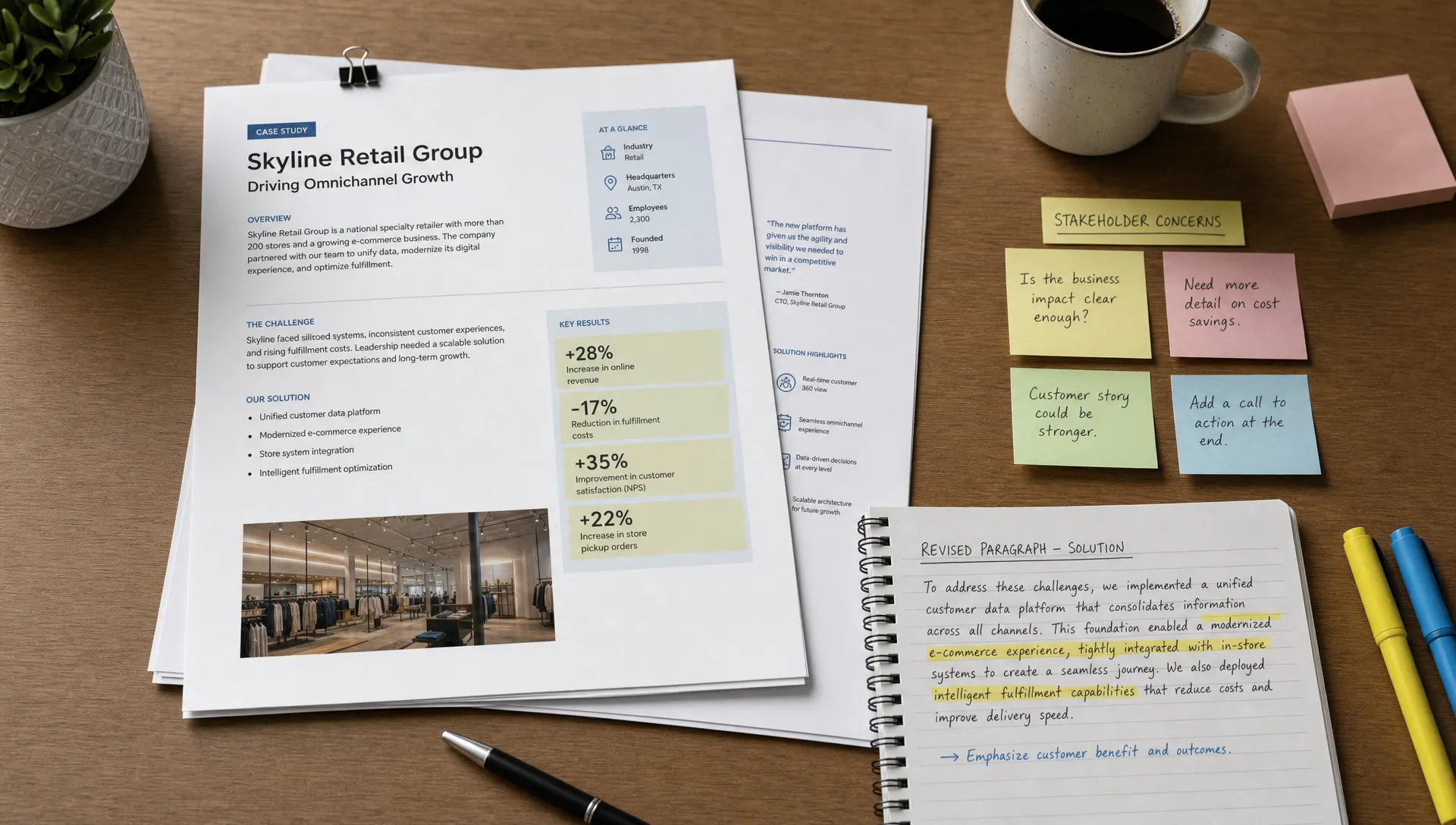
Add stakeholder friction
Natural case study writing includes people with different incentives. AI drafts often flatten those differences by saying the organization needed to improve efficiency, increase engagement, or adopt innovation. Those phrases are too general unless you explain who was affected and how.
For example, a recommendation that helps senior leadership reduce costs might make frontline employees’ work harder. A new software rollout might help managers track performance but frustrate customers if the transition is confusing. A pricing change might improve margins but weaken trust among long-term clients.
When rewriting, look for the people inside the case:
- Customers or users
- Employees or frontline staff
- Managers or executives
- Suppliers or partners
- Regulators or community groups
- Investors, donors, or board members
Then add one or two sentences that explain how the issue looked from their perspective. This makes the case feel less like a summary and more like an analysis of a real situation.
Cut inflated language without making the draft dull
AI writing often tries to sound authoritative by using heavy phrases. In case studies, that can make the analysis feel distant. The fix is not to oversimplify. The fix is to choose clearer verbs and remove padded phrasing.
The Purdue OWL Paramedic Method is a useful editing technique for cutting unnecessary words and making sentences more direct. For case study drafts, focus especially on weak verbs and abstract nouns.
| Inflated phrase | Cleaner alternative |
|---|---|
| It is important to note that | Cut it, or say the point directly |
| The organization was able to achieve | The organization achieved |
| This serves to illustrate | This shows |
| Due to the fact that | Because |
| A variety of different challenges | Several challenges |
| In order to improve | To improve |
A clearer sentence usually sounds more natural because it feels like someone is trying to communicate, not perform.
Keep source use honest and visible
A natural rewrite should not blur where information came from. If your case study uses class materials, interviews, company reports, academic articles, or public data, keep the source trail intact.
Do not rewrite direct quotes as if they are your own words. Do not change citation details to make a sentence sound smoother. Do not let a humanizer alter author names, page numbers, report titles, or reference formatting.
This matters for both plagiarism checkers and AI detection workflows. A plagiarism checker looks for overlap with existing sources, while an AI content detector estimates patterns in writing. Neither replaces careful citation. If your case study follows a specific style guide, keep formatting stable while you revise the prose.
Before and after: rewriting a bland AI case study paragraph
Here is a common AI-style paragraph:
The company faced many challenges in adapting to changing customer expectations. Its leadership team recognized the need for a more customer-centered approach and implemented several strategic initiatives. These efforts improved customer satisfaction and positioned the company for long-term success.
The paragraph is grammatically fine, but it could describe almost any case. It has no decision, no evidence, no friction, and no specific outcome.
A more natural rewrite might look like this:
The case suggests that the company’s problem was not a lack of customer data, but a failure to act on it quickly. Customer complaints had already pointed to slow response times, yet the leadership team kept prioritizing acquisition campaigns over service improvements. The shift toward a customer-centered approach became more convincing only after the company connected retention losses to the support backlog. That makes the service redesign a practical response, although the case leaves open whether the team had enough staff to maintain the new standard.
This version is stronger because it adds a real interpretation. It identifies the deeper problem, explains why the strategy changed, and includes a limitation instead of pretending the solution was perfect.
A practical editing workflow for AI case study drafts
Use this sequence when you need a fast but careful rewrite:
- Read the draft once without editing: Mark any sentence that sounds generic, unsupported, or too polished.
- Create a fact lock: List the names, numbers, dates, citations, and outcomes that cannot change.
- Find the decision point: Write one sentence that states the core problem or choice in the case.
- Rewrite topic sentences first: Make each paragraph start with a case-specific claim, not a broad lesson.
- Add evidence where claims feel vague: Use one concrete detail instead of two abstract sentences.
- Show tradeoffs: Add constraints, risks, stakeholder tension, or uncertainty.
- Cut inflated wording: Replace padded academic or business language with direct verbs.
- Read aloud: If a sentence sounds like a template, rewrite it the way you would explain it to a serious reader.
This workflow helps you humanize AI text without weakening the case logic or introducing errors.
What not to do when rewriting a case study
Some edits make an AI case study sound different but not better. Avoid these mistakes:
- Adding casual phrases that do not match the assignment or audience.
- Replacing precise terms with vague synonyms.
- Changing numbers or citations to improve sentence flow.
- Adding fake details to make the case sound realistic.
- Overusing first person if the case study requires formal analysis.
- Treating AI detection as the only goal instead of improving clarity and originality.
The goal should not be to hide a copied draft or bypass AI detection at the expense of accuracy. A stronger goal is to turn a rough AI-assisted draft into a clear, source-aware case analysis that reflects your own thinking.
Frequently Asked Questions
How do I make an AI-generated case study sound less generic? Replace broad claims with case-specific details. Add the decision point, name the constraint, show the evidence, and explain why the recommendation fits the situation.
Can I use a text humanizer on a case study draft? Yes, but use it as an editing aid, not a replacement for review. Always check that names, numbers, citations, quotes, and conclusions remain accurate after rewriting.
Should I rewrite data, quotes, or citations? No. Data, direct quotes, and citation details should stay stable. You can rewrite the surrounding explanation, but the source information should remain accurate and traceable.
Will rewriting help with Turnitin or AI detection? Rewriting can improve clarity, voice, and originality, but you should follow your school, publisher, or workplace policy on AI writing tools. Do not rely on detection scores as proof that the work is accurate or acceptable.
What is the fastest way to improve an AI case study draft? Start by rewriting the topic sentences. If each paragraph begins with a specific claim about the case, the rest of the draft becomes easier to revise naturally.
Final thought
A natural case study does not sound human because it is imperfect. It sounds human because it shows judgment. When you preserve the facts, identify the decision, explain the tradeoffs, and write in your own voice, the draft becomes more useful to the reader and more defensible as analysis.
If you want help reviewing AI-assisted writing more carefully, explore Detection Drama’s free AI writing tools and guides. Use them after you have locked your facts and clarified your argument, so the final case study sounds natural without losing accuracy.
Want to bypass Turnitin in 2026? Grab the free prompt pack.
Get the exact text-humanization prompts I use to drop an AI score by hand — copy, paste, submit. Free, straight to your inbox.
Send me the free prompts →