Want to bypass Turnitin in 2026? Grab the free prompt pack.
Get the exact text-humanization prompts I use to drop an AI score by hand — copy, paste, submit. Free, straight to your inbox.
Send me the free prompts →How Much Universities Spend on AI Detection Tools: 2026 Data and Analysis
Key Takeaways
- Turnitin operates in
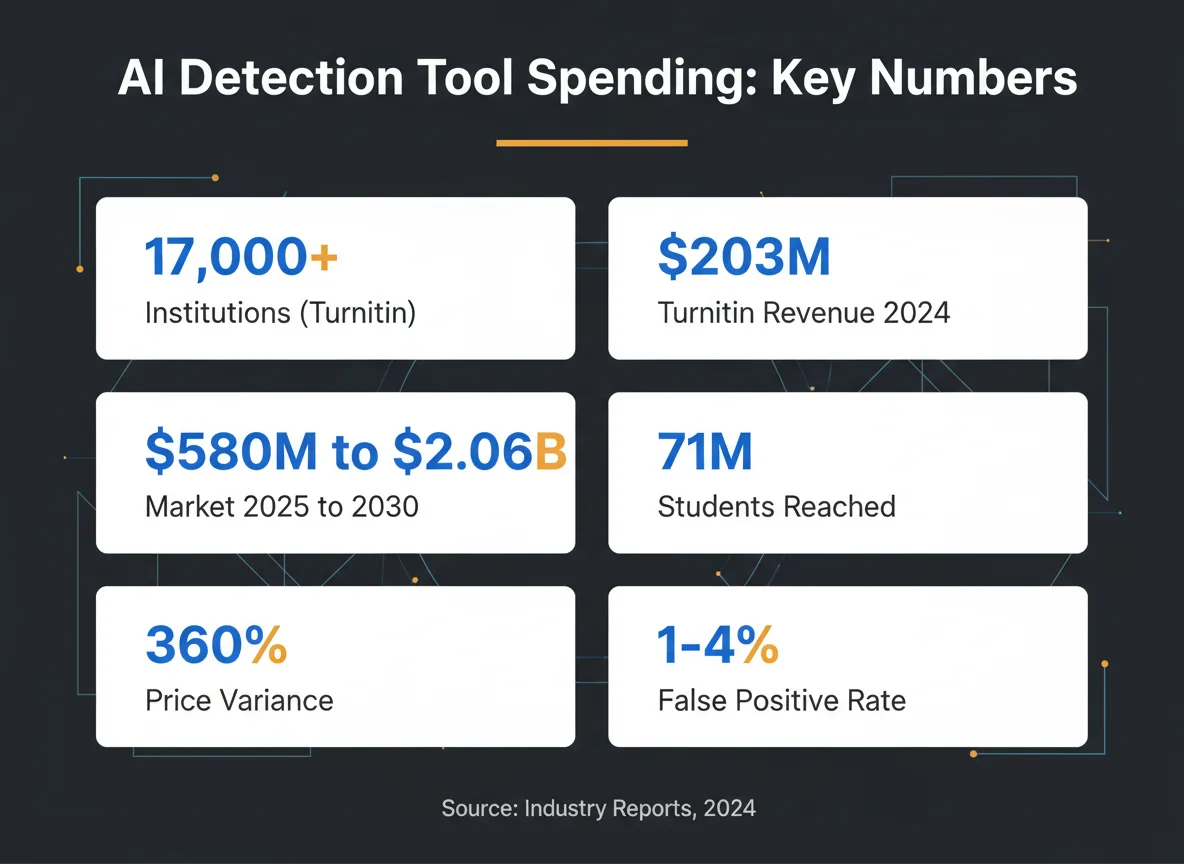
17,000+institutions and reaches71Mstudents globallySacra, 2025 - Turnitin 2024 revenue hit
$203M, up10%year over yearSacra financials - Per-student pricing varies from
$1.79to$6.50— a360%spreadGradPilot procurement records - The global AI detector market is forecast at
$580M → $2.06B(2025→2030) at a28.8% CAGRMarketsandMarkets, 2025 - Individual contracts range from
$2,768(San Joaquin Delta) to$1.98M(CUNY)Public procurement filings 12+elite universities have deactivated Turnitin’s AI detector over false positive riskInstitutional policy tracking- GPTZero crossed
$16MARR and3,500college deploymentsSacra, GPTZero disclosures
On This Page
The AI detection market in 2026
AI detection is no longer a line item on a procurement spreadsheet — it is a $580 million market in 2025 growing at an almost software-startup pace. MarketsandMarkets projects the category will quadruple to $2.06 billion by 2030, a 28.8% CAGR that reflects three simultaneous tailwinds: rising faculty adoption, spillover into enterprise hiring screens, and a wave of K-12 districts following the higher-ed playbook. Turnitin’s installed base of 17,000 institutions and 71 million students forms the backbone of that demand, but the category now includes GPTZero, Copyleaks, Originality.ai, Writer.com, Smodin, and Hive Moderation — each pursuing a slightly different slice.
Most industry conversation still treats AI detection as a single product. It isn’t. What universities actually buy is a bundle: plagiarism detection (the original Turnitin product, sold per student), an AI detection add-on (typically $0.41–$0.48 per student), sometimes a feedback or grading layer on top, and less visibly, a long-term contract commitment that makes switching painful. The procurement records we analyzed show that bundle is where the real money lives — and where the biggest pricing surprises hide.
What universities actually pay: real procurement contracts
GradPilot’s 2025 investigation obtained procurement records from more than 66 U.S. universities through state-level public records requests. The results expose a market that has never been priced transparently. A 7-month Turnitin AI detection upgrade at San Joaquin Delta College cost $2,768 — roughly what a Big Ten university pays per week. At the other end, the CUNY System’s Turnitin contract totals $1,985,050 across 2020–2025, while California State University signed a $1.1 million deal for 2025 alone. Even that understates the real Cal State footprint, which reaches $6M+ in cumulative spending since 2019.
The middle of the market is where the most replicable benchmarks live. A mid-sized public university — think Stephen F. Austin, Wright State, West Texas A&M, Ocean County College — typically spends between $30,000 and $230,000 per year depending on whether it layers AI detection, plagiarism detection, and a feedback suite. These numbers mirror what our research team found when we documented universities that banned AI detectors after evaluating the same vendors: the cost-per-flag math rarely penciled out once faculty time and appeals workload were included.
| Institution | Vendor | Contract Value | Period |
|---|---|---|---|
| CUNY System | Turnitin | $1,985,050 | 2020–2025 |
| California State University System | Turnitin | $1,100,000 | 2025 only |
| UC Berkeley | Turnitin | $1,200,000 | 10-year total |
| College of the Canyons | Turnitin | $500,000+ | 21-year total |
| Stephen F. Austin State | Turnitin Suite + Originality | $225,695 | 2024–2027 |
| Cal Poly San Luis Obispo | Turnitin (canceled) | $171,000 | 2020–2024 |
| City Colleges of Chicago | D2L + Copyleaks | $110,400 | 2025–2026 |
| Ohio State University | Turnitin | $105,000/yr | 2024 renewal |
| Wright State | Turnitin + AI detector | $42,000/yr | Annual |
| West Texas A&M | Turnitin | $41,200 | 2025 |
| Grand Rapids CC | Copyleaks | $35,020 | Annual |
| Ocean County College | Turnitin Feedback Studio + Originality | $30,245 | Annual |
| San Joaquin Delta College | Turnitin AI Detector upgrade | $2,768 | 7 months |
For students caught in the crossfire, the dollar figures matter because they shape institutional behavior. Schools paying six figures feel pressure to use the tool they bought, which influences how aggressively submissions get flagged. Our guide to Turnitin’s AI detection score threshold and our breakdown of what Turnitin’s AI highlighting actually means both speak to the downstream effect: a detection-heavy culture produces defensive students, and defensive students drive the anxiety statistics that universities pay $15M to manufacture.
The 360% per-student price spread
The most useful benchmark our research surfaced is per-student cost, because it strips out enrollment size and exposes pure negotiation effectiveness. CUNY negotiated to $1.79 per student. Cal State paid $2.59 in 2024, then $2.71 in 2025, and agreed to $3.12 for AI detection after an initial ask of $3.05–$3.19. UC Berkeley lands at $2.11. UC Irvine Continuing Education sits at $6.50 — more than triple what a similar-sized CSU campus pays.
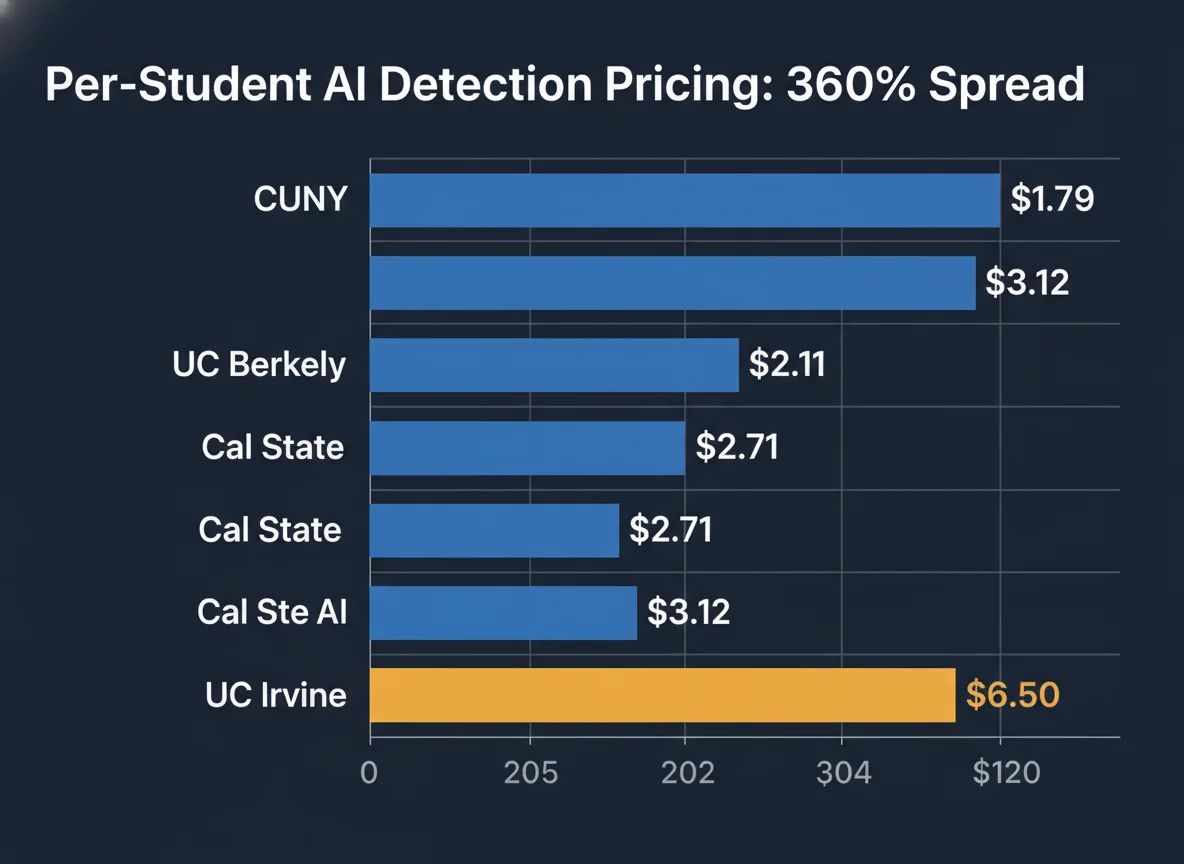
The AI detection add-on itself — $0.41 to $0.48 per student — becomes the hinge. Because it is priced separately from plagiarism detection, procurement teams with technical sophistication can negotiate it to near zero during renewal windows, while schools that accept the default price essentially double-pay for a feature many faculty don’t use. Schools that review the supervised-writing flagging behavior, the underlying detection methodology, and whether teachers see the real Turnitin AI percentage before renewal typically pay less, because their procurement teams come in prepared to question the accuracy case.
Consumer pricing: what the public pays
For individual users — students running their own drafts, freelance writers, SEO teams — the retail prices look nothing like institutional rates. Copyleaks starts at $8.33/month for 1,200 credits (one credit covers 250 words), with a combined AI + plagiarism plan at $14.17/month. Originality.ai offers Lite at $9.95/month (50K words) and Pro at $14.95/month (100K words), with pay-as-you-go roughly $0.01 per 100 words. GPTZero’s individual plan is $10/month on annual billing or $15/month on monthly, with a 10,000-word free tier.
| Tool | Starting price | Key detail |
|---|---|---|
| Turnitin (institutional) | $1.79–$6.50/student/yr | AI detection add-on $0.41–$0.48 |
| Copyleaks | $8.33/mo (AI only) | 1,200 credits; 250 words each |
| GPTZero | $10/mo (annual) | 10K words/mo free tier |
| Originality.ai | $9.95/mo (Lite) | ~$0.01 per 100 words PAYG |
| Scribbr | From ~$9.95/scan | Direct-to-student only |
Students frequently compare these options when a flag lands — our walkthrough on the best AI detector alternatives to Turnitin for students and our piece on why Turnitin flags AI when other detectors don’t both address the cross-tool gap students experience after they’ve already been accused.
Market leaders and revenue snapshots
Turnitin’s commercial dominance is built on integration: it lives inside Canvas, Blackboard, Moodle, and D2L, meaning switching costs aren’t just financial — they’re LMS-deep. That lock-in produced $203M in 2024 revenue (up 10% from $185M in 2023) and a $199.8M run-rate projection for 2025. Average revenue per institution is approximately $11,900 per year, though the distribution is heavily skewed toward large systems.
Since Turnitin launched its AI detector in April 2023, the tool has scanned more than 200 million papers. Public data from that scan volume shows 11% of submissions contained at least 20% AI-flagged content, while 3% contained 80% or more. That 3% figure is roughly the population of students being flagged at the high-confidence end — 6 million students at Turnitin’s reach, though detection-level flags don’t map cleanly to discipline outcomes. Faculty adoption has followed: 68% of teachers now run submissions through an AI detector, and discipline rates for suspected AI plagiarism jumped from 48% to 64% in just two academic years. Our analysis of AI cheating consequences statistics breaks down what happens after those flags, our coverage of AI detection lawsuits explains where the legal exposure is concentrating, and our look at the broader AI humanizer industry shows how the adjacent market has scaled in response.
Who’s cutting detection budgets — and why
The spending story has a counter-narrative. As the AI detector market has grown, a visible slice of elite research universities has begun deactivating the feature most responsible for pushing academic policy into controversy. At a Vanderbilt-scale institution processing roughly 75,000 papers per year, even Turnitin’s acknowledged 1% false positive floor translates into approximately 750 statistically expected false accusations per year. At a 4% rate — which independent studies say is closer to the real-world floor — that figure rises to 3,000. Every one of those flags generates an appeal, a hearing, or a suspension that lands first on non-native English speakers.
The ESL bias in AI detection is the research finding most often cited when universities pull the plug. Our coverage of 61% false positives in real student writing and the ongoing expert warnings on AI detector harm both trace the same pattern: the math of institutional scale converts an error rate disclosure into thousands of wrongful disciplinary cases per year, and universities eventually notice. Cal Poly’s $171,000 write-off is the kind of visible budget signal that procurement peers pay attention to.
2026 spending forecast
Projecting forward requires holding two opposing trends at once. On one side: market-level CAGR of 28.8% implies another 25–30% in gross spending in 2026, with enterprise hiring and media verification picking up slack as K-12 districts ramp. On the other: elite universities are the loudest budget voices in the room, and their deactivations will not show up as reduced vendor revenue (contracts run multi-year) but as reduced renewals starting in 2027. The net effect for 2026 is that institutional detection spending continues to climb in dollar terms while the percent of U.S. R1 universities using the detector plateaus or declines slightly.
For students and administrators planning around this market, the actionable signal is procurement timing. Renewal windows in 2026 will be the most negotiation-friendly period since 2019, because vendors have read the same deactivation headlines. Universities that enter renewal with hard data on false positive rates, appeal volumes, and per-student comparables — the kind of data in this analysis — will extract materially better terms than universities that roll over the prior contract.
Calculator: estimate your institution’s likely spend
AI Detection Budget Estimator
Methodology & sources
How this data was compiled
Contract values were pulled from publicly available U.S. state and public-institution procurement records, primarily via GradPilot’s investigation of 66 universities (2025) and verified against California state procurement systems. Vendor revenue figures come from Sacra’s private-company tracker and Turnitin’s own disclosures. Market size and CAGR come from MarketsandMarkets’ AI Detector Market report (2025). Consumer pricing was captured from vendor pricing pages (Copyleaks, Originality.ai, GPTZero) as of April 2026. Any figure labeled “derived” is calculated from two cited inputs; no statistic in this article was estimated or projected without an underlying source.
Frequently asked questions
How much do universities typically spend on AI detection tools each year?
U.S. university spending on AI detection ranges from $2,768 at small community colleges (San Joaquin Delta) up to $110,400 at mid-sized institutions (City Colleges of Chicago), with large systems like CUNY exceeding $1.98M across five years. The average Turnitin customer pays roughly $11,900 per year in institutional licensing, though elite research universities frequently exceed $100K annually before AI detection add-ons.
Why is there a 360% price variation between similar universities?
Per-student rates range from $1.79 at CUNY to $6.50 at UC Irvine Continuing Education. The spread reflects negotiation leverage, contract bundling (AI detection is sold as an add-on at $0.41–$0.48 per student), enrollment size, and whether a university buys plagiarism detection, AI detection, or the full Turnitin suite.
Which AI detection tool dominates the market?
Turnitin leads with 17,000+ institutional customers and 71 million students reached, generating $203M in 2024 revenue. GPTZero is the fastest-growing challenger with 3,500+ college deployments and $16M ARR. The broader AI detector market is projected to grow from $580M in 2025 to $2.06B by 2030 (MarketsandMarkets).
How large is the global AI detection market?
MarketsandMarkets values the 2025 AI detector market at $580M and forecasts $2.06B by 2030 — a 28.8% CAGR driven by academic, enterprise, and media verification demand. Turnitin, GPTZero, Copyleaks, Originality.ai, Writer.com, Smodin, and Hive Moderation are the named market leaders.
Are any universities cutting AI detection budgets?
Yes. At least 12 elite institutions — including UCLA, UC San Diego, Cal State LA, MIT, Northwestern, and Vanderbilt — have disabled Turnitin’s AI detection module, citing 1–4% false positive rates that would generate roughly 750 wrongful accusations per 75,000 papers reviewed. Cal Poly San Luis Obispo canceled its $171,000 contract in 2024.
What will universities spend on AI detection in 2026?
Based on GradPilot’s 66-university investigation and the 28.8% CAGR in the AI detector market, total U.S. higher-education spending on AI detection is likely to exceed $40M in 2026, concentrated among Turnitin’s largest customers. Expect more selective adoption as faculties weigh accuracy disclosures against discipline rates that climbed from 48% to 64% in two years.
Sources & references
- GradPilot — University AI Detection Procurement Investigation (2025): 66 universities, $15M+ California total.
- GradPilot — Colleges AI Detection Tools Spending (2025): per-contract breakdowns.
- Sacra — Turnitin revenue tracker (2025): $203M 2024 revenue, 17,000 institutions, 71M students.
- MarketsandMarkets — AI Detector Market Research Insight (2025): $0.58B → $2.06B forecast, 28.8% CAGR.
- Copyleaks official pricing page (2026).
- Originality.ai official pricing page (2026).
- GPTZero pricing and ARR disclosures (2025).
- Academic integrity reporting — 68% faculty usage; 48% → 64% discipline rates (2023–2025).
- Wired — Turnitin 200M-paper dataset: 11% ≥20% AI; 3% ≥80% AI (2024).
- Public procurement records: CUNY, Cal State, UC Berkeley, Ohio State, Stephen F. Austin, Wright State, Ocean County, Cal Poly, City Colleges of Chicago, San Joaquin Delta, Grand Rapids CC, West Texas A&M.
