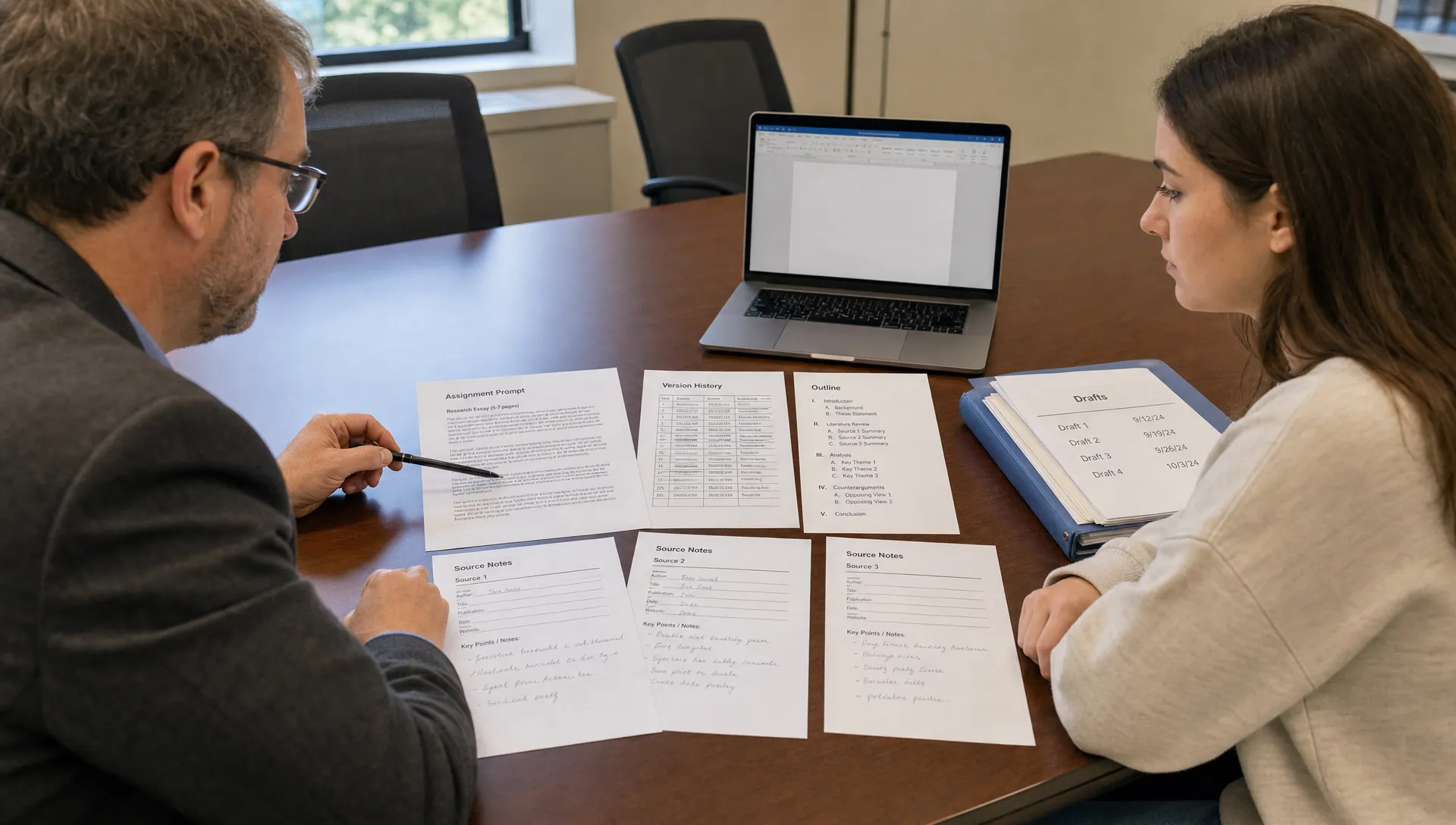
An AI detector result can feel final until it collides with a professor's judgment. Maybe your professor says the paper reads like AI even though your checker says human. Maybe an LMS report flags a paragraph while your instructor says the rest looks fine. Either way, the next step is not to hunt for a more flattering score. The next step is to turn the disagreement into a fair evidence review.
AI detection disputes are stressful because they mix technology, authority, grades, and academic integrity. But a disagreement between a detector and a professor is not automatically proof that you did something wrong. It usually means the situation needs context: your drafts, sources, version history, assignment requirements, course AI policy, and the exact reason your work was questioned.
Want to bypass Turnitin in 2026? Grab the free prompt pack.
Get the exact text-humanization prompts I use to drop an AI score by hand — copy, paste, submit. Free, straight to your inbox.
Send me the free prompts →This guide walks through what to do when an AI detector disagrees with your professor, how to respond without making things worse, and how to protect your academic record with process-based evidence.
Why AI detectors and professors disagree
AI detectors and professors are not measuring the same thing.
Most AI content detectors estimate whether text resembles patterns often found in AI-generated content. Depending on the tool, that may involve predictability, sentence structure, word choice, repetition, and statistical similarity to known machine-generated writing. A professor, on the other hand, may be reacting to classroom context: your prior writing, participation, topic knowledge, citation behavior, or whether your work suddenly looks different from earlier assignments.
Both can be wrong. Both can also notice something worth discussing. The problem begins when either one is treated as absolute proof.
OpenAI discontinued its own public AI classifier in 2023 because of low accuracy, a useful reminder that even the companies building AI systems have acknowledged detection limits. Researchers have also found that some detectors can misclassify polished writing by non-native English writers, as discussed by Stanford HAI. That does not mean every AI flag is false. It means detector results need context before they affect a grade or misconduct record.
Some universities have reached similar conclusions in practice. Vanderbilt's Center for Teaching, for example, explained why it disabled Turnitin's AI writing detection indicator in 2023, citing concerns about reliability and interpretation. The safest way to think about any AI detector report is this: it is a signal, not a verdict. Detection Drama covers that distinction in more depth in its guide on whether professors can use AI detectors as proof.
First, identify the type of disagreement
Before you respond, clarify what is actually being disputed. A professor disagreeing with an AI detector can mean several different things.
| Situation | What it usually means | Best next move |
|---|---|---|
| Your detector says human, but your professor suspects AI | The professor may be relying on style, prior work, or course context rather than the tool | Ask what specific evidence or passages raised concern, then provide drafting evidence |
| Turnitin or another school tool flags AI, but another detector says human | Tools use different thresholds and models, so scores often conflict | Preserve both reports, but focus on version history and writing process |
| Your professor says the issue is plagiarism, not AI | A plagiarism checker measures source overlap, not AI authorship | Separate the source-citation issue from the AI detection issue |
| You used AI in a permitted way, but the professor thinks it was unauthorized | The disagreement may be about disclosure or policy scope | Explain exactly what tool you used, when, and for what purpose |
| Your professor says the paper does not sound like you | This is a style and authorship concern, not necessarily a detector issue | Offer drafts, notes, an oral walkthrough, or a writing-process explanation |
If the conflict involves one detector saying human while Turnitin says AI, the response strategy is slightly different because Turnitin is often embedded in the course workflow. Detection Drama has a dedicated guide on what to do when an AI detector says human but Turnitin says AI.
Also remember that an AI detector is not the same as a plagiarism checker. A plagiarism report asks whether text overlaps with existing sources. An AI report estimates whether writing looks machine-generated. If both issues appear in the same conversation, handle them separately. This distinction matters enough that students should understand how an AI detector differs from a plagiarism checker before responding.
What to do in the first 24 hours
The first day after an accusation or warning matters. Do not panic-edit the document. Do not delete files. Do not run the paper through ten tools and rewrite it repeatedly to bypass AI detection after the fact. That can make the timeline harder to explain.
Instead, preserve the record as it existed when you submitted the assignment.
- Save the submitted file, the assignment prompt, the rubric, and the LMS submission receipt.
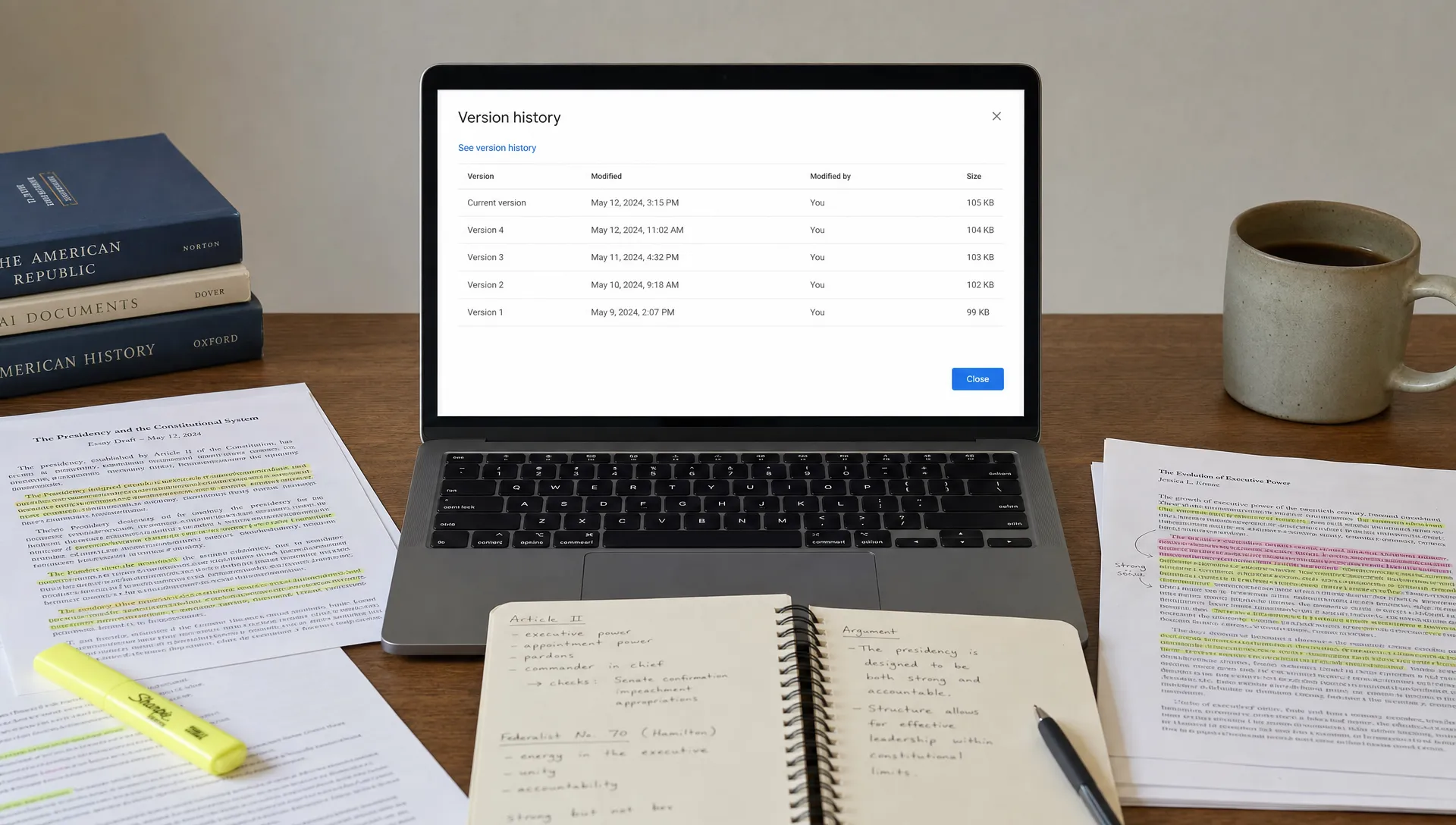
- Export or screenshot version history from Google Docs, Microsoft Word, Overleaf, Pages, or any other writing platform you used.
- Gather outlines, notes, source annotations, library searches, PDFs, screenshots of research tabs, and handwritten planning materials.
- Save any AI detector reports you already ran, including the tool name, date, score, and whether the text was pasted exactly as submitted.
- Write a short timeline of how you completed the assignment, from topic selection to final revision.
- Preserve any emails, class notes, or policy statements explaining what AI use was allowed or prohibited.
This is not about overwhelming your professor with a giant folder. It is about showing that your paper has a real writing trail.
If you used AI in any allowed way, such as brainstorming, grammar help, outlining, translation support, or citation formatting, write down exactly what happened. Be precise. There is a big difference between asking a tool to explain a concept, asking it to polish a paragraph, and asking it to generate a complete essay. Course policies often treat those uses differently.
Build an evidence packet, not a detector duel
A private AI detector result that says human can help show that the situation is not obvious. But it should not be your only defense. If your entire response is my detector says I am fine, your professor can respond that another detector, their judgment, or the course policy says otherwise.
A stronger response is a small, organized evidence packet.
| Evidence | Why it matters | How to present it |
|---|---|---|
| Version history | Shows drafting over time, revisions, and development | Export timestamps or screenshots from the document history |
| Early outline or thesis notes | Shows planning before the final prose existed | Include dated notes, bullets, or brainstorming pages |
| Source trail | Shows how your argument came from research | Provide annotated PDFs, database searches, or citation notes |
| Prior writing samples | Helps compare your normal style | Use similar course assignments, not unrelated casual writing |
| Assignment-specific decisions | Shows you understood the prompt | Explain why you chose your thesis, structure, and evidence |
| AI-use disclosure, if relevant | Clarifies whether any tool use was permitted | Describe the tool, purpose, and boundaries honestly |
If you do not have perfect documentation, do not invent it. Partial evidence is still useful. A timestamped outline plus annotated sources may be enough to show a real process. A professor may also be willing to ask you to explain your argument orally, revise a section under supervision, or answer questions about your sources.
How to email your professor
Your tone matters. A defensive or accusatory message can make the conversation harder, even if you are right. The goal is to request clarification, show cooperation, and move the discussion from suspicion to evidence.
Here is a simple template you can adapt:
Dear Professor [Name], I understand there are concerns about my submission, and I would like to respond carefully. I can provide my outline, notes, sources, version history, and a timeline showing how I drafted the paper. I also ran an AI detector that gave a different result, but I understand detector scores are not conclusive. Could we meet to review the specific concern and the policy standard being applied?
That message does three useful things. It does not attack the professor. It does not claim the detector proves innocence. It asks for the exact basis of the concern.
During the meeting, focus on specific questions.
| Question to ask | Why it helps |
|---|---|
| Which passages raised concern? | Moves the discussion from general suspicion to reviewable text |
| Is the concern based on a detector, writing style, sources, or another issue? | Separates AI detection from plagiarism or quality concerns |
| What course policy or academic integrity rule applies? | Clarifies whether the issue is tool use, disclosure, or authorship |
| Can my drafting materials be reviewed? | Gives the professor a fair way to consider evidence |
| Is this an informal concern or a formal allegation? | Helps you understand deadlines, rights, and next steps |
If your professor says the writing does not sound like you, do not dismiss that as meaningless. Instead, explain what changed. Maybe you used the writing center. Maybe you spent more time revising. Maybe the assignment was more formal than previous work. Maybe you used templates from class examples. Concrete explanations are more persuasive than simply saying the detector is wrong.
What if the professor still disagrees?
If the professor is not persuaded and the situation may affect your grade or academic integrity record, move carefully into the formal process. Check your syllabus, student handbook, academic integrity policy, and appeal deadlines. Many schools require written notice, a chance to respond, and a clear statement of the evidence.
Ask for the concern in writing. Ask what evidence is being used. Ask whether detector results are part of the record and whether you can submit your own evidence packet. If your campus has an academic integrity office, ombuds office, advisor, student advocate, graduate program director, or writing center, consider contacting them early.
Do not fabricate drafts, backdate files, or ask someone else to create evidence for you. That can turn a disputable detector issue into a much more serious integrity issue. If you did use AI beyond what the course allowed, the best path is usually honesty plus context: what you used, why you misunderstood the rule, what part of the work is yours, and what corrective step you are willing to take.
If English is not your first language, or if you have a disability, accommodation, or writing support history that may affect style, consider getting advice from the appropriate campus office. You do not need to disclose private information to a professor without support, but you may want guidance if the accusation seems connected to language patterns or accessibility tools.
How to prevent this next time
The best protection is not a better AI score. It is a better paper trail.
For future assignments, write in a platform with version history whenever possible. Start the document early, even if the first version is rough. Keep your outline, source notes, and major revisions in the same file or in dated companion files. Avoid pasting a finished essay into a blank document at the end, because that erases the visible drafting process.
If your school allows some AI writing tools, document their use as you go. Save prompts if relevant. Note whether a tool helped with brainstorming, grammar, translation, summarization, or wording. If the policy is unclear, ask before submitting. A short email asking whether a grammar tool or text humanizer is allowed is far easier than defending it after a detector flag.
Also keep your writing human in the ordinary sense: specific, source-grounded, and connected to your actual thinking. Formulaic academic prose can look suspicious when it is generic. The more your paper includes class concepts, original reasoning, detailed citations, and decisions you can explain, the easier it is to defend.
Frequently Asked Questions
Can a professor ignore my AI detector result? Yes. A private AI detector result can be useful context, but it does not force a professor to accept your paper as human-written. The stronger move is to combine that result with drafts, notes, sources, and a clear writing timeline.
Does an AI detector score prove I used AI? No. AI detection scores are estimates, not direct proof of authorship. They can support a concern, but they should be reviewed alongside other evidence, especially if a grade penalty or misconduct allegation is involved.
Should I run my paper through multiple AI detectors? You can, but do not turn the dispute into a scoreboard. Different tools often disagree because they use different models and thresholds. Save any reports you already ran, but prioritize process evidence.
What if I used ChatGPT only for brainstorming? Check the course policy. If brainstorming was allowed, explain when and how you used it, and show that the submitted wording and analysis were your own. If disclosure was required and you forgot, address that honestly.
What if my professor says the paper sounds too polished? Ask which passages or features raised concern. Then show your revision process, writing center feedback, prior formal writing, or notes explaining how you developed the final version. Polished writing is not misconduct by itself.
Can AI detection be mixed up with plagiarism detection? Yes, especially in tense conversations. Ask whether the issue is AI authorship, source overlap, citation problems, or all of the above. Each requires a different response.
Bottom line
When an AI detector disagrees with your professor, do not rely on another detector to save you. Treat the disagreement as a prompt to document your process, clarify the policy, and ask for a fair review.
If you want to understand how AI content detectors interpret writing before a misunderstanding starts, explore the free guides and tools at Detection Drama. Use any AI writing tools within your school's rules, and remember that the most persuasive defense is still simple: a real draft history, honest explanations, and work you can confidently explain.
