
If a ChatGPT essay sounds strange, the problem usually is not one sentence. It is the pattern: polished but vague claims, stiff transitions, inflated vocabulary, and paragraphs that feel like they were assembled from a template. Running that draft through a random paraphraser can make it worse, replacing clean AI phrasing with awkward wording that no student, editor, or professor would naturally use.
Want to bypass Turnitin in 2026? Grab the free prompt pack.
Get the exact text-humanization prompts I use to drop an AI score by hand — copy, paste, submit. Free, straight to your inbox.
Send me the free prompts →The better way to humanize ChatGPT essays is to edit for authorship, not disguise. That means adding your argument, your sources, your class context, and your natural sentence rhythm while protecting facts and citations. It also means understanding that AI detection tools are probabilistic. OpenAI retired its own AI text classifier because of low accuracy, and research from Stanford HAI found that detectors can be biased against non-native English writers. So the goal should not be “trick the machine at all costs.” The goal is to make the essay read like a real piece of writing you can explain and defend.
Below is a practical workflow for making ChatGPT-assisted essays sound natural without weird phrasing, fact drift, or obvious AI filler.
What Makes a ChatGPT Essay Sound Weird?
ChatGPT often produces text that is grammatically correct but oddly frictionless. It explains everything in a balanced, generic way, even when the essay needs a sharper claim. It also tends to overuse stock academic phrases like “it is important to note,” “in today’s society,” “this highlights the significance of,” and “a multifaceted approach.”
A human essay usually has more texture. It contains uneven but purposeful sentence lengths, specific references to the prompt, small judgment calls, and moments where the writer takes a position. Human writing can be polished, but it rarely feels like every paragraph came from the same mold.
Here are common signs that a ChatGPT essay needs human editing:
- The introduction starts too broadly before reaching the actual topic.
- Paragraphs follow the same rhythm: claim, explanation, transition, conclusion.
- The essay uses impressive words where simple ones would be clearer.
- Evidence is summarized without close analysis.
- The thesis is technically correct but too safe or obvious.
- Transitions sound formal but do not show a real logical connection.
- The conclusion repeats the introduction instead of leaving a final insight.
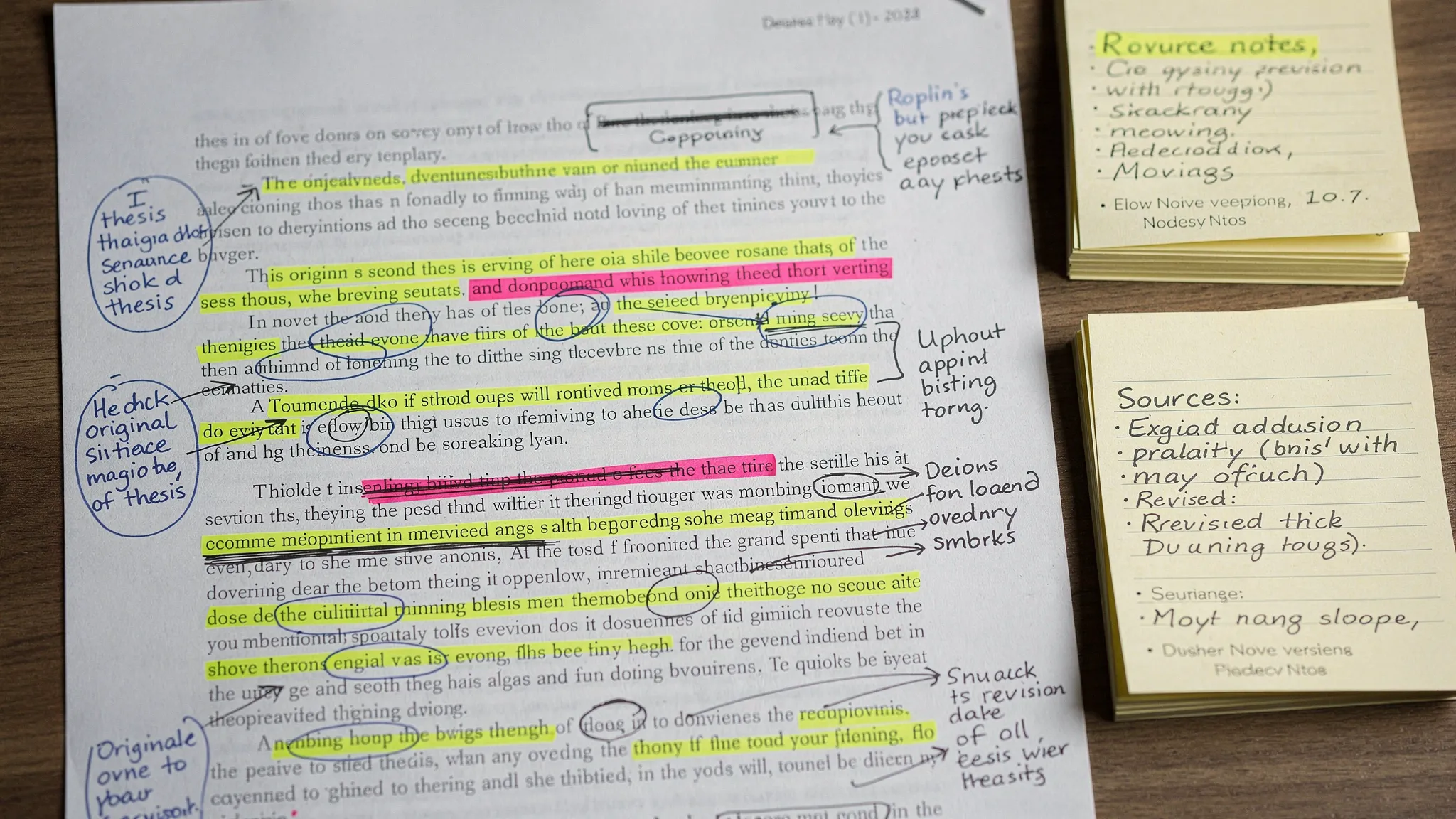
The Best Workflow: Rebuild Before You Rephrase
The biggest mistake is trying to humanize every sentence immediately. If the essay’s structure is generic, polishing the wording will only create a more elaborate generic essay.
Use this sequence instead:
| Stage | What to do | Why it works |
|---|---|---|
| Audit | Highlight vague claims, generic transitions, unsupported statements, and phrases you would not say | Finds the actual AI patterns before rewriting |
| Rebuild | Add your thesis, source notes, class concepts, and assignment-specific details | Makes the essay grounded in your work |
| Voice edit | Rewrite sentences in plain, natural language with varied rhythm | Removes robotic phrasing without random synonym swaps |
| Verify | Check citations, facts, formatting, and version history | Prevents humanization from damaging credibility |
If you are writing for a course, also check the AI policy before submitting. Some instructors allow brainstorming but not AI-drafted prose. Others require disclosure. If you need a safer academic workflow, Detection Drama’s guide to a safe AI writing workflow for college explains how to preserve drafts, proof, and policy compliance.
1. Delete the Generic ChatGPT Wrapper
Many AI essays begin with a broad statement that sounds polished but says almost nothing. These openings are easy to spot because they could apply to hundreds of topics.
| AI-style phrase | Better move | Example revision |
|---|---|---|
| “In today’s rapidly evolving world…” | Start with the specific problem | “Campus AI policies have changed faster than most students can interpret them.” |
| “Throughout history, X has played a significant role…” | Name the period, case, or conflict | “In the postwar chapters of the novel, memory becomes less a record than a survival strategy.” |
| “This essay will explore…” | State the argument directly | “The policy fails because it treats detection scores as evidence rather than as prompts for review.” |
| “It is important to note that…” | Cut the phrase or make the point sharper | “The key problem is not AI use itself, but undocumented AI use.” |
A strong essay usually does not need a ceremonial opening. It needs a clear reason for existing. Ask: What is the specific debate, problem, text, case, or question this essay answers?
2. Add Details Only You Could Have Chosen
ChatGPT writes safely because it does not know your class discussion, your professor’s emphasis, your draft process, or which source passage you found most convincing. Humanizing an essay means adding those details.
For academic essays, useful specificity includes:
- A concept from lecture or seminar discussion.
- A page number, chapter, scene, dataset, case study, or primary source detail.
- A sentence explaining why one source is more persuasive than another.
- A limitation in your argument.
- A connection to the exact wording of the assignment prompt.
For example, this sentence is polished but generic:
The author uses symbolism to show the complexity of identity and belonging.
A more human version makes a real choice:
The repeated references to locked doors make belonging feel conditional, as if the character is allowed into the household only when she performs the role others expect from her.
The second version is not just “less AI.” It is more analytical. It points to a pattern, explains its effect, and gives the reader something concrete to evaluate.
3. Rewrite the Argument, Not Just the Words
Weird phrasing often comes from trying to disguise a weak paragraph. If the paragraph does not have a clear job, the rewrite becomes word salad.
Before changing vocabulary, identify the paragraph’s function. Is it defining a concept, interpreting evidence, comparing sources, addressing a counterargument, or explaining consequences? Once you know the job, rewrite toward that job.
A simple paragraph test works well:
| Question | If the answer is weak, revise this |
|---|---|
| What is this paragraph claiming? | Topic sentence |
| What evidence proves or complicates that claim? | Source integration |
| What does the evidence mean? | Analysis |
| Why does this matter for the thesis? | Final sentence |
This is where many AI-generated essays fail. They summarize evidence but do not analyze it. A professor is less likely to be convinced by “this demonstrates the importance of communication” than by a specific explanation of how one scene, statistic, or quote changes the argument.
4. Use Natural Sentence Rhythm, Not Random Variation
Some humanizer tools try to evade AI patterns by making sentences choppy, casual, or unnecessarily tangled. That creates the “weird phrasing” readers notice immediately.
Good sentence variation follows the logic of the idea. Use shorter sentences for emphasis. Use longer sentences when you need to connect cause, contrast, or evidence. Do not vary length just to vary length.
Consider this AI-style sentence:
The implementation of AI detection systems in universities has created significant concerns among students because these systems may not always produce accurate results and can lead to misunderstandings about academic integrity.
A natural revision might be:
AI detection tools have made many students anxious. The issue is not only whether the tools are accurate, but whether a score is treated as proof before the student’s drafts, notes, and process are reviewed.
The revision is not full of fancy synonyms. It breaks the idea into a rhythm a human reader can follow.
5. Stop Synonym Swapping
Most awkward humanized essays come from synonym swapping. A tool replaces “shows” with “elucidates,” “uses” with “utilizes,” or “problem” with “predicament,” even when the simpler word is better.
Plain English is usually more human than inflated academic language.
| Awkward phrasing | Natural phrasing |
|---|---|
| “The author elucidates the societal ramifications…” | “The author shows the social consequences…” |
| “This predicament is multifaceted in nature…” | “This problem has several causes…” |
| “The evidence facilitates an understanding of…” | “The evidence helps explain…” |
| “The character’s behavior is indicative of…” | “The character’s behavior suggests…” |
A good rule: if you would feel strange reading the sentence aloud to your instructor, rewrite it.
6. Make Transitions Logical Instead of Fancy
ChatGPT often uses transitions that sound smooth but do not reveal the relationship between ideas. “Furthermore” and “Moreover” are not wrong, but overusing them makes an essay feel machine-generated.
Better transitions show what the next sentence does:
| Relationship | Natural transition examples |
|---|---|
| Contrast | “The problem with this reading is…” “That explanation works until…” |
| Cause | “Because of this…” “This matters because…” |
| Evidence | “The clearest example appears when…” “This pattern is visible in…” |
| Limitation | “Still, this does not mean…” “The argument becomes weaker when…” |
| Consequence | “As a result…” “This shifts the focus from…” |
Do not add transitions just to sound academic. Add them when the reader needs help following your reasoning.
7. Protect Citations, Quotes, Names, and Numbers
Humanization should never change the facts. This is especially important for essays with citations, statistics, legal cases, scientific terms, or direct quotations. A rewrite that lowers an AI score but changes a date, quote, author name, or DOI creates a bigger problem than the one it solves.
Before editing, mark anything that must remain unchanged:
| Element to protect | Example | What can go wrong |
|---|---|---|
| Direct quotes | “…” | Wording changes, making the quote inaccurate |
| Citations | (Smith, 2024) | Author or year gets changed or misplaced |
| Technical terms | “perplexity,” “neoliberalism,” “mitosis” | Tool replaces terms with incorrect synonyms |
| Numbers | 35%, 2026, 1,200 respondents | Digits drift or units disappear |
| Names | Turnitin, Copyleaks, Stanford HAI | Entities get swapped or generalized |
For a deeper workflow, read Detection Drama’s guide on how AI humanizers can ruin facts. The safest approach is to rewrite around protected facts, not through them.
8. Use ChatGPT as an Editor, Not a Ghostwriter
If your course or workplace policy allows AI assistance, ChatGPT can help you find awkwardness without writing the final essay for you. The key is to ask for diagnosis, questions, and options rather than a finished replacement.
Try prompts like these:
- “Identify phrases in this paragraph that sound generic or overly formal. Do not rewrite the paragraph yet.”
- “Ask me five questions that would help make this essay more specific to my argument and sources.”
- “Point out any claims that need evidence or closer analysis.”
- “Suggest simpler alternatives for awkward phrases, but preserve all citations, quotes, names, and numbers.”
- “Tell me where the paragraph sounds repetitive or formulaic.”
This keeps you in control. You decide which edits match your voice, your evidence, and your assignment.
9. Read It Like a Professor Would
A human read-through catches problems detectors cannot. Before submitting, read the essay as if you were grading it. Look for places where the writing sounds polished but thin.
Ask yourself:
- Can I explain this thesis without looking at the essay?
- Does each body paragraph make a distinct point?
- Are my sources analyzed, not just mentioned?
- Did I include the assignment’s required texts, terms, or methods?
- Are there any sentences that sound like a thesaurus was used too aggressively?
- Does the conclusion add a final insight rather than simply repeating the thesis?
If you cannot explain a paragraph out loud, it probably needs more than a wording change. It needs clearer thinking.
10. Keep a Version History and Draft Trail
Humanized writing should still be defensible as your work. If you are using ChatGPT for brainstorming, outlining, or editing, preserve evidence of your process. That includes notes, source annotations, outlines, rough drafts, and version history in Google Docs or Word.
This matters because AI detectors, including tools used by schools, do not prove authorship by themselves. Turnitin describes its AI writing feature as a system that produces indicators for instructor review, not as a complete substitute for human judgment. If a question ever comes up, your drafts and notes are more persuasive than saying “a detector was wrong.”
For academic risk reduction, see Detection Drama’s guide on lowering a Turnitin AI score without humanizer tricks. The central idea is simple: authentic process evidence beats last-minute panic editing.
A Before-and-After Example
Here is a typical ChatGPT-style paragraph:
Social media has had a significant impact on political activism in modern society. It allows people to communicate quickly and spread awareness about important issues. However, it also creates challenges because misinformation can spread easily. Therefore, social media is both beneficial and harmful for political movements.
The paragraph is not terrible, but it is generic. It has no case, no stance, and no analytical edge. A humanized version might look like this:
Social media does not simply help political movements spread faster. It changes what participation looks like. A repost can bring attention to a protest within minutes, but it can also make activism feel complete before anyone joins an organization, attends a meeting, or takes a material risk. That tension is why online activism should be judged not only by visibility, but by whether visibility turns into sustained pressure.
Notice what changed. The revision does not rely on strange synonyms. It adds a sharper claim, names a tension, and gives the paragraph a direction. That is the difference between “humanized” and “paraphrased.”
Manual Editing vs. Humanizer Tools
A text humanizer can be useful for spotting stiff wording or creating a first-pass rewrite, but it should not be the final authority. The more important the essay, the more you need manual review.
| Option | Best for | Risk |
|---|---|---|
| Manual editing | Voice, argument, source analysis, citations | Takes more time |
| AI humanizer tool | First-pass phrasing cleanup | May create awkward wording or fact drift |
| AI detector pre-check | Finding sections that may read as formulaic | Scores can be inconsistent or misleading |
| Version history | Showing authorship process | Weak if all writing was pasted at once |
Detection Drama offers free guides, tool access, and AI authenticity analysis for readers who want to inspect their text before finalizing it. Use those checks as feedback, not as a replacement for your own revision. If a tool changes something you cannot explain, undo it.
Common Mistakes That Make ChatGPT Essays Sound Worse
The fastest way to create weird phrasing is to overcorrect. Many students and writers take a clean but generic AI draft and run it through multiple paraphrasers until it becomes less detectable but also less readable.
Avoid these mistakes:
- Running the same paragraph through three or four humanizers.
- Replacing simple words with rare synonyms.
- Adding slang or contractions that do not match the essay’s tone.
- Changing direct quotes or citation details.
- Making every sentence uneven just to avoid a pattern.
- Adding personal opinions where the assignment asks for evidence-based analysis.
- Trusting a detector score more than a careful read-through.
The best humanized essays usually look less dramatic than bad humanized essays. They are clearer, more specific, and easier to defend.
Quick Final Checklist
Before you submit or publish a ChatGPT-assisted essay, use this checklist:
| Check | Pass if… |
|---|---|
| Thesis | The argument is specific and debatable |
| Evidence | Each body paragraph uses concrete support |
| Analysis | You explain how the evidence supports the claim |
| Voice | The essay sounds like something you could read aloud naturally |
| Phrasing | No sentence feels like synonym-swapped AI text |
| Citations | Quotes, names, dates, and references are unchanged |
| Policy | Your AI use follows the assignment or publication rules |
| Proof | Drafts, notes, and version history show your process |
For more on making AI-generated text pass a human read-through, Detection Drama has a related guide on editing generated AI text for real readers.
Frequently Asked Questions
Can I humanize a ChatGPT essay without using a humanizer tool? Yes. In many cases, manual editing works better. Focus on your thesis, evidence, source analysis, sentence rhythm, and natural word choice before using any tool.
Why do AI humanizers create weird phrasing? Many tools rely too heavily on paraphrasing patterns, synonym replacement, and sentence restructuring. That can make the text look different without making it clearer or more human.
Will humanizing a ChatGPT essay guarantee it passes Turnitin? No. AI detectors are probabilistic, and results can vary by tool, settings, text length, and revisions. Humanizing can improve readability, but it cannot guarantee any specific detection result.
What should I edit first in a ChatGPT essay? Start with the argument and evidence. If the thesis is generic or the paragraphs only summarize, sentence-level rewriting will not solve the deeper problem.
How do I make an essay sound like me? Compare it to your own past writing. Look at sentence length, vocabulary, transition style, and how directly you state opinions. Then revise the AI-assisted draft toward that baseline.
Is it okay to use ChatGPT for college essays? It depends on your institution, course, and assignment policy. Some allow brainstorming or editing support, while others restrict AI-generated prose. When in doubt, ask and keep documentation of your process.
Make Your ChatGPT Essay Sound Like You
Humanizing an essay is not about making the writing messy. It is about making it specific, accurate, and accountable. If you use AI, use it as a support tool, then revise with your own argument, sources, and voice.
To check your draft and explore practical humanization resources, visit Detection Drama. You can use the site’s free guides, instant tool access, and AI authenticity analysis to identify risky or unnatural sections, then make the final judgment yourself.
