
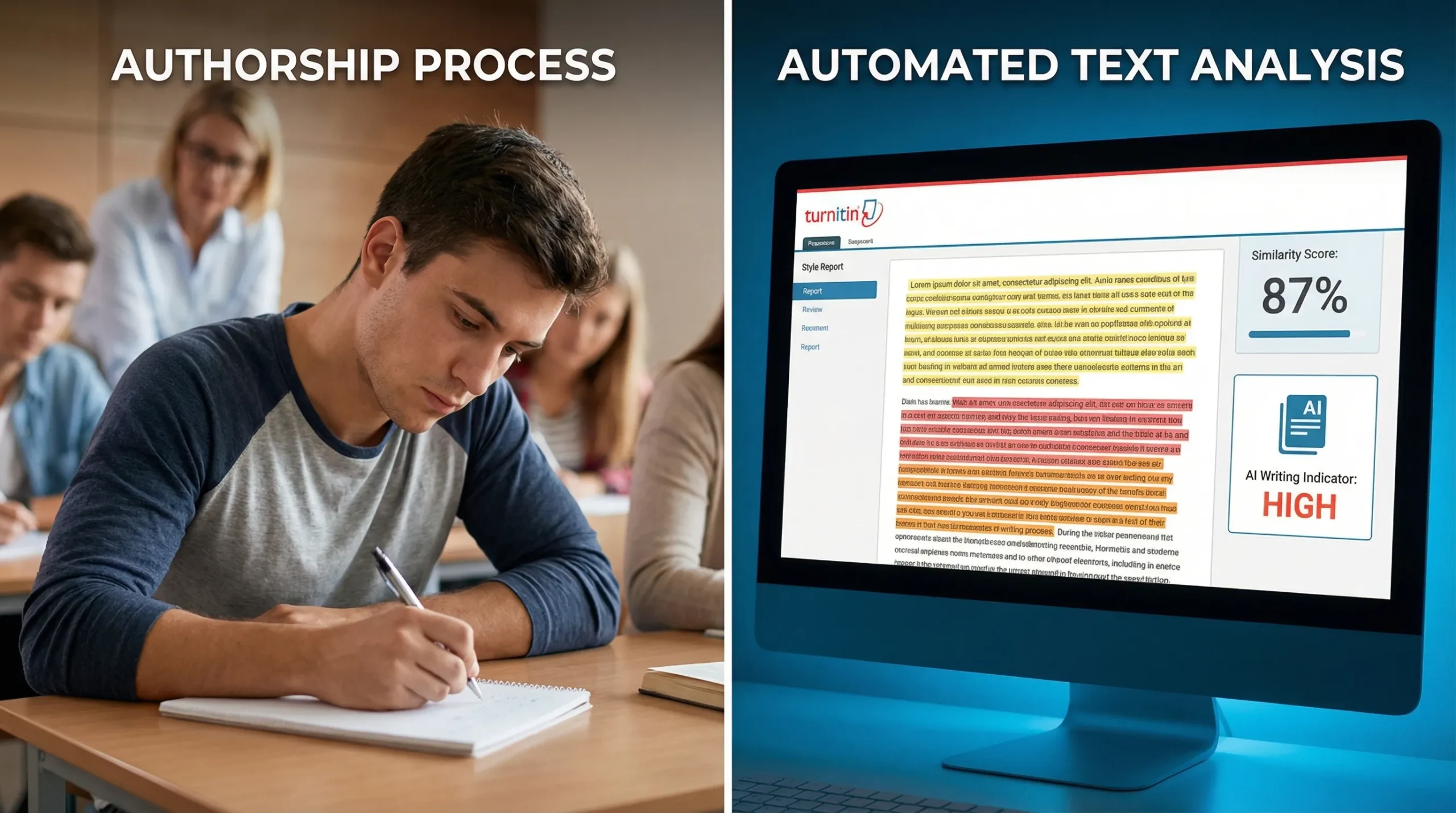
“I wrote it in class” or “my tutor watched me write it” feels like it should settle the question. In practice, supervised writing can still get flagged as AI by Turnitin because Turnitin is not verifying who typed the words. It is evaluating whether the finished text contains statistical patterns that resemble AI-assisted writing.
That mismatch is the root of most “how is this possible?” cases: supervision proves process, while Turnitin’s AI indicator estimates likelihood based on linguistic signals. Those are different types of evidence.
What “supervised writing” proves (and what it doesn’t)
Supervised writing typically means one or more of the following:
- In-class timed writing (paper or computer)
- Proctored lab session
- Writing center session or tutoring with live oversight
- A monitored drafting workshop with checkpoints
- A teacher requiring outlines, drafts, peer review, or writing logs
This kind of supervision can be excellent authorship evidence. But it does not automatically change the textual features that Turnitin uses to make its estimate.
Turnitin’s AI indicator is text-based, not identity-based
Turnitin’s AI writing detection is designed to identify patterns consistent with AI-generated or AI-assisted text, not to authenticate authorship or confirm whether a student was supervised. Turnitin itself frames the feature as an indicator to support human review, not a definitive verdict.
If you want the broader “why does Turnitin flag when others don’t?” angle, this companion explanation goes deeper: Why Turnitin Flags AI When Other Detectors Don’t.
Yes, supervised writing can be flagged, here are the most common reasons
Below are the scenarios that show up repeatedly in real disputes.
1) Your supervised draft was edited heavily later
A lot of “supervised” assignments are only partially supervised.
For example:
- You wrote 60% in class, then “cleaned it up” at home.
- You rewrote multiple paragraphs for clarity and flow.
- You used a rewriting tool, paraphraser, grammar tool, or AI assistant for “final polish.”
Even if the core ideas are yours, final-pass polish can push writing toward patterns that detectors associate with AI (high uniformity, low friction, smooth transitions, predictable syntax).
Related: Grammarly Triggered Turnitin AI: How to Prove Authorship.
2) You used AI earlier (outline, notes, “starter paragraph”) then wrote “on your own” under supervision
This is extremely common and often misunderstood by students.
If AI was used at the planning stage, you may end up reproducing:
- AI phrasing you memorized
- AI structure (topic sentence, 3 supporting points, generic wrap-up)
- AI-style connective tissue (“Moreover,” “Additionally,” “In conclusion”)
Even if you type it yourself in a supervised setting, the output can still look AI-assisted because parts of your mental draft came from AI.
3) The assignment format is templated, and your writing matches that template too perfectly
Many academic genres are formulaic for good reasons (lab reports, business memos, literature analysis).
But detectors can overreact to:
- Highly standardized paragraph shapes
- Repetitive transition patterns
- Consistently similar sentence lengths
- “Safe,” general claims with limited specifics
If your class teaches a strict structure (or you follow a rubric very closely), you can unintentionally produce text that looks machine-regular.
Related: Normal Writing Habits That Can Trigger Turnitin AI Flags.
4) You wrote in a “highly edited” voice that doesn’t match your usual voice
In supervision disputes, instructors often compare the flagged submission to:
- prior assignments
- in-class discussion style
- emails
- short reflections
If your supervised essay sounds significantly more polished (or significantly more generic) than your baseline, it can create suspicion, even if you truly wrote it.
5) Short, generic, or low-specificity writing can be risky
Turnitin and other detectors generally perform worse at the extremes:
- very short submissions
- writing that avoids concrete details
- broad summaries without “messy” human reasoning
A supervised writing task that forces you to be brief can unintentionally create a detection-friendly sample.
6) ESL and dialect effects can raise false positives
Independent research and institutional experience have repeatedly raised concerns that AI detectors can misclassify non-native English writing or certain constrained writing styles.
If this applies to you, it is worth citing evidence in your appeal and requesting a human-led review rather than treating the AI indicator as proof.
Related: AI Detection Bias Against ESL Students: Research & Evidence (2026).
A practical way to think about it: “proof of process” vs “probability signal”
Turnitin’s AI indicator is a probability-style signal. Supervision artifacts are process evidence. If you’re flagged, your goal is to stack process evidence until it outweighs a probabilistic flag.
Here’s a quick mapping of common supervised scenarios and what helps most.
| Supervised writing scenario | Why it can still get flagged | Best evidence to collect |
|---|---|---|
| In-class typed essay | Final text can still match AI-like patterns (regularity, generic phrasing) | Draft checkpoints, instructor timestamps, rough outline, in-class notes |
| Writing center session | Tutor oversight proves presence, not text origin | Tutor confirmation (if allowed), session notes, before/after drafts |
| Proctored lab + later edits | Post-session polishing can introduce AI-like signals | Version history showing incremental edits, separate “lab draft” file |
| Handwritten draft then typed | Typing step can become a rewrite step that looks overly polished | Photos/scans of handwritten draft, typing timeline, tracked changes |
| Group workshop with peer review | Peer edits can shift voice and structure | Peer comments, workshop notes, revision rationale |
How to reduce the chance of a false flag during supervised writing
This is not about “tricking” Turnitin. It is about writing in a way that is clearly human and auditable.
Add specificity that only a real student in your context would include
Detectors tend to be more confident when text feels interchangeable.
Examples of specificity that helps:
- Refer to the exact reading prompt and the author’s specific claim
- Mention the class concept or term your instructor used (accurately)
- Use one concrete example with dates, numbers, or an observation you can explain
- Include a short “why I think this matters” sentence that reflects your reasoning
Keep some natural variation in rhythm and structure
You do not need to write badly to look human. But perfectly uniform writing can look synthetic.
Simple ways to create healthy variation:
- Mix short and long sentences naturally
- Use occasional parenthetical clarification (when it matches your voice)
- Avoid stacking the same transition words repeatedly
Don’t over-optimize the final draft with “smoothing” tools
If your class allows tools like Grammarly, use them transparently and lightly:
- Prefer spelling fixes and obvious grammar corrections
- Avoid full-sentence rewrites and style “rephrases” on many paragraphs
- Save versions before and after any tool-assisted changes
If you need a checklist for documentation, this article focuses on what version history can and cannot prove: Is Google Docs or Word Version History Enough as Proof?.
If your supervised writing still gets flagged: what to do next
Treat the AI score as disputable, and shift the conversation to evidence
In most academic integrity processes, the strongest approach is:
- Acknowledge the flag
- Request a human review
- Provide a clear authorship packet
- Offer an oral explanation of your argument and sources
This guide is built for the first day after a flag: Accused of AI Use: What to Do in the Next 24 Hours.
Build a simple “authorship packet” tailored to supervised writing
For supervised writing, the most persuasive packet is usually short and concrete:
- The prompt and the rubric
- Your outline (handwritten photo or doc)
- In-class notes or planning sheet
- Draft versions (with timestamps) showing the evolution of your ideas
- Sources with your highlights/annotations (screenshots are fine)
- A one-page timeline: when you planned, drafted, revised, and submitted
If your case involves a mid-range flag that an instructor is treating as decisive, this can help frame what proof matters: Flagged 35% AI on Turnitin: What Proof Can Clear You?.
Ask for a fair alternative verification method
If you truly wrote it, supervised context gives you options beyond arguing about a percentage:
- Short oral defense: explain your thesis, why you chose evidence, and what you’d revise
- Live rewrite: revise one paragraph in front of the instructor
- Source walk-through: show how each citation supports a specific claim
These methods evaluate learning, not detector output.
What not to do (especially when you have supervision evidence)
If you wrote the work yourself, avoid actions that can undermine your credibility:
- Don’t “re-humanize” and resubmit a totally different version as if nothing happened
- Don’t paste your essay into random third-party sites that store text (privacy risk)
- Don’t claim Turnitin is “wrong” without providing process evidence
If you did use AI in a way your policy prohibits, your best path is usually honesty paired with a plan (and proof of what you did write yourself). Trying to force a “0% AI” outcome can backfire.
Frequently Asked Questions
Can Turnitin flag a paper written in front of a teacher? Yes. Turnitin evaluates the final text’s patterns, not whether a teacher observed you writing. Supervision is strong evidence, but it is separate from the AI indicator.
Does supervised writing guarantee a 0% AI score? No. Turnitin’s AI indicator is probabilistic and can produce false positives, especially with templated, highly polished, or low-specificity writing.
If I wrote it in Google Docs during class, is that enough proof? It helps, but it is not always decisive on its own. Version history plus outlines, notes, and a clear timeline is typically more persuasive.
Can Grammarly or other editing tools cause a supervised essay to get flagged? They can. Heavy rewriting, tone smoothing, and sentence-level rephrasing can make text look more AI-like, even when the ideas are yours.
What’s the best way to defend myself if my supervised writing is flagged? Provide an authorship packet (drafts, notes, version history, sources) and request a human review with an oral explanation or live writing verification.
Check your risk and document your case with Detection Drama
If you’re dealing with a confusing Turnitin flag, you usually need two things: (1) a clearer read on which passages look “AI-like,” and (2) a clean record of your writing process.
Detection Drama offers free tools and guides to help you:
- Run an AI authenticity analysis and get a detailed detection report
- Use a free humanizer tool (no email required) to reduce overly uniform phrasing (when allowed by your policy)
- Learn practical, evidence-based steps for handling Turnitin AI disputes
Start here: Detection Drama and, if you’re actively disputing a flag, keep this action plan open: Accused of AI Use: What to Do in the Next 24 Hours.
