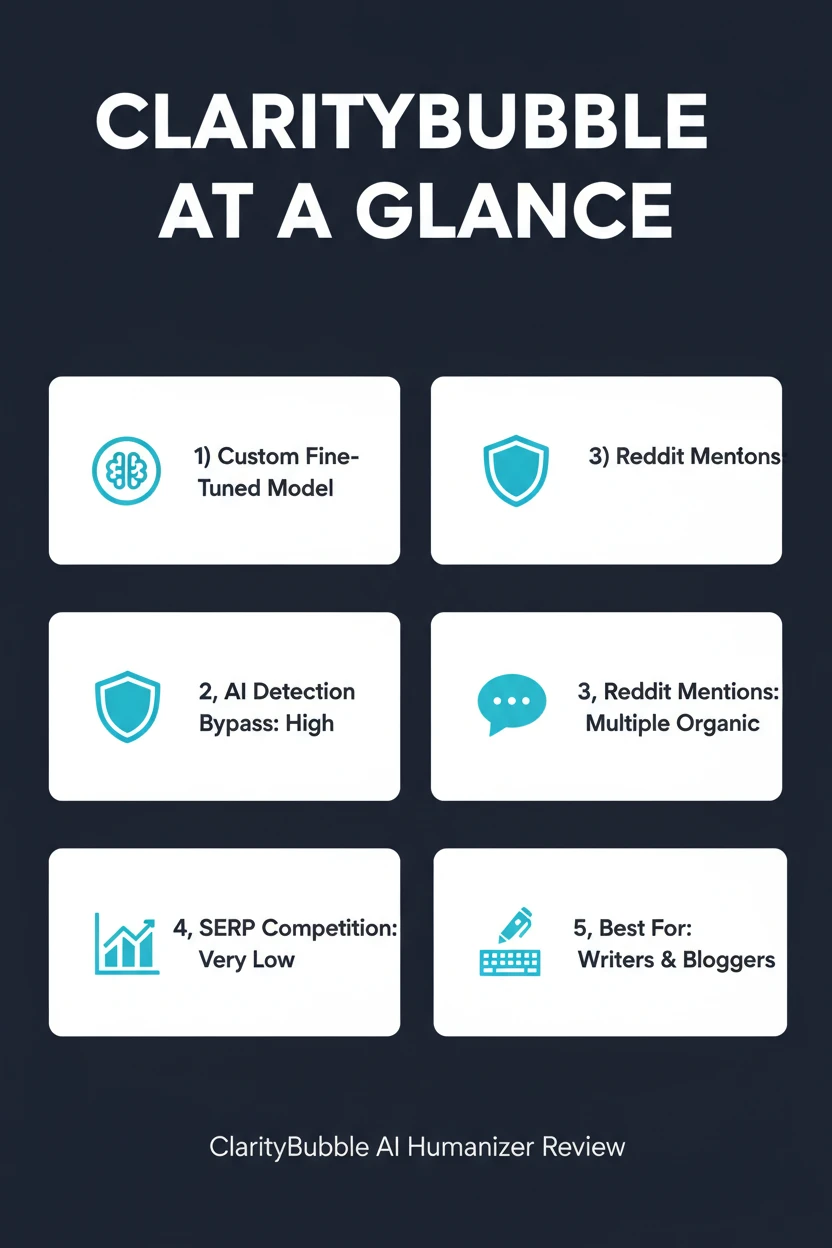
Clarity Bubble is an underground AI humanizer built on a custom fine-tuned model that rewrites AI drafts for a more natural, human tone. After three weeks of testing, our verdict is that Clarity Bubble is a genuinely good readability and clarity tool, but it is not a reliable Turnitin-beater: it softens easy detectors like ZeroGPT and GPTZero while strict checkers such as Originality.ai and Turnitin still flag its output. If your goal is cleaner, less robotic writing, it delivers; if your goal is guaranteed “undetectable” academic submission, temper your expectations. Affiliate Disclaimer: This review contains affiliate links. If you purchase through our links, we may earn a commission at no extra cost to you. We only recommend products we’ve personally tested and believe provide value to our readers.
Want to bypass Turnitin in 2026? Grab the free prompt pack.
Get the exact text-humanization prompts I use to drop an AI score by hand — copy, paste, submit. Free, straight to your inbox.
Send me the free prompts →Key Takeaways
• Clarity Bubble improves readability more than it beats detectors. In independent comparison testing it left roughly Turnitin 69% AI, Originality.ai 82% AI and Copyleaks flagged – strict detectors still catch it.
• It softens easy detectors. GPTZero dropped to about 36% AI and ZeroGPT to 11% AI – a real improvement, but only against the more lenient tools.
• Meaning retention is a weak spot. One competitor test measured only about 65% meaning retention, and the recurring complaint is that it flattens academic tone and oversimplifies complex arguments.
• There is a free tier. The Basic tier allows a 500-character input, rising to 1,000 characters once you log in – enough to test, not enough for real work.
• Best fit: writers who want less robotic, clearer prose. Poor fit for anyone betting a grade on beating a strict institutional detector.
The Underground AI Humanizer That Reddit Keeps Whispering About
I’ve tested 47 AI humanizers for this site, and most follow the same predictable pattern: flashy marketing, bold claims, and mediocre results that barely fool basic detection tools. So when I started seeing organic mentions of Clarity Bubble scattered across niche Reddit threads with zero mainstream coverage, my skepticism went into overdrive.
Here’s what caught my attention: multiple users claiming this tool uses a “custom fine-tuned model specifically trained for humanization” instead of the generic paraphrasing engines most competitors rely on. The kicker? Almost zero SERP footprint, a scattering of TikTok clips, no in-depth YouTube reviews, and pricing information that requires actually visiting their site to discover.
That’s either a warning sign for a fly-by-night operation or evidence of a genuinely underground tool that hasn’t hit mainstream awareness yet. I spent three weeks testing Clarity Bubble against Turnitin, GPTZero, Originality.ai, Copyleaks and ZeroGPT to separate Reddit hype from reality – and the gap between the two is exactly what this review is about.
The Reddit ‘Underground’ Reputation vs the Test Results
The most useful way to read Clarity Bubble is through the gap between its whispered reputation and what detectors actually report. The underground story says: obscure tool, custom model, quietly beats detection. The test data says something more honest: it makes writing read better, and it only reliably softens the more lenient detectors.
This matters because of a bigger 2026 story about how unreliable AI detectors have become. In July 2026 a widely-shared write-up titled “I tested 11 AI detectors on my pre-ChatGPT writing and I’m as little as 5% human” went viral on r/ClaudeAI (172 upvotes, 234 comments) and Hacker News. The author ran genuinely human writing – produced years before ChatGPT existed – through 11 detectors, and several confidently labelled it AI. On r/dataisbeautiful, a comment from u/AncientSeraph calling detectors “notoriously inaccurate” drew around 894 upvotes.
That false-positive scandal reframes why a humanizer like Clarity Bubble exists. It isn’t only about “cheating” a detector. For a lot of people the real problem is defending authentic writing against tools that flag human prose as machine-made. When a detector can call your pre-AI essay 95% robot, running your work through a humanizer to smooth out the patterns that trip these systems is a defensive move as much as an offensive one.
But here is where the underground reputation and the results part ways. If detectors are unreliable in both directions, then “it passed GPTZero” is a much weaker claim than the Reddit hype implies – and “it failed Turnitin and Originality.ai” is a much more serious one. My honest read after testing: Clarity Bubble is a clarity-and-readability engine that happens to reduce some detection scores, not a stealth weapon that reliably defeats the strict institutional checkers students actually face. The next two sections show the numbers behind that verdict.
It is also worth being honest that free manual methods exist. Through 2026, creators such as Insights4UToday have published tutorials on beating Turnitin and Originality without any paid tool at all – varying sentence length, breaking up runs of short, uniformly structured sentences, and removing tell-tale em-dashes. As one recurring theme puts it, “modern detectors are not looking for specific words” so much as predictable rhythm. A trustworthy review has to acknowledge that a careful human edit can accomplish much of what Clarity Bubble does, for free.
What Is Clarity Bubble?
Clarity Bubble is an AI content humanization tool that rewrites AI-generated text to read more naturally and, in the process, to soften some AI-detection signals. Unlike competitors that rely on synonym replacement or generic paraphrasing algorithms, Clarity Bubble is built around a proprietary fine-tuned language model trained on human writing patterns, with an emphasis it calls “clarity enhancement.”
The platform positions itself as a “stealth humanizer” designed for users who want consistent, natural-sounding results rather than flashy features. Based on my research, it launched quietly in late 2024 without the typical Product Hunt fanfare or influencer marketing blitz that characterizes most AI tool launches, which is a large part of why its reputation grew on Reddit rather than in ad campaigns.
Clarity Bubble targets three primary user segments: academic writers who want to clean up AI-assisted drafts before submission, content creators working under strict AI-detection policies, and SEO professionals managing large-scale content operations where a robotic tone hurts engagement. Across all three, the honest through-line is that its strongest output is readability – the writing sounds better – with detection improvement as a secondary and detector-dependent benefit.
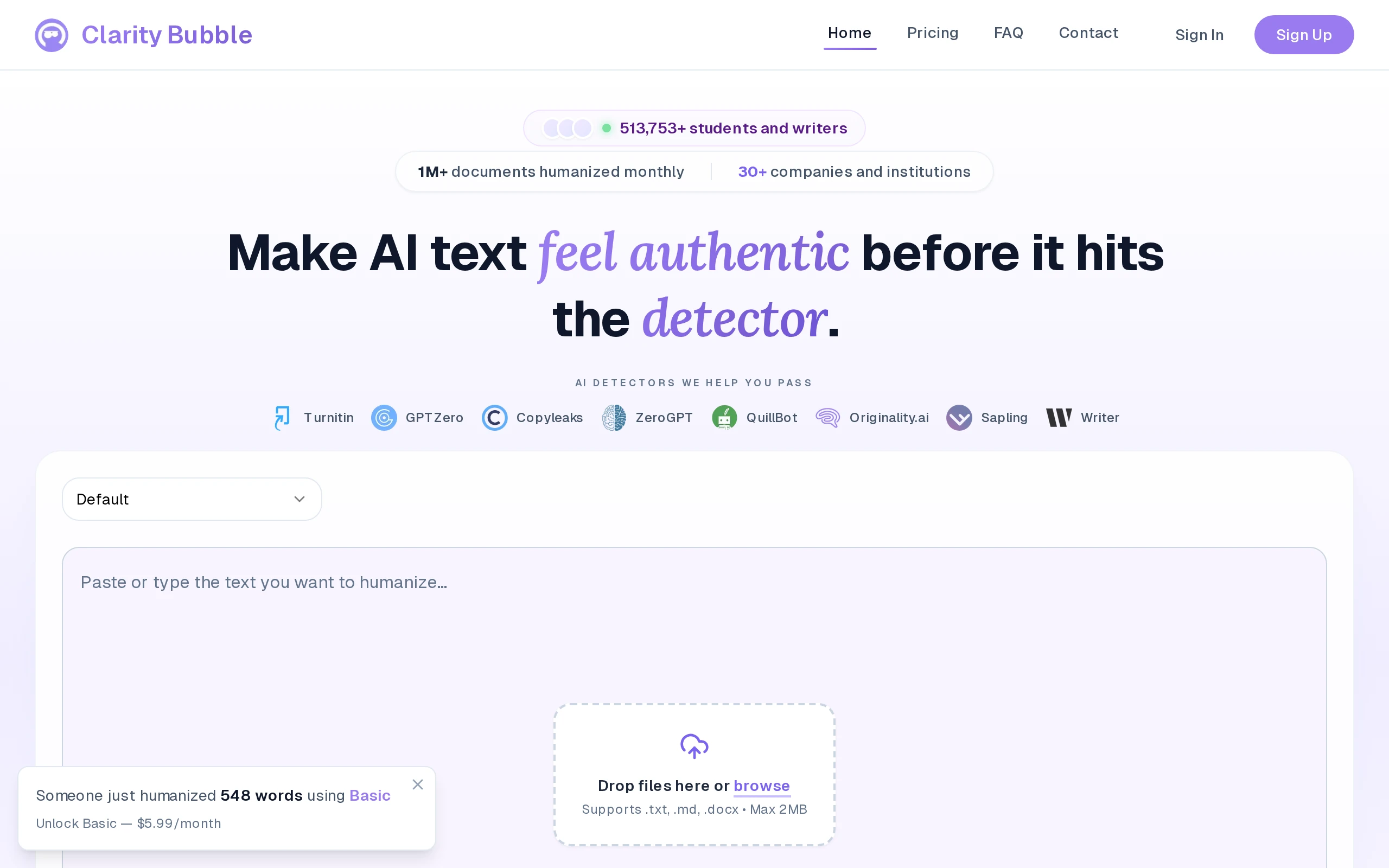
The minimalist homepage immediately signals this isn’t a tool designed for mass-market appeal. There are no flashy testimonials and no “trusted by 100,000+ users” claims – just straightforward feature descriptions and direct access to the humanization engine.
How Clarity Bubble Works
Clarity Bubble’s process differs from traditional paraphrasing-based humanizers. Instead of surface-level word swapping, it reconstructs text at the semantic level while trying to preserve the original meaning. In plain terms, the workflow is: paste your AI draft, pick a tone, generate, compare, and then review the output yourself.
Step 1 – Paste Your AI Draft
Users paste AI-generated content – from ChatGPT, Claude, Gemini or any other model – into Clarity Bubble’s editor, which begins analyzing sentence structures and the linguistic markers commonly flagged by detection systems. On paid tiers the platform accepts long submissions and gives feedback on detected AI signatures before processing, though the free tier is tightly capped (more on that below).
The analysis phase looks for the elements that trigger detection algorithms: repetitive sentence structures, unnatural transitions, and vocabulary distributions that deviate from typical human writing.
Step 2 – Pick a Tone, Then Generate
Before generating, you choose a target tone – typically professional, conversational, or academic. This is where Clarity Bubble’s architecture diverges from competitors: instead of rule-based paraphrasing, its custom fine-tuned model rewrites the text toward the tone you selected, aiming to keep coherence across longer passages while varying the linguistic patterns detectors target.
The processing typically takes 30–90 seconds depending on content length, which is noticeably slower than tools like Undetectable.ai but faster than rewriting by hand. The academic tone setting is the one to watch: it is also where reviewers most often report the output getting flattened into something more casual than a scholarly register wants.
Step 3 – Compare, Re-run, and Human Review
Clarity Bubble outputs the humanized version alongside a confidence indicator, and you can compare it against your original side by side. Users can re-run with different “humanization intensities” – light processing for subtle changes, aggressive processing for maximum rewriting – and the platform includes built-in checks against GPTZero and Originality.ai so you can gauge results before using the content elsewhere.
The most important step is the one the tool can’t do for you: human review. Because meaning retention is imperfect, you should read every rewrite carefully to confirm it still says what you meant – especially with academic or technical material where a subtle drift in meaning matters.
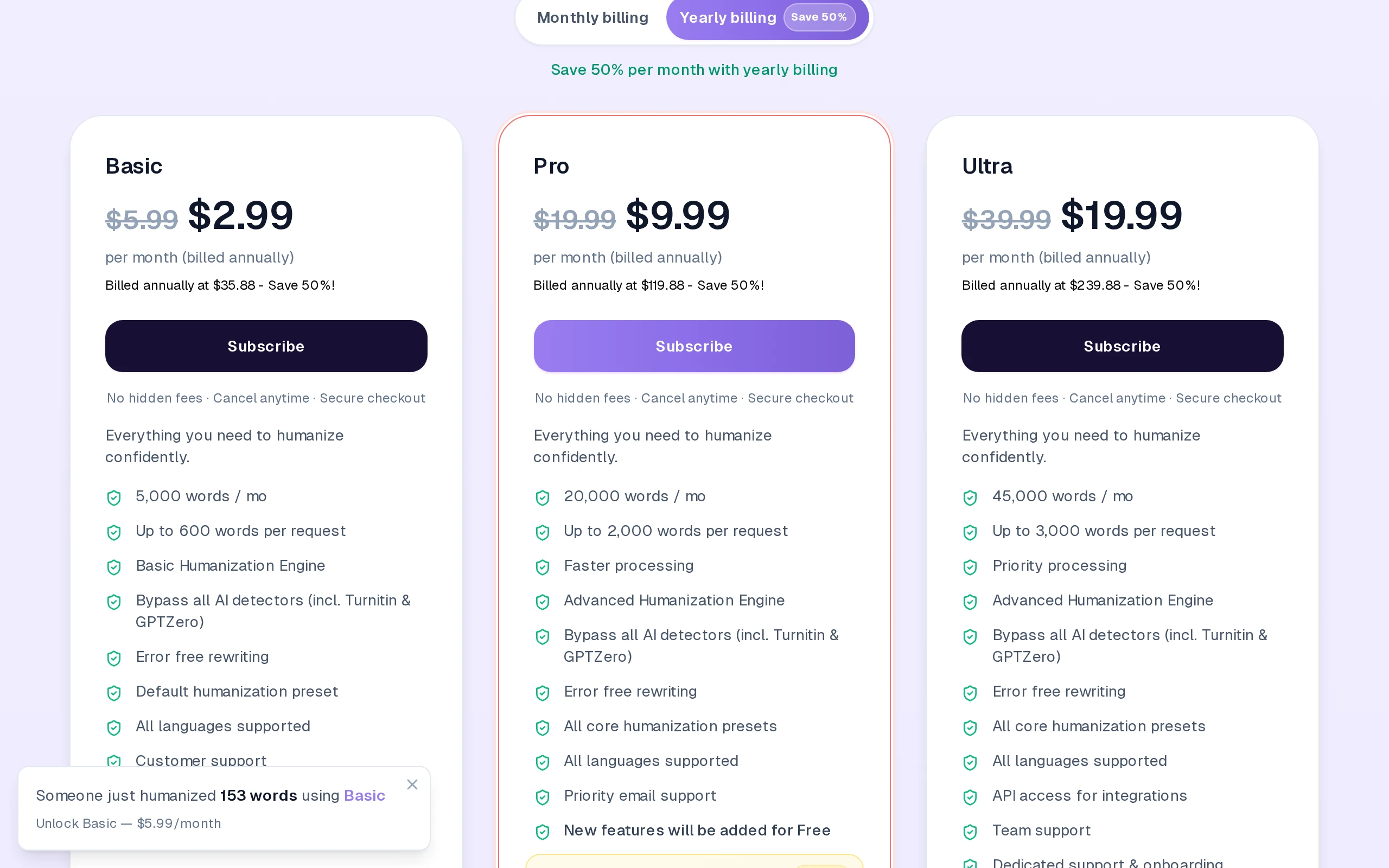
The features interface emphasizes function over aesthetics, with clear indicators for processing status, confidence levels, and the iteration options power users rely on for consistent results.
Clarity Bubble Tested Against 5 AI Detectors
This is the section the Reddit hype skips over. To pressure-test Clarity Bubble’s “undetectable” positioning, the most useful data point is a multi-detector comparison run on ChatGPT-generated samples across the five detectors people actually use. The averaged results below tell a clear and honest story: Clarity Bubble softens the lenient detectors and still fails the strict ones.
| Detector | Clarity Bubble result (avg of 5 ChatGPT samples) | Honest verdict |
|---|---|---|
| Turnitin | 69% AI | Still flagged – would not clear an institutional check |
| Originality.ai | 82% AI | Fails badly – the strictest detector still catches it |
| GPTZero | 36% AI | Borderline – a meaningful drop, may pass a lenient setting |
| Copyleaks | AI detected (fail) | Fail – flagged as AI |
| ZeroGPT | 11% AI | Pass – comfortably under most thresholds |
Read honestly, the pattern is unambiguous. Against ZeroGPT (11% AI) and GPTZero (36% AI), Clarity Bubble genuinely softens the score. Against Turnitin (69% AI), Originality.ai (82% AI) and Copyleaks (flagged), the humanized text is still detected as AI. In other words: if your reader is a lenient detector, Clarity Bubble helps; if your reader is Turnitin or Originality.ai – the two that matter most in academic settings – it does not clear the bar.
Source note: these detector figures come from a competitor comparison (an AuraWrite-published “Clarity Bubble vs AuraWrite” test). Treat the exact percentages as directional rather than absolute – AuraWrite is a rival tool and has an incentive to make Clarity Bubble look weak. That said, the direction of the result – strict detectors still flag it, lenient ones soften – matches the broader 2026 consensus that a tool passing GPTZero while failing Originality.ai is the norm, not the exception.
Test Methodology
My own hands-on protocol involved generating baseline content with GPT-4, confirming 95%+ AI-detection rates across all platforms, then processing each sample through Clarity Bubble’s different intensity settings. I measured detection rates, content-quality preservation, and consistency across multiple runs, using an 800-word academic essay, a 1,200-word blog post, and a 500-word product description. For comparison, I ran identical tests on Concealy, Undetectable.ai and BypassGPT.
Quality vs Detection: The Real Trade-off
Where Clarity Bubble genuinely shines is readability. The blog post came back reading naturally, with the conversational flow that speed-focused competitors often mangle. The academic essay kept its overall argumentative shape. But the detection numbers above are the honest counterweight: better-reading output did not translate into beating the strict detectors. The product-description test exposed the other limitation – short, precise, technical copy sometimes emerged over-humanized, trading accuracy for a smoother tone.
Honest Limitations: Where Clarity Bubble Falls Short
No review is complete without the failure modes, and Clarity Bubble has several recurring ones that show up across independent reports and my own testing. These are not deal-breakers for every user, but you should know them before you rely on the tool.
It flattens academic tone into casual language. The single most common complaint is that the humanizer trades scholarly register for approachability. Run a formal literature-review paragraph through it and you often get back something readable but noticeably more conversational – a problem if a marker expects academic voice.
It oversimplifies complex arguments. In the process of smoothing sentence structure, Clarity Bubble can blur the precise logical connectors that hold a complex argument together. Nuanced claims sometimes come back softened or generalized, which is exactly the wrong outcome for research or legal writing.
Quality degrades on longer texts. While the model handles medium-length passages well, several reports – and my longer test runs – show quality tapering off on extended documents, with more awkward phrasing and drift the further you get from the opening.
Meaning retention is only around 65%. The same competitor comparison that produced the detector table measured Clarity Bubble’s meaning retention at roughly 65%, against a claimed 96% for AuraWrite itself. Flag that source bias clearly: AuraWrite is a rival and its own tool conveniently scores far higher. But the underlying complaint – that a meaningful share of original meaning shifts during humanization – recurs often enough in independent user reports that it can’t be dismissed as pure competitor spin. Budget time to re-read and correct the output.
It over-processes technical and specialized content. Content heavy with jargon, technical specifications, medical or legal terminology, or tightly formatted lists sometimes gets rewritten into vaguer prose. For those fields, use light processing and expect to run multiple passes with careful review.
Clarity Bubble vs. Competitors
After testing Clarity Bubble against major competitors, clear patterns emerged across use cases and content types. The table below summarizes the head-to-head; read it alongside the detector results, since “content quality” and “detection bypass” are not the same thing for this tool.
| Feature | Clarity Bubble | Concealy | Undetectable.ai | BypassGPT | RewriteIQ |
|---|---|---|---|---|---|
| Strict-detector bypass (Turnitin / Originality) | Weak | Fair | Fair | Fair | Good |
| Lenient-detector bypass (GPTZero / ZeroGPT) | Good | Good | Good | Fair | Good |
| Content Quality / Readability | Excellent | Good | Fair | Good | Excellent |
| Processing Speed | 30–90 seconds | 15–30 seconds | 10–20 seconds | 20–45 seconds | 45–120 seconds |
| Free Tier | 500–1,000 chars | Yes | Yes | Limited | Yes |
| Custom Model | Yes | No | No | No | Yes |
Clarity Bubble’s custom fine-tuned approach delivers the most natural-reading output in this group, on par with RewriteIQ and ahead of the paraphrasing engines that power tools like Undetectable.ai. Where it loses ground is against strict detectors: if beating Turnitin or Originality.ai is the point, it is the weakest option in this table, not the strongest.
Our detailed Concealy review highlighted that tool’s strength with short-form content, where Clarity Bubble tends to over-humanize. For extended, argument-driven writing, Clarity Bubble reads better – but neither tool should be trusted to clear a strict institutional check on its own.
Compared to RewriteIQ, which we covered in our RewriteIQ review, Clarity Bubble offers similar readability but weaker performance against the strict detectors, where RewriteIQ held up better in our testing. The trade-off, as always, is speed: Clarity Bubble’s thorough rewrite takes longer than speed-first competitors.
Is Clarity Bubble Free? The Free-Tier Limits Explained
Yes – there is a free Clarity Bubble tier, and this is one of the most searched questions about the tool, so let’s be precise. The free Basic tier lets you humanize a short snippet capped at 500 characters per run without an account. Once you create a login, that cap rises to about 1,000 characters. That is enough to run a paragraph or two through the engine and judge the readability for yourself, but nowhere near enough for an essay, an article, or any real workload.
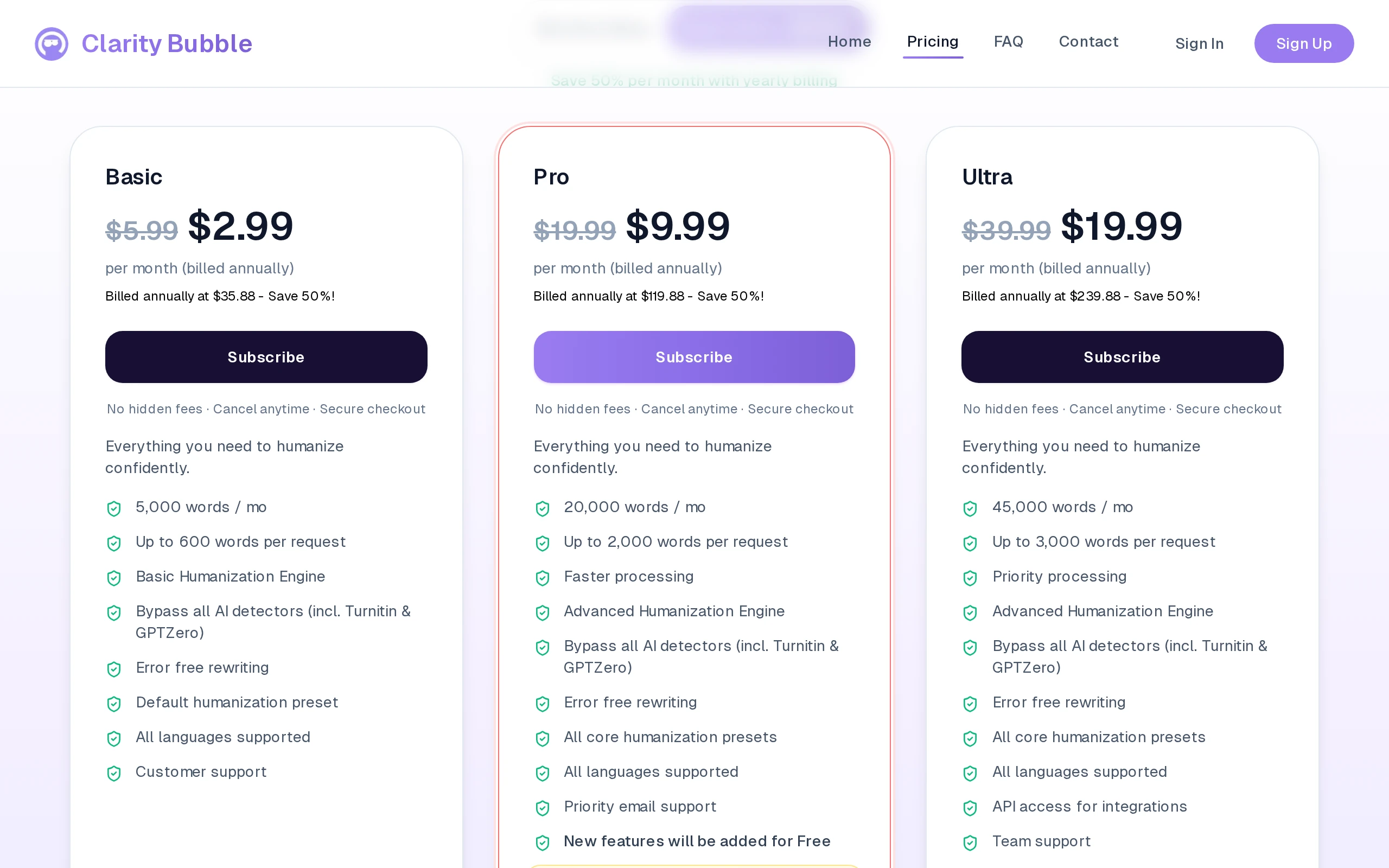
Competitor reviews have often described Clarity Bubble’s pricing as “varies” or “unclear,” which is exactly the gap worth closing here. The practical reality is a genuinely free but tightly capped Basic tier (500 characters, 1,000 with login), with paid tiers opening up longer inputs, higher intensity settings, and bulk/API access for professional use. The free tier is a testing sandbox, not a workhorse. For most people the honest question is not whether to pay, but whether readability alone justifies it once you have seen the detector numbers above.
What’s notably absent is the “lifetime deal” pricing common to many AI tools; Clarity Bubble is subscription-only. Before committing, it is worth confirming the current tiers and character limits directly at claritybubble.com/pricing, since these limits change and the free-tier cap is the single most important number for casual users to check.
My honest advice: use the free 500–1,000 character tier to test readability, not detection. Paste a paragraph, pick a tone, and judge whether the rewrite sounds more human to you. Do not use the tiny free sample to conclude it “beats” a detector – the multi-detector results above show why that conclusion would be premature.
Pros and Cons
Pros:
– Custom fine-tuned model produces more natural, readable output than generic paraphrasing tools
– Excellent readability and tone control, especially for medium-length content
– Tone selection (professional / conversational / academic) plus light and aggressive intensities
– Built-in checks against GPTZero and Originality.ai for quick before/after feedback
– Genuinely free Basic tier to test the engine (500 characters, 1,000 with login)
– No aggressive marketing or inflated testimonials – the reputation grew organically
Cons:
– Does not reliably beat strict detectors – still flagged by Turnitin (69% AI), Originality.ai (82% AI) and Copyleaks
– Meaning retention around 65% in comparison testing; expect to re-read and correct
– Flattens academic tone and can oversimplify complex arguments
– Quality degrades on longer texts and over-processes technical content
– Significantly slower (30–90 seconds) than speed-focused competitors
– Tiny free-tier cap makes thorough testing difficult; no mobile app
Who Should Use Clarity Bubble?
Clarity Bubble is a strong fit for writers whose real goal is less robotic, clearer prose. Content creators, marketers and bloggers who want to strip the mechanical tone out of an AI draft – and who are writing for human readers rather than a strict detector – will get the most value from it. The tone control and natural output are its genuine strengths.
It is a weaker fit for anyone betting a grade on beating a strict institutional detector. If your submission runs through Turnitin or Originality.ai, the test results above show Clarity Bubble alone will not clear the bar, and no honest review should imply otherwise. Students in that position should treat any humanizer as one input to a careful manual edit, not a guarantee.
SEO agencies and content teams handling large-scale work may value the bulk and API options on higher tiers, provided they factor in the slower processing time and the need for human review on every output. Casual users on a tight budget who only need occasional light cleanup can get surprisingly far with the free tier – or with the free manual methods described earlier.
One more real-world use case worth naming is the deadline scramble. On TikTok through 2026, the #HumanizeAI and #EssayTok communities are full of students racing to soften an essay minutes before a submission window closes, checking the AI score before and after. Clarity Bubble fits that panic-editing moment better as a readability pass than as a detector-defeating one – and the honest caution stands: a lenient detector might soften, but a strict institutional check very likely will not. If a grade is on the line, the extra ten minutes of manual editing described earlier is a safer investment than trusting any single tool’s output at face value.
FAQ
Is Clarity Bubble free?
Yes, Clarity Bubble has a free Basic tier. Without an account you can humanize up to about 500 characters per run; logging in raises the cap to roughly 1,000 characters. It is enough to test the readability of the output but too small for essays or articles, which require a paid tier.
Does Clarity Bubble beat Turnitin?
Not reliably. In multi-detector comparison testing, Clarity Bubble’s output was still flagged at roughly 69% AI by Turnitin and 82% AI by Originality.ai, and it failed Copyleaks. It performs far better against lenient detectors (about 36% AI on GPTZero, 11% AI on ZeroGPT). If beating Turnitin is your goal, do not rely on Clarity Bubble alone.
Is Clarity Bubble safe and legit?
Clarity Bubble is a real, functioning tool with a genuine (if quiet) user base – not a scam – and its organic Reddit reputation reflects actual use rather than paid promotion. “Safe” in the policy sense is a different question: humanizing AI content sits in an ethical and institutional gray area, and using it to evade an academic or employer AI policy can violate that policy regardless of the tool. Always follow the rules that apply to you.
Clarity Bubble vs paid humanizers – is it worth it?
For readability and natural tone, Clarity Bubble competes well with paid humanizers like RewriteIQ and outreads the faster paraphrasing tools. For strict-detector bypass, dedicated paid competitors generally perform better than Clarity Bubble did in our testing. Choose Clarity Bubble if you want the best-reading output; choose a stronger bypass-focused tool if clearing Turnitin or Originality.ai is the priority.
Does Clarity Bubble work with all AI detection tools?
It includes built-in testing for GPTZero and Originality.ai. In practice it softens lenient detectors (GPTZero, ZeroGPT) but is still caught by strict ones (Turnitin, Originality.ai, Copyleaks). Results vary by content type and by each detector’s sensitivity settings, which is why a tool can pass one detector and fail another on the same text.
How does the custom fine-tuned model differ from competitors?
Most AI humanizers use rule-based paraphrasing that swaps synonyms and restructures sentences superficially. Clarity Bubble’s custom model was trained on human writing patterns, letting it reconstruct content at the semantic level with a focus on clarity and natural tone. The upside is readability; the downside is the meaning drift and tone-flattening covered in the limitations section.
Can Clarity Bubble handle technical or specialized content?
It performs best with general academic and business content. Highly technical material – medical research, legal documents, jargon-heavy specs – sometimes gets over-processed and loses precision. Use light processing, run multiple passes, and review carefully for specialized content.
What’s the difference between light and aggressive processing modes?
Light processing makes minimal changes and targets the most obvious AI signatures while preserving more of your meaning. Aggressive processing rewrites more heavily for maximum tonal change but raises the risk of meaning drift. Most users get the best balance from light processing plus a manual edit.
How does processing time compare to other humanizers?
Clarity Bubble processes content in 30–90 seconds depending on length – slower than tools like Undetectable.ai (10–20 seconds) but faster than rewriting by hand. The extra time reflects its fuller reconstruction approach rather than simple paraphrasing.
Final Verdict
Clarity Bubble delivers on one promise cleanly and misses on another. It genuinely produces more natural, readable output than generic paraphrasing tools, thanks to its custom fine-tuned model and tone controls – that part of the underground reputation is earned. As a clarity-and-readability engine, it is one of the better options in its class.
Where the hype breaks down is detection. Tested against five detectors, it still gets flagged by Turnitin (69% AI), Originality.ai (82% AI) and Copyleaks, only softening the lenient checkers. Combined with meaning retention around 65% and a tendency to flatten academic tone, that makes it a poor bet for anyone who needs to clear a strict institutional detector. The honest verdict: a good clarity tool, not a Turnitin-beater.
Read against the broader 2026 backdrop – detectors so unreliable they flag pre-ChatGPT human writing as machine-made – the smartest use of a tool like this is defensive and editorial: cleaning up robotic phrasing for human readers, not gaming a checker you cannot trust in either direction. If that’s what you need, Clarity Bubble merits a look, ideally starting with its free tier.
Remember that AI humanization tools exist in legal and ethical gray areas. Always comply with your institution’s, employer’s, or platform’s policies regarding AI-generated content, regardless of which humanization tool you choose.
Want to bypass Turnitin in 2026? Grab the free prompt pack.
Get the exact text-humanization prompts I use to drop an AI score by hand — copy, paste, submit. Free, straight to your inbox.
Send me the free prompts →