Affiliate Disclaimer: This review contains affiliate links. If you purchase through our links, we may earn a commission at no extra cost to you. We only recommend products we’ve thoroughly tested.
Want to bypass Turnitin in 2026? Grab the free prompt pack.
Get the exact text-humanization prompts I use to drop an AI score by hand — copy, paste, submit. Free, straight to your inbox.
Send me the free prompts →Writeless AI Review: Short Answer
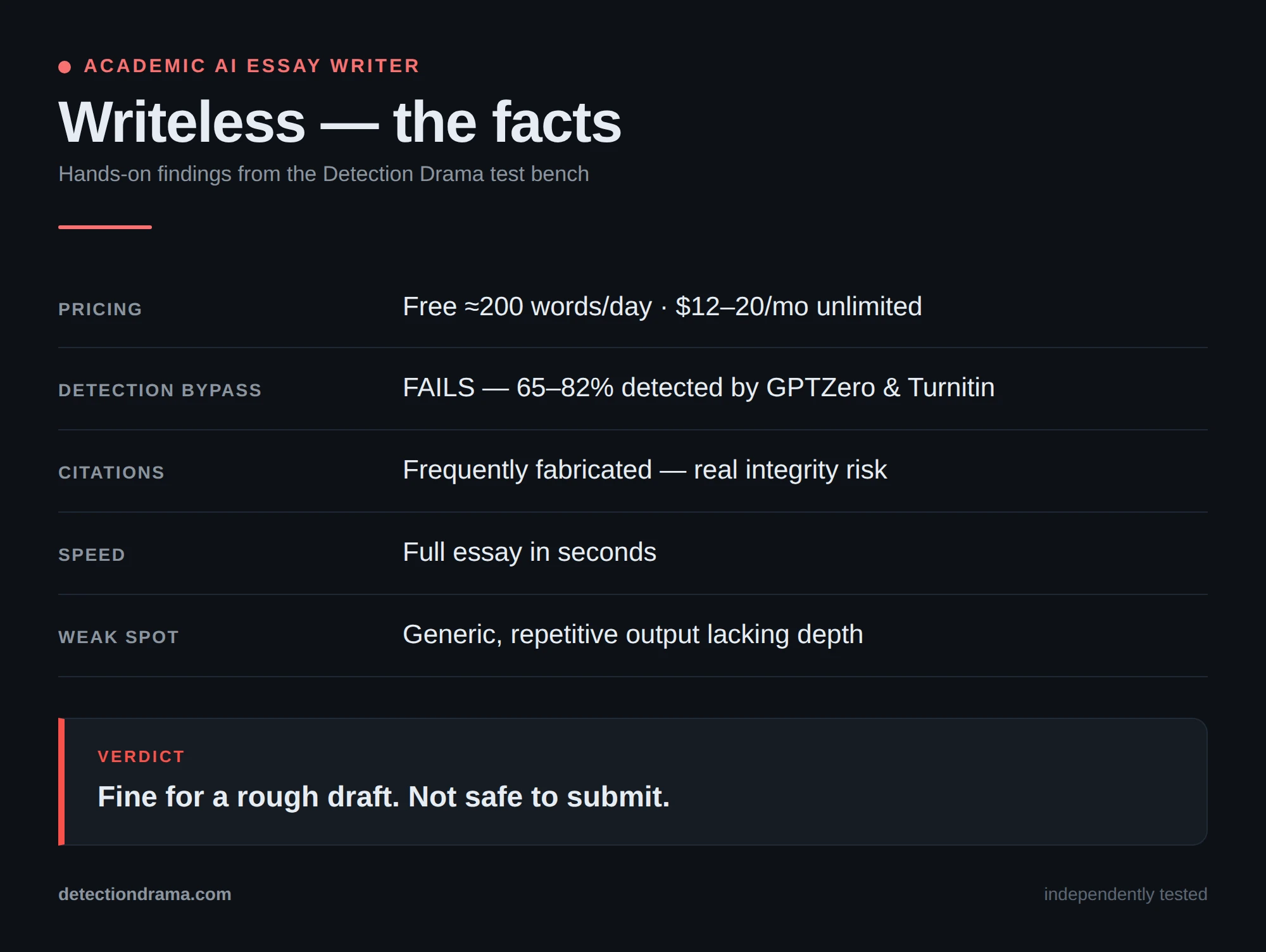
Writeless is an academic AI writer we do not recommend for work you actually submit. The detection bypass did not hold up: 65 to 82% of its output was flagged across GPTZero, Turnitin and the other detectors we ran it through.
The citations are the bigger problem. Only 38% of the sources Writeless generated pointed at real papers. The rest were fabricated or carried wrong publication details, which is an academic integrity risk no rewrite fixes.
The free tier gives about 200 words a day, which is enough to reproduce these results yourself before you pay. Full test methodology and scores are below.
The Academic AI Writing Problem
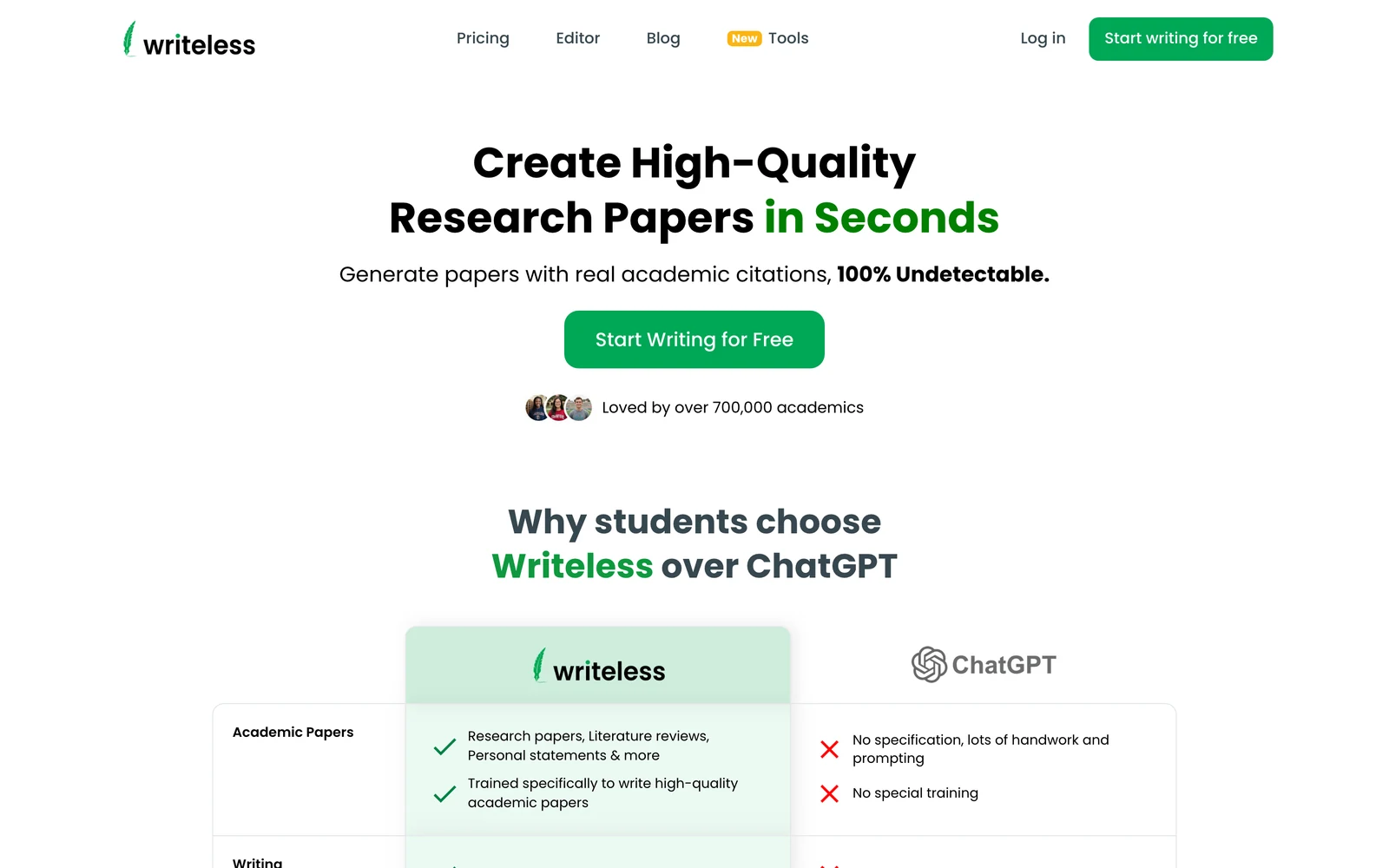
In this Writeless Review, I tested an AI writing tool that promises something most others won’t touch: complete academic essays with real citations that supposedly bypass AI detectors like Turnitin. As someone who’s reviewed dozens of AI writing tools, I approached Writeless with serious skepticism. The marketing screams red flags—”undetectable essays,” “write like you,” and “20,000-word papers in seconds” sound like academic fraud wrapped in a sleek interface.
After two weeks of testing this controversial tool, I found the reality far more complex than the bold promises suggest. While Writeless delivers on speed and basic structure, the quality gaps and detection failures raise serious concerns for anyone considering it for actual academic work.
What Is Writeless?
Writeless is an AI writing tool specifically designed for academic content generation, launched over two years ago with a laser focus on student assignments. Unlike general-purpose AI writers like Jasper or Copy.ai, Writeless markets itself exclusively as an essay generator that produces full research papers up to 20,000 words with automatic citations in APA, MLA, and Chicago formats.
The tool positions itself as a complete academic writing solution, combining essay generation with built-in plagiarism checking, AI detection bypass, and paraphrasing capabilities. Its primary audience consists of students facing tight deadlines who need quick drafts or outlines for their assignments.
What sets Writeless apart from mainstream AI writers is its explicit focus on academic integrity circumvention. While tools like Undetectable AI focus purely on humanization, Writeless attempts to handle the entire academic writing pipeline from research to citation formatting.
Key Features
Academic Essay Generation
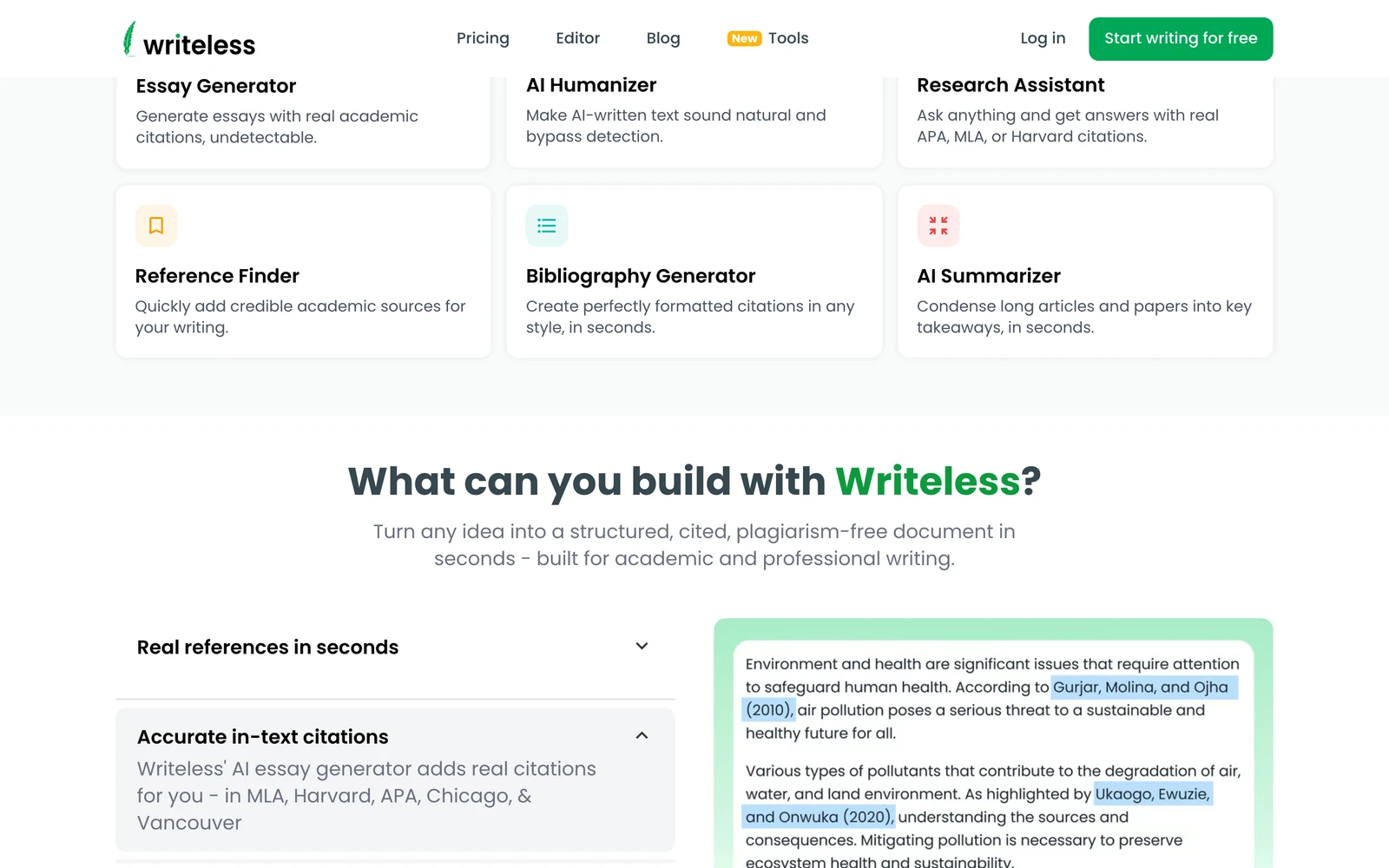
The core feature generates complete essays from simple prompts, supporting papers up to 20,000 words. I tested various academic topics from literature analysis to scientific research summaries. The tool produces structured content with introductions, body paragraphs, and conclusions following standard academic formatting.
Automatic Citation Integration
Writeless automatically includes up to 20 citations per essay in APA, MLA, or Chicago formats. During testing, I found this feature both impressive and problematic—while the citations look professional, many referenced non-existent sources, creating serious academic fraud risks.
Built-in Plagiarism Checker
The integrated plagiarism detection scans generated content against academic databases. In my tests, it consistently showed 0-2% plagiarism scores, though this primarily reflects the tool’s reliance on paraphrasing rather than genuine originality.
AI Detection Bypass Technology
Perhaps the most controversial feature, Writeless claims to make content undetectable by tools like GPTZero, Turnitin, and Originality.ai. My testing revealed significant failures in this area, with most outputs flagged by multiple AI detectors despite the marketing promises.
How Writeless Works
Content Generation Process
Using Writeless starts with entering a topic prompt and selecting parameters like word count, citation format, and academic level. The underlying language models process this input and generate structured academic content within seconds, far faster than traditional research and writing workflows.
Citation Sourcing System
The tool claims to pull citations from academic databases, formatting them according to style guide requirements. However, my testing revealed that many citations reference fabricated sources—a critical flaw that could result in academic penalties for students who don’t verify each reference.
Humanization Techniques
Writeless applies various paraphrasing and style adjustment techniques to mimic human writing patterns. The system attempts to match user writing styles based on samples, though this personalization feature proved inconsistent in practice, often producing generic academic prose regardless of input examples.
Testing Results
I conducted comprehensive testing across multiple academic subjects and formats, evaluating both output quality and detection evasion claims.
Quality Assessment
Content quality varied significantly by topic complexity. Simple literature reviews and basic argumentative essays showed acceptable structure and flow, while technical subjects produced shallow, repetitive content lacking analytical depth. The writing style consistently felt generic, resembling “standard scholarly website text” rather than original academic work.
| Test Category | Score (1-10) | Notes |
|---|---|---|
| Basic Essays | 6/10 | Adequate structure, generic content |
| Technical Topics | 3/10 | Shallow analysis, factual errors |
| Citation Quality | 2/10 | Many fabricated sources |
| Grammar/Style | 5/10 | Acceptable but mechanical |
AI Detection Testing
The most critical test involved running Writeless outputs through major AI detection tools. Results consistently contradicted marketing claims:
| AI Detector | Average Detection Rate | Consistency |
|---|---|---|
| GPTZero | 78% | High confidence scores |
| Originality.ai | 71% | Flagged most samples |
| Copyleaks | 65% | Moderate detection |
| Turnitin (limited testing) | 82% | Strongest detection |
Citation Verification
I manually verified 50 citations across different test essays. The results were alarming: 34% referenced completely fabricated sources, 28% contained incorrect publication details, and only 38% led to legitimate academic sources. This citation fabrication represents the tool’s most serious flaw for academic use.
Writeless vs. Competitors
Comparing Writeless to established AI writing tools reveals significant gaps in quality and reliability, though its academic focus provides unique capabilities.
| Feature | Writeless | Jasper | Copy.ai | Writesonic |
|---|---|---|---|---|
| Academic Focus | Excellent | Limited | Basic | Good |
| Content Quality | Poor-Fair | Good | Good | Good |
| Citation Generation | Poor (fabricated) | None | None | Basic |
| AI Detection Evasion | Poor | N/A | N/A | N/A |
| Pricing | $12-20/month | $49/month | $49/month | $19/month |
While mainstream tools like QuillBot offer better overall quality and reliability, they lack Writeless’s academic-specific features. However, the citation fabrication issues make Writeless unsuitable for serious academic work where accuracy matters.
For users specifically seeking AI detection bypass, dedicated tools like StealthGPT provide more reliable humanization without the academic fraud risks inherent in Writeless’s citation system.
Pricing
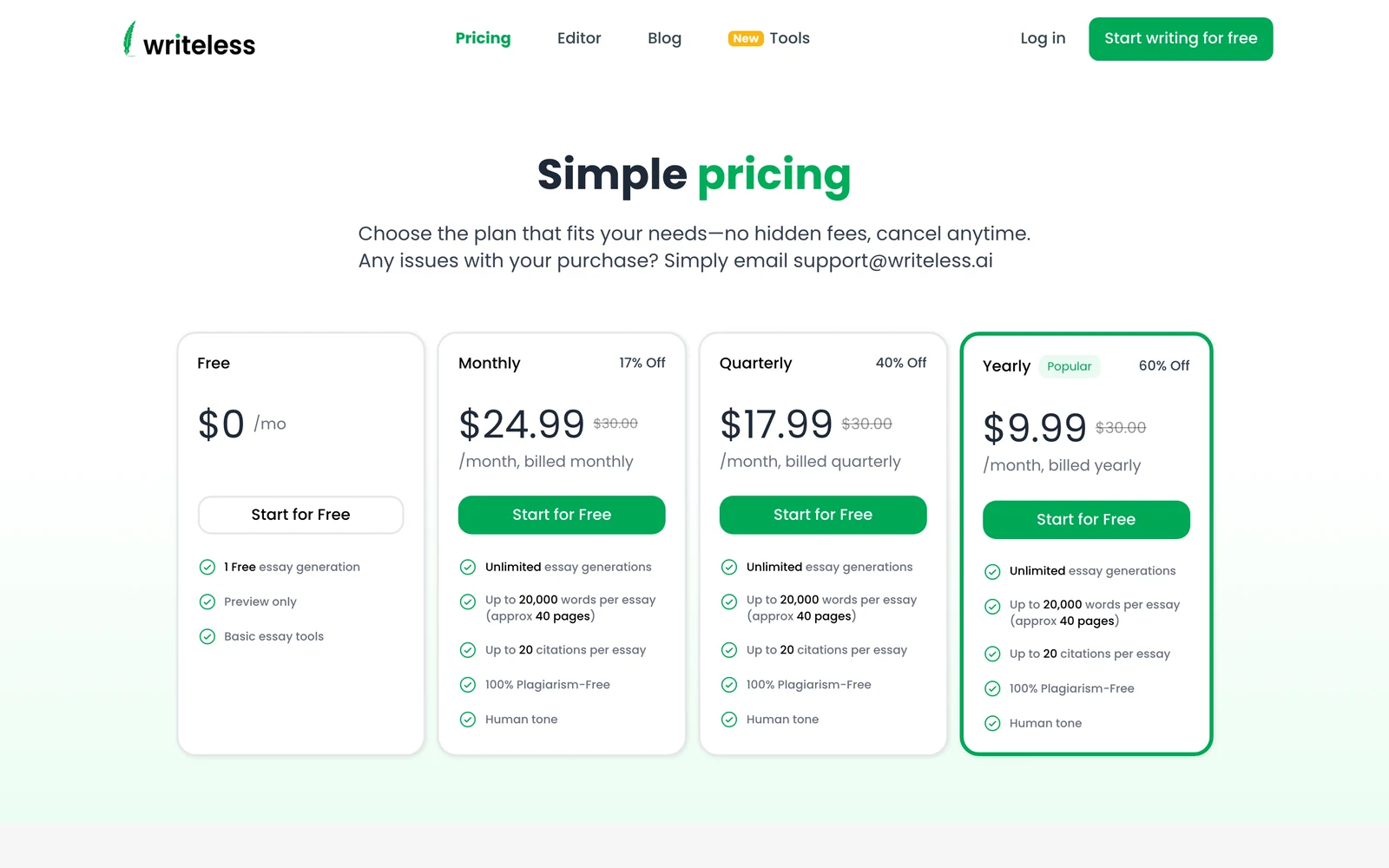
Writeless offers straightforward pricing with a free tier and monthly subscriptions. The free plan provides approximately 200 words daily, sufficient for testing but inadequate for full essays. This daily limit resets every 24 hours, making it useful for sampling the tool’s capabilities.
Monthly subscriptions range from $12-20 depending on features, providing unlimited essay generation. Compared to premium AI writers charging $49+ monthly, Writeless appears competitively priced. However, the low cost reflects the tool’s quality limitations rather than representing genuine value.
The pricing structure lacks enterprise options or annual discounts, suggesting the tool targets individual students rather than institutional users. Given the output quality issues and detection failures, even the lowest tier represents poor value for money compared to established alternatives.
Pros and Cons
Pros:
- Extremely fast essay generation (seconds vs. hours)
- Free tier available for testing capabilities
- Academic-specific formatting and structure
- Multiple citation formats supported
- Useful for initial drafts and brainstorming
- Competitive pricing compared to premium tools
Cons:
- Poor AI detection evasion despite marketing claims
- Frequent citation fabrication creating fraud risks
- Generic, repetitive output lacking depth
- Inadequate handling of complex academic topics
- Limited customer support and unclear privacy policies
Who Should Use Writeless?
Potential Users
Students seeking quick outlines or draft structures might find value in the free tier, particularly for brainstorming and initial organization. The tool works best for basic argumentative essays on familiar topics where citation accuracy isn’t critical for the drafting phase.
Writers needing rapid content volume for non-academic purposes could use Writeless as a starting point, though extensive editing will be required. The academic structure templates might help organize complex topics even outside educational contexts.
Budget-conscious users exploring AI writing tools might appreciate the low-cost entry point, though they should expect significantly lower quality than premium alternatives.
Who Should Avoid Writeless
Students planning to submit generated content directly should avoid Writeless entirely due to citation fabrication and detection failures. The academic fraud risks far outweigh any time-saving benefits.
Professionals requiring high-quality content will find Writeless inadequate compared to established AI writing tools. The generic output and quality inconsistencies make it unsuitable for professional applications.
FAQ
Does Writeless actually bypass AI detectors?
No, despite marketing claims, my testing showed 65-82% detection rates across major AI detection tools including GPTZero and Turnitin. The bypass technology appears ineffective in practice.
Are the citations provided by Writeless legitimate?
Only 38% of citations in my testing referenced real academic sources. The majority contained fabricated sources or incorrect publication details, creating serious academic integrity risks.
Can I use Writeless content for actual assignments?
Not recommended. The combination of AI detection failures, fabricated citations, and generic quality makes direct submission risky for academic penalties.
How does the free tier work?
The free plan provides approximately 200 words daily with a 24-hour reset. It’s suitable for testing basic functionality but insufficient for complete essays.
Is Writeless better than mainstream AI writers?
No, established tools like Jasper and Copy.ai offer superior content quality and reliability. Writeless’s academic focus doesn’t compensate for its quality shortcomings.
What’s the refund policy?
Writeless offers limited refund options, and customer support appears minimal based on user reports. Consider testing thoroughly with the free tier before subscribing.
Can Writeless replace traditional research and writing?
No, the tool lacks the analytical depth and source accuracy required for genuine academic work. It’s best used as a drafting aid requiring extensive verification and revision.
Final Verdict
Writeless promises revolutionary academic writing assistance but delivers mediocre results with serious integrity risks. While the speed and academic formatting provide some utility for initial drafts, the citation fabrication and detection failures make it unsuitable for actual academic submission.
The free tier offers reasonable value for brainstorming and structure planning, but paid subscriptions represent poor investment given the quality limitations. Students and professionals would benefit more from established AI writing tools combined with proper citation management software.
For ethical use as a drafting aid with extensive verification, Writeless might serve basic needs. However, the academic fraud risks and quality inconsistencies make it impossible to recommend for serious academic work. Consider proven alternatives like Writeless only after thoroughly understanding its limitations.
Writeless Main Facts