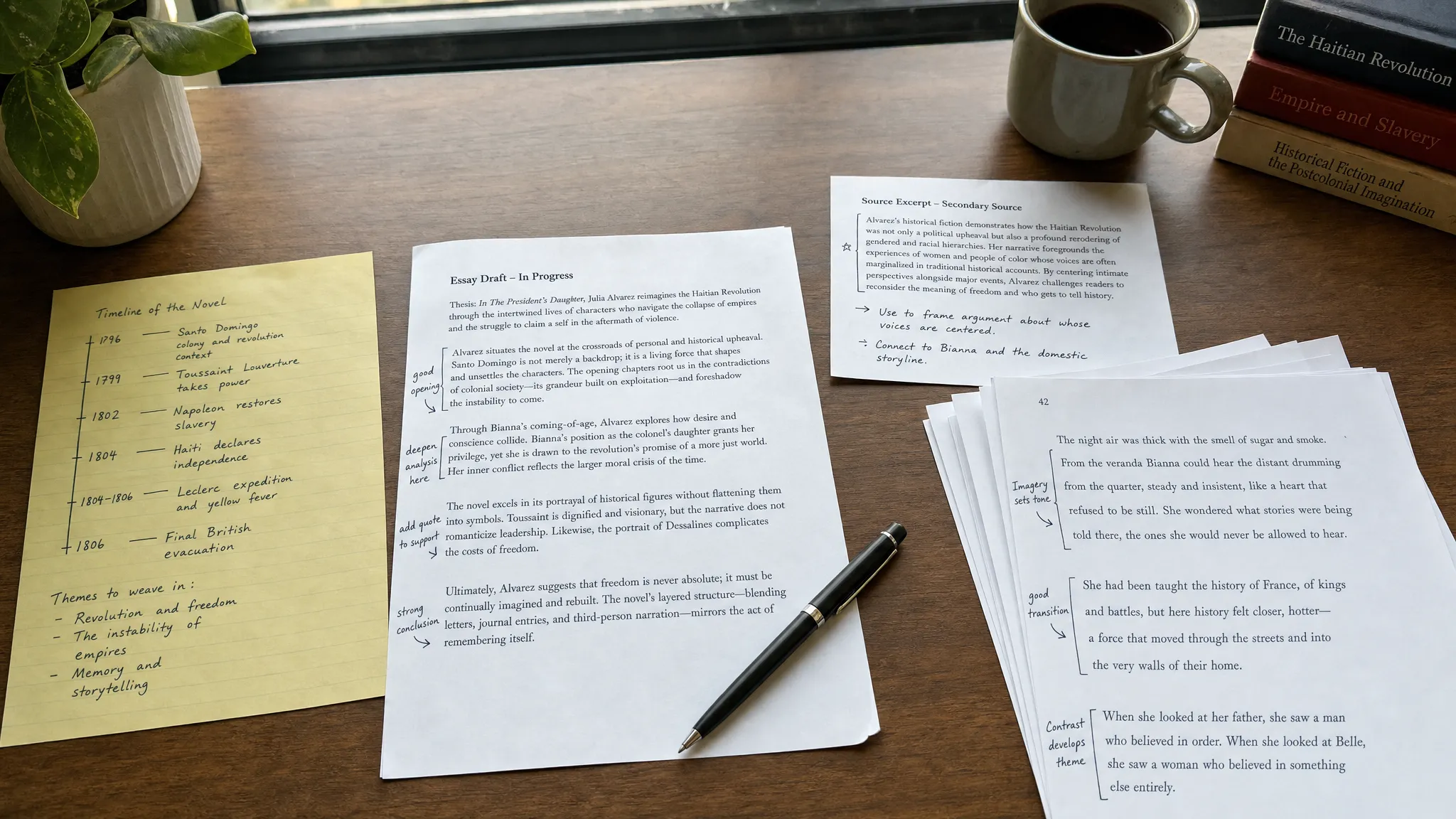
Yes, a human-written essay can still look AI generated. That does not mean you cheated, and it does not mean an AI content detector has proof of authorship. It means the finished text contains patterns the detector, or a human reader, associates with AI-generated content.
Want to bypass Turnitin in 2026? Grab the free prompt pack.
Get the exact text-humanization prompts I use to drop an AI score by hand — copy, paste, submit. Free, straight to your inbox.
Send me the free prompts →This matters because students, applicants, freelancers, and professionals are now being judged not only on what they write, but on how “human” their writing appears. A clean, polished essay can become suspicious if it sounds too generic, too evenly structured, or too detached from the writer’s actual process.
The good news: most of the risk is explainable. Better yet, you can reduce misunderstandings without making your writing worse, hiding evidence, or relying on gimmicks.
The short answer: yes, human writing can trigger AI suspicion
AI detection tools do not read your mind, your notes, your browser history, or your intention. Most AI detectors analyze the final text and estimate whether its linguistic patterns resemble text produced by large language models.
That distinction is important. An AI detector is not the same thing as a plagiarism checker. A plagiarism checker looks for overlap with existing sources. An AI detector looks for statistical and stylistic signals, such as predictability, sentence uniformity, generic phrasing, and smooth transitions. For a deeper breakdown, see our guide on the AI detector vs plagiarism checker difference.
Even major AI companies have acknowledged the limits of automated detection. OpenAI discontinued its own AI text classifier in 2023, saying it was no longer available because of its low accuracy, according to its classifier update page. Academic research has also raised concerns about bias and reliability, especially for non-native English writers. Stanford researchers, for example, reported that GPT detectors can be biased against non-native English writing.
So if your essay is human-written but looks AI generated, the question is not “How do I trick the detector?” The better question is: “What signals in my writing are being misread, and how can I show real authorship?”
Why a human-written essay can look AI generated
There is no single AI “fingerprint.” Instead, detectors and readers react to clusters of patterns. Some are common in AI-generated essays, but many also appear in normal student writing.
The essay is too generic for the assignment
Generic writing is the biggest reason a human essay can look AI generated. If a prompt asks you to analyze a specific novel, case study, lecture, experiment, or personal experience, but your essay stays broad, it can resemble AI output.
For example, phrases like “throughout history,” “in today’s society,” “this highlights the importance of,” and “it is crucial to understand” are not wrong. Human writers use them constantly. But when an essay relies on these phrases without specific evidence, context, or original reasoning, it can feel machine-produced.
A human-written essay becomes more credible when it includes details that only come from engaging with the actual assignment: a class concept, a specific passage, a data point, a source limitation, a personal observation, or a mistake you corrected during drafting.
The structure is perfectly symmetrical
Many AI essays follow a balanced pattern: introduction, three body paragraphs, each body paragraph with the same internal rhythm, then a conclusion that restates everything neatly. Human students are also taught this structure, especially in timed writing and early academic courses.
The problem is that overly symmetrical structure can look formulaic. If every paragraph begins with a broad topic sentence, gives one example, explains it in vague terms, and ends with a polished transition, the essay may read like a template.
You do not need to make your writing messy. You do need to make the reasoning visible. Human essays often contain moments of prioritization: “This example matters more than the previous one because…” or “At first, this seems to contradict the thesis, but…” Those moves show judgment, not just fluency.
The sentences have the same rhythm
AI-generated content often has consistent sentence length and cadence. But many careful human writers do this too, especially when they are trying to sound formal.
If every sentence is medium-length, grammatically clean, and emotionally neutral, your essay can feel algorithmic. This is especially common after heavy editing with grammar tools, paraphrasers, or style checkers.
Natural writing usually has more variation. Some sentences are short. Others are longer because the idea is complicated. Some transitions are plain. Some paragraphs contain a sentence that sounds like the writer thinking through the problem rather than simply presenting the final answer.
Grammar tools over-polished the draft
Using tools like Grammarly, Microsoft Editor, or other writing assistants does not automatically mean your essay is AI-written. But aggressive suggestions can smooth out the very quirks that make your writing sound like yours.
Common over-polishing effects include replacing simple wording with formal phrasing, removing contractions everywhere, standardizing sentence structure, and turning direct claims into abstract academic language. If you used an editor and then got flagged, read our guide on what to do if Grammarly triggered Turnitin AI.
The safest approach is to treat grammar tools as assistants, not ghostwriters. Accept fixes that correct real errors, but be cautious with full-sentence rewrites that change your voice.
ESL writing can be misread as AI-like
Non-native English writers often learn academic English through patterns: clear topic sentences, formal transitions, careful grammar, and repeated structures. Unfortunately, those same features can be misread by AI detectors.
This is one reason ESL bias has become such a major concern in AI detection. A polished essay from a multilingual writer may have lower idiomatic variation, fewer casual turns of phrase, and more standardized syntax. That does not make it AI-generated. It may simply reflect how academic English is taught.
If this applies to you, the answer is not to deliberately add errors. Instead, preserve your drafting evidence, keep notes in your own words, and add assignment-specific reasoning that shows your engagement with the material. We cover the research in more detail in our article on AI detection bias against ESL students.
Common signals that make human writing look AI-like
The table below shows how innocent writing choices can be misread and what to do about them.
| AI-like signal | Human-written reason it happens | Better revision approach |
|---|---|---|
| Generic introduction | Student is trying to sound formal or safe | Start closer to the prompt, text, case, or question |
| Repetitive transitions | Writer learned academic templates | Use transitions that reflect the actual logic of your argument |
| Uniform sentence length | Heavy editing or cautious writing | Vary rhythm where the idea naturally requires it |
| Vague examples | Writer understands the topic but has not grounded the claim | Add source details, class concepts, or concrete evidence |
| Overly polished tone | Grammar tool or multiple edits smoothed the voice | Keep clarity, but restore direct phrasing where appropriate |
| No visible uncertainty | Essay presents conclusions without showing reasoning | Explain tradeoffs, limits, or why one interpretation is stronger |
| Formulaic conclusion | Writer repeats thesis because that is how essays are taught | End by clarifying the implication of the argument |
Can Turnitin mark a real essay as AI?
Yes, a real essay can receive an AI writing indicator in Turnitin or another AI content detector. Turnitin describes its AI writing feature as a tool for identifying text that may have been generated by AI, but any detector output still requires interpretation. Turnitin’s own public materials frame AI detection as a feature for review, not a magical authorship witness.
This is why many institutions treat AI scores as a starting point for discussion rather than automatic proof. A 20%, 35%, or even higher score should be evaluated alongside drafts, version history, research notes, assignment context, and the student’s ability to explain the work.
If you are trying to understand what Turnitin actually reports, read our explanation of what Turnitin’s AI highlighting means. If the issue is a specific percentage, our guide on being flagged 35% AI on Turnitin explains what evidence can help.
Human readers can also mistake real writing for AI
This problem is not limited to software. Teachers, editors, recruiters, and clients may also say an essay “sounds like ChatGPT” even when no AI was used.
Human readers usually react to different cues than detectors. They notice blandness, lack of personal investment, missing specifics, and a voice that feels disconnected from the writer. A human reader may not care about perplexity or burstiness, but they will notice if the essay says many correct things without making any distinctive choices.
A human-written essay often feels more authentic when it shows ownership. That might mean explaining why you chose one source over another, acknowledging a limitation, connecting the argument to a class discussion, or using a concrete example instead of a universal claim.
Compare these two versions:
| Version | Example |
|---|---|
| AI-like but possibly human | “Social media has significantly impacted communication by changing how people interact and share information in modern society.” |
| More clearly authored | “In the survey example from Week 4, the biggest change was not that students communicated more, but that they avoided slower conversations that required disagreement.” |
The second version is not more “human” because it has errors. It is more human because it makes a specific interpretive choice.
How to make a human-written essay look more clearly human
The goal is not to outsmart AI detection. The goal is to make your real thinking visible. If your essay is already yours, the strongest improvements usually come from specificity, process evidence, and voice consistency.
Add assignment-specific details
Review each body paragraph and ask: could this paragraph appear in almost any essay on this topic? If the answer is yes, it needs more context.
Strong details can include a quote from the assigned reading, a lecture concept, a page number, a data point from your source, a reference to the exact prompt wording, or a concrete example from your own analysis. Avoid adding random anecdotes just to sound personal. The detail should support the argument.
Show your reasoning, not just your conclusion
AI-like essays often jump from claim to polished explanation without showing the thinking in between. Human writing becomes more convincing when it explains why the evidence matters.
Instead of writing, “This proves the character is isolated,” explain what part of the passage creates that interpretation. Is it the diction? The contrast with another scene? The narrator’s silence? The timing of the event? That reasoning is hard to fake and easy to defend.
Keep your natural voice where it helps clarity
Some students accidentally remove their voice because they think academic writing must sound distant. But a strong essay can be formal and still sound authored.
You can use direct phrasing like “I argue,” “this matters because,” or “the stronger reading is” if your instructor allows first person or analytical signposting. Even without first person, you can write with a clear point of view instead of hiding behind vague phrases.
For more editing guidance, see our article on what makes writing sound AI generated to real human readers.
Do not intentionally add mistakes
One of the worst myths about AI detection is that you should add grammar errors to look human. That can hurt your grade, weaken your credibility, and still fail to address the real issue.
Human writing is not defined by mistakes. It is defined by judgment, context, and development. A clean essay can be fully human. A sloppy essay can still look AI-generated if it is vague and formulaic.
Keep proof of your writing process
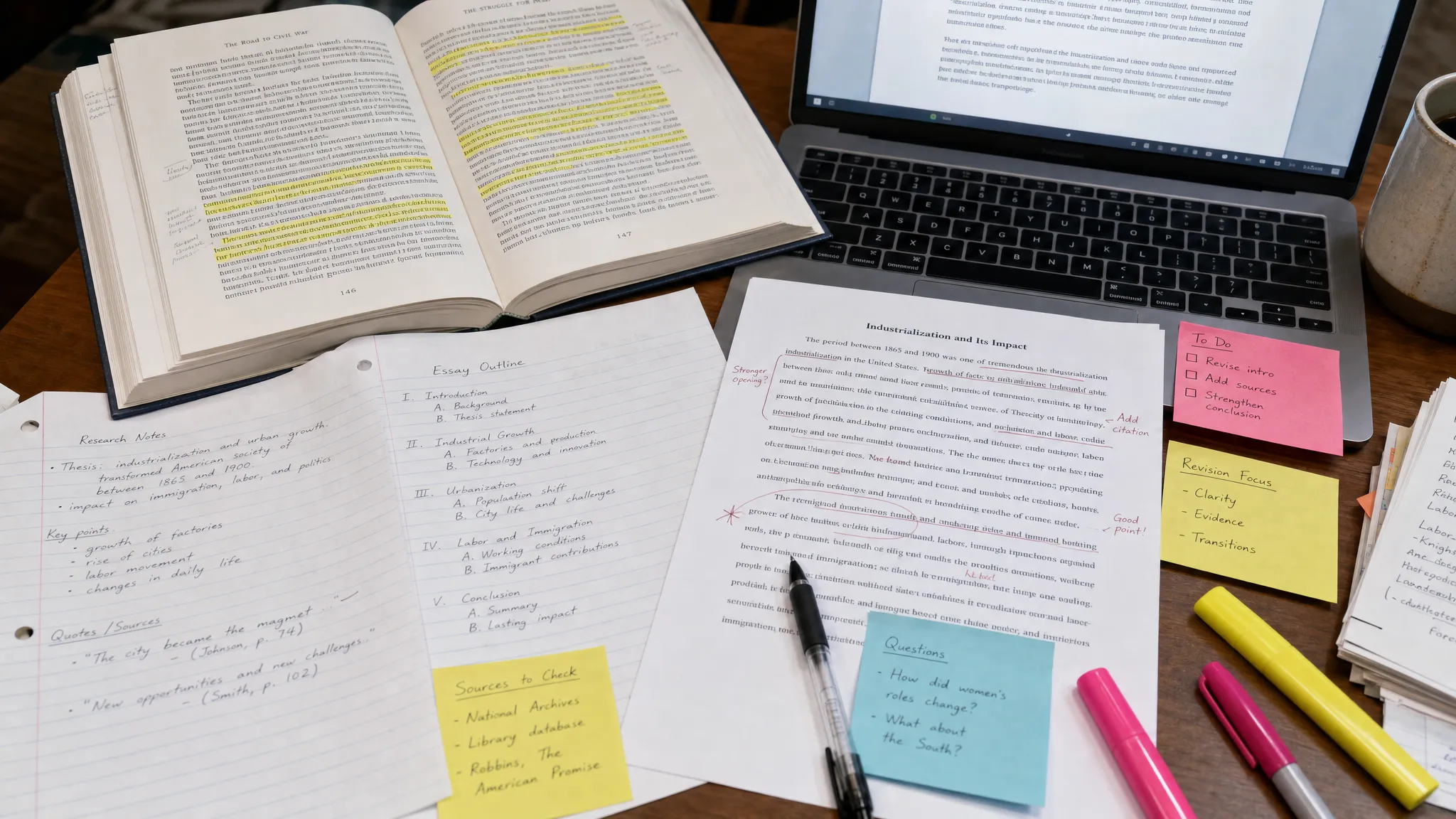
If your work is questioned, evidence matters more than vibes. Save drafts, outlines, notes, source annotations, and version history. If you write in Google Docs or Word with cloud saving enabled, your revision history can show gradual development.
Useful authorship evidence includes:
- The original assignment prompt and rubric
- Brainstorming notes or an outline
- Drafts with timestamps
- Google Docs or Word version history
- Research notes, annotations, or source summaries
- Feedback from a tutor, classmate, or instructor
- A short timeline explaining when and how you wrote the essay
This does not guarantee the dispute disappears, but it gives an instructor something better to evaluate than a detector score. If you want a full template, use our guide on how to build an authorship packet before you submit.
What to do if your human-written essay is already flagged
If your essay has already been flagged, do not panic and do not immediately rewrite the file. Rewriting after the accusation can make the timeline harder to explain. Preserve the exact submitted version first.
Start by saving the submitted document, screenshots of timestamps, version history, notes, and any feedback records. Then ask for the report details, especially highlighted passages if the platform provides them. The highlighted areas help you respond specifically instead of arguing against the entire score.
Next, prepare a short explanation of your process. Keep it factual. Mention when you started, what sources you used, what tools were used if any, and how the essay changed across drafts. If you used a grammar checker, say so honestly and describe the level of assistance.
You can also offer fair verification. That might include discussing the essay live, explaining your thesis and sources, doing a short supervised rewrite, or walking through your version history. These methods are more meaningful than debating whether one AI detector is better than another.
If you need a time-sensitive plan, read Accused of AI Use: What to Do in the Next 24 Hours.
Should you use an AI detector before submitting?
A pre-submission AI detection check can be useful, but only if you treat it as a diagnostic tool. It should not become score-chasing.
Different detectors often disagree because they use different models, thresholds, training data, and text preprocessing. A draft can look safe in one detector and risky in another. That does not automatically mean one is lying. It means the category is probabilistic.
Use AI detection to identify passages that may read as generic or overly smooth. Then revise for clarity, specificity, and evidence. Do not blindly paraphrase every highlighted sentence, because that can introduce awkward phrasing, distort facts, or make your essay less defensible.
For a safer workflow, see our guide to the best pre-submission check for Turnitin AI risk.
Where text humanizers fit, and where they do not
A text humanizer can sometimes help identify stiff phrasing or suggest more natural alternatives. Detection Drama provides free tools and resources for analyzing AI-like writing patterns, including no-email options and humanizer workflows.
But a humanizer should not replace your thinking. If you paste an essay into a tool and submit the rewritten output without reviewing it, you risk losing your voice, damaging citations, changing facts, or creating a version you cannot explain. That can be worse than the original flag.
The safest use is limited and transparent: use tools to spot unnatural passages, compare wording options, and then manually edit the final draft yourself. Protect quotes, citations, data, and specialized terms. If your essay is academic, always follow your course policy on AI assistance.
Frequently Asked Questions
Can a completely human-written essay be flagged as AI? Yes. AI detectors estimate patterns in the finished text. A human-written essay can be flagged if it is generic, highly polished, formulaic, short, or similar to the kind of writing AI tools often produce.
Does an AI detection score prove I used ChatGPT? No. A score is a signal, not direct proof. It should be reviewed with drafts, version history, notes, sources, and your ability to explain the essay.
Why does my essay sound AI-generated if I wrote it myself? It may use broad claims, repetitive transitions, balanced paragraph structure, or over-polished grammar. These are common in human academic writing, but they can also resemble AI-generated content.
Should I make grammar mistakes to avoid AI detection? No. Adding errors is a bad strategy. Focus on specific evidence, visible reasoning, natural sentence variation, and proof of your writing process.
Can Grammarly make my essay look AI generated? It can contribute if you accept large rewrites or style suggestions that make the essay overly smooth and generic. Keep a record of tool use and preserve earlier drafts.
What is the best proof that an essay is mine? The strongest proof is a combination of version history, drafts, outlines, research notes, source annotations, and a clear explanation of your writing process.
Make your authorship easier to see
A human-written essay can still look AI generated, but you are not powerless. The best defense is a draft that shows specific thinking and a process trail that proves how the work developed.
If you want to check whether a draft reads too generic, explore the free guides and tools at Detection Drama. Use them to diagnose AI-like patterns, improve naturalness, and protect your authorship evidence before a detector score becomes a problem.
