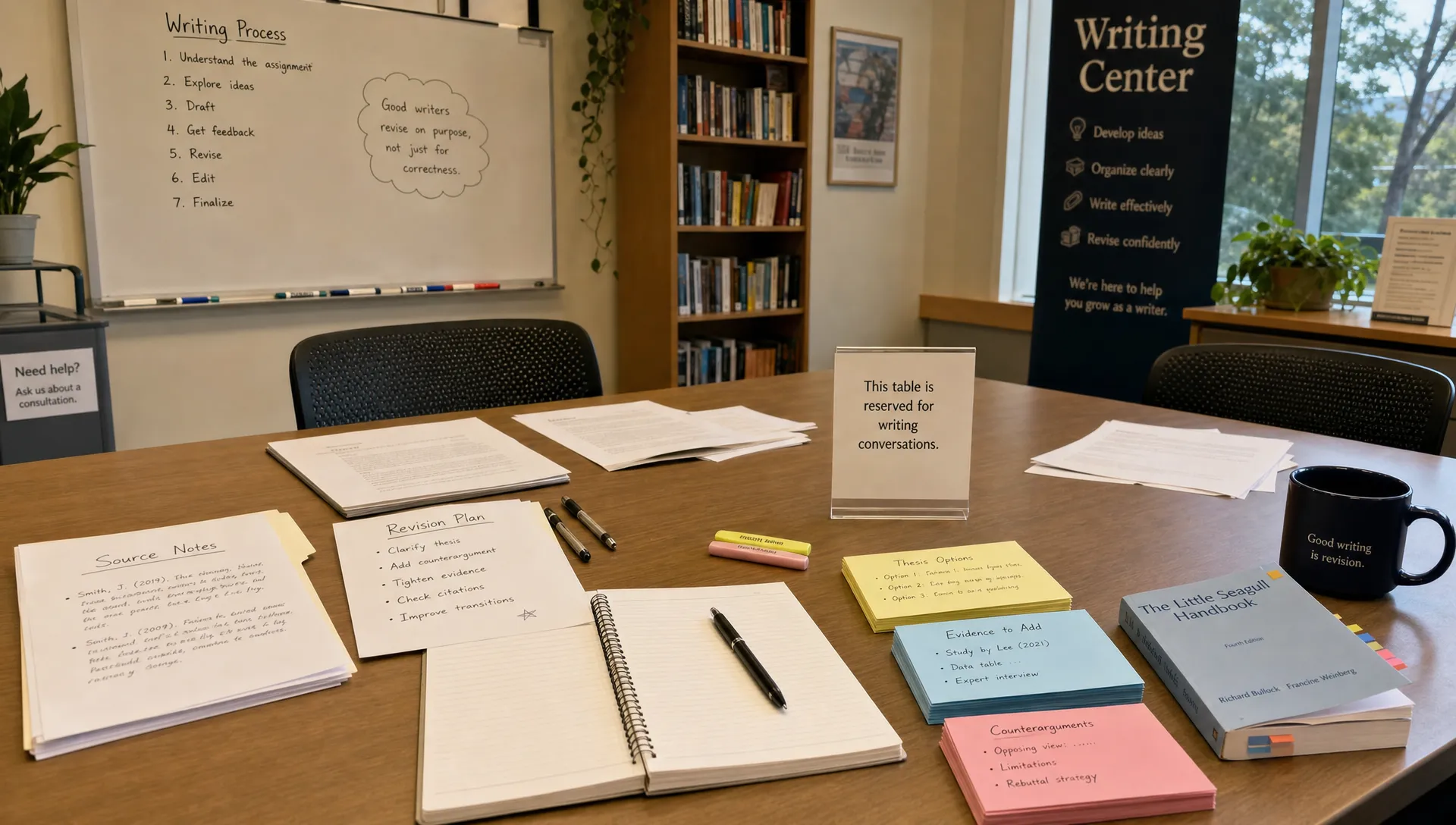
If you want to humanize AI text without a detector, start by changing the goal. A detector score is not the same as a human judgment. The stronger goal is to make the draft read like something you understand, can defend and would actually send under the rules of your class, workplace or publishing context.
That shift matters because detector-focused editing often makes writing worse. People run a paragraph through several AI content detector tools, get conflicting results, then start swapping words until the prose becomes awkward. A better approach is to revise the draft for meaning, specificity, source handling and voice before you worry about software.
Want to bypass Turnitin in 2026? Grab the free prompt pack.
Get the exact text-humanization prompts I use to drop an AI score by hand — copy, paste, submit. Free, straight to your inbox.
Send me the free prompts →Use this workflow for legitimate AI-assisted writing: drafts you are allowed to revise, emails, discussion posts, marketing copy, notes and class work where AI assistance is permitted. If a school, client or employer requires disclosure, follow that policy. Humanizing text should make the writing more honest and more useful, not hide work you were not allowed to outsource.
Why detector-free humanization works better than score chasing
Most AI-looking writing has visible problems before any tool flags it. The claims are broad, the transitions are too smooth, the paragraphs have the same shape and the conclusion repeats the introduction. The writing may be grammatical, but it does not feel anchored in a real person making choices.
An AI content detector is also not proof of authorship. It estimates patterns. Different detectors can return different results for the same passage, and the score can change after small edits. The NIST AI Risk Management Framework emphasizes validity, reliability and transparency when AI systems influence decisions. That is a useful reminder: do not let a black-box score become your editor.
A detector-free process works because it focuses on what real readers notice. Readers look for a clear stance, concrete context, source awareness, uneven but natural rhythm and sentences that sound like they came from someone who knows why each line is there.
| Detector-chasing habit | What often happens | Better detector-free choice |
|---|---|---|
| Running the same draft through multiple detectors | Conflicting scores create panic edits | Use a human read-through checklist first |
| Swapping synonyms everywhere | Meaning shifts and phrasing gets strange | Rewrite around the claim, not the individual words |
| Adding contractions and slang randomly | Tone feels fake or inconsistent | Match the voice to the audience and purpose |
| Shortening every sentence | Prose becomes choppy and mechanical | Vary sentence length based on the idea |
| Rewriting citations with the body text | Sources, quotes and references can break | Protect citations before any rewrite |
The best way to humanize AI text without a detector
The best way to humanize AI text without a detector is to rebuild the draft from the inside out. Start with meaning, then fix structure, then adjust voice. Sentence-level polish comes last.
Start with a meaning lock
Before rewriting, create a short meaning lock. This is a plain-language note that defines what the piece must still say after editing. It prevents the most common humanizer problem: the rewritten text sounds smoother but no longer makes the same point.
Your meaning lock should include:
- The main claim in one sentence
- The intended audience
- Required facts, sources or examples
- Terms that should not be changed
- Any quotes, citations or data that must remain exact
For a deeper workflow, Detection Drama has a guide on using an AI humanizer without changing meaning that expands this idea into a safer editing process.
A meaning lock is especially useful when the original draft includes technical terms, academic claims, legal language or client-approved messaging. Without it, a text humanizer may improve the surface while weakening the substance.
Replace AI-shaped structure with human argument
AI-generated content often follows a predictable structure: broad opener, balanced middle, generic takeaway. That shape feels safe, but it rarely feels owned. A human paragraph usually has a more direct reason for existing.
Instead of asking whether the paragraph sounds natural, ask what job it performs. Does it define a problem, prove a claim, compare options, explain a consequence or make a recommendation? If the paragraph does not have a job, rewrite it or cut it.
AI-shaped: In today's fast-paced world, technology has greatly changed education by making learning more accessible and convenient for students everywhere.
Humanized: Online tools matter most when they remove a specific barrier. For a working student, a recorded lecture is not just convenient; it can be the only realistic way to keep up after a late shift.
The second version is not human because it uses slang or mistakes. It is human because it makes a choice. It narrows the claim, names a real scenario and explains why the point matters.
Add source reality, not decoration
A common AI pattern is source decoration. The draft mentions research, statistics or historical context without showing how the source actually supports the claim. Human writing usually has more friction. It names what the evidence does and where its limits are.
When revising, look for claims that sound confident but unsupported. Add the missing source context or soften the claim. If the evidence is not in your notes, do not invent it. A humanized draft should be more accountable than the AI version, not just less detectable.
If you are working in an academic format, protect citations before rewriting. Do not send reference lists, direct quotes, DOIs, page numbers or parenthetical citations through aggressive rewriting unless you are prepared to verify every character afterward. Detection Drama also covers how to humanize AI text without breaking APA or MLA if your paper needs formal citation handling.
Use your own constraints
Real writing usually carries constraints that AI cannot infer unless you add them. Those constraints make the text more specific and less generic.
For a student, the constraint might be the exact class prompt, a lecture concept, a lab result or a personal interpretation of a reading. For a marketer, it might be the product category, customer objection, brand tone or sales stage. For a professional email, it might be the recipient's concern, the deadline or the decision you need.
Add context only when it is true. Do not fabricate personal experiences, fake sources or pretend you ran tests you did not run. The safest way to sound human is to include real thinking that belongs in the piece.
Fix cadence after content
Once the meaning and structure are solid, revise the rhythm. AI prose often has a polished sameness: medium-length sentences, neat transitions and predictable paragraph endings. Human prose varies because the ideas vary.
Read the draft aloud. Long sentences should carry layered ideas, not filler. Short sentences should land a point, not replace thinking. If every paragraph begins with a transition like furthermore, moreover or in conclusion, remove some of them and let the logic carry the reader.
Do not add typos to seem human. Do not force slang into a formal essay. Do not break grammar on purpose. Natural cadence comes from control, not carelessness.
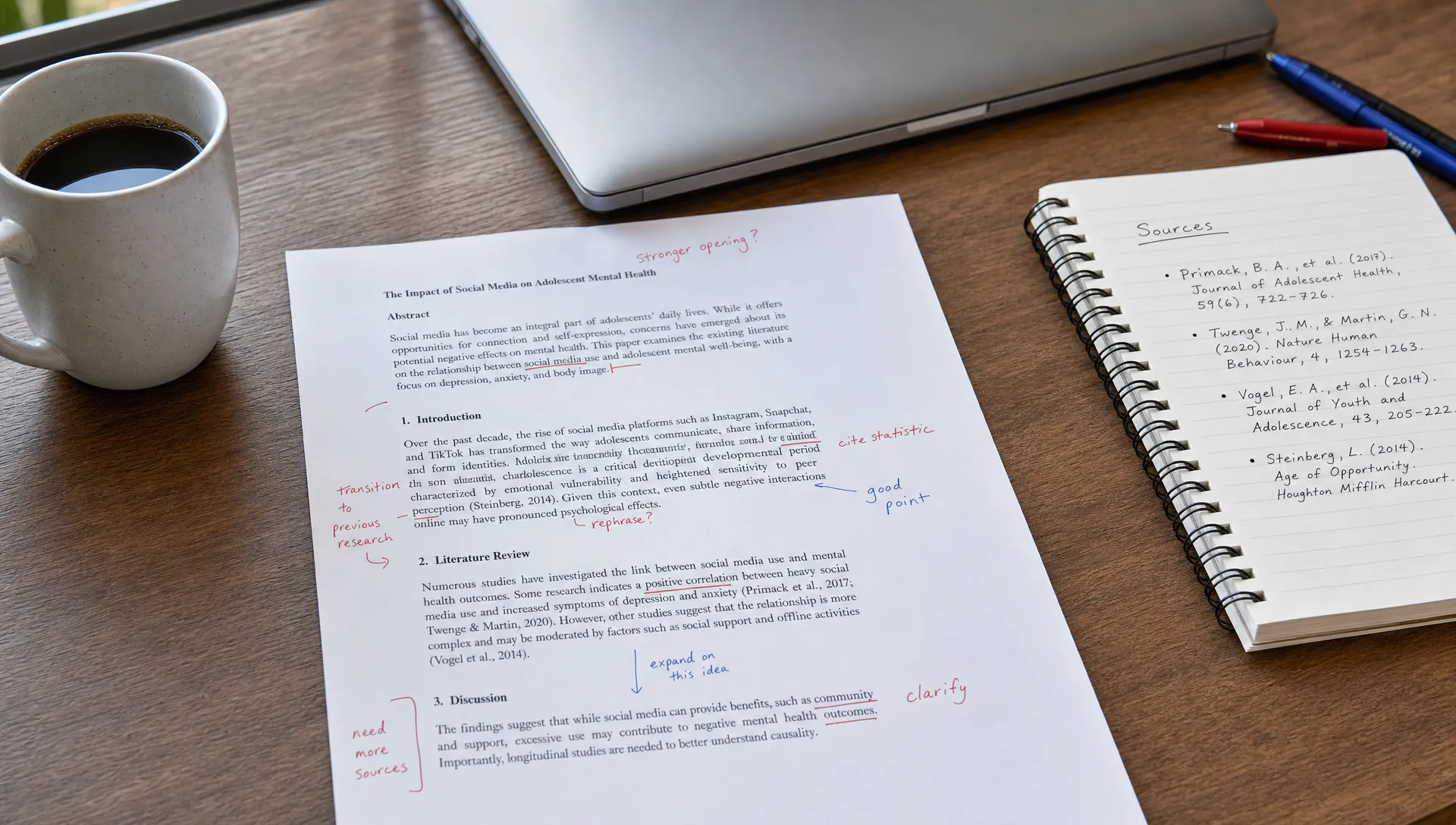
A practical 20-minute humanization pass
If you need a fast workflow, use a timed pass. The point is not to perfect every sentence. The point is to remove the most obvious AI patterns before doing a final proofread.
- Cut the template opener: Delete broad first lines about modern society, technology, history or importance unless they add necessary context.
- Underline the real claims: Mark every sentence that actually advances the argument. If a paragraph has no marked sentence, rewrite it around one clear point.
- Add one concrete detail per paragraph: Use a source detail, example, limitation, comparison or consequence. Keep it relevant and true.
- Replace padded transitions: Swap generic connectors for cause-and-effect language. Instead of additionally, explain how the next idea follows.
- Check every citation and factual claim: Make sure sources still match the sentence they support. Verify names, dates, quotes and page references.
- Read aloud once: Edit the sentences that feel too smooth, too stiff or unlike something you would actually say in that context.
- Do a final purpose check: Ask whether the finished draft answers the prompt, brief or reader need better than the original.
This process works without a detector because it improves the signals that matter to people. If a human reader can see your reasoning, follow your evidence and hear a consistent voice, the writing is already doing the work detector scores try to approximate.
Before and after: what real humanization changes
Humanization is not just paraphrasing. It changes the relationship between the writer, the evidence and the reader.
| Layer | AI-like version | Humanized version |
|---|---|---|
| Claim | Social media has many effects on mental health | Social media is most harmful when it turns comparison into a daily habit |
| Evidence | Research supports this idea | A source should be named, summarized and tied to the exact claim |
| Voice | This topic is important in today's world | The sentence should show why this reader should care now |
| Structure | Three balanced points with equal weight | Stronger points get more space, weaker points get cut or qualified |
| Ending | Restates the introduction | Explains the consequence, recommendation or final judgment |
Here is a simple example.
Draft: Remote work has become increasingly popular in recent years because it provides flexibility and allows employees to have a better work-life balance. It also helps companies reduce costs and improve productivity.
Humanized: Remote work is not automatically better for every team. It helps most when the work is measurable and the team has clear communication habits. Without that structure, flexibility can turn into longer response times and vague expectations.
The humanized version adds judgment. It does not try to sound casual. It makes a narrower claim, adds a condition and acknowledges a tradeoff. Those moves make the writing feel less generated because they show decision-making.
When a text humanizer helps, and when it hurts
A text humanizer can help after you know what the piece should say. It can smooth repetitive syntax, break up robotic phrasing and create a stronger first revision. It is especially useful for short essays, emails, discussion replies and drafts that already have correct facts but sound stiff.
It hurts when you use it as a substitute for thinking. If the original draft is vague, unsupported or off-prompt, a humanizer may produce a better-sounding version of the same weak content. If the draft contains citations, quotes or technical terms, a careless rewrite can also create errors that are worse than an AI detection score.
The safest order is simple: outline the meaning, protect facts and citations, run a controlled rewrite if needed, then manually revise. A tool should shorten the editing process, not remove you from it.
Common mistakes that make AI-assisted text sound less human
Many writers try to humanize AI text by making surface changes. That is why the result still feels artificial. These are the mistakes to avoid:
- Synonym spinning: Replacing common words with unusual alternatives often makes the sentence less clear.
- Fake casualness: Adding anyways, kinda or a lot of contractions can clash with an academic or professional tone.
- Perfect symmetry: Three paragraphs of the same length with the same internal structure often feel generated.
- Empty balance: AI drafts love saying both sides are important without deciding what the reader should do with that information.
- Over-polished certainty: Claims that sound universal need evidence, limits or clearer conditions.
- Citation drift: Rewriting around citations can make a source appear to support a claim it does not support.
The fix is not to make the text messy. The fix is to make the writing accountable. Every paragraph should earn its place.
How to check your work without an AI detector
After revising, check the draft like a reader, not like a machine. A strong human read-through asks whether the piece feels motivated, specific and consistent.
First, explain the main point out loud without looking at the draft. If you cannot do that, the writing probably depends too much on AI-generated structure. Next, read each paragraph and ask what changed for the reader after that paragraph. If the answer is nothing, revise or cut.
Then compare the finished draft to the original prompt or purpose. For a school assignment, did you answer the exact question? For a business email, did you make the decision or request clear? For a blog post, did you give the reader practical value instead of general commentary?
Finally, proofread for the boring things: grammar, formatting, citations, names, dates and links. Human writing is not error-filled writing. It is writing that reflects a person making accurate choices.
Frequently Asked Questions
What is the best way to humanize AI text without a detector? The best way is to revise for human readability instead of chasing a score. Lock the meaning, rebuild paragraphs around real claims, add accurate context, preserve citations and adjust cadence after the substance is clear.
Can humanized AI text still be flagged by an AI content detector? Yes. No workflow can guarantee that every detector will return the result you want. Detectors use probability, thresholds and pattern matching, so focus on producing writing that is accurate, policy-compliant and defensible to a human reader.
Is using a text humanizer plagiarism? A text humanizer is not automatically plagiarism, but it can be misused. If you submit work that violates your institution's or client's AI policy, the problem is the misuse. If you use a tool to revise permitted AI-assisted drafting and keep the ideas, sources and disclosures accurate, it is closer to editing support.
Should I use a plagiarism checker as well as humanizing the text? A plagiarism checker and an AI detector do different jobs. A plagiarism checker looks for overlap with existing sources. If your draft uses research, quotations or paraphrases, checking for proper attribution can be useful even after you humanize the prose.
Do grammar mistakes help AI text pass as human? No. Intentional mistakes usually make writing look careless, not authentic. A better humanization strategy is to add specific reasoning, real examples, source context and a voice that fits the audience.
How do I keep citations intact while humanizing AI text? Separate citations, quotes and reference entries before rewriting. Humanize the surrounding prose in small sections, then verify every citation against the source. Never assume a rewritten sentence still matches the same citation.
Humanize with a workflow, not guesswork
The best way to humanize AI text without a detector is not to trick a tool. It is to turn a generic draft into a piece of writing that has clear meaning, real evidence and a consistent voice.
If you want help with that first rewrite pass, try Detection Drama's free text humanizer. It gives you instant access without email, then you can apply the workflow above to check meaning, sources and tone before you use the final text.
Want to bypass Turnitin in 2026? Grab the free prompt pack.
Get the exact text-humanization prompts I use to drop an AI score by hand — copy, paste, submit. Free, straight to your inbox.
Send me the free prompts →