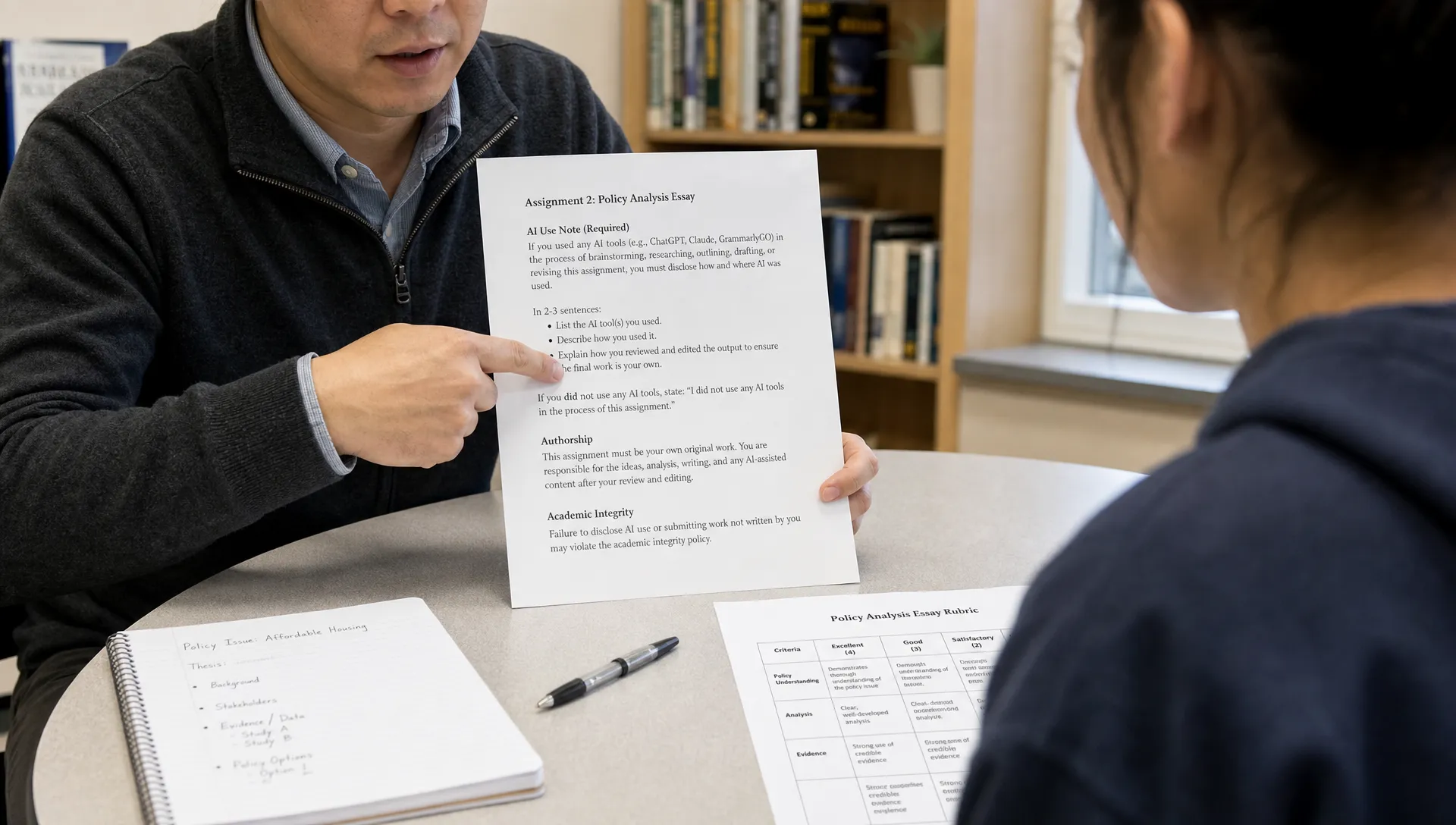
A useful AI disclosure is not a confession, a legal defense or a full transcript of every prompt you typed. It is a short note that tells your instructor what role AI played in the assignment and what work remained yours.
That distinction matters because many students overcorrect. They write half a page explaining that they used ChatGPT only for ideas, that they were tired, that they checked Turnitin or that they promise the paper is still their own. The extra detail can make a normal, permitted use of AI sound suspicious. It can also distract from the actual assignment.
The goal is simple: disclose AI use in an assignment clearly enough to satisfy the policy, but briefly enough that the note does not become the focus of the submission.
Want to bypass Turnitin in 2026? Grab the free prompt pack.
Get the exact text-humanization prompts I use to drop an AI score by hand — copy, paste, submit. Free, straight to your inbox.
Send me the free prompts →Why a concise AI disclosure matters
AI policies in 2026 are more specific than they were a few years ago, but they are still inconsistent from one course to another. One professor may allow AI for brainstorming and grammar edits. Another may ban AI-generated content but allow a spelling checker. A third may require an AI use statement with every submission, even if the use was minor.
A good disclosure helps your instructor understand authorship. It shows that you know the difference between using AI writing tools for support and submitting AI-generated content as if it were entirely student-written. It also gives you a cleaner record if a detector, plagiarism checker or Turnitin report raises questions later.
What it does not do is erase a policy violation. If the assignment said no AI and you used AI to draft the work, a polished disclosure will not make that use acceptable. In that situation, the honest move is to speak with the instructor before submitting or ask how to revise the assignment within policy.
If you want a broader process for staying inside course rules, Detection Drama has a practical guide to a safe AI writing workflow for college that focuses on drafts, proof and policy instead of last-minute panic.
Start with the assignment policy, not the tool
Before writing any AI disclosure, look for the rule that actually applies. Check the syllabus, assignment prompt, learning management system announcement and any department academic integrity policy. Do not assume that because one class allows ChatGPT, another class will treat it the same way.
Most course rules fall into one of four categories:
- No AI use allowed means you should not use AI for brainstorming, drafting, rewriting or editing unless the instructor explicitly creates an exception.
- Limited AI use allowed means the instructor permits specific tasks such as idea generation, grammar correction or formatting help, but not writing original analysis.
- AI use allowed with disclosure means you can use AI as part of your process, but you must state how it contributed to the work.
- AI use required or assigned means the assignment is partly about using AI, evaluating its output or reflecting on its limitations.
If the policy is unclear, ask a narrow question. Instead of asking whether AI is okay, ask whether a specific use is permitted. For example: Can I use an AI tool to suggest possible counterarguments if I write and source the final analysis myself? That question gives the instructor something concrete to answer.
The four-part disclosure formula
A concise disclosure usually needs four pieces of information: tool, purpose, scope and responsibility. You do not need a dramatic explanation if those parts are clear.
- Tool identifies what you used, such as ChatGPT, Claude, Grammarly, Copilot or another AI writing assistant.
- Purpose explains the task, such as brainstorming, outlining, sentence-level clarity, translation support or feedback on organization.
- Scope states how much of the assignment was affected, such as the introduction only, the outline, selected sentences or all sections for grammar review.
- Responsibility confirms what you did yourself, such as selecting sources, writing the final argument, checking facts or revising the final text.
A simple version looks like this:
I used ChatGPT to generate possible counterarguments and to review sentence clarity in two paragraphs. I wrote the final analysis, selected the sources and verified all claims myself.
That is enough for many assignments. It names the tool, explains the use, limits the scope and protects the authorship boundary without turning the note into a personal essay.
What to include and what to leave out
The easiest way to avoid overexplaining is to focus on the academic relevance of the AI use. Your instructor needs to know whether AI contributed to ideas, structure, wording, research or final expression. They usually do not need to know what time you used the tool, how many tabs were open or whether you were anxious about the deadline.
Use this table to calibrate the level of detail:
| AI use | Good disclosure | Too much detail |
|---|---|---|
| Brainstorming | I used ChatGPT to brainstorm possible topics and chose the final topic myself. | I asked ChatGPT for ten ideas, rejected most of them, felt unsure about one and then changed my mind after dinner. |
| Outline support | I used an AI tool to compare two possible outlines, then created the final structure. | I pasted the entire assignment prompt into the tool and kept asking it to make the outline sound more academic. |
| Grammar and clarity | I used Grammarly to identify grammar issues and improve sentence clarity. | I ran the paper through several tools, changed some commas and checked whether it sounded human. |
| Draft feedback | I used Claude to identify unclear transitions in a draft I had already written. | I uploaded my whole paper multiple times and asked whether it would pass an AI detector. |
| AI-generated wording | I used ChatGPT to draft sample wording for part of the introduction, which I revised and fact-checked before submission. | The AI gave me language, but I changed enough of it that it is basically mine now. |
Notice the pattern. The stronger versions are specific but unemotional. They describe the role of AI in the assignment. They do not argue with an imaginary accusation.
Short disclosure templates you can adapt
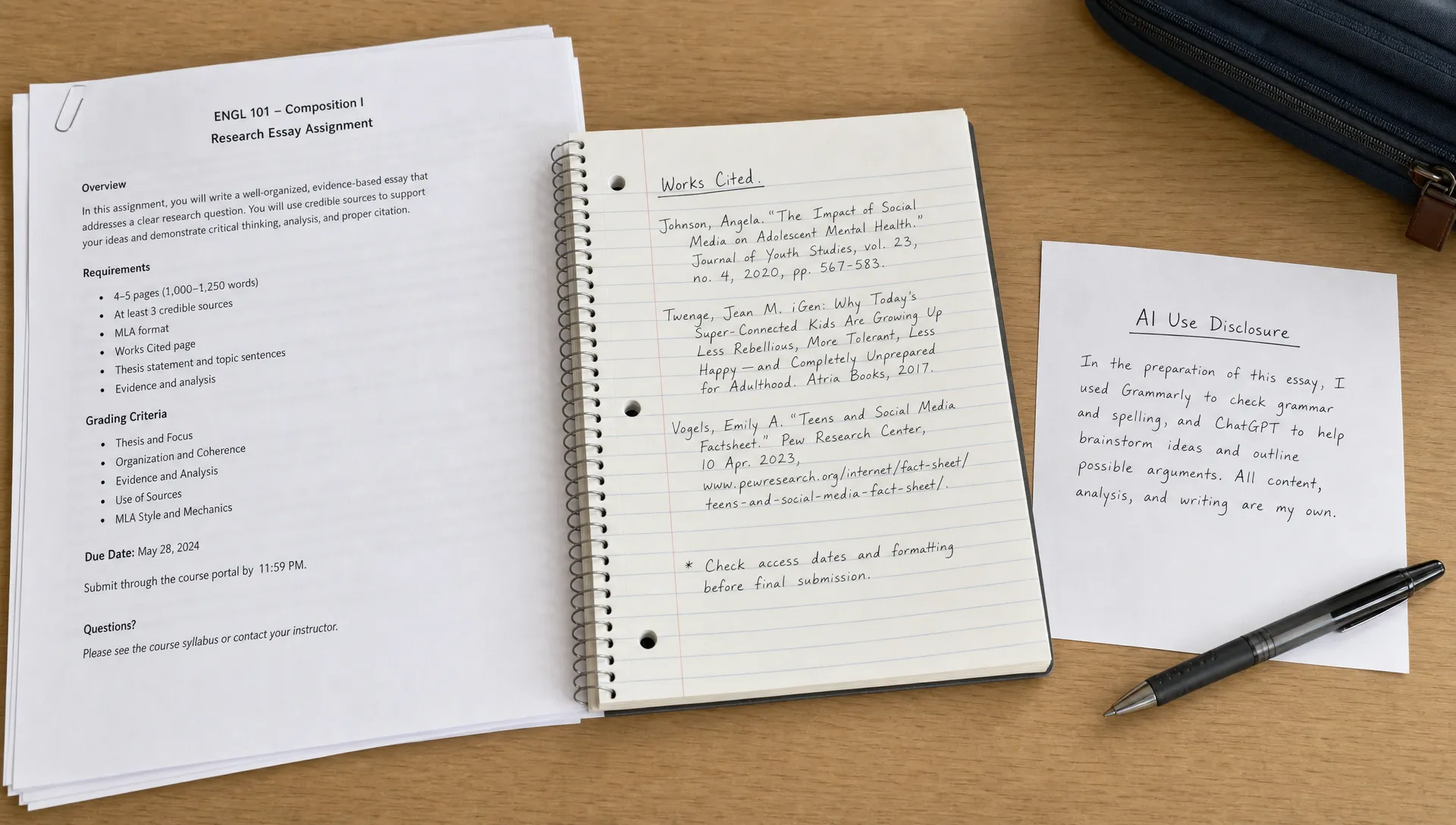
Templates are useful, but do not paste one that says more than your actual use. A disclosure that exaggerates your involvement can be as misleading as one that hides AI involvement.
Minimal disclosure for brainstorming
I used ChatGPT to brainstorm possible angles for this assignment. I selected the final topic, developed the argument and wrote the submitted paper myself.
Disclosure for outlining
I used an AI writing tool to compare possible outline structures before drafting. The final thesis, evidence, organization and wording are my own.
Disclosure for grammar or clarity only
I used Grammarly to identify grammar, punctuation and clarity issues. I reviewed each suggestion and made the final edits myself.
Disclosure for feedback on a student-written draft
I used Claude to identify places where my draft needed clearer transitions and stronger topic sentences. I revised the final version myself and verified the accuracy of all sources.
Disclosure when AI helped generate sample wording
I used ChatGPT to draft sample wording for a small portion of the introduction. I revised that text substantially, checked it against my sources and wrote the rest of the assignment myself.
Disclosure when the instructor asks for prompts
I used ChatGPT for brainstorming and organization feedback. The prompts and outputs are included in the appendix as requested, and the submitted analysis is my own final work.
If your AI use was more extensive than these examples, say so directly. A short honest disclosure is better than a vague one that collapses under follow-up questions.
Where to put the AI disclosure
The correct location depends on the assignment instructions. If your professor gives a required format, follow it exactly. If not, place the disclosure somewhere visible but not disruptive.
Common locations include an AI use statement after the conclusion, a note before the references, a footnote on the first page, a cover sheet field or an appendix. For longer projects, an appendix makes sense if you must include prompts and outputs. For a short essay, one brief note near the end is usually cleaner.
Do not mix up an AI disclosure with a citation. A disclosure tells the instructor how AI supported your process. A citation points to a source used in the work. If you quote or reproduce AI output, your style guide or instructor may require a formal citation. The APA Style guidance on citing ChatGPT and the MLA Style Center guidance on generative AI both address situations where AI output itself becomes part of the work.
For most ordinary assignments, you should not treat AI as a factual authority. If ChatGPT suggests a claim, statistic or source, verify it through a reliable source before using it. AI tools can produce plausible wording around false or misremembered information.
How to avoid sounding defensive
Overexplaining usually happens when a student tries to pre-answer every possible suspicion. That instinct is understandable, especially when AI detection feels unpredictable, but it can make the disclosure harder to trust.
Avoid these phrases unless they are directly required by the prompt:
- I only used AI a little.
- I checked an AI detector and it said the paper was fine.
- I did not use AI to cheat.
- I changed the wording so it would sound more human.
- The AI did not really do anything important.
- I used it the same way everyone else does.
Replace defensiveness with specificity. Instead of saying AI did not do much, say what it did. Instead of saying the work is human, say what parts you created, verified and revised.
A disclosure should not ask the instructor to trust your intention. It should make your process understandable.
If you used more AI than allowed
If you realize before submission that your AI use went beyond the policy, do not try to fix the problem by writing a clever disclosure. The safer choice is to revise the assignment so it complies with the rule, ask for clarification or contact the instructor before the deadline if possible.
For example, if the policy allowed grammar help but you used AI to write half the essay, a disclosure saying AI helped with wording is not accurate. You may need to rebuild the assignment from your own outline, sources and notes. Keep the earlier version, but do not submit it as if the authorship problem disappeared.
If you have already submitted and are now being questioned, gather your drafts, version history, notes, source annotations and any AI logs that show what happened. Detection Drama’s guide on what to do if you are accused of AI use in the next 24 hours explains how to preserve evidence before memories and files become harder to reconstruct.
AI detectors, Turnitin and disclosure
A disclosure is not written for an AI content detector. It is written for a human reader who needs to understand how the work was produced. That difference matters.
AI detection tools estimate patterns associated with AI-generated content. They do not observe your writing process. Even Turnitin’s AI writing detection materials frame the tool as part of an instructor review process, not as a standalone account of authorship. If you want to understand what these reports can and cannot prove, start with Detection Drama’s breakdown of what AI detector reports actually show.
This is another reason not to overexplain. A long note about detectors can make the disclosure look like it was written to manage suspicion rather than to follow policy. Keep the AI statement focused on process. Keep your drafts and notes as separate proof of authorship in case anyone asks.
A final checklist before you submit
Before turning in the assignment, read your AI use statement once as if you were the instructor. Ask whether it answers the practical questions without adding unnecessary drama.
A strong disclosure should pass this checklist:
- It names the AI tool or tool category.
- It describes the specific task AI performed.
- It identifies the affected part of the assignment.
- It explains what work you completed yourself.
- It matches the actual course policy.
- It does not mention AI detector scores unless the instructor asked.
- It does not include excuses, emotional context or unrelated details.
If the statement is longer than the assignment paragraph it refers to, cut it down. Most AI disclosures can be one to three sentences unless the instructor asks for prompts, outputs or a reflection.
Frequently Asked Questions
Do I need to disclose AI use if I only used grammar suggestions? Follow your course policy. If the policy requires disclosure for any AI tool, mention it briefly. A simple sentence such as I used Grammarly for grammar and clarity suggestions is usually enough.
Should I include the exact prompts I used? Only include prompts if the instructor, assignment or department policy asks for them. Otherwise, summarize the purpose and scope of the AI use in a short statement.
Can an AI disclosure protect me from Turnitin or an AI detection flag? A disclosure does not override a course policy or guarantee that a detector will not flag the work. It does help document your process, especially when combined with drafts, notes and version history.
What if I used AI to write a paragraph and then rewrote it? Say that AI helped draft sample wording and that you revised it. If the policy bans AI-generated wording, you may need to rewrite that section from scratch or ask the instructor how to proceed.
Is it better to say AI was used for inspiration only? Only say that if it is true. Inspiration is vague, so it is better to name the actual use, such as brainstorming topics, comparing outlines or identifying unclear sentences.
Build a cleaner submission trail next time
The easiest AI disclosure to write is the one supported by a clean process. Start with the policy, draft in your own document, keep version history on, save research notes and record any AI use as it happens. Then your final disclosure becomes a quick summary instead of a stressful reconstruction.
If you use Detection Drama to understand AI writing risks, pair that knowledge with transparent academic practice. The best outcome is not a longer explanation. It is a short, accurate statement backed by work you can stand behind.
Want to bypass Turnitin in 2026? Grab the free prompt pack.
Get the exact text-humanization prompts I use to drop an AI score by hand — copy, paste, submit. Free, straight to your inbox.
Send me the free prompts →