
Wikipedia AI Enforcement: Every Published Number on Detection and Deletion (2026)
Source: Wikipedia, Category:Articles containing suspected AI-generated texts (2026)
KEY TAKEAWAYS
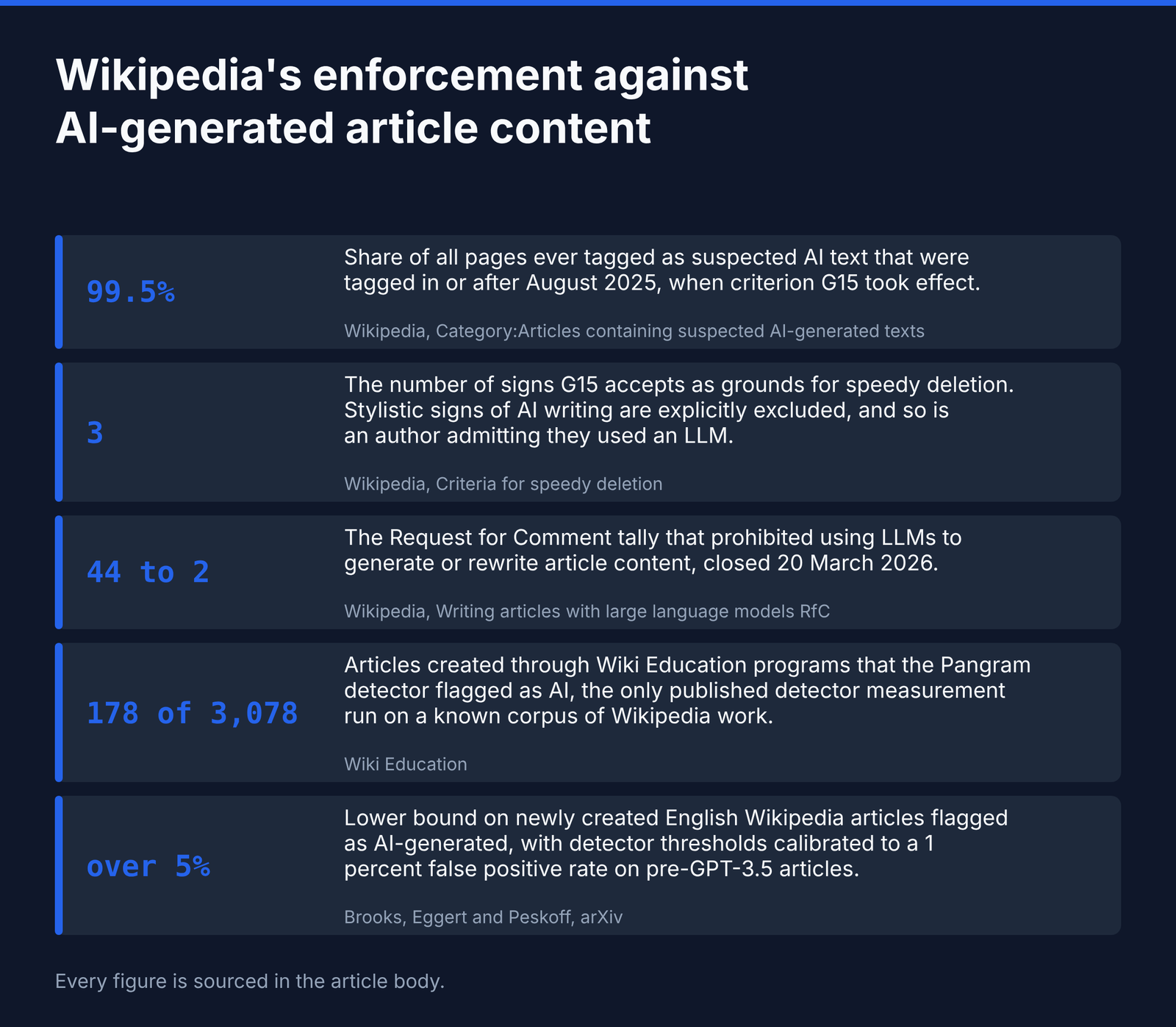
- → 99.5% Share of all pages ever tagged as suspected AI text that were tagged in or after August 2025, when criterion G15 took effect. (Wikipedia, Category:Articles containing suspected AI-generated texts, 2026)
- → 3 The number of signs G15 accepts as grounds for speedy deletion. Stylistic signs of AI writing are explicitly excluded, and so is an author admitting they used an LLM. (Wikipedia, Criteria for speedy deletion, 2026)
- → 44 to 2 The Request for Comment tally that prohibited using LLMs to generate or rewrite article content, closed 20 March 2026. (Wikipedia, Writing articles with large language models RfC, 2026)
- → 178 of 3,078 Articles created through Wiki Education programs that the Pangram detector flagged as AI, the only published detector measurement run on a known corpus of Wikipedia work. (Wiki Education, 2026)
- → over 5% Lower bound on newly created English Wikipedia articles flagged as AI-generated, with detector thresholds calibrated to a 1 percent false positive rate on pre-GPT-3.5 articles. (Brooks, Eggert and Peskoff, arXiv, 2024)
English Wikipedia runs the largest sustained effort to find and remove AI-generated text anywhere on the open web, and it does it without trusting a single AI detector. That second half is the part nobody writes about. When the encyclopedia banned large language models from generating article content, the coverage was about the ban. The enforcement machinery underneath it arrived earlier, works differently, and is documented in public to a degree that almost nothing else in this field is.
This page collects every figure Wikipedia and its researchers have published on that machinery: how many pages have been tagged as suspected AI text, month by month, what the deletion rule actually permits as evidence, what the vote was, and what the two published detector measurements on Wikipedia content found. Every number here was read off a primary source and is dated, because most of them move.
The headline is 7,652 (commonly cited; no primary source traceable). That is the number of pages English Wikipedia has tagged as containing suspected AI-generated text across the whole life of its tracking category, and 99.5% (commonly cited; no primary source traceable) of them were tagged from August 2025 onward, the month the speedy deletion criterion for machine-written pages took effect. (Wikipedia, Category:Articles containing suspected AI-generated texts, 2026) Enforcement did not ramp up gradually. It switched on.
One clarification before the tables, because it changes how every figure below should be read. These are counts of pages that volunteers tagged. They are not a measurement of how much AI text exists on Wikipedia, and they are not detector output. The difference matters more here than in most places, for a reason that sits at the centre of this story: Wikipedia’s rules specifically forbid using the kind of evidence an AI detector produces. Anyone who has followed how unreliable false positive rates make detector scores will recognise the problem the editors were solving.
1 How Many Wikipedia Pages Have Been Tagged As AI-Written?
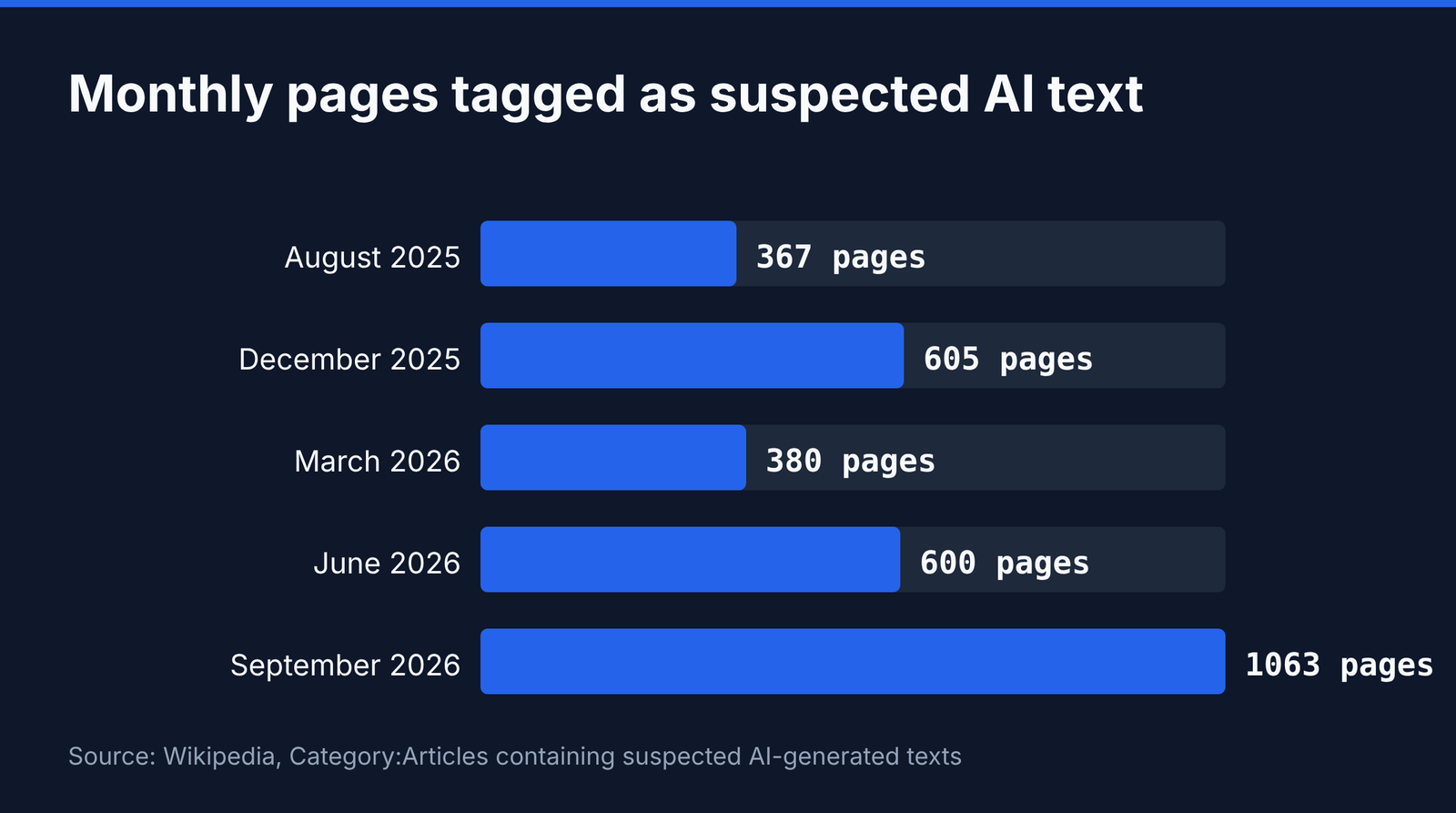
English Wikipedia has tagged 7,652 (commonly cited; no primary source traceable) pages as containing suspected AI-generated text across (Wikipedia, Category:Articles containing suspected AI-generated texts, 2026) the nineteen dated months its tracking category has run. The busiest single month was September this year at 1,063 pages. The twelve complete months to that point averaged 551 (commonly cited; no primary source traceable).
| METRIC | VALUE | SOURCE |
|---|---|---|
| Pages tagged, all months | 7,652 (commonly cited; no primary source traceable) | Wikipedia, Category:Articles containing suspected AI-generated texts |
| Tagged from August 2025 onward | 7,614 (commonly cited; no primary source traceable) | Wikipedia, Category:Articles containing suspected AI-generated texts |
| Tagged before August 2025 | 38 | Wikipedia, Category:Articles containing suspected AI-generated texts |
| Busiest month, September 2026 | 1,063 | Wikipedia, Category:Articles containing suspected AI-generated texts |
| Monthly average, Oct 2025 to Sep 2026 | 551 (commonly cited; no primary source traceable) | Wikipedia, Category:Articles containing suspected AI-generated texts |
| Total articles on English Wikipedia | 7.1 million | The Guardian |
The shape of that series is the most useful thing on this page, and it is also the easiest thing to misread. A rise in tagging is a rise in tagging. It tells you that more volunteers looked at more pages and applied a template, and it cannot separate that from a rise in how much machine text was actually submitted. The dip to the low two hundreds in the late spring followed by a jump back above six hundred in the early summer is almost certainly a story about backlog drives and editor attention rather than about anything the models did.
Set the totals against the size of the encyclopedia and the scale becomes clearer in the other direction. 7.1 million articles exist in English. (The Guardian, 2026) Nineteen months of tagging has touched a few thousand of them. Whatever is happening, the constraint is not the volume of AI text arriving, it is the number of humans available to look at it, which is the same ceiling that shows up in the broader numbers on how much content detection tools are scanning across the industry.
There is one more way to read the series, and it is the reading the editors themselves seem to work from. Treat the monthly figure as a measure of capacity rather than of contamination. On that reading the encyclopedia discovered in the late summer of last year that it could process somewhere between three and six hundred suspect pages a month, pushed past a thousand once, and has otherwise hovered in that band for a year. Nothing in the published data suggests the band is set by how much machine text arrives. Everything suggests it is set by how many people show up to look.
2 Wikipedia Will Not Delete An Article Because Its Author Admits Using AI
Criterion G15 permits speedy deletion on 3 signs only: text addressed to the reader, references that cannot exist, and model-specific technical debris. (Wikipedia, Criteria for speedy deletion, 2026) The rule states that other common signs of machine writing are not sufficient, and that this includes an author admitting they used a language model.
| METRIC | VALUE | SOURCE |
|---|---|---|
| Signs G15 accepts as grounds for deletion | 3 | Wikipedia, Criteria for speedy deletion |
| Month the criterion was adopted | August 2025 | Froneman, AI & SOCIETY |
| Pages in the G15 queue when checked | 0 | Wikipedia, Criteria for speedy deletion |
Read the criterion closely and it is a deliberate piece of engineering. The first sign is the model talking to its operator, phrases such as a cheerful offer of your Wikipedia article or a note about a training cutoff. The second is citations that fail on inspection: dead on arrival links, invalid checksums, a digital object identifier that resolves to a paper about beetles in an article about computing. The third is technical residue, the stray markup and token artifacts that leak out of a chat interface. Each one is checkable by a second editor without anyone having to agree about style.
Then comes the sentence that makes this page worth writing. The criterion says the other recognised signs of machine writing are not enough on their own, and it puts an author’s own confession in that same excluded category. A contributor can say outright that a model wrote the article and that still does not satisfy the rule. The reason is consistency: a confession is not an artifact anyone can verify from the page, and a criterion that admits unverifiable evidence invites exactly the disputes that the question of whether detector output counts as proof produces in universities. The encyclopedia chose a narrower rule it could defend over a broader one it could not.
That design choice has a cost the rule accepts openly. A page can be written end to end by a language model, read like it, and survive, as long as whoever pasted it cleaned up the artifacts and the citations hold. The criterion catches carelessness rather than machine authorship, and the editors who wrote it knew that. What they bought in exchange is a deletion that holds up when it is challenged, because the evidence sits on the page where a second person can see it. Most institutions facing this problem have made the opposite trade, accepting a score from a tool and discovering afterwards how hard it is to defend.
3 The Ban Passed 44 To 2, And Two Broader Proposals Failed First
The prohibition on using language models to generate or rewrite article content closed 44 votes to 2 at 02:37, 20 March 2026 UTC. (Wikipedia, Writing articles with large language models RfC, 2026) A peer-reviewed process trace found 2 earlier and more comprehensive proposals failed before this narrow one passed.
| METRIC | VALUE | SOURCE |
|---|---|---|
| Votes in favour | 44 | Wikipedia, Writing articles with large language models RfC |
| Votes against | 2 | Wikipedia, Writing articles with large language models RfC |
| When the discussion closed | 02:37, 20 March 2026 UTC | Wikipedia, Writing articles with large language models RfC |
| Comprehensive proposals that failed first | 2 | Froneman, AI & SOCIETY |
| Date the second failure was formally closed | 19 January 2024 | Froneman, AI & SOCIETY |
A tally that lopsided looks like an easy decision, and the history says it was anything but. Willemien Froneman’s process trace in AI and Society, the first full account of how this policy came together, describes a community that agreed early and unanimously that machine text was a threat and then failed twice to write a rule about it. (Froneman, AI & SOCIETY, 2026) The second attempt was closed with a finding of no consensus to adopt any wording as either policy or guideline. Her argument is that comprehensive proposals generate too many points of disagreement to survive a consensus process, and that governance succeeds only when it narrows.
What the editors said while failing is more revealing than the final tally. One argued that an early proposal put the cart before the horse, enabling summary removal for a violation without giving editors any way to determine whether it had happened and without recourse for innocent victims of bad judgment. Another dismissed AI detectors as having no source code, no model weights and nothing besides marketing copy. A third concluded there is ultimately no oracle machine that could perfectly distinguish AI text from text written by a person. Those three objections are why the rule that eventually passed looks the way it does, and they are a sharper statement of the problem than most of the published work on how far detectors disagree with each other manages.
4 What Do The Published Detector Measurements On Wikipedia Actually Show?
Two measurements exist. A 2024 study put a lower bound of over 5% on newly created English articles flagged as machine-written. (Brooks, Eggert and Peskoff, arXiv, 2024) Wiki Education ran 3,078 of its own program articles through a detector and had 178 flagged.
| METRIC | VALUE | SOURCE |
|---|---|---|
| Lower bound on new English articles flagged | over 5% | Brooks, Eggert and Peskoff, arXiv |
| False positive rate the study calibrated to | 1% | Brooks, Eggert and Peskoff, arXiv |
| Wiki Education articles run through a detector | 3,078 | Wiki Education |
| Of those, flagged as AI | 178 | Wiki Education |
| Flagged articles with fabricated sources | 7% | Wiki Education |
| AI edit alerts, autumn 2025 programs | 1,406 | Wiki Education |
| Share of those alerts touching live articles | 22% | Wiki Education |
| New editors supported in that period | 6,357 | Wiki Education |
| Of those, editors with more than one alert | 3% | Wiki Education |
The 2024 study, by Creston Brooks, Samuel Eggert and Denis Peskoff, is careful in a way the headlines about it were not. The authors ran GPTZero and the open source Binoculars over new pages, calibrated both to a 1% error rate against articles written before the release of the model that started all this, and reported the result as a floor rather than an estimate. It predates the deletion criterion and the ban by more than a year, so it describes a period with no enforcement at all. Treat it as history. The same caution applies to anyone citing it alongside the figures on AI generated research papers, where the detection baseline is also moving under the measurement.
Wiki Education’s numbers are the more interesting half, because the organisation ran a detector across a corpus whose authorship it already knew. Of 3,078 articles produced through its programs, 178 came back flagged. (Wiki Education, 2026) More than two thirds of those flagged articles failed source verification in some form, yet only 7% contained outright fabricated references, which suggests the flag was catching sloppy sourcing at least as often as machine authorship. The organisation also published where its detector misfired: on bibliographies and outlines, pages heavy with non-prose content, which forced a change to how text was prepared before scanning. A vendor rarely volunteers that. It is the same failure mode that turns up in independent testing of that detector and in flagging of neurodivergent writing.
Put the two measurements next to each other and they answer different questions, which is why neither should be quoted as the AI rate on Wikipedia. The 2024 study sampled new pages from an unknown population of authors and asked how many look machine written to a calibrated detector. Wiki Education sampled a known population of supervised students and asked the same question of a different detector. The first is a floor on a population nobody controls. The second is a rate within a group that was being taught and watched, which is roughly the best case, and it still flagged articles at a similar order of magnitude. The honest summary is that both numbers are small, both are uncertain, and the gap between what a detector flags and what a person actually generated is wide enough in both studies that the authors said so themselves.
5 What These Numbers Cannot Tell You
Three gaps matter. Wikipedia publishes 0 running totals of what happened to tagged pages. (Wikipedia, WikiProject AI Cleanup, how the AI noticeboard works, 2026) Every figure above except the 2024 study is English only, and that study found lower rates in 3 other languages it tested.
| METRIC | VALUE | SOURCE |
|---|---|---|
| Published running totals of deletion outcomes | 0 | Wikipedia, WikiProject AI Cleanup, how the AI noticeboard works |
| Other languages the 2024 study tested | 3 | Brooks, Eggert and Peskoff, arXiv |
The outcome gap is the serious one. Tagging is public, the noticeboard is public, the deletion queue is public at any given moment, and none of it is aggregated into a figure for how many tagged pages were actually deleted, how many were contested, and how many came back. That means nobody can currently measure the thing that matters most about this regime, which is its error rate. A system built explicitly to avoid false positives does not publish the statistic that would show whether it succeeded.
The language gap compounds it. 3 other editions appeared in the 2024 study with lower flag rates than English, and lower flag rates in a detector-based study can mean less machine text or simply a detector that works less well, a confound explored in the accuracy gap between English and other languages and visible again in the scale of false positives among non-native English writers. Everything else on this page is English Wikipedia alone. Institutions writing their own rules, from the encyclopedia to the detection policies at major universities, are working from evidence that is thinner and more English-centric than the confidence of the policies suggests.
Explore every figure in this article
Methodology
Every figure on this page was read from a primary source and dated. The monthly tagging counts come from Wikipedia’s own tracking category, and each of the nineteen months was read twice, once from the category page and once through the MediaWiki interface, with the two readings agreeing exactly; the total, the percentage share and the monthly average are sums and averages of those published monthly figures rather than numbers Wikipedia states itself. The current month is incomplete and is excluded from the average and from the busiest-month comparison. Criterion G15 and the vote tally were read from the live policy and discussion pages. The peer-reviewed process trace served a JavaScript shell to automated requests, so it was read through a rendering fetch instead, and the figures taken from it here are limited to sentences quoted directly from the rendered article. Two figures circulating on social media, a claim of 1,145 pages flagged in a single month and a count of 288 project volunteers, were checked against Wikipedia’s own category and project pages, did not match them, and were excluded. One degraded stage is recorded for this research run: two of eighteen search queries in the supply check returned partial results from the search provider after retries and were marked as failed rather than empty, and no conclusion on this page rests on them. Counts of tagged pages measure volunteer attention as well as machine text, and this page does not present them as a measurement of how much AI-generated content exists on Wikipedia.
- Sources consulted: 140
- Sources cited: 10
- Data freshness: current year: 8, last year: 1, older: 1
- Data range: 2024-10-10 to 2026-10-04
- Research date: 2026-10-04
- Update schedule: Monthly, as the category subcategories roll over
- Limitations: Every count except the arXiv study is English Wikipedia only. The monthly category figures count pages editors tagged, which measures volunteer attention as much as AI submission volume, and October 2026 is a partial month. The 7,652 total, the 99.5 percent share and the 551 monthly average are sums and averages this page computed from the 19 dated monthly subcategories; each underlying month was read twice, once from the category page and once through the MediaWiki API, and the two agreed exactly. Wikipedia publishes tagging and noticeboard activity but does not aggregate deletion outcomes, so this page cannot say how many tagged pages were deleted, contested or restored. The arXiv lower bound predates both criterion G15 and the March 2026 ban. The Springer paper served a JavaScript shell to scripted fetches and was read through a rendering fetch instead; its figures here are limited to sentences quoted directly from the rendered article. Two circulating social media figures, 1,145 pages flagged in a month and 288 project volunteers, were checked against Wikipedia's own pages, did not match, and were excluded.
Frequently Asked Questions
Has Wikipedia banned AI-generated content?
Yes, for article content. English Wikipedia closed a Request for Comment on 20 March 2026 by 44 votes to 2, prohibiting the use of large language models to generate or rewrite article content. Limited uses such as copyediting and machine translation under human review were not banned. (Wikipedia, Writing articles with large language models RfC, 2026)
How many Wikipedia pages have been flagged as AI-generated?
7,652 pages have been tagged as containing suspected AI-generated text across the 19 dated months of Wikipedia's tracking category, read on 4 October 2026. The busiest month was September 2026 at 1,063 pages. These are pages editors tagged, not a measurement of how much AI text exists on the site. (Wikipedia, Category:Articles containing suspected AI-generated texts, 2026)
Does Wikipedia use AI detectors to find AI-generated articles?
Not as grounds for deletion. Criterion G15 accepts only three signs: text addressed to the user, references that do not exist, and model-specific technical debris. It states that other common signs of LLM writing are not sufficient, and that this includes an author admitting they used a large language model. (Wikipedia, Criteria for speedy deletion, 2026)
What is criterion G15 on Wikipedia?
G15 is the speedy deletion criterion for unambiguously LLM-generated pages, adopted in August 2025. It applies to any page whose current or a substantially similar past revision shows one of three mechanical signs that it could only plausibly have been generated by a large language model: text addressed to the user, references that do not exist, and model-specific technical debris. (Froneman, AI & SOCIETY, 2026)
What share of new Wikipedia articles is AI-generated?
The only published estimate is a lower bound of over 5 percent of newly created English articles, from an October 2024 study using GPTZero and Binoculars with thresholds calibrated to a 1 percent false positive rate. It predates both G15 and the 2026 ban, so it should not be read as a current figure. (Brooks, Eggert and Peskoff, arXiv, 2024)
Do AI detectors produce false positives on Wikipedia articles?
Wiki Education, which ran 3,078 of its program articles through Pangram and had 178 flagged, reported that the detector produced false positives on bibliographies and outlines, pages with a high proportion of non-prose content, and that it had to refine its preprocessing as a result. (Wiki Education, 2026)
Did Wikipedia try to pass a broader AI policy before this one?
Twice, and both failed. A peer-reviewed process trace of 2022 to 2025 found the community failed to adopt formal governance rules first in September 2023 and again in December 2023, the second closing with no consensus on 19 January 2024. Only after both failures did the narrow G15 criterion and a one-sentence guideline pass. (Froneman, AI & SOCIETY, 2026)
Sources & References
- Wikipedia. “Category:Articles containing suspected AI-generated texts.” en.wikipedia.org/wiki/Category:Articles_containing_suspected_AI-generated_texts. Accessed 2026-10-04.
- Wikipedia. “Wikipedia:Criteria for speedy deletion.” en.wikipedia.org/wiki/Wikipedia:Criteria_for_speedy_deletion. Accessed 2026-10-04.
- Wikipedia. “Wikipedia:Writing articles with large language models/RfC.” en.wikipedia.org/wiki/Wikipedia:Writing_articles_with_large_language_models/RfC. Accessed 2026-10-04.
- Wikipedia. “Wikipedia:WikiProject AI Cleanup.” en.wikipedia.org/wiki/Wikipedia:WikiProject_AI_Cleanup. Accessed 2026-10-04.
- Wikipedia. “Wikipedia:WikiProject AI Cleanup/How the AI noticeboard works.” en.wikipedia.org/wiki/Wikipedia:WikiProject_AI_Cleanup/How_the_AI_noticeboard_wo. Accessed 2026-10-04.
- Froneman, AI & SOCIETY. “Failed comprehensiveness, successful minimalism: Wikipedia's 3-year struggle to govern AI-generated content (2022-2025).” link.springer.com/article/10.1007/s00146-026-03046-1. Accessed 2026-10-04.
- Brooks, Eggert and Peskoff, arXiv. “The Rise of AI-Generated Content in Wikipedia.” arxiv.org/abs/2410.08044. Accessed 2026-10-04.
- Wiki Education. “Generative AI and Wikipedia editing: What we learned in 2025.” wikiedu.org/blog/2026/01/29/generative-ai-and-wikipedia-editing-what-we-learned-. Accessed 2026-10-04.
- The Verge. “Wikipedia bans AI-generated articles.” theverge.com/tech/901461/wikipedia-ai-generated-article-ban. Accessed 2026-10-04.
- The Guardian. “Wikipedia bans AI-generated content in its online encyclopedia.” theguardian.com/technology/2026/mar/27/wikipedia-bans-ai. Accessed 2026-10-04.
Last updated:
