If your SOP was flagged as AI after Grammarly, do not panic: most graduate schools enforce AI rules through a signed attestation and a human reader, not a detector, and grammar checks are a permitted use in the policies that spell it out.
Written by Vlad Ivanov
Runs Detection Drama, which covers AI detectors and humanizers. I am not an admissions officer or consultant, and I ran no detector test for this piece. It is based on published sources (admissions policies from Cornell, Oxford, the University of Maryland, Duke Fuqua and SMU, two peer-reviewed detector studies and Clear Admit’s interviews with admissions officers) and reader reports from 7 Reddit threads, all read on 22 November 2026. Reddit comments are people’s claims, not verified facts.
Last updated: 22 November 2026
Key Takeaways
- Grammar checks are allowed in the policies that name them: Cornell, Oxford and Duke Fuqua all list grammar and spelling tools as a permitted use (Cornell, Oxford).
- Few grad schools name a detector. Maryland’s English department uses Turnitin for Admissions and Fuqua says essays “may also be reviewed using AI-detection tools”. Cornell says it does not rely on detector software as primary evidence.
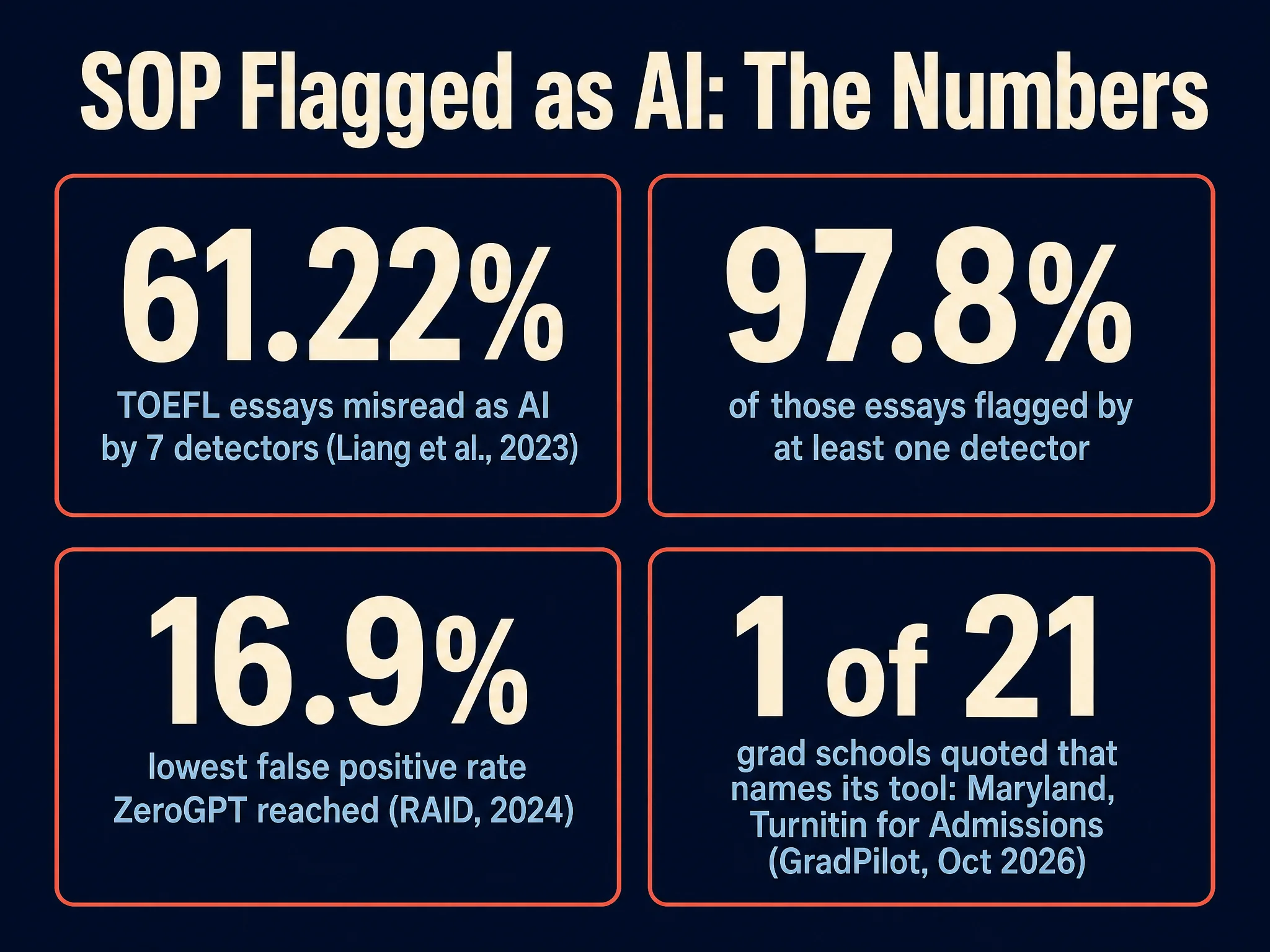
- Detectors misread non-native English: seven tools labeled 61.22% of TOEFL essays as AI on average, and 97.8% were flagged by at least one (Liang et al., 2023).
- ZeroGPT, the free checker most applicants quote, could not get its false positive rate below 16.9% in the RAID benchmark (Dugan et al., 2024).
- A humanizer is the wrong fix for a statement you wrote: it adds AI assistance, which SMU Moody’s attestation rules out entirely.
- Disclosure can be mandatory even for permitted use: Cornell requires a short AI Use Disclosure if you used any GenAI tool, including a grammar tool.
- Keep dated drafts. They answer a false flag better than any score.
My SOP was flagged as AI. Do grad schools actually check?
Some do, most do not with software, and nearly all make you sign something. The enforcement tool at most graduate schools is an attestation that the statement is your own work, backed by a faculty reader who compares it with your writing sample, CV and interview. A detector score you generated at home is not part of that file.
The panic is real, though. On 20 November an applicant to UK universities posted on r/gradadmissions that their self-written personal statement scored 77% AI on ZeroGPT and 32% on Copyleaks after they used AI to paraphrase and shorten sentences. A week earlier another applicant asked whether 47% after Grammarly-only edits was acceptable. The replies were split between “detectors are unreliable” and “committees can tell anyway”, and both are partly right.
Which graduate schools say they use AI detection tools?
Only a handful say so in writing, and each phrases it differently. The University of Maryland’s English graduate admissions page states that “the University of Maryland authenticates submitted materials through TurnItIn for Admissions” (UMD English). Duke’s Fuqua School of Business scans all MBA essays with plagiarism software and adds that essays “may also be reviewed using AI-detection tools” (Fuqua application instructions).
Fuqua’s admissions team said the same out loud. In Clear Admit’s August 2026 roundup of what 23 admissions officers said about AI, Fuqua’s Sieber is quoted: “We do scan for, it can get pinged if it feels overly AI in our system” (Clear Admit). Note the wording: “feels overly AI”. That is a reader’s judgement with a tool behind it, not an automatic rejection at a percentage.
The strongest statement runs the other way. Cornell’s Graduate School, in a policy updated 1 September 2026, says it “does not rely on automated AI-detection software as primary evidence of a policy violation, as such tools can produce inequitable false positives, particularly for non-native English speakers” (Cornell Graduate School). GradPilot’s directory of 21 graduate schools found Maryland to be the only one on its list whose pages describe routine authentication (GradPilot, October 2026). Some universities have gone further and dropped detectors entirely; our list of universities that banned AI detectors tracks them.
| School or unit | Grammar tools allowed? | Says it uses a detector? | Disclosure or attestation |
|---|---|---|---|
| Cornell Graduate School | Yes | No, not as primary evidence | Disclose any GenAI use; attestation at submission |
| University of Oxford (graduate) | Yes (spelling and grammar) | Not stated | Footnote AI used for initial research |
| University of Maryland English (graduate) | Not stated | Yes, Turnitin for Admissions | Not stated |
| Duke Fuqua (Daytime MBA) | Yes (editing and clarity) | “May” use AI-detection tools; plagiarism scan on all essays | Fuqua Honor Code |
| SMU Moody (all graduate programs) | No AI assistance of any kind | Not stated | Attestation: “without any artificial intelligence (AI) assistance” |
Sources: Cornell, Oxford, UMD English, Fuqua, SMU Moody, all read on 22 November 2026. Policies change every cycle, so check your own program’s page.
Is using Grammarly on an SOP allowed?
In the policies that address it, yes. Cornell lists “using grammar- and spelling-correction tools to review your own writing” as permitted. Oxford permits “checking spelling and grammar” and explicitly allows AI tools used to assist with a disability. Fuqua says tools such as Grammarly or ChatGPT “may be used to support editing and clarity, but your ideas, experiences, and responses should be your own”.
The line those policies draw is between checking and rewriting. Cornell prohibits “copying, pasting, or lightly editing AI-generated text and presenting it as your own writing”, and Oxford bans using AI to translate your materials into English. If Grammarly or ChatGPT rewrote whole sentences and you accepted them, that is closer to the prohibited side than a spelling fix. Our explainer on whether using AI to check grammar counts as cheating goes through the same line for coursework.
One school rules out even the checking. SMU’s Moody School asks graduate applicants to confirm they completed the application “without any artificial intelligence (AI) assistance” (SMU Moody). If your program’s attestation is that broad, ask the program what it covers rather than assume grammar tools are exempt.
Why do free detectors flag SOPs written by non-native English speakers?
Because detectors score predictability, and careful second-language writing is predictable. Stanford researchers ran 91 TOEFL essays written by non-native speakers through seven detectors. On average the detectors labeled 61.22% of them as AI, and 97.8% were flagged by at least one detector, while essays by US eighth graders were classified almost perfectly (Liang et al., Patterns 2023; Stanford HAI summary).
A statement of purpose stacks the same risk factors: formal register, standard field terminology and a grammar tool smoothing the rough edges. That is why the r/gradadmissions threads keep coming from international applicants. One applicant to MBZUAI and CSC scholarships said their SOP scored 80% AI after using Claude to fix grammar; an MBA applicant writing in a second language reported 60% to 100% on Pangram after AI grammar fixes. For graduate writing beyond admissions, see our guide to AI detector false positives in graduate writing.
Which detector gave you that score, and how much should you trust it?
Less than the number suggests, especially if it came from ZeroGPT. In RAID, the largest independent detector benchmark, ZeroGPT’s false positive rate bottomed out at 16.9%, meaning roughly one human text in six still came back as AI at its strictest setting (Dugan et al., 2024). Our ZeroGPT vs GPTZero comparison walks through that result and the mid-November 2026 reports of ZeroGPT scores jumping on unchanged work.
The tools also disagree with each other on the same file, which is the clearest sign that no single percentage is a verdict. The UK applicant above got 77% and 32% from two tools on one statement. If you want to know how a stricter, more accurate detector reads your text, our Pangram vs GPTZero comparison covers the two most cited options, and Grammarly’s own AI detector has its own accuracy problems.
Should you humanize or rewrite a flagged SOP?
If you wrote it, no. An AI humanizer rewrites your sentences with another model, so it turns a statement with a grammar check into a statement with substantial AI assistance. Under an attestation like SMU’s, that is the violation you were worried about. Under Cornell’s rules, it is AI-generated text you would have to disclose.
Rewriting by hand to chase a lower score has its own trap. When we put pre-ChatGPT application essays through free detectors for our college essay test, rewriting a flagged line just moved the flag to the new sentence. Applicants report the same: an r/gradadmissions user whose statement had already won admission at top programs found it now scored 100% AI a year later. The writing did not change; the detector did.
The useful edit is the one readers reward anyway: make generic sentences specific. Name the lab, the dataset, the result that failed, the professor whose paper you want to extend. Faculty replies in these threads say the same thing in blunter words; one wrote that profs “would rather see typos than slop” (r/gradadmissions). We cover humanizers for SOP drafts that started as AI output in a separate guide on using an AI humanizer on an SOP; that guide assumes an AI-assisted draft, and it does not change the advice here for a statement you wrote yourself.
What did you actually use on your SOP?
Pick the option closest to your situation for a plain next step. It reads nothing you type and sends nothing anywhere.
What if your recommender or editor ran your SOP through a detector?
Ask what tool they used and what changed in the text before they ran it. One applicant on r/gradadmissions sent their SOP to a professor for a recommendation letter, and the professor ran it through Turnitin and got 89% and 100%. The applicant had paid a Fiverr editor to polish it, and the most upvoted reply asked whether that editor had used AI.
That is the scenario to rule out first. If an editor’s version differs sentence by sentence from your last draft, revert those sentences to your own wording and keep both files. A recommender who has read your other writing can also say so in the letter, which carries more weight than any detector. Our guide on whether Google Docs or Word version history is enough as proof explains what a draft trail can and cannot show.
What should you do before you submit a flagged SOP?
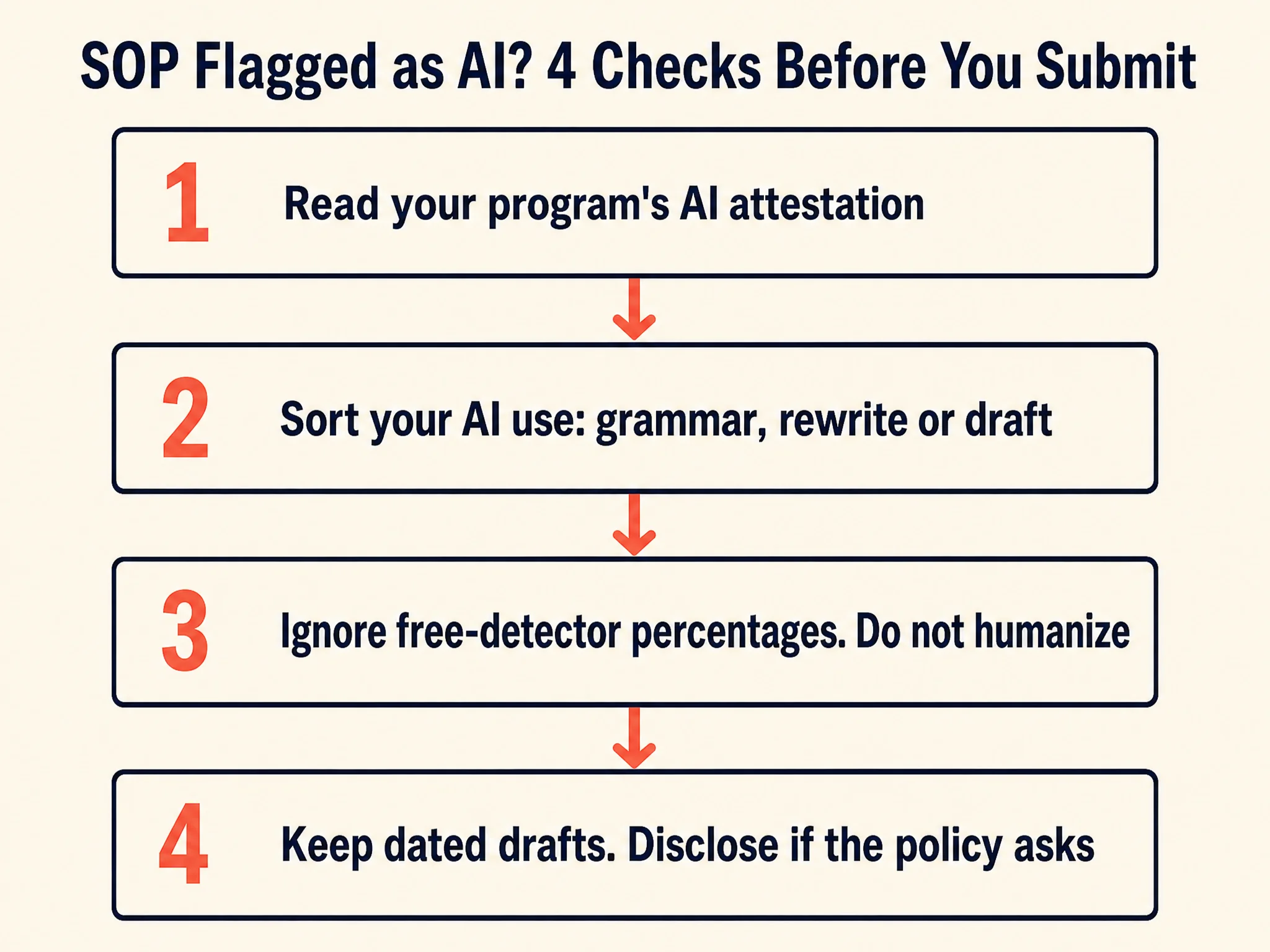
Work through four checks, in this order:
- Read the attestation. It is usually on the final page of the application portal. Cornell and SMU publish theirs; many programs do not, so read it before you change anything.
- Sort your AI use into the three buckets policies use: grammar and spelling (usually allowed), rewriting sentences (often prohibited), drafting (prohibited wherever there is a rule).
- Disclose where the policy asks. Cornell requires a short AI Use Disclosure naming the tool category and purpose. A disclosed permitted use is not a violation.
- Keep dated drafts. Northwestern’s career office advises applicants to save copies of all drafts with their name and draft number in case materials are ever questioned (Northwestern Career Advancement).
The same logic applies in other lanes. If you are applying to medicine, law or UK undergrad, see do medical schools check for AI, our law school AI detector policies and does UCAS check personal statements for AI.
Is a paid SOP review with AI detection worth it?
Only if one credible second opinion will stop you from rewriting a good statement at 2 a.m. Free checkers give you a different number each time; a paid review is useful when it reads the statement against what admissions readers look for and gives one detection result from a stronger model, so you can stop testing.
GradPilot is the option we have reviewed for this. It scores a statement of purpose against a published rubric, and its paid Full Review adds AI detection from Pangram Labs with sentence-level context. Our GradPilot review covers the catches: the $5 Trial gives you no way to switch detection off, and credits expire. One more caution from GradPilot itself: if your program’s attestation forbids AI assistance of any kind, an AI review tool counts too, so follow the attestation.
Want one reliable read instead of five free ones?
GradPilot reviews your SOP against an admissions rubric and, on paid reviews, runs Pangram-based AI detection with sentence-level context.
Get 20% off your first GradPilot purchase
Partner link: new users get 20% off their first purchase. Detection Drama earns a commission at no extra cost to you. That did not change the advice above.
FAQ: SOPs flagged as AI
Do grad schools run statements of purpose through AI detectors?
A few say they may. The University of Maryland English department says it authenticates materials through Turnitin for Admissions, and Duke Fuqua says MBA essays may be reviewed with AI-detection tools. Most graduate schools with a written policy rely on a signed attestation and a human reader instead, and Cornell says it does not use detector software as primary evidence.
Will Grammarly make my SOP get flagged as AI?
It can raise a free detector’s score, because grammar and rewrite suggestions push text toward the smooth, predictable phrasing detectors look for. Applicants on r/gradadmissions report 30% to 60% after Grammarly edits. Cornell, Oxford and Fuqua all name grammar and spelling checks as a permitted use, so the edit itself is usually allowed.
What AI score is acceptable for an SOP?
There is no accepted threshold, because most programs do not publish one and the free tools disagree with each other on the same text. One applicant saw 77% on ZeroGPT and 32% on Copyleaks for the same statement. Judge the statement by your program’s AI policy and by whether it reads like you, not by a percentage.
Should I run my SOP through an AI humanizer?
Not if you wrote it yourself. A humanizer rewrites your sentences with AI, which can breach strict attestations such as SMU Moody’s “without any artificial intelligence (AI) assistance”, and it can flatten the specific details readers look for. Fix generic sentences by hand instead.
Do I have to disclose that I used Grammarly on my SOP?
At Cornell’s Graduate School, yes: any GenAI tool, even for a permitted purpose, must be disclosed in a short note. Oxford asks you to footnote AI used for initial research. Many programs say nothing, so read the application’s certification page before you submit.
My SOP got me admitted last year and now scores 100% AI. What changed?
The detector changed, not your statement. Free detectors update their models without notice, and Reddit users reported ZeroGPT scores on unchanged work jumping in November 2026. An SOP that real committees already admitted is strong evidence it reads as human.
Can my recommender or a paid editor get my SOP flagged?
They can. One applicant’s professor ran the SOP through Turnitin and got 89% and 100% after a Fiverr editor had worked on it, and commenters suspected the editor had used AI. Ask any editor whether they use AI, keep your pre-edit draft, and compare the two.
