Tested by Vlad Ivanov
Runs Detection Drama, which tests AI detectors and essay tools on real text. I am not an admissions officer, counselor or lawyer. On 18 November 2026 I ran two human-written application essays, both from before ChatGPT existed, through the free versions of ZeroGPT and QuillBot. Disclosure: GradPilot gave Detection Drama free review credits for earlier testing, and we earn a commission if you buy through our partner link. ZeroGPT and QuillBot gave us nothing.
Last updated: 18 November 2026
If your college essay got flagged as AI and you wrote every word, you are in a very crowded room this month. So I tested it on writing that cannot be AI: two real application essays written before ChatGPT launched. One came back clean everywhere. The other was flagged by both free detectors I tried, and the two tools flagged completely different sentences. When I rewrote the flagged lines, the score dropped and the flag simply moved to my new sentence.
Partner link: new users get 20% off their first purchase. Detection Drama earns a commission at no extra cost to you.
Watch the test (8 minutes)
You Are Not the Only One: What Applicants Posted This Month
In the 30 days before this test, the same story kept appearing on Reddit. A student wrote an essay without AI and got 100% AI on GPTZero and 0% on ZeroGPT. Another had three UC essays score human and the fourth score 100% AI, after a guidance counselor told them to run checkers. A grad applicant wrote that the more they edited, the higher the AI rating went.
The clearest example came from one applicant who ran a single personal statement through eight detectors, three days before the deadline:
Same essay: 96% on one tool, 0% on two others. That spread is the whole problem. Reddit posts can’t be verified, so I ran my own test on essays whose dates I can prove.
The Test: Two Essays Written Before ChatGPT
| Essay | Source | Length tested |
|---|---|---|
| Essay 1: Common App style personal essay | Johns Hopkins “Essays That Worked”, Class of 2025 (archived), so written by early 2021 | Full essay, 624 words |
| Essay 2: graduate statement of purpose | A PhD statement its author finalized in December 2020 and published online | First ~600 words, headings removed |
ChatGPT launched on 30 November 2022, so neither essay could have been written with it. I am not naming either writer, and supervisor names are blurred in every screenshot.
Rules: free versions, logged out, pasted unedited, all on 18 November 2026. One run per essay per tool. I also tried GPTZero, but its scanner sent me to a captcha I couldn’t get past with automation, so it is not in this test. GradPilot results are from 11 November, when I reviewed both essays as part of my GradPilot vs ChatGPT test.
Result 1: The Personal Essay Passed Everywhere
| Tool | Essay 1 (JHU, 624 words) |
|---|---|
| ZeroGPT | 0% AI GPT, “Your Text is Human written” |
| QuillBot | 0% likely AI (0% AI-generated, 0% AI-refined, 100% human) |
| GradPilot (Pangram), 3 reviews | Clear, Clear, Clear |
If this is your result too, you can stop worrying about detectors and get back to the essay (our UC PIQ test shows what a genuinely AI-written essay looks like by comparison). Essay 2 is where it gets interesting.
Result 2: Two Detectors Flagged the Statement, but Not the Same Sentences
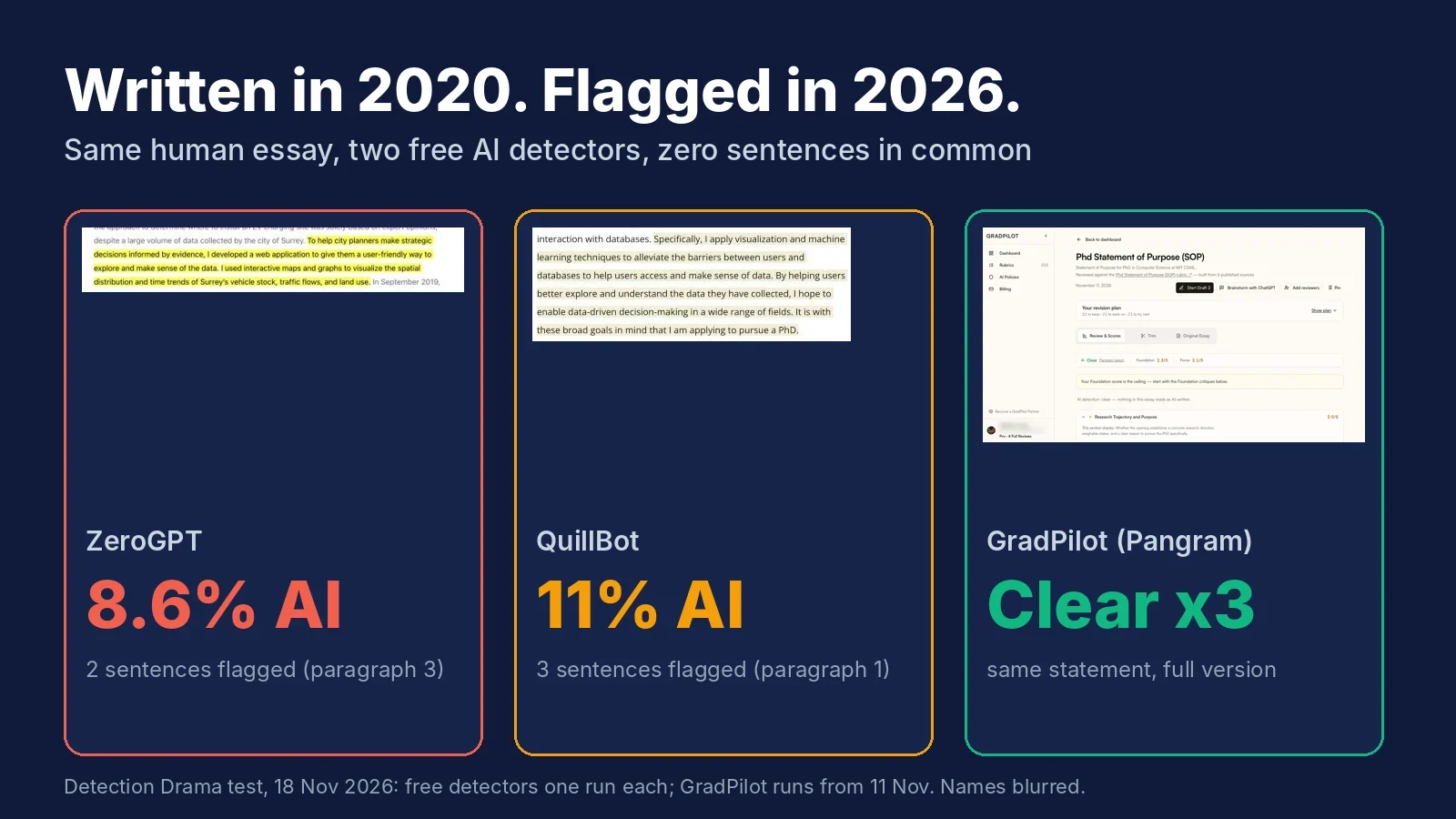
ZeroGPT gave the 2020 statement 8.6% AI. The headline still said “Human written”, but it highlighted two sentences in yellow:
QuillBot gave the same text 11% AI-generated (89% human-written), marked “High probability”, and highlighted a different passage: the three opening sentences, from “Specifically, I apply visualization and machine learning techniques” to “I am applying to pursue a PhD.” Its reasons: overly formal tone and generic language.
| Tool | Score on Essay 2 | Sentences flagged |
|---|---|---|
| ZeroGPT | 8.6% AI (“Human written”) | 2, in paragraph 3 |
| QuillBot | 11% AI-generated | 3, in paragraph 1 |
| Sentences both flagged | 0 | |
| GradPilot (Pangram), full statement, 3 reviews | Clear, Clear, Clear (11 November) | |
If you rewrote this statement to satisfy ZeroGPT, you would be editing different sentences from the ones QuillBot cared about. That is the “reword game” applicants keep describing, and it never ends because each tool is aiming at something different.
The Rewrite: The Score Dropped, and the Flag Moved
Here is the experiment almost everyone is tempted to run. I replaced only the two sentences ZeroGPT flagged with a plainer, more concrete version of the same facts. This is my demo edit, not the author’s words:
Before: “To help city planners make strategic decisions informed by evidence, I developed a web application to give them a user-friendly way to explore and make sense of the data. I used interactive maps and graphs to visualize the spatial distribution and time trends of [the city’s] vehicle stock, traffic flows, and land use.”
After: “The city had years of vehicle, traffic and land-use data and no easy way to look at it, so I built its planners a web app. One map showed where [the city’s] vehicles were registered, how traffic moved through the day, and how each area was zoned.”
ZeroGPT went from 8.6% to 3.3%. Then I looked at the highlight.
The score fell, but the flag moved to my new sentence. That is why chasing 0% can burn your last days before a deadline. It also explains why students end up deleting words like “furthermore” and “consequently” and making their writing worse to please a scanner.
Why Detectors Disagree About Human Writing
An AI detector does not know who wrote your essay. It estimates how predictable the text looks to a model, and each vendor uses its own model, its own training data and its own threshold. Formal, list-heavy, “polished” sentences look predictable, which is exactly how many application essays are written after five rounds of feedback.
- Turnitin’s own numbers: it aims to keep false positives under 1% for documents with over 20% AI writing. In its own words, that means it “might flag a human-written document as having AI writing for one out of every 100 human-written documents”. Below 20% it shows only an asterisk, because false positives are higher in that range. Students usually can’t see their Turnitin AI score at all; instructors and admins can. More in our Turnitin AI detection statistics.
- Non-native writers get flagged more: a Stanford study published in Patterns (Liang et al., 2023) ran seven detectors on TOEFL essays and found an average 61% were wrongly flagged as AI, while essays by US eighth graders were almost never flagged.
- Stronger detectors still miss sometimes: Pangram, the engine inside GradPilot, publishes very low false positive rates and did well in independent tests, yet the applicant above got 83% on Pangram for their own statement, and a user in r/gradpilot reported their own sentences being flagged.
What to Do Before You Submit: 5 Steps
-
Don’t rewrite in a panic
One flag from one free tool is not a verdict. Before you change a word, check the same text in a second tool. If they disagree, like mine did, that tells you how much the first number was worth.
-
Save your evidence today
Open Google Docs and look at File → Version history, or check Word’s version history in OneDrive. Export old drafts, outlines and notes, and write down who read it (teacher, counselor, parent). If a school ever asks, that record proves authorship. A percentage can’t.
-
Fix sentences, not scores, and only once
Read the flagged sentences and ask a reader’s question: is this generic, something anyone could write? If yes, add one concrete detail only you know. If the sentence is already specific, leave it. Make one pass and stop. Never paste your essay into a “humanizer”: they can change facts and meaning, and the result is no longer fully yours.
-
Get one stronger second opinion, not ten free ones
If you need peace of mind, use one tool that grades the essay itself and runs a stronger detector, so you learn whether the essay is good, not just whether it “sounds human”. That is where GradPilot fits (details below). A teacher or counselor who knows your voice is just as useful.
-
Submit, and know the actual rule
The Common App fraud policy, which applies at more than 1,000 colleges, bans submitting “the substantive content or output of an artificial intelligence platform, technology, or algorithm” as your own. Nothing in it says your essay has to score 0% on a free checker. Some schools, like Brown, are stricter about any AI use. If a school asks questions, share your drafts and talk about how you wrote it. Nobody can do that better than the writer.
Do Colleges Check for AI?
Most colleges do not publish whether they run a detector. Many follow the Common App fraud policy, and some say they may review applications for authenticity or ask for more writing. Admissions readers mostly talk about specificity and voice, not scanner scores. School-by-school details are in our guides on UC PIQs, medical school and UCAS.
The honest takeaway: you can’t control which tool a school uses, or whether it uses one at all. You can control your evidence and how specific your essay is. Those are what hold up if anyone asks.
Quick Check: How Worried Should You Be?
Where GradPilot Fits (and Where It Doesn’t)
GradPilot is a rubric-based essay grader with AI detection from Pangram Labs. In my tests it called both human essays Clear, three times each, and it gives rubric feedback that quotes your own sentences. When it does detect AI, it shows which sentences, as on this genuinely AI-written UC essay:
Honest limits: Pangram is not perfect. It flags some human sentences, and when GradPilot detects AI it caps your scores. A Clear result is not a guarantee, and a flag is not a verdict. GradPilot does not predict admission.
| GradPilot plan | Price | What you get |
|---|---|---|
| Quick Review | Free | Feedback, no scores |
| Full Review | $5 | Rubric scores + Pangram AI check |
| Pro | $50 | 10 Full Reviews |
| Application Season Special | $200 | Up to 200 reviews, used within 30 days |
Partner link: new users get 20% off their first purchase. Detection Drama earns a commission at no extra cost to you.
What This Test Doesn’t Prove
Two essays, two free detectors, one run each on 18 November 2026, plus GradPilot reviews from 11 November. GPTZero and Turnitin were not tested. This shows how much detectors can disagree about real human writing. It does not measure any tool’s accuracy, and your essay may score differently. For how far one grader’s own scores can move on the same essay, see GradPilot vs ChatGPT, and for the wider numbers, our Turnitin AI detection statistics.
FAQ
Will colleges reject my essay if an AI detector flags it?
There is no public evidence that a free-checker score decides anything. Most colleges don’t say whether they use detectors, and the Common App rule is about submitting substantive AI-generated content as your own, not about a score. If a school has questions, your drafts and version history are your answer.
Should I rewrite my essay to get 0% AI?
No. In our test, rewriting the flagged sentences dropped ZeroGPT from 8.6% to 3.3%, but the flag moved to the new sentence. Fix sentences that are genuinely generic, once, then stop.
Why did two AI detectors give my essay different scores?
Each tool uses a different model, training data and threshold. On our 2020 statement, ZeroGPT and QuillBot both flagged it but chose completely different sentences.
How do I prove I wrote my college essay?
Keep your Google Docs or Word version history, older drafts, outlines and notes, and the names of anyone who read it. Being able to talk about how you wrote it matters more than any detector score.
Can Grammarly make my essay get flagged as AI?
Accepting grammar fixes is different from letting a tool rewrite sentences. In our earlier test, the same human essay with 7 Grammarly grammar fixes still came back Clear in GradPilot. Generative “rewrite” features are a different story, and many colleges don’t allow them.
Bottom line: stop, save your proof, fix only what is genuinely generic, get one solid second opinion if you need it, and submit. A detector’s percentage is the least important number in your application.
Partner link: new users get 20% off their first purchase. Detection Drama earns a commission at no extra cost to you.
Sources
- Detection Drama test, 18 November 2026 (ZeroGPT and QuillBot free, logged out); GradPilot reviews, 11 November 2026.
- Essay 1: Johns Hopkins “Essays That Worked”, Class of 2025.
- Common App Fraud Policy and Brown: Integrity in the Application Process.
- Turnitin AI writing report guide and Turnitin chief product officer update.
- Liang et al., “GPT detectors are biased against non-native English writers”, Patterns, 2023, via The Markup.
- Reddit posts linked above (r/ApplyingToCollege, r/gradadmissions, r/QuickAITurnitinCheck, r/gradpilot), October to November 2026.
