Does UCAS check personal statements for AI? Not with an AI score. UCAS screens every statement for similarity against past statements and web samples, and you sign a declaration that names AI. The percentages free detectors give you are not what UCAS measures.
Written by Vlad Ivanov
Runs Detection Drama, which covers AI detectors and humanizers. I ran no detector test for this piece and I am not an admissions tutor. It is based on UCAS’s own documents, university pages and 8 Reddit threads from UK applicants, all read on 16 November 2026. Reddit comments are people’s claims, not verified facts.
Last updated: 16 November 2026
Key Takeaways
- UCAS publishes no AI score. Its applicant guidance describes similarity screening, not an AI detector.
- Statements above 30% similarity go to the UCAS Verification Team, a human review, per the UCAS similarity guidance.
- The comparison library is past UCAS statements plus sample statements from websites. Yours is added after it is processed.
- The UCAS declaration names AI software as a source you must not present as your own.
- Universities decide what happens next. LSE says AI-generated statements may lead to rejection.
- You cannot edit a statement after you submit, and UCAS says it does not expect grounds to appeal a similarity report.
- Most 2027 courses close on 13 January 2027 at 18:00 UK time, so save your drafts now.
Does UCAS check personal statements for AI?
UCAS checks for copying, and it asks you to promise the words are yours. It does not describe an AI detector anywhere in its applicant guidance. What it does describe is a similarity service that compares every statement with a library, and a Verification Team that reviews anything above 30%.
That gap between what people fear and what UCAS documents is why the question keeps coming back. In the last 60 days, applicants on r/UCAS and r/6thForm have asked it at least 8 times. One student wrote that a statement they wrote alone kept coming up as AI generated on 4 or 5 free checkers. Another asked whether UCAS will have a better AI checker. A third simply asked how the similarity or AI check works.
The short answer for all of them: UCAS does not see your ZeroGPT or GPTZero result, and it does not produce one of its own in any process it publishes. The real risks are copied or generic wording, the declaration you sign, and what a university’s own readers think.
What does UCAS actually check?
Three separate things, and people often merge them into one.
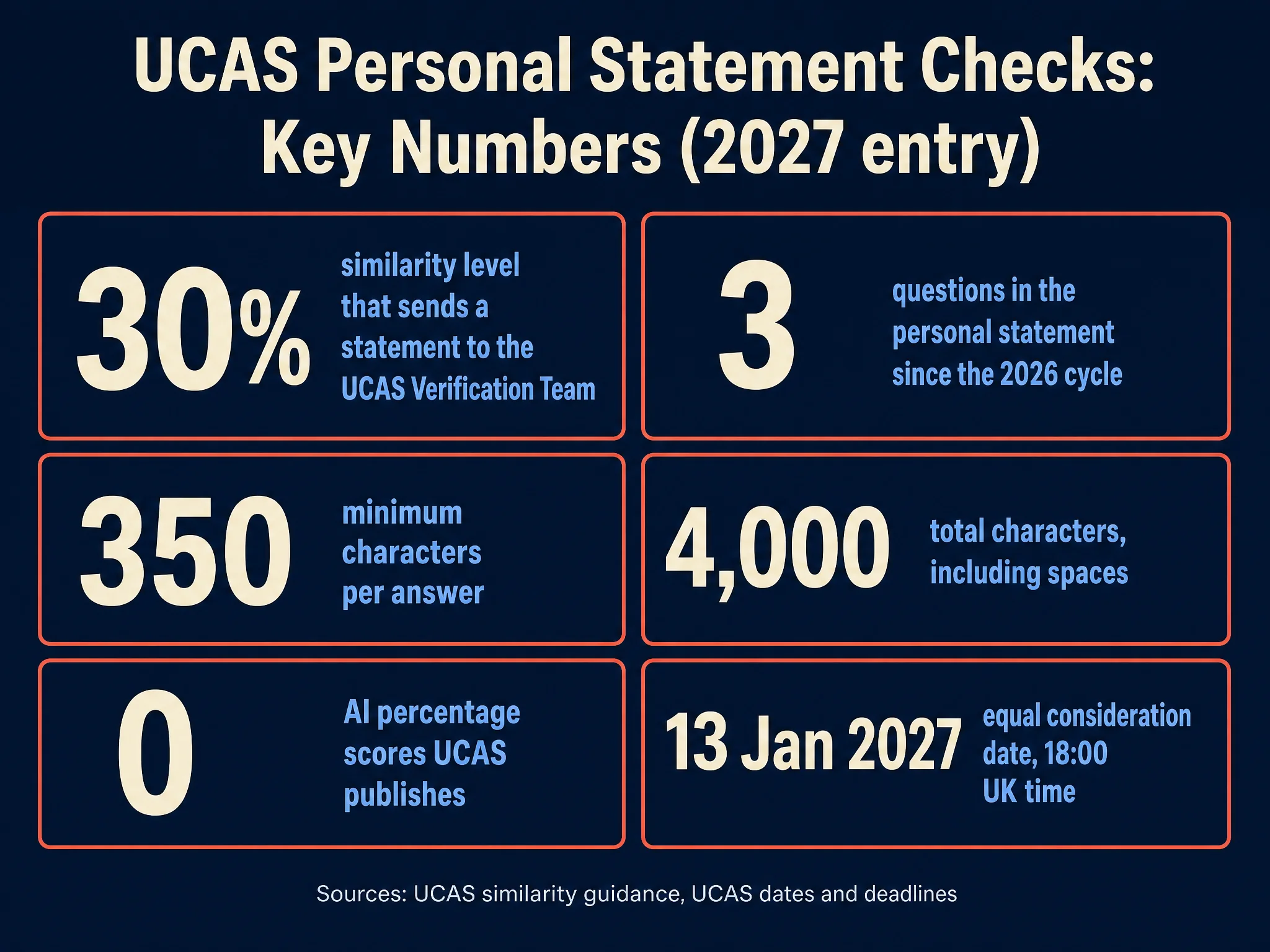
1. Similarity. The UCAS similarity guidance says every UCAS Undergraduate and Conservatoire statement goes through its similarity detection software. Each one is compared with statements previously sent to UCAS and with sample statements collected from websites and other sources. Common words such as "and" and common phrases such as "Duke of Edinburgh" are ignored. Anything above 30% similarity is reviewed by trained staff.
2. The declaration. When you apply, you confirm the statement is your own work. The UCAS Undergraduate declaration lists friends, writing services and artificial intelligence software as sources that may not supply the content. If UCAS thinks material came from one of them, it may tell your school and your chosen universities.
3. Fraud checks. UCAS’s fraud and similarity page says it screens applications for false, missing or misleading information, not only the statement. Invented experiences fall here, whoever wrote them.
None of the three is an AI-percentage check. This mirrors what we found for US medical school services and law schools: a signed promise does more work than any detector.
Does UCAS use Turnitin or an AI detector?
UCAS’s current applicant guidance does not name Turnitin, GPTZero or any AI detector. It describes its own "Similarity Detection Service". Several guides call the tool Copycatch, including EducAd, but the UCAS PDF I read does not use that name.
Some pages say more than the sources support. One UK medicine prep site states that UCAS and universities use Turnitin and GPTZero, with no source for it. On Reddit, one commenter says UCAS uses Turnitin, which also checks for AI, while another in the same thread says it only runs similarity checks. Here is how the common claims line up with UCAS’s own documents.
| What applicants say | What UCAS’s documents say | Verdict |
|---|---|---|
| "UCAS gives every statement an AI percentage." | The guidance describes similarity screening and a declaration. No AI score is mentioned. | Not supported |
| "UCAS runs Turnitin or GPTZero." | No vendor is named. UCAS describes its own Similarity Detection Service. | Not supported |
| "It tells you on submit if it looks like AI." (r/6thForm) | Automatic emails go out after staff review similarity. They point you to a colour-coded transcript in your application. | Not supported |
| "Under 30% means you are safe." | 30% is the level that triggers a human review. Universities still read every answer and the declaration still applies. | Half true |
| "If a free checker says 90% AI, UCAS will flag it." | A free checker cannot see UCAS’s library and measures something else. | Not supported |
| "You can fix it or appeal later." | No changes after submission. UCAS says it does not expect grounds to appeal a similarity report. | False |
| "Any AI use is cheating." | UCAS lists brainstorming, structure and readability checks as reasonable uses. | False |
The difference between these tools matters. A similarity checker looks for matching sentences. An AI detector guesses at how text was produced. We explain the split in AI detector versus plagiarism checker.
What does a UCAS similarity report actually show?
It shows matched sentences, colour by colour, not a verdict on how you wrote. According to the UCAS similarity guidance, the report is a colour-coded transcript of your statement.
- Red: sentences matched to the most similar statement.
- Blue, then pink: the second and third best matches.
- Brown: any other matches.
- Grey: no match, or a sentence too short to check.
- Black words: words in a matched sentence that are not in the library version. Underlined black words are close but not identical.
Dates at the bottom show how long a matched statement has been in the UCAS collection, or when a web source was found. UCAS stresses that the date does not prove that file was your source. If the report is sent, the automatic email goes both to you and to each university you chose.
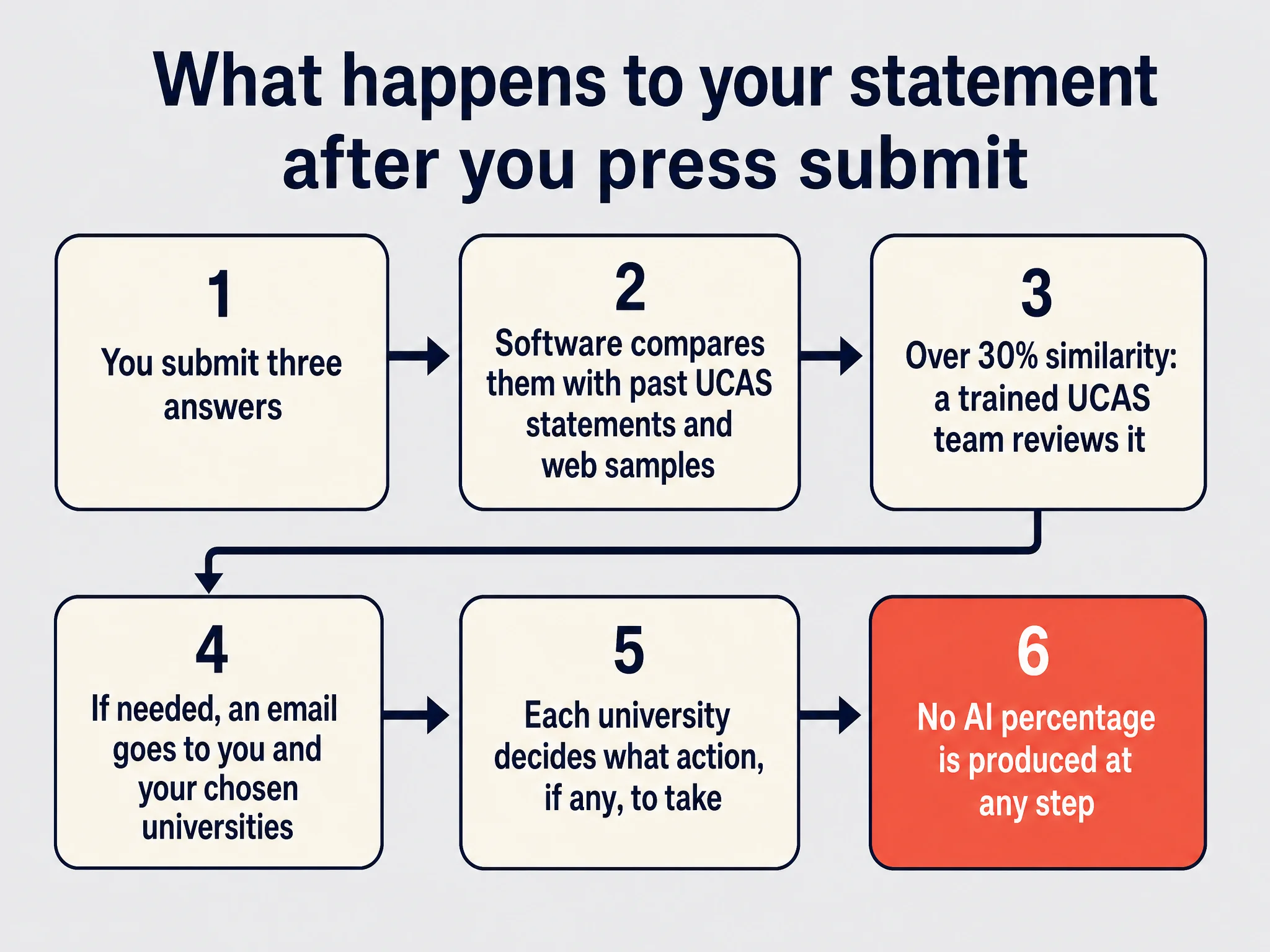
Two rules make this report final. You cannot replace a statement once the application is sent, and UCAS says it does not expect grounds for an appeal because the report only shows matches to data it holds. If you have context to add, UCAS tells you to contact your universities directly.
Can AI-written text still get you flagged by UCAS?
Yes, through similarity rather than AI detection. Chatbots reuse the same stock sentences for thousands of users, and the UCAS library keeps growing because every processed statement is added to it. UCAS’s own AI and ChatGPT guide makes the same argument: the more applicants paste in generated text, the more detectable it becomes through similarity software.
Newcastle University’s applicant blog says the same in its 2 September 2026 post: GenAI raises the chance of a statement being flagged as plagiarism. Manchester warns that AI use may get work caught by UCAS’s plagiarism software, on its personal statement page.
The UCAS guide even prints two ChatGPT-written lines as bad examples. One opens with being fascinated "from a young age" by the legal system. If your opening sounds like that, the problem is not a detector. It is that thousands of other statements may say nearly the same thing.
No public figure tells you how many AI-assisted statements cross the 30% line, so treat this as a risk UCAS describes, not a measured rate.
Why does your personal statement keep coming up as AI on free checkers?
Because a personal statement is the kind of text detectors misread. It is short, formal, tightly edited and full of standard academic phrasing. One commenter who reads statements put it simply: UCAS statements are more likely to get flagged because conciseness matters.
The scores applicants report are all over the place. On r/6thForm, one student said three checkers rated their own statement 80% AI, 92% AI and 90% human. Another said a statement drafted from handwritten notes scored 63%, 29% and 7% on three tools. These are claims, but they match what we see in how much AI detectors disagree and in published false positive rates.
Length matters too. Each UCAS answer can be as short as 350 characters, roughly 60 words. Detectors are weakest on short text, as covered in why short essays get flagged more often. Non-native writers face extra risk, covered in our ESL bias page.
Can pasting your statement into a free checker get it flagged by UCAS?
Not on the evidence UCAS publishes, but posting it publicly is a different matter. UCAS compares statements with past UCAS statements and with samples collected from websites. A private checker that does not publish your text is not one of those sources, as far as any UCAS document shows.
Publishing is the real risk. The UCAS similarity guidance tells applicants not to post statements on the internet or social media, or share them except with people they trust for feedback. A statement posted on a forum could become a web sample that matches someone else’s, or yours. r/6thForm’s moderator bot warns applicants not to share statements for the same reason.
Privacy is a separate worry. Several commenters warn that free checkers may keep or train on what you paste. Policies vary by tool. We compared two in should you run your college essay through an AI detector, which also explains why one check on a final draft is plenty.
What do individual universities say about AI in personal statements?
The universities set the consequences, and several now say so plainly. UCAS only reports. I read these pages on 16 November 2026. This is a sample of clear statements, not every university.
| University | What its page says | What it means for you |
|---|---|---|
| LSE | Does not encourage generative AI to create statements. Says they are not high quality and may lead to rejection. | The strongest consequence I found in writing. |
| Manchester | Avoid generative AI to create the statement. AI is fine for ideas, reading suggestions and proofreading your own writing. | Clear line between help and authorship. |
| St Andrews | Lists using tools such as ChatGPT to generate the statement under things not to do, beside plagiarism. | Treated in the same breath as copying. |
| Hull | AI may help with ideas or structure, but the statement must be in your own words. Detected plagiarism can mean withdrawal or rejection. | Same rule, stated as a yes-and-no. |
| Greenwich | Avoid relying heavily on AI. Submitting large AI-generated sections could be treated as cheating. | Repeats the UCAS wording. |
None of these pages says the university runs an AI detector on applications. A commenter on r/UCAS says some universities run their own checks when tutors suspect AI, and that may be true, but I could not find a university that publishes such a process. Check each page on your list yourself, because these change every cycle.
What should you do if a checker says your statement is AI?
Start with how you actually wrote it. The score does not change what UCAS does with your statement, so pick the option closest to your situation.
My statement got an AI score. What now?
Whichever applies, keep your evidence before you change anything. Our guides to building an authorship packet and whether version history is enough proof apply to statements too. If a school or university later raises a concern, start with what to do in the first 24 hours.
A humanizer is the wrong fix here. If you wrote the statement, it swaps your words for a machine’s. If AI wrote part of it, a rewrite does not change the declaration you sign, and paraphrased stock sentences can still match the library. We made the same call for US college essays.
Want a second reader before 13 January? GradPilot reviews all three UCAS answers against a published rubric and adds an AI-authenticity signal. Its own UCAS page says that signal cannot see UCAS’s private library, so treat it as feedback, not a UCAS preview.
Read our GradPilot review for the pricing and the catches, or use our partner link: new users get 20% off their first GradPilot purchase.
Disclosure: Detection Drama earns a commission if you buy through this link.
Methodology and limits
For this article I read UCAS’s similarity guidance PDF, its declaration, its AI and ChatGPT guide, its fraud page and its 2027 dates, plus five university pages and Newcastle’s applicant blog. I also read the 10 Google UK results for this question and 8 r/UCAS and r/6thForm threads from 1 October to 15 November 2026, with their comments. I ran no detector and submitted nothing to UCAS. UCAS can change its process at any time, so read the live declaration when you apply.
Frequently Asked Questions
Does UCAS use AI detection software on personal statements?
Not according to its published guidance. UCAS describes similarity detection software that compares statements with past UCAS statements and web samples, plus a declaration that the statement is your own work. It names no AI detector and publishes no AI score.
Can UCAS tell if I used ChatGPT?
Not directly through any process it publishes. But generated text can share sentences with other statements in the library, which can push similarity above 30%, and admissions tutors read every answer. Using ChatGPT for ideas, structure or readability is within UCAS’s guidance; submitting its wording is not.
What similarity percentage does UCAS flag?
Statements with more than 30% similarity are reviewed by the UCAS Verification Team. Staff then decide whether to report it to you and your chosen universities, and the universities decide what, if anything, to do.
Did the three-question format change UCAS’s checks?
No. From the 2026 cycle the statement became three questions, with a 350-character minimum per answer and 4,000 characters in total. UCAS says similarity detection works as before and reporting does not change.
Is it safe to put my personal statement into a free AI checker?
UCAS’s library is built from past UCAS statements and web samples, so a private check is not a UCAS risk on the evidence published. Posting your statement publicly is, and UCAS tells applicants not to. Read a checker’s privacy policy before pasting anything personal.
Can I change my personal statement after a similarity flag?
No. UCAS does not accept changes to a statement after the application is submitted, and it says it does not expect grounds to appeal a similarity report. You can contact your universities directly with extra context.
Do UK universities run AI detectors on applications?
None of the five university pages I read says so. LSE, Manchester, St Andrews, Hull and Greenwich warn against AI-generated statements, and LSE says they may lead to rejection, but none publishes a detector or a score cutoff for applications.
Sources and References
- UCAS: Similarity guidance for applicants (PDF), Undergraduate declaration, AI and ChatGPT guide, Fraud and similarity, Dates and deadlines.
- Universities: LSE, Manchester, St Andrews, Hull, Greenwich, Newcastle Belong blog.
- Other guides checked: EducAd, Dream Medic, GradPilot on UCAS.
- Reddit (claims, unverified): Personal Statement showing as AI?, ai detector for personal statement, AI usage in personal statement, How does similarity/AI check work in UCAS?, Will UCAS have a better AI checker?, Is this considered AI use on PS?, AI detectors keep saying PS is AI, Why does my PS keep coming up as AI?
Related reading on this site: AI in admissions essays, the statistics.
