Do medical schools check for AI? Not routinely: none of the four US application services (AMCAS, AACOMAS, TMDSAS, CASPA) says it scans every personal statement with an AI detector, but you sign a certification that your writing is your own, and individual schools and readers can still look.
Key Takeaways
- No US medical application service says it runs every personal statement through an AI detector. AMCAS, AACOMAS, TMDSAS and CASPA rely on a certification you sign.
- The AI some schools use to read and sort applications (Hofstra/Northwell, NYU Grossman) is not an AI-writing detector. AAMC says the Thalamus tool that reads statements does not check whether AI wrote them.
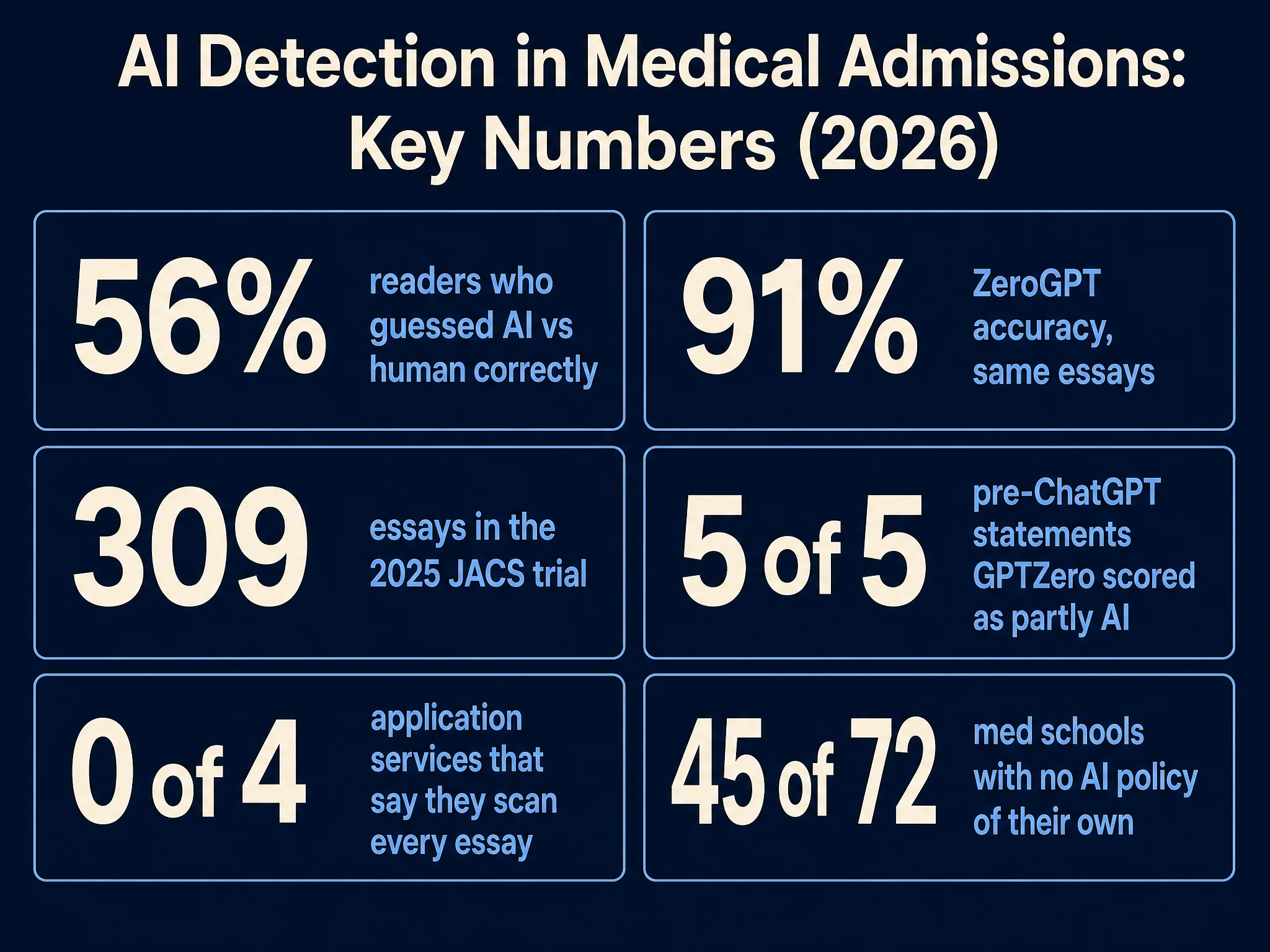
- In a 2025 trial of 309 essays, medical school readers spotted AI vs human authorship only 56% of the time. ZeroGPT hit 91% but the authors called its false positives unacceptably high.
- CASPA is the strictest service (AI only for spelling and grammar), yet PAEA says it will not open an investigation when the only evidence is an AI detector flag.
- In a 2025 residency study, GPTZero gave all 5 human personal statements written before ChatGPT a partial AI score (11% to 36%).
- If your own statement flags, keep your version history and drafts, and do not "dumb down" your writing to please a free detector.
By Vlad Ivanov
Runs Detection Drama, which has tested AI detectors and their false positives on student writing since 2024. Not an admissions consultant and not affiliated with AAMC, AACOM, TMDSAS or PAEA. For this guide we read the current AI language of all four application services, two peer-reviewed detector studies on medical admissions essays, and the Reddit threads from 2025 to 2026 where applicants posted flagged statements.
Last updated: 6 November 2026
Do medical schools check personal statements for AI?
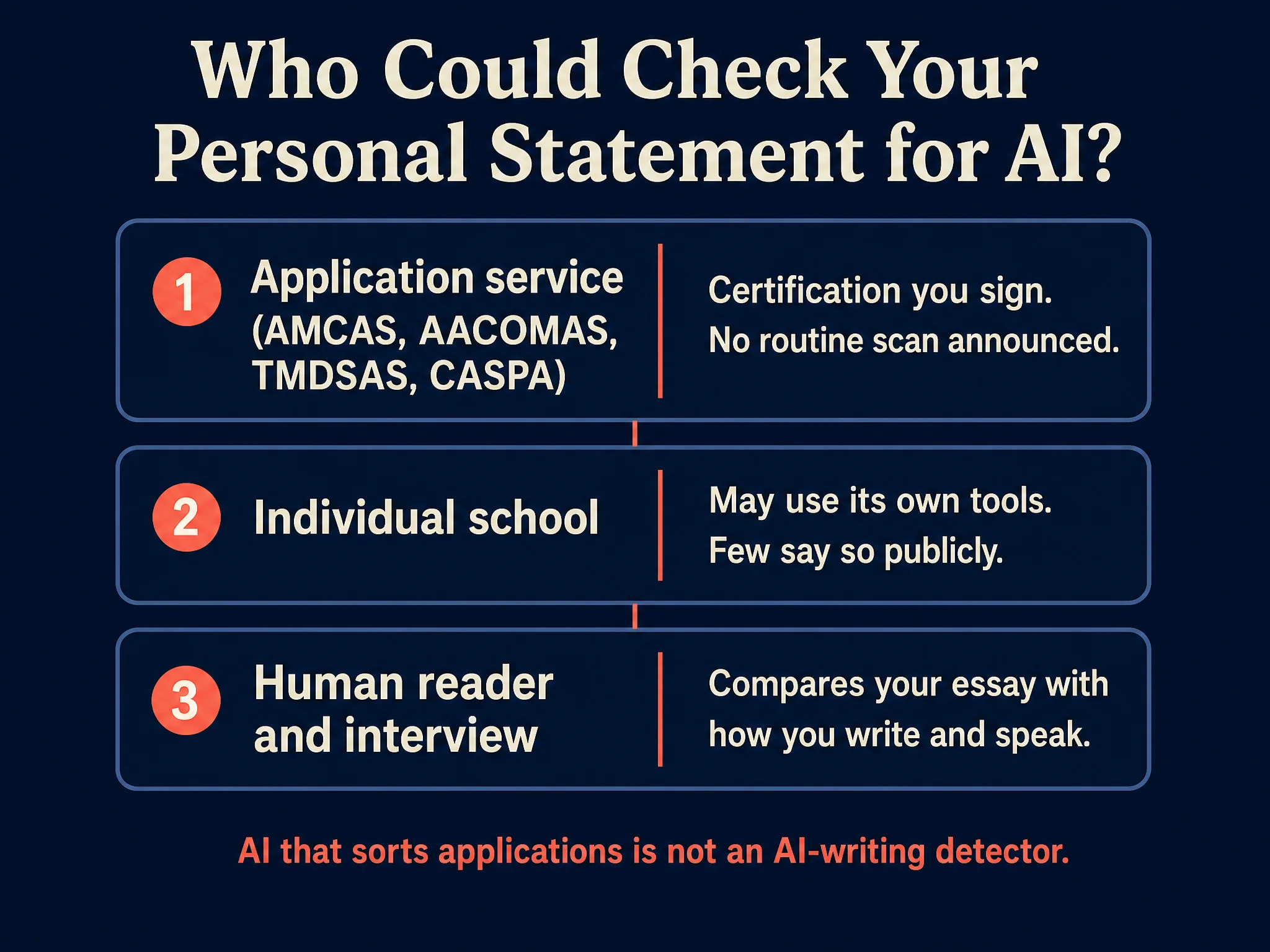
Most do not run a routine AI scan, and the application services have not announced one. What every applicant does face is a signed certification. The AMCAS certification says that all your writing, including personal comments, MD-PhD essays and work/activities descriptions, is your own (AAMC certification statements).
AAMC also says on its AI in AAMC service programs page that AI tools are acceptable for brainstorming, proofreading or editing, as long as the final submission represents your own work. So the real question is not “will a robot catch me” but “does this essay still read like me, and could I defend it in an interview”.
Three different people or systems could look at your essay for signs of AI. They are easy to confuse, and most of the confusion online comes from mixing them up.
What do AMCAS, AACOMAS, TMDSAS and CASPA actually say about AI?
The four services draw the line in different places. CASPA, for physician assistant programs, is the strictest. AACOMAS, for osteopathic schools, says the least.
| Service | Who uses it | What AI use is allowed | Stated AI detection |
|---|---|---|---|
| AMCAS | Most US MD schools | Brainstorming, proofreading, editing; final work must be your own | No routine scan announced |
| AACOMAS | US DO schools | No AI-specific language; general certification that the work is yours | None stated |
| TMDSAS | Texas MD, DO, dental, vet schools | Brainstorming, organizing, editing; responses must reflect your own thoughts, voice and intent. No AI in interviews | None stated |
| CASPA | PA programs | Spelling and grammar only (2026-27); substance must be your own | Will not investigate on a detector flag alone |
The AMCAS line comes from AAMC directly. The TMDSAS wording and the AACOMAS gap are as documented in GradPilot’s medical school AI policy tracker, verified in February 2026.
CASPA: strict rule, cautious enforcement
CASPA softened its rule for 2026-27. The 2025-26 certification banned content written or modified in any part by generative AI. The 2026-27 version allows AI for non-substantive fixes like spelling and grammar, but the writing must still be yours.
What matters more for nervous applicants is enforcement. PAEA, which runs CASPA, has said it will not investigate an applicant if the only evidence comes from AI detection software. Its suggested check is having applicants write a short response during the interview. Individual programs can go further: GradPilot reports that MEDEX Northwest reserves the right to use detection tools.
Individual schools and secondaries
Secondary essays go straight to each school, so the school’s own rules apply there. Most schools have not written any. GradPilot’s tracker of 72 medical schools found 45 with no AI-specific admissions policy, deferring to AMCAS or TMDSAS. Only one, Georgetown, is classified as using screening tools, and the tracker does not say which. Applying to law school as well? The picture there is similar; see our law school AI detector policies.
Is the AI that reads your application an AI detector?
No, and this is where several pages ranking for this question go wrong. Some schools now use AI to read and sort applications. That is a screening tool, not an AI-writing detector.
According to AAMCNews (January 2025), the Zucker School of Medicine at Hofstra/Northwell and NYU Grossman use AI for initial screening of the structured parts of applications, such as grades and experiences. The University of Cincinnati planned to pilot AI on essays, George Washington University was building a tool for the whole application, and UC San Diego was exploring the idea. The article describes recommendations reviewed by staff. It never mentions detecting AI-written essays.
AAMC is even more direct about residency. Its AI services page says the ERAS platform does not use AI to analyze, sort or evaluate applications. Thalamus Cortex does use AI to read personal statements, but AAMC says it does not use AI to determine whether an essay was written with AI tools.
What happens when real medical school essays go through AI detectors?
Two recent peer-reviewed studies put real admissions essays through detectors, and they explain why the services are cautious.
The Journal of the American College of Surgeons trial (December 2025)
Vaccaro and colleagues took real personal statements from the 2019 cycle, before AI chatbots, and had ChatGPT 4.0 write new ones from summaries of the originals. Seventeen medical school application readers completed 325 rubrics across 309 essays (PubMed 41051105).
The readers guessed authorship correctly 56% of the time, barely better than a coin flip. They also tended to assume the better essays were human, and the AI essays scored higher on average. ZeroGPT reached 91% accuracy, but the authors concluded its false positive rate was still unacceptably high for admissions.
The 2025 Cureus residency study
Cumbo and colleagues ran personal statements through GPTZero, Undetectable AI and Winston AI (Cureus 2025). Five statements written by past residents before ChatGPT existed got GPTZero scores of 11% to 36% AI, and two were labelled “likely a mix”. Winston AI called all five fully human. The sample was small, five essays per group, but the disagreement is the point: the same human essay can pass one detector and look mixed on another.
Second-language writers carry extra risk. A Stanford-led study found GPT detectors misclassified 61.3% of human-written TOEFL essays as AI on average (Liang et al., 2023). That matters for international medical graduates writing ERAS statements. We cover the wider data in our AI detection false positive rates roundup and in why graduate-level writing gets flagged.
What should you do if your own personal statement gets flagged?
Do not panic, and do not wreck a good essay to lower a free detector’s number. Applicants post this exact fear every cycle: a UK medicine applicant on r/UCAT had a self-written statement come back as “most definitely AI”, and a pre-dental applicant on r/predental watched paragraphs about their own life score 100% AI, then drop on a re-run.
- Keep your proof. Write in Google Docs or Word with version history on, and save early drafts and notes. That is the strongest evidence you wrote it if anyone asks. Our 24-hour plan for an AI accusation covers what to send.
- Use one good detector, not seven. Free detectors disagree; running ten of them just collects scary numbers. See our Pangram review and Pangram vs GPTZero for which ones are stricter and which are noisier.
- Fix substance, not surface. Generic lines are what readers notice. Replace abstract claims with a specific patient, a specific shift, a specific mistake you made. Our guide to what makes an essay sound too polished lists the patterns.
- Watch the editing tools. Heavy rewriting by Grammarly or a chatbot can push your score up and, on CASPA, cross the line on substance. See whether edits by a tutor or tool can trigger detectors.
- Be ready to write live. PAEA’s suggested check is an on-the-spot writing prompt at interview. If your statement is yours, that is easy.
Want to see what a reader might see?
GradPilot runs Pangram AI detection and scores your personal statement against the AMCAS, AACOMAS, TMDSAS or CASPA prompt in about 2 to 3 minutes. It never reports essays to schools. A full review is $5; Pro ($50 for 10) lets you switch detection on or off.
Check my statement with GradPilot, 20% off →
Partner link: 20% off your first purchase. Detection Drama earns a commission. Read our full GradPilot review first.
Can you use ChatGPT on a medical school personal statement?
On AMCAS and TMDSAS, yes for brainstorming and editing; on CASPA, only for spelling and grammar. Across all four, the substance, the experiences and the reflection have to be yours. Check every school’s secondary instructions too; Icahn Mount Sinai, for example, bans AI during interviews and calls drafting with AI unethical, per GradPilot’s tracker.
A practical rule that fits every service: write the first full draft yourself, then use tools only to point out problems, not to rewrite. If you want a checklist for that workflow, use our safe AI writing workflow for application drafts, and before you submit, check whether your essay sounds AI-written.
How we researched this
We read the AI language of the four US medical application services (AMCAS, AACOMAS, TMDSAS, CASPA) as published for the 2026-27 cycle, AAMC’s AI services page and its January 2025 screening article, PAEA’s guidance to programs, and two peer-reviewed studies covering 309 and 15 admissions essays. We also reviewed the 10 pages ranking on Google for “do medical schools check for AI” on 6 November 2026, and applicant threads on Reddit from 2025 and 2026. Where a policy detail comes from GradPilot’s tracker rather than the service’s own page, we say so. Policies change every cycle; we will update this page when they do.
Do medical schools check for AI: FAQ
Does AMCAS check personal statements for AI?
AAMC has not said that AMCAS scans applications with AI-detection software. You certify that all your writing is your own, and AAMC says AI may be used for brainstorming, proofreading or editing.
Can medical schools tell if you used ChatGPT?
Not reliably by eye. In a 2025 trial, 17 medical school application readers identified AI vs human authorship correctly only 56% of the time, and they rated the AI-written essays slightly higher.
Is it allowed to use AI on a medical school personal statement?
On AMCAS, yes for brainstorming, proofreading and editing, as long as the final statement is your own work. TMDSAS has similar guidance. CASPA allows AI only for spelling and grammar. AACOMAS does not mention AI in its certification. Check each school’s own policy too.
Do secondary applications get checked for AI?
Secondaries go straight to each school, so the school’s own policy applies. Few schools publish whether they use screening tools. GradPilot’s tracker lists Georgetown as the only school it classifies as using screening tools.
Will an AI detector flag get my application rejected?
No application service has said a detector score alone leads to rejection. PAEA, which runs CASPA, says it will not open an investigation when the only evidence is an AI detection tool.
Why does my human-written personal statement show as AI?
Polished, formal, well-structured prose is what many detectors score as AI. Grammar tools, heavy editing and writing in a second language all raise the risk. Different detectors often disagree wildly on the same text.
Should I run my personal statement through an AI detector before submitting?
Only if you know how to read the result. Use one strong detector, treat the score as a signal, and fix substance rather than chasing a lower number. A tool that also scores the essay against the AMCAS or CASPA prompt is more useful than a bare percentage.
Do residency programs check ERAS personal statements for AI?
AAMC says the ERAS platform does not use AI to analyse, sort or evaluate applications, and that Thalamus Cortex reads statements but does not determine whether they were written with AI tools. Individual programs may still use their own tools.
Check your statement before an admissions reader does
Free Quick Reviews (2 a day) give rubric feedback with no scores. Paid Full Reviews add scores, specific fixes and Pangram AI detection.
Check my statement with GradPilot, 20% off →
Partner link: 20% off your first purchase. Detection Drama earns a commission. Read our full GradPilot review first.
