Grammarly AI detector scores are accurate enough for a rough self-check and not accurate enough to prove anything. Grammarly’s own help pages say the score is not “an objective source of truth” and will not match Turnitin.
Written by Vlad Ivanov
Runs Detection Drama and covers AI detectors and humanizers. I ran no detector test for this piece. It is based on Grammarly’s own pages, the public RAID leaderboard and reader reports, all read on 8 November 2026. Reddit comments are people’s claims, not verified facts.
Last updated: 8 November 2026
Key Takeaways
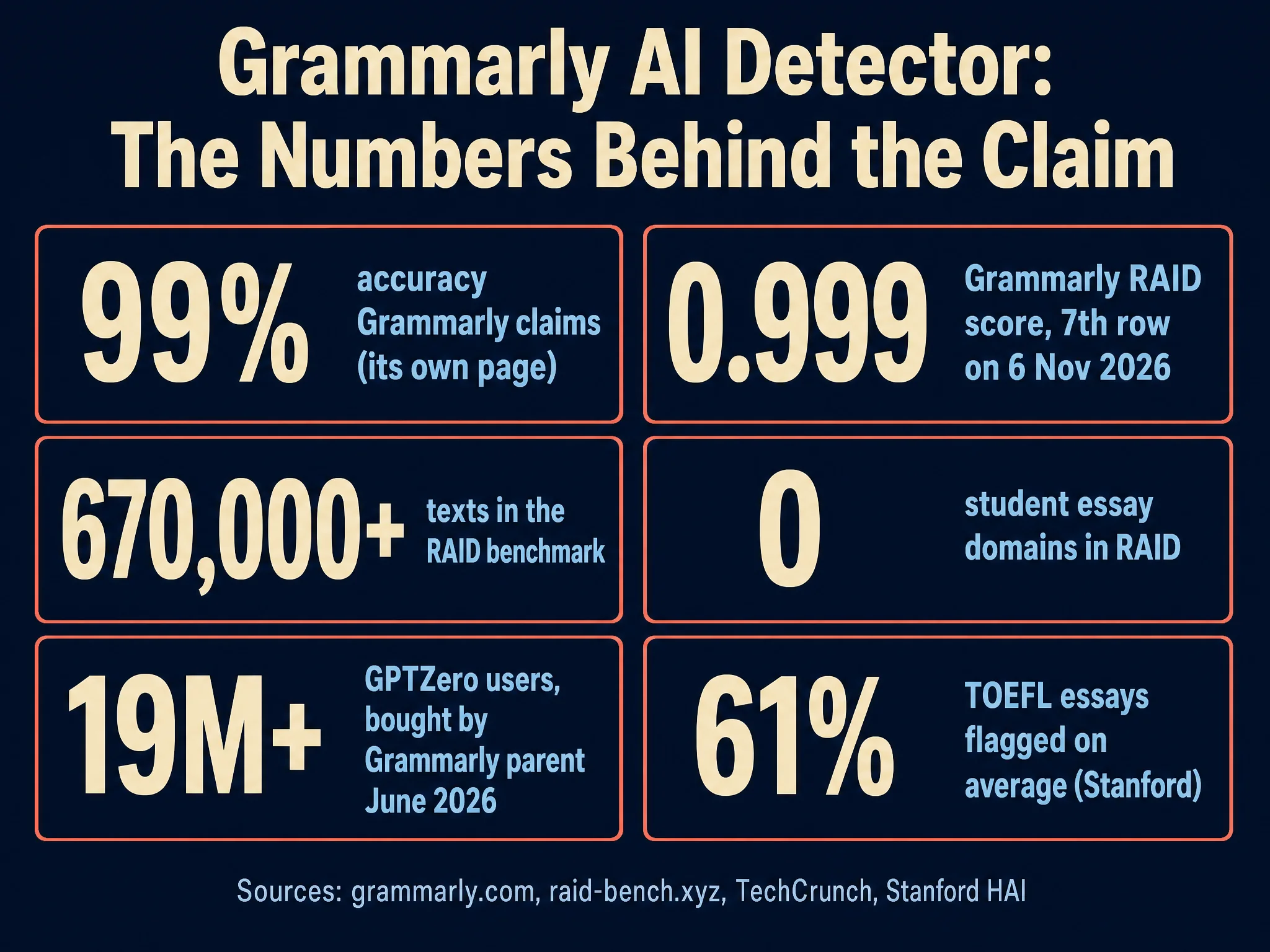
- Grammarly claims 99% accuracy and a #1 spot on the RAID benchmark (Grammarly). RAID covers news, books, recipes, poetry and similar text, with no student essays in its domain list.
- On the RAID leaderboard copy dated 6 November 2026, Grammarly scored 0.999 and was listed seventh, not first. The difference to the top is in the third decimal.
- Grammarly says its model is proprietary and that scores “may differ” from Turnitin, GPTZero and Copyleaks. A low Grammarly score does not predict your school’s result.
- Its own rewrite agents (Grammarly, Paraphraser, Humanizer) produce text the detector will “likely” flag, per its support guide. Plain red and blue fixes “should typically not” raise it.
- Scores can jump overnight on unchanged text because the model “updates continuously”. Several users reported 0 to 5% turning into 68 to 80% in September 2026.
- The useful Grammarly feature for a worried student is Authorship, a free record of what you typed and pasted, not the percentage.
- Grammarly’s parent Superhuman agreed to buy GPTZero in June 2026, so one company now owns two detectors that can give you two different numbers.
Is Grammarly’s AI detector accurate?
Grammarly’s AI detector is accurate on the kind of text its benchmark uses and unreliable as evidence about a single essay. Those are two different questions, and most of the confusion comes from treating the first as an answer to the second.
Grammarly’s own wording is careful. Its AI Detector user guide calls the model “directionally accurate”, says the percentage “should not be used as an objective source of truth” and describes the score as “an average estimate rather than a definitive percentage assessment”. That is a self-check tool by its maker’s own description, not a verdict.
The marketing page is bolder. It promises “99% detection accuracy” and “#1 on RAID’s independent benchmark”, then lower down repeats that “no AI detector is 100% accurate”. Both statements can be true at once, which is exactly why the score confuses people. If you have already been flagged by a different tool, the steps in what to do in the first 24 hours matter more than anything Grammarly shows you.
What does the RAID benchmark behind the 99% claim actually test?
RAID measures whether a detector can separate human and machine text across eight public domains, and student essays are not one of them. The leaderboard’s own filters list the domains as abstracts, books, news, poetry, recipes, Reddit posts, reviews and Wikipedia.
Grammarly announced its #1 ranking on 9 February 2026 and describes RAID as a set of more than 670,000 texts. The generator list on the RAID leaderboard is ChatGPT, GPT-4, GPT-3, GPT-2, Mistral, Cohere, Llama chat and MPT. Newer models that students actually use in 2026 are not separate columns.
The ranking has also moved. In the copy of the leaderboard dated 6 November 2026, the default view lists Winston AI, FLAIRD, Zhuque, XYZ Science and GPTTrace at 1.000, then FCM at 0.999, then Grammarly at 0.999 in seventh place. QuillBot sits at 0.997 and GPTZero at 0.984. We covered the top name on that list in our Winston AI detector review.
| Grammarly says | What the fine print or data shows | Source |
|---|---|---|
| “99% detection accuracy” | Same page: “No AI detector is 100% accurate” | Grammarly |
| “#1 on RAID” | Listed seventh at 0.999 in the 6 Nov 2026 leaderboard copy | RAID |
| Built for “research papers” and “school assignments” | RAID domains contain no student essays | RAID |
| Trained on “tens of thousands of texts” from “before 2021” | Help center says “hundreds of thousands” of texts, no year | Support |
| “Reduced false positives” | “Shorter passages are slightly harder to measure” | Support |
None of this makes the benchmark worthless. It means a strong RAID score tells you the model separates clean machine text from clean human text in those domains, and says little about a 900-word reflection written by a tired student who used spell check.
Why did my Grammarly AI score jump overnight on the same text?
The most likely reason is that the model changed, not your essay. Grammarly’s detector page says the tool “updates continuously”, so the same paragraph can be scored by a different model next week.
That matches what readers described in September 2026. In an r/Grammarly thread, one user said a paper went from 0% to 68% between two checks a week apart, and another said every piece that had shown 0 to 5% suddenly showed 80% or more. Those are claims, not measurements, but they all point at a model update rather than a change in the writing.
Turnitin users see the same pattern for the same reason, which we explained in why a Turnitin AI score changes overnight. The practical lesson is simple: a number that moves while your text stays still is measuring the tool, so chasing it with rewrites wastes your time.
Does Grammarly flag text its own tools rewrote?
Yes, and Grammarly says so. Its support guide states that rewrites from the Grammarly, Paraphraser and Humanizer agents “come from our LLM”, so the AI detection agent will “likely” flag that content.
The same guide draws a useful line. Traditional red and blue underline corrections “should typically not impact the percentage score”, while using generative agents “to meaningfully rewrite sentences and full paragraphs will raise the percentage score”. Grammarly’s advice is to take the agents’ feedback and apply it by hand instead of accepting whole rewrites.
This explains a lot of the Reddit confusion. A student in r/BypassAiDetect reported 0 to 2% in Grammarly and 92% in another detector after heavy Grammarly use. If Turnitin is the tool that flagged you after Grammarly, start with what to do if Turnitin flags your essay after Grammarly and how to prove authorship after a Grammarly-triggered flag.
Will my professor see the same score?
No. Grammarly’s help center says its detector “uses a proprietary in-house model, so the scores may differ from those of other solutions like Turnitin, GPTZero, Copyleaks”. It also says you “should not view any scores” from Grammarly “as a clear indication” of what your professor will see.
Detectors disagree all the time, and the gaps are not small. Our roundup of how much AI detectors disagree collects the published numbers. One r/CollegeRant poster said Grammarly showed 0% on an outline that Copyleaks flagged at 100%, which is the sort of split covered in our Copyleaks limits explainer.
Some schools hand students Grammarly and use something else to check. Western Governors University announced Grammarly as an AI writing partner in a May 2024 press release, and in an October 2026 r/WGU_MBA thread a commenter who said they were an instructor told students to ignore Grammarly AI reports. One student in r/WGU said capstone sections scored 70 to 80% and still passed on the first attempt, and others said they simply ignore the number. Treat those as anecdotes, not policy.
Who gets false positives most often?
Writers with formal, simple or heavily corrected English carry the most risk with any detector. A Stanford study summarized by Stanford HAI found seven detectors classified 61.22% of TOEFL essays by non-native speakers as AI on average, and 97% of the 91 essays were flagged by at least one. Grammarly was not one of the seven, so treat this as a warning about the method, not a Grammarly score.
Grammarly’s support guide says its model is “optimized to minimize false positives” and that it expects such misreads to be “very rare”. Commenters in r/WGU and r/WGU_MBA said citations, their own names and course titles were flagged, which suggests formulaic text is still a weak spot. We cover the wider pattern in AI detection and ESL bias and in why short essays get flagged more often.
When should you act on a Grammarly AI score?
Act on the score only when it tells you something you did not already know about your own process. If you wrote the text, the score adds worry and no proof. The table and chart below sort the common situations.
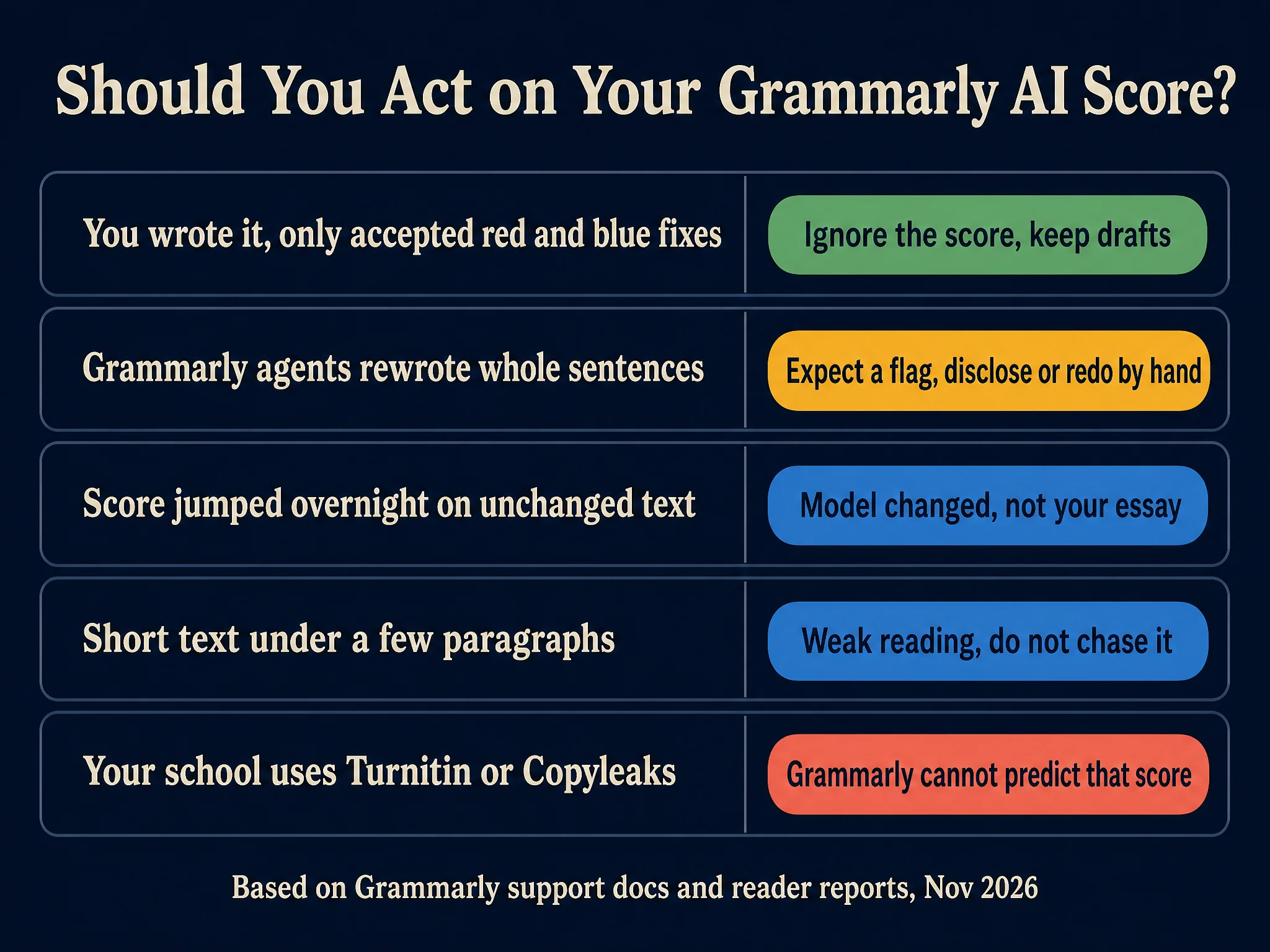
| Your situation | What the score means | What to do |
|---|---|---|
| You wrote it and accepted only spelling and grammar fixes | Little. Grammarly says these fixes “should typically not” raise it | Submit. Keep drafts and version history |
| Grammarly agents rewrote whole sentences | A flag is expected, per Grammarly | Disclose the help, or redo those lines by hand |
| Score jumped on unchanged text | The model updated | Do not rewrite to chase it |
| Text is a short answer or discussion post | Weakest reading, per Grammarly | Ignore small swings |
| School uses Turnitin, Copyleaks or GPTZero | Grammarly cannot predict their number | Focus on process evidence, not scores |
The tool that actually helps in a dispute is Grammarly Authorship. It is free on Grammarly Free and Pro, works in Google Docs, Microsoft Word and the Grammarly Editor, records what was typed, pasted or AI-assisted, and stays private unless you share the report. It sits alongside the other evidence in our guide to building an authorship packet before you submit, and it answers the question whether version history alone is enough proof.
If you want one pre-submission check, our pre-submission audit for Turnitin AI risk starts with policy and drafts, not a percentage. That order matters more than which detector you pick.
What changes now that Grammarly’s parent owns GPTZero?
For now, you have two detectors under one roof that can still disagree. Superhuman, the company Grammarly became, agreed to acquire GPTZero on 23 June 2026, and TechCrunch reported GPTZero at roughly $30 million in annual recurring revenue and more than 19 million registered users.
Superhuman’s announcement says GPTZero’s detection, plagiarism and writing replay tools will join Grammarly’s authorship tools in Superhuman Go. It does not say the Grammarly detector will be replaced. Grammarly’s help center still describes its own detector as a separate, proprietary model, and on RAID the two sit at different scores (0.999 and 0.984).
Our earlier take on the deal is in Grammarly’s parent now owns your AI detector. For a student the short version is this: a Grammarly number and a GPTZero number are still two separate opinions, and neither one is your professor’s. The Pangram vs GPTZero comparison shows how far two well-known detectors can drift on the same text.
How we put this together
No detector test was run for this article. It draws on Grammarly’s AI detector page, its help center guide and its Authorship page, the RAID leaderboard copy dated 6 November 2026, the Superhuman and TechCrunch acquisition coverage, and the Stanford HAI summary. Reader reports come from five Reddit threads posted between 11 September and 11 October 2026, found with an automated workflow and quoted as claims.
Frequently asked questions
Is Grammarly’s AI detector free?
Yes. The basic check at grammarly.com/ai-detector is free and returns one percentage. Grammarly Pro adds the AI Detector agent, which highlights the passages that look AI-generated.
Is Grammarly’s AI detector really 99% accurate?
That figure comes from Grammarly, based on the RAID benchmark. RAID contains no student essays, and on the 6 November 2026 leaderboard copy Grammarly was listed seventh at 0.999. Grammarly’s own help center calls the score “directionally accurate”, not definitive.
Does Grammarly’s AI detector match Turnitin?
No. Grammarly says its model is proprietary and its scores “may differ” from Turnitin, GPTZero and Copyleaks. A low Grammarly score is not a prediction of your Turnitin result.
Why does Grammarly flag my own writing as AI?
Formal, tidy or formulaic text can look like AI to any detector, and short passages are harder to score. If you let Grammarly agents rewrite sentences, the detector will likely flag that text by design.
Do normal Grammarly corrections raise the AI score?
Grammarly says red and blue underline corrections “should typically not impact the percentage score”. Generative rewrites of full sentences or paragraphs will raise it.
Why did my Grammarly AI percentage change without edits?
Grammarly says its detector updates continuously, so a newer model can score the same text differently. Users reported jumps from near 0% to 68% or more in September 2026.
Can my school see my Grammarly AI score or Authorship report?
Your free AI check result is shown to you. Grammarly says your school cannot see your Authorship report unless you create it, make it shareable and send it.
Does owning GPTZero mean Grammarly now uses GPTZero to score my text?
Not according to anything published so far. Superhuman says GPTZero’s tools will join Superhuman Go, while Grammarly’s help center still describes a separate in-house model.
Sources and References
- Grammarly: AI Detector page, AI Detector user guide, RAID ranking announcement, Authorship
- Benchmark: RAID leaderboard
- Acquisition: Superhuman announcement, TechCrunch
- Research: Stanford HAI on detector bias, WGU and Grammarly press release
- Reddit (claims, unverified): r/Grammarly, r/WGU, r/WGU_MBA, r/BypassAiDetect, r/CollegeRant
Already flagged by a detector your school uses? Start with what to do in the first 24 hours.
