Reviewed by Vlad Ivanov
Runs Detection Drama, stress-testing AI detectors and humanizers; publishes Words At Scale to 26,000+ subscribers. This comparison is built from both vendors' own benchmark posts, pricing and support pages, Pangram's 3.2 model card, three independent studies and the Reddit threads where students and writers report the two tools disagreeing, all read between 31 October and 1 November 2026. I did not buy either plan for this piece, and neither company paid for it.
Want to bypass Turnitin in 2026? Grab the free prompt pack.
Get the exact text-humanization prompts I use to drop an AI score by hand — copy, paste, submit. Free, straight to your inbox.
Send me the free prompts →Last updated: 1 November 2026
This Pangram vs GPTZero comparison starts with a Reddit post from 24 October. A student ran a personal statement through GPTZero, ZeroGPT and Copyleaks and got 100% human on all three. Then Pangram said 100% AI. A day later an engineering student posted the reverse: 100% human on Pangram, 35% AI on GPTZero. Same kind of document, opposite scores, and both students asking the same thing: which one do I believe?
My short answer: for long, human-written prose, Pangram is the stronger detector on the evidence that is not written by either vendor. But "which is more accurate" is the wrong question for most people. The score that matters is the one from the tool your reader actually runs, and the two tools measure different things, so a disagreement often tells you more about the text than about the detectors.
Pick Pangram if: you write long-form prose, submit to publishers or post on Substack, or want the lowest independently measured false positive rate.
Pick GPTZero if: your school or teacher uses it, you need a free tier (10,000 words a month), or you want it inside Google Docs and your LMS.
Cost: Pangram $20 a month for 300,000 words. GPTZero $14.99 to $45.99 a month, with a free plan.
Pangram vs GPTZero at a glance
Both are AI text detectors: you paste or upload writing, and they estimate how much of it a language model produced. GPTZero is the older, better known name in classrooms. Pangram is the newer tool that publishers and Substack now rely on. Since June 2026 GPTZero has a new owner: Superhuman, the company behind Grammarly, agreed to acquire it, which we covered in what the Grammarly deal means for students.
| Pangram | GPTZero | |
|---|---|---|
| Free use | 7-day trial, no permanent free plan listed | Free plan, 10,000 words a month |
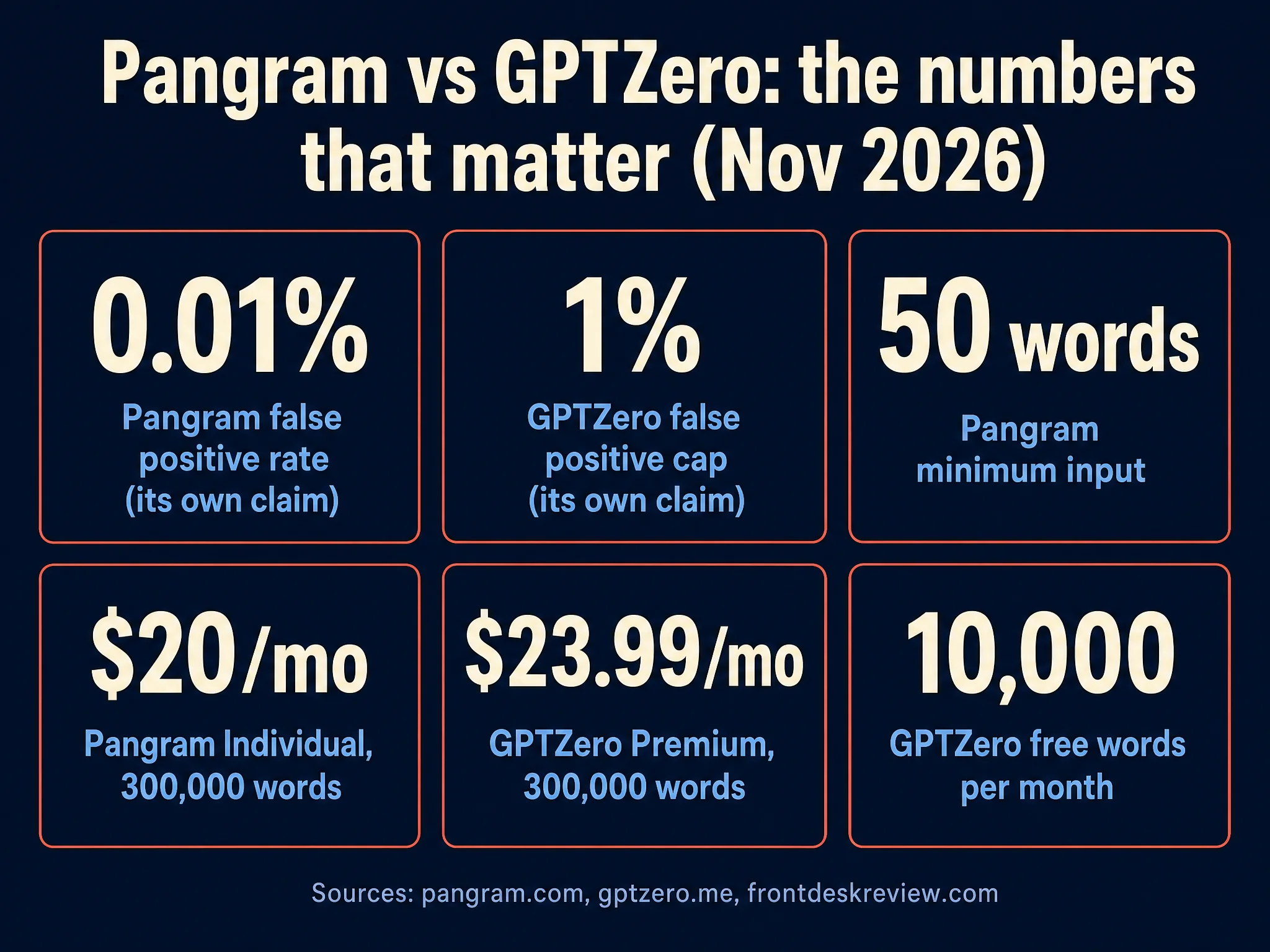
| Cheapest paid plan | $20/mo, 300,000 words | $14.99/mo, 150,000 words |
| Minimum input | 50 words (model 3.2) | No public word floor on the plan pages |
| How it labels text | Per segment: AI-Generated, Moderately AI-Assisted, Lightly AI-Assisted, Human-Written | Per document: entirely human, entirely AI, or mixed |
| Own false positive claim | 0.01% (about 1 in 10,000) | 1% cap in its published numbers |
| Where you meet it | Substack scan button, publishers, Pangram site | Schools, Google Docs extension, LMS tools |
Sources: Pangram pricing, Pangram 3.2 model card, GPTZero support, GPTZero plan tracker (verified 27 Sep 2026).
How the two tools show you a result
The interfaces look alike: a box, a button, a percentage. The difference is in what the percentage is made of. GPTZero gives one verdict for the whole document and, since its three-class update, splits the AI probability into a "completely AI" part and a "mixed" part. It also shows a certainty level, and its own help page says a low-certainty result "should be interpreted with caution".
Pangram cuts the text into segments of roughly 50 words and labels each one. The document label then summarises them, for example "AI Assisted" or "Mostly Human, AI Detected", with a percentage for each band. That is why a Pangram result can say 30% while every sentence of your text is your own idea: the model is reading phrasing, not authorship.
Accuracy: what the evidence says
Why Pangram and GPTZero each claim to win
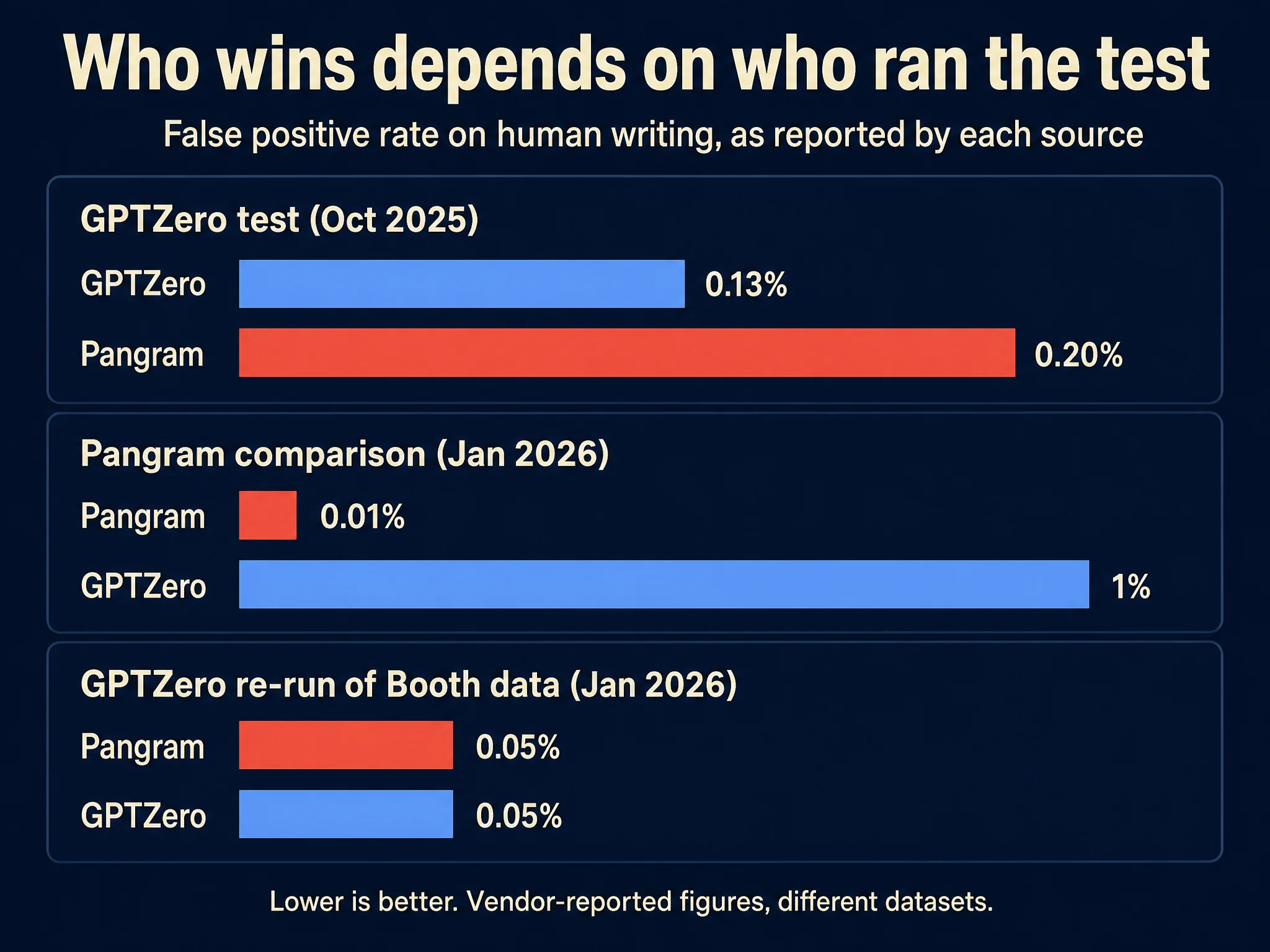
Search for this comparison and the first two results are the vendors themselves, and each one wins its own test. GPTZero's comparison (October 2025, updated April 2026) reports GPTZero at 99.6% accuracy with a 0.13% false positive rate, against Pangram at 97.5% and 0.20%. It does not publish the dataset or how many documents were tested.
Pangram's comparison (January 2026) puts its own false positive rate at 0.01% and GPTZero's at 1%, quoting GPTZero's published figure. On text from OpenAI's o3, it reports 99.86% detection for itself against 89.9% for GPTZero. Pangram also admits the two sets of numbers were not measured on the same documents.
So neither vendor page settles it. The useful evidence is the work neither company wrote:
- University of Chicago Booth / NBER (September 2025). Brian Jabarian and Alex Imas tested Pangram, GPTZero, Originality.ai and an open-source model. They found Pangram was "the only tool to satisfy a strict cap (FPR ≤ 0.005) without sacrificing accuracy" (NBER working paper 34223). GPTZero disputes this, saying the researchers read the wrong output field. Its own re-run puts both tools at a 0.05% false positive rate, with GPTZero ahead on recall, 99.3% to 98.9% (as summarised by GradPilot).
- Vrije Universiteit Brussel (2026). A peer-reviewed study in the International Journal for Educational Integrity tested GPTZero, Pangram, Copyleaks and Turnitin on 160 documents of known origin. All four handled fully human documents correctly, and Pangram did best on hybrid and "humanised" texts, according to AI Weekly's summary of the paper.
- AIMultiple's small test (updated October 2026). 18 short texts of 100 to 196 words. Neither tool flagged any of the 9 human texts; GPTZero caught 8 of 9 AI texts and Pangram reported 85% (AIMultiple). Too small to rank anything, but a useful reminder that both do well on clean cases.
Read together: Pangram has the edge in the independent work, especially on edited or "humanised" AI text. GPTZero is close behind and disputes the gap. For more on how often detectors misfire across the board, see our AI detection false positive rates roundup.
My scores, based on the studies and plan pages linked in this article. Not a lab test.
Same essay, opposite scores: what each number actually measures
When the two tools disagree on one document, one of four things is usually going on.
1. Pangram sees "assistance" that GPTZero does not count
Pangram has two middle bands, Lightly and Moderately AI-Assisted. If Grammarly rewrote your sentences, a tutor or teacher made edits, or you used AI to brainstorm and kept its structure, Pangram can label those segments even when GPTZero calls the whole thing human. In the r/ApplyingToCollege thread, the top reply suggested the teacher's edits as the cause and told the student to scan the original draft before anyone touched it. That is the right test. We cover the same pattern in can AI detectors flag writing edited by a tutor and when Grammarly triggers an AI flag.
2. GPTZero's "mixed" class catches formal writing
The engineering student's 35% came from GPTZero, and the top reply in that thread made the common point: formal, technical prose looks a lot like what models were trained on. GPTZero's own published false positive cap is 1%, a hundred times Pangram's claim. A lone GPTZero "mixed" score next to a clean Pangram result on a long, human-written paper is the pattern you would expect from a false positive. GPTZero's team has said its newer model is better on ESL writing; we were skeptical of that claim when it launched.
3. The text is short or not really prose
Pangram will not score anything under 50 words, and its model card lists bullet lists, instructions, templated writing, reference sections and dense maths as more prone to false positives. Poetry had its highest false positive rate, 0.54%. GPTZero does not publish a comparable list on its plan pages. Short supplemental essays and lab reports are where both tools are least reliable, which we explain in why short essays get flagged more often.
4. Re-running changed the result
Several writers in r/WritingWithAI said the same chapter came back different on repeat scans, one after adding two commas. That is a Reddit report, not a measured result, but it matches how segment-based scoring works: small edits can move a segment across a band boundary. If a score flips on a trivial change, treat both readings as weak.
Disagreement decoder
Enter what each tool told you. The decoder explains the gap and what to do next. It runs in your browser and does not send your text anywhere, because it never sees your text.
Which plan would you need?
Which detector your reader is actually running
A student does not get graded by Pangram because Pangram is more accurate. They get graded by whatever their institution licensed. That makes "who reads this?" the first question, before "which is better?"
- Substack readers run Pangram. Substack added a reader-side "Scan for AI text" button powered by Pangram in July 2026, with Human, AI-assisted and AI-generated bands and a 100-word minimum (Online Writing Club). More in our Substack AI detector guide.
- Publishers increasingly run Pangram. We covered the manuscript cases, from Shy Girl to the Caine Prize, in do publishers use AI detectors.
- Schools mostly run Turnitin, then GPTZero. GPTZero sells classroom plans and integrations with Word, Google Docs and learning platforms (huby's comparison lists them). If your school uses Turnitin, neither tool shows you Turnitin's number; see Turnitin vs GPTZero for how those two differ.
College applicants are the confusing case. Reddit commenters keep repeating rules like "keep it under 20% on Pangram". No college I could find publishes a Pangram threshold, so treat that as folklore. Our AI in admissions essays statistics page tracks what colleges have actually said.
Comparative analysis: cost and features
What each one costs per 1,000 words in November 2026
Prices from Pangram's pricing page (read 1 November 2026) and a plan tracker verified on 27 September 2026, because GPTZero's own pricing page did not show individual plan prices when we read it. Per-1,000-word cost assumes you use the full monthly allowance.
| Plan | Monthly price | Words a month | Cost per 1,000 words |
|---|---|---|---|
| GPTZero Free | $0 | 10,000 | $0 |
| GPTZero Essential | $14.99 | 150,000 | about $0.10 |
| Pangram Individual | $20 | 300,000 | about $0.07 |
| GPTZero Premium | $23.99 | 300,000 | about $0.08 |
| GPTZero Professional | $45.99 | 500,000 | about $0.09 |
| Pangram Professional | $65 | 5x Individual | not stated as a word count |
Two practical notes. First, a student checking a few essays a month never needs a paid plan of either: GPTZero's free 10,000 words covers about fifteen 650-word essays, and Pangram's 7-day trial covers a one-off check. Second, both sell annual billing: Pangram says annual saves $60 a year on Individual, and GPTZero's annual Premium works out to about $12.99 a month on the tracker. If you only want a free pre-check, our best free AI detector for students list covers the options.
Feature comparison
| Feature | Pangram | GPTZero |
|---|---|---|
| Segment-level "AI-assisted" bands | Yes, light and moderate | No, document-level mixed class |
| Languages | 20+ | 3 (English, French, Spanish), per GradPilot |
| Similarity (plagiarism) check | Included on every scan | Sold as a separate product feature |
| Writing replay / authorship | Google Docs and Gmail integrations | Authorship and Writing Replay listed in product menu |
| Image scans | 100 a month on Individual | Not listed for individual plans |
What happens to the text you paste in
A popular r/Substack thread in October claimed Pangram trains its models on your writing. Pangram's own help page says the opposite: "Pangram never uses your data to train our models", and submissions are stored so you can see your results later (Pangram knowledge hub). GPTZero says documents sent through its API are not stored by default, but text you paste into the gptzero.me dashboard is stored and "only used in aggregate" to improve the service (GPTZero support).
Neither statement is an audit, and both are vendor promises. If your essay is unpublished and sensitive, the safest habit is the same with any checker: paste the section in question, not the whole manuscript. We go further on this in what happens to text you paste into AI tools.
Pros and cons
Pangram: pros
- Best independent false positive results (NBER, VUB study)
- Separate light and moderate AI-assisted bands
- 50-word floor stops useless short-text scores
- Lowest cost per 1,000 words of the paid plans
- Says it never trains on submissions
Pangram: cons
- No permanent free plan, only a 7-day trial
- Assisted bands can flag Grammarly or tutor edits on your own work
- Poetry, lists and templates more error-prone, by its own model card
- Its 0.01% figure is self-reported
GPTZero: pros
- Real free plan, 10,000 words a month
- Widely used in schools, so its number is often the one a teacher sees
- Google Docs and LMS integrations
- Close to Pangram on recall in its own re-run
GPTZero: cons
- Published false positive cap of 1%, higher than Pangram's claim
- Weaker on humanised and hybrid text in the VUB study
- Dashboard submissions are stored
- Individual prices were not shown on its own pricing page when we checked
What changed in 2026
- 27 February 2026: Pangram 3.2 lowered the minimum input from 75 to 50 words and kept the false positive rate of the previous release (model card).
- January 2026: GPTZero re-ran the Booth study data and published a result with itself ahead on recall.
- June 2026: Superhuman, Grammarly's parent, agreed to acquire GPTZero.
- July 2026: Substack shipped its Pangram-powered scan button.
- October 2026: The VUB peer-reviewed study got wide coverage, and a Pangram flag on the Caine Prize winner put the tool in mainstream news.
Purchase recommendations
Best for Pangram
- Novelists, Substack writers and freelancers whose readers or editors use Pangram
- Anyone checking long-form prose who wants the lowest measured false positive rate
- Professors who want segment labels rather than one document score
Best for GPTZero
- Students whose school or teacher uses GPTZero
- Anyone who needs a free checker for a few essays a month
- Teachers who want it inside Google Docs or an LMS
Skip both if
- Your school runs Turnitin and you want to know Turnitin's number. Neither tool shows it.
- You plan to rewrite your own work until a score drops. Keep your version history instead; it is better evidence than any detector.
Want the deeper single-tool picture? Read our full Pangram review, which looks at the false negatives behind the near-zero false positive claim.
Where to buy and how to pay less
Buy only from pangram.com and gptzero.me. In r/CollegeEssays, one commenter's first question to a flagged student was whether they had used the official Pangram site rather than a lookalike. Start with the free options: GPTZero's free plan and Pangram's 7-day trial. Pay annually only once you know you will keep using it.
Final verdict
Evidence and proof
These are the user reports this comparison was built around. They are first-hand claims from Reddit, not verified tests.
For how to read any detector report line by line, see AI detection reports explained.
FAQ
Is Pangram more accurate than GPTZero?
On the independent evidence, yes for false positives and for edited or humanised AI text. The University of Chicago Booth / NBER paper found Pangram was the only tool to meet a 0.5% false positive cap without losing accuracy, and a 2026 VUB study found it best on hybrid and humanised texts. GPTZero disputes the Booth ranking and its own tests show it ahead.
Why does Pangram say AI when GPTZero says human?
Usually because Pangram labels light and moderate AI assistance per segment, so Grammarly rewrites, tutor edits or AI-shaped structure can show up even when GPTZero sees a human document. Scan the version from before any edits to check.
Why does GPTZero say mixed when Pangram says human?
GPTZero's published false positive cap is 1%, much higher than Pangram's 0.01% claim, and formal or technical prose is the most common trigger. On long human-written prose, a lone GPTZero mixed result next to a clean Pangram score is the typical false positive pattern.
Is Pangram free?
Pangram lists no permanent free plan. It offers a 7-day free trial, then $20 a month for 300,000 words on the Individual plan.
How much does GPTZero cost?
A free plan covers 10,000 words a month. Paid plans were $14.99 (Essential, 150,000 words), $23.99 (Premium, 300,000) and $45.99 (Professional, 500,000) a month on a plan tracker verified in September 2026, with cheaper annual billing.
What is Pangram's minimum word count?
50 words for the 3.2 model released in February 2026, down from 75. Substack's Pangram scan button needs 100 words.
Does Pangram train on my writing?
Pangram says it never uses submitted data to train its models and stores submissions so you can view results. That is the company's statement, not an independent audit.
Which detector do colleges use?
Most schools that use one run Turnitin, and GPTZero is common in classrooms. No college we found publishes a Pangram score threshold for admissions essays, so advice like "stay under 20% on Pangram" is Reddit folklore.
