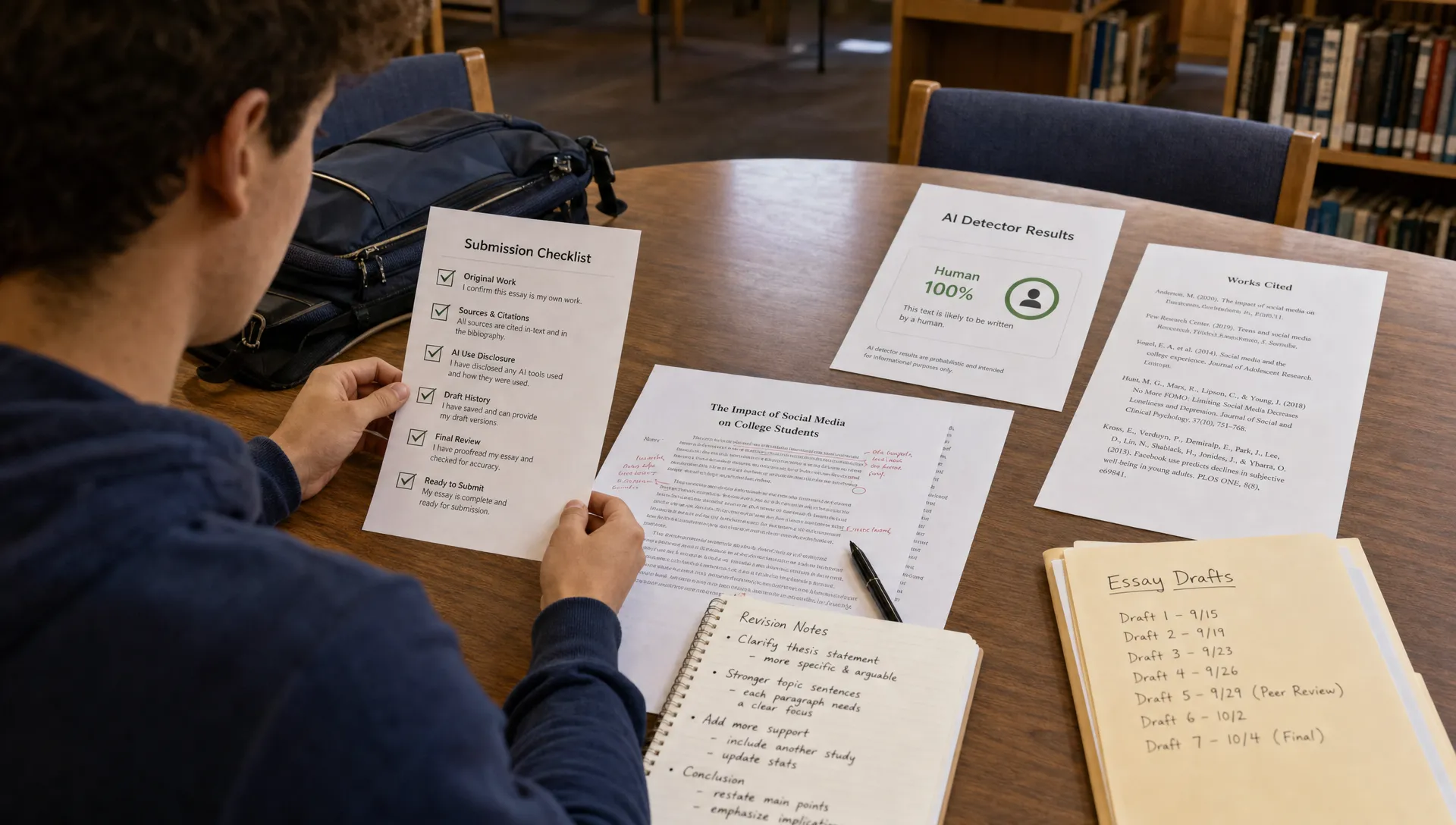
Checking your paper with a free AI detector before submission can be useful, but it should not be the only step between your final draft and the upload button. AI detectors do not prove authorship. They estimate whether text resembles common patterns in AI-generated content, and those estimates can be wrong.
For students, the best free AI detector is the one that helps you find risky sections, improve weak writing, and protect your draft history without making you chase a meaningless “0% AI” score. Used correctly, it is a pre-submission screen, not a verdict.
Want to bypass Turnitin in 2026? Grab the free prompt pack.
Get the exact text-humanization prompts I use to drop an AI score by hand — copy, paste, submit. Free, straight to your inbox.
Send me the free prompts →Quick answer: the best free AI detector for students
For most students, GPTZero is the best free AI detector to try before submission because it is easy to use, student-friendly, and usually gives more useful feedback than a simple yes-or-no result. Its sentence or paragraph-level signals can help you identify sections that sound generic, repetitive, or disconnected from your own argument.
That said, no public AI detector can guarantee what Turnitin or another school system will report. If your grade, academic standing, or peace of mind depends on the result, use a detector as one part of a broader pre-submission review.
A strong student workflow looks like this: check the paper with one free AI detector, review any flagged passages for real writing problems, confirm citations and source use with a plagiarism checker if your school allows it, and preserve your drafts, notes, outlines, and version history.
If your specific concern is Turnitin, it is worth reading a dedicated guide to a pre-submission check for Turnitin AI risk because Turnitin risk is not the same as a random public detector score.
What makes an AI detector useful before submission?
A student does not need the most technical AI content detector. You need one that helps you make a better decision before submitting. The tool should make it easier to answer practical questions: Does this section sound too generic? Did I over-edit until my voice disappeared? Are my citations doing enough work? Can I explain how this draft developed?
The best free AI detector for students should have these qualities:
- Clear results that show which sections are being flagged, not just a single unexplained percentage.
- Enough free usage to check a full essay or at least the most important sections.
- No confusing claims that a score is absolute proof of AI use.
- Reasonable privacy practices, especially if you are pasting unpublished academic work.
- Useful writing feedback that helps you revise substance, clarity, and evidence.
A detector that simply says “AI: 87%” without explaining why is less helpful than a tool that points to specific paragraphs. Students need actionable feedback, not panic.
Free AI detector comparison for students
Free access changes often, so always check the tool’s current limits before relying on it for an important submission. The table below focuses on how useful each option is for student pre-submission checking, not whether it can perfectly match your school’s detector.
| Tool | Best use before submission | Why students use it | Main caution |
|---|---|---|---|
| GPTZero | Overall AI risk screening | Often gives more detailed section-level signals than basic detectors | A high or low score is still not proof |
| QuillBot AI Detector | Fast paste-and-check review | Simple interface and quick feedback | May be less useful if you need detailed evidence |
| Scribbr AI Detector | Student-oriented writing review | Familiar academic writing brand with related citation resources | Free limits and features can change |
| Copyleaks AI Detector | More formal AI detection checks | Known in education and enterprise settings | Free access may require limits, trials, or account steps |
| Sapling AI Detector | Quick short-text checks | Useful for testing paragraphs or excerpts | Short samples can produce unstable results |
If you want a broader comparison beyond the top free option, Detection Drama’s guide to AI detector alternatives to Turnitin for students explains how different tools compare and why matching Turnitin exactly is difficult.
Why AI detector scores can be misleading
AI detectors work by analyzing patterns in text. They may look at predictability, sentence structure, word choice, repetition, and other statistical signals associated with AI writing tools. The problem is that human writing can also look predictable, especially in formal academic assignments.
This is why detector results should be interpreted carefully. A concise lab report, a polished literature review, or an essay written by an English-language learner may be flagged even when the student wrote it themselves. A widely cited 2023 study in Patterns found that GPT detectors can be biased against non-native English writing, highlighting a serious false-positive concern in academic settings.
AI detection is also different from plagiarism detection. A plagiarism checker looks for copied or closely matched text from existing sources. An AI detector estimates whether text has characteristics associated with machine-generated writing. A paper can be original but flagged as AI, or plagiarized but not flagged as AI.
That distinction matters before submission. If your school uses Turnitin, remember that Turnitin’s plagiarism similarity score and AI writing indicator are different signals. One does not replace the other.
The best way to use a free AI detector before submission
The smartest approach is not to run your essay through five detectors until one gives you the answer you want. Instead, use a detector to guide a focused revision.
Start by checking the assignment policy. Some instructors allow brainstorming with AI, some allow grammar support, and some prohibit AI writing tools entirely. Before worrying about a detector score, make sure you understand what your course actually permits.
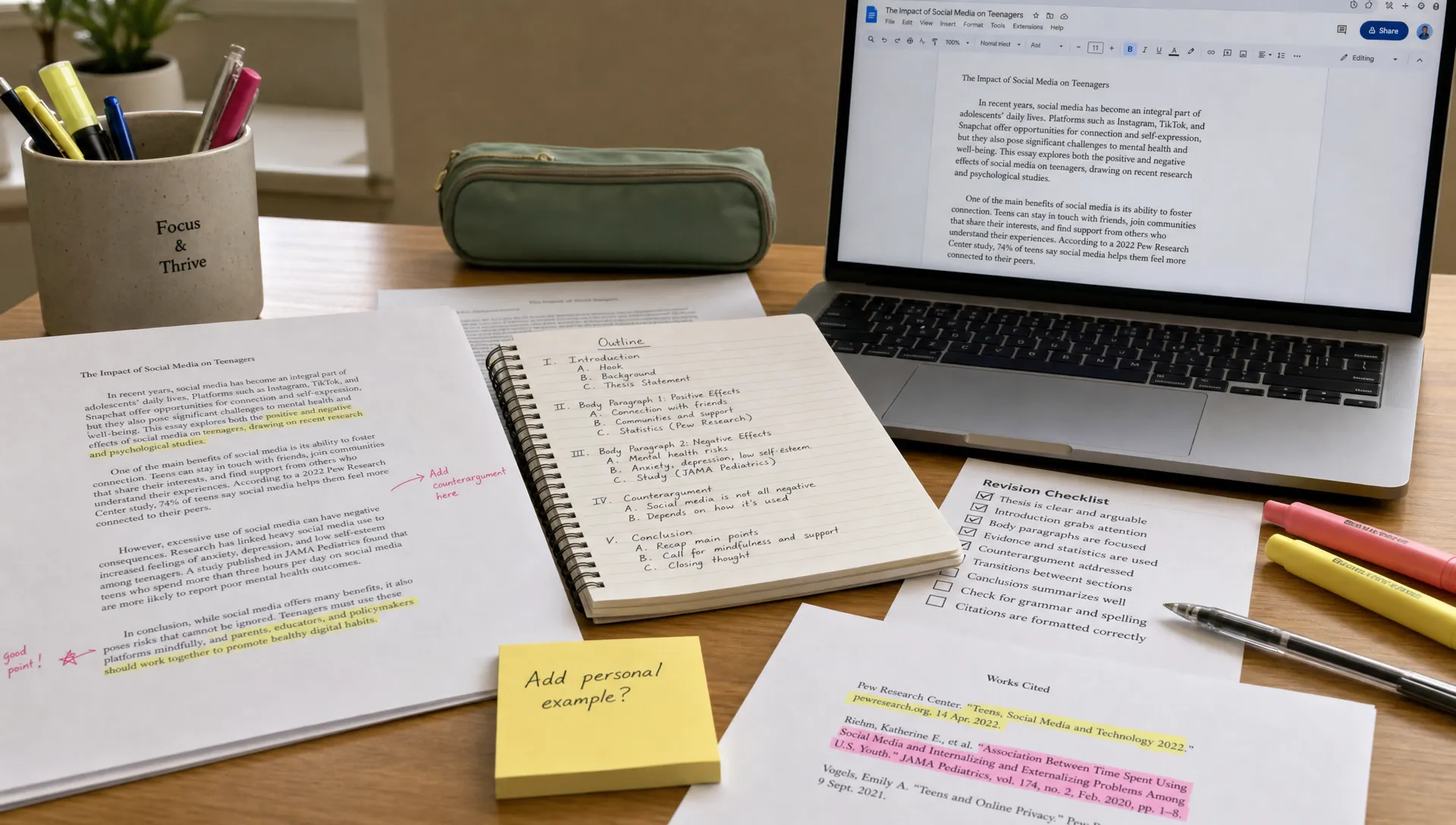
Next, save evidence of your writing process. Keep your outline, research notes, draft versions, comments, citations, and document history. If a false positive ever becomes a problem, process evidence is often more persuasive than a screenshot from a free detector.
Then run your final draft, or the most important sections, through your chosen AI detector. Look for patterns rather than isolated scores. If the introduction, conclusion, or generic background paragraphs are flagged, that may mean they sound formulaic. If your evidence-heavy analysis is flagged, check whether it uses your own reasoning or relies too heavily on broad claims.
Here is a simple pre-submission review framework:
| Step | What to check | Why it matters |
|---|---|---|
| Policy review | Your syllabus, assignment sheet, and AI rules | A detector score does not decide what is allowed |
| Draft evidence | Outlines, notes, version history, comments | Shows your authorship process if questioned |
| AI detector scan | Flagged paragraphs and overall pattern | Helps identify generic or over-polished sections |
| Citation review | Quotes, paraphrases, reference list, missing sources | AI detection does not catch all source problems |
| Final read-aloud pass | Voice, logic, transitions, specific examples | Human writing should sound intentional and context-aware |
This workflow is slower than pasting text into one tool, but it is much safer. It helps you improve the actual paper rather than optimizing for a detector that may not be reliable.
What to do if your paper gets a high AI score
A high AI score can feel alarming, especially if you wrote the paper yourself. The first step is not panic. False positives happen, and detector percentages are not the same as proof.
Read the flagged sections closely. Many AI-like passages share the same problems: vague claims, repetitive transitions, unsupported summaries, overly smooth wording, and paragraphs that could fit almost any assignment. Instead of trying to “trick” a detector, revise for substance.
Add more assignment-specific reasoning. Refer to the actual prompt, class concepts, data, readings, or case details. Replace broad statements with precise claims you can defend. If a paragraph sounds like a generic overview, connect it to your thesis and evidence.
You can also compare the flagged section to your earlier drafts. If your draft history shows how the paragraph developed, keep that evidence. If you used AI writing tools in a way your course allows, document what you used them for and make sure the final work still reflects your own analysis.
If detection anxiety is affecting how you write, you are not alone. Many students now worry that polished academic writing may be misread as AI-generated, and Detection Drama’s article on AI detection anxiety statistics explores how that stress changes student behavior.
Common mistakes students make with free AI detectors
The biggest mistake is treating one free detector score as a final truth. Different detectors can return different results for the same essay because they use different models, thresholds, and training data.
Another mistake is checking only the final draft. If you wait until the last minute, a scary result can push you into rushed edits that weaken the paper. It is better to check a near-final draft early enough to revise thoughtfully.
Students also sometimes confuse “human-sounding” with “good academic writing.” A paper can sound casual and still be weak. The goal is not to add slang, random errors, or awkward phrasing. The goal is to make the argument more specific, sourced, and clearly yours.
Privacy is another concern. Before pasting an unpublished essay into any tool, review the site’s terms and privacy policy. Avoid uploading sensitive personal information, unpublished research data, confidential case details, or anything your institution prohibits sharing with third-party tools.
Should you use more than one AI detector?
Using two detectors can be helpful if you are interpreting results cautiously. If GPTZero flags a section and another tool also flags the same section, that paragraph deserves a closer look. But if one tool says 90% AI and another says 10% AI, that disagreement is a reminder that detection is uncertain.
Do not average scores and treat the result as scientific. Instead, ask what the tools are pointing you toward. Are the flagged paragraphs vague? Are they disconnected from your sources? Do they sound unlike the rest of your paper? Are they written in a template-like style?
For most students, one good detector plus a careful authorship and citation review is better than obsessively checking ten tools.
Best free AI detector verdict
If you want one free AI detector to try before submission, start with GPTZero. It is practical, accessible, and usually more informative than basic copy-paste detectors. But the best protection is not a single score. It is a complete pre-submission process that includes policy awareness, draft evidence, citation review, and meaningful revision.
Use AI detection as a warning light, not a judge. A warning light tells you where to inspect. It does not automatically tell you what happened or who is at fault.
Frequently Asked Questions
What is the best free AI detector for students before submission? GPTZero is a strong first choice for most students because it is easy to use and often gives section-level feedback. However, no free AI detector can guarantee what Turnitin or your school’s system will report.
Can a free AI detector match Turnitin? No public detector can reliably promise the same result as Turnitin. Different tools use different models and thresholds, so a low score on a free AI content detector does not guarantee a low Turnitin AI indicator.
Is an AI detector the same as a plagiarism checker? No. A plagiarism checker compares your writing against existing sources to find similarity. An AI detector estimates whether the writing resembles AI-generated content. Students should think about both originality and authorship.
What should I do if my own writing is flagged as AI-generated? Review the flagged passages for vague wording, generic claims, missing citations, or over-polished language. Keep your outlines, notes, drafts, and version history so you can show your writing process if needed.
Should I use a text humanizer before submitting? Be careful. A text humanizer is not a substitute for original thinking, accurate citations, or following your course policy. If you revise, focus on making the paper more specific, evidence-based, and clearly connected to your own argument.
Final pre-submission advice
A free AI detector can help you spot risk, but it cannot replace judgment. Before you submit, ask a better question than “Will this pass?” Ask: “Can I explain how I wrote this, where my evidence came from, and why every major claim belongs in this paper?”
For more student-focused guides, detector reviews, and AI authenticity resources, explore Detection Drama before your next submission. The goal is not just a better detector score. It is a paper you can stand behind with confidence.
