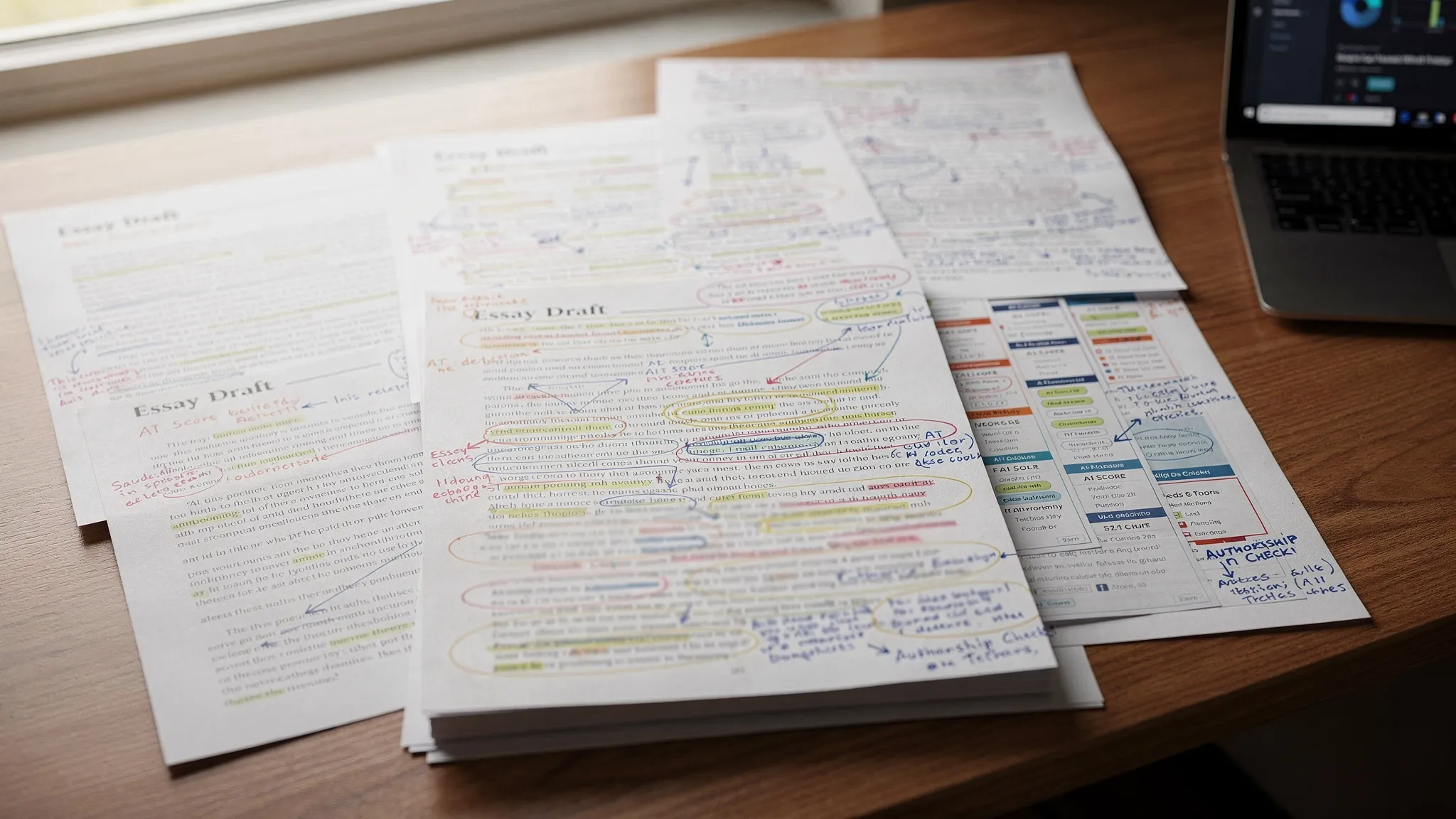
Short essays are one of the most frustrating edge cases in AI detection. A 450-word reflection can get flagged while a 2,000-word research paper from the same writer passes cleanly. That does not mean the short essay is more likely to be AI-generated. It usually means the detector has less evidence to work with, so normal patterns look louder than they should.
Want to bypass Turnitin in 2026? Grab the free prompt pack.
Get the exact text-humanization prompts I use to drop an AI score by hand — copy, paste, submit. Free, straight to your inbox.
Send me the free prompts →AI detectors do not know who wrote a document. They estimate probability from language patterns, structure, predictability, and similarities to text seen during training. In short essays, a few polished paragraphs, repeated transitions, or generic claims can dominate the entire score. That is why short-form academic writing, discussion posts, admissions responses, and timed reflections often create more disputed flags than longer work.
This matters because the score can feel more certain than it is. Even OpenAI retired its public AI Text Classifier because of low accuracy, and independent research has repeatedly shown that detectors can misclassify human writing, especially in academic and non-native English contexts. The practical takeaway is simple: a short essay flag should be treated as a review signal, not proof of misconduct.
The short version: less text means less context
The shorter the essay, the more unstable the detection result can be. Detectors need enough language to evaluate sentence rhythm, vocabulary range, paragraph variation, and document-level consistency. A short essay gives them a narrow slice of your writing, so one formulaic introduction or unusually smooth conclusion can skew the whole result.
| What a detector tries to evaluate | What happens in a short essay | Why the flag can be unstable |
|---|---|---|
| Sentence rhythm | Only a small number of sentences are available | A few similar sentences can look like a strong pattern |
| Paragraph variety | Many short essays use a fixed intro, body, conclusion format | Template structure can resemble AI-generated organization |
| Specificity | There is limited room for detailed examples or source work | Broad claims can look generic or machine-like |
| Style consistency | A single polished paragraph may dominate the sample | One edited section can create a high apparent AI signal |
| Human reasoning | The writer may summarize instead of showing thought process | The essay can look complete but impersonal |
Some tools also have minimum word count rules or eligible-text requirements. Turnitin, for example, has an AI writing product page that emphasizes institutional interpretation and review rather than automatic judgment. If a submission barely clears a tool's minimum threshold, the result may be especially sensitive to small wording changes.
How AI detectors read a short essay
Most AI content detectors compare the submitted text against patterns that tend to appear in machine-generated writing. They may look at predictability, sentence uniformity, transitions, repetition, vocabulary distribution, and whether the text follows an unusually neat argumentative path.
This is why the phrase AI detection can be misleading. The tool is not detecting a hidden watermark in most cases. It is making a statistical judgment about the text. A human can write predictable prose, and an AI model can write messy prose. The detector is working with probabilities, not certainty.
That distinction becomes critical in short essays. In a long paper, there is more room for natural variation: a rougher paragraph, a personal example, a source-specific explanation, a sentence that changes pace, or a section where your thinking visibly develops. In a short essay, those human signals may be missing simply because the assignment does not give you space.
Why short essays get flagged more often
1. The sample-size problem is real
Small samples are noisy. If you flip a coin four times and get heads three times, that looks like a pattern. If you flip it 400 times, the pattern usually evens out. AI detectors face a similar problem with short essays. They have fewer sentences to analyze, so a small cluster of predictable sentences can appear more meaningful than it really is.
This is one reason a 300 to 600 word submission can feel risky. It may be long enough to produce a score, but not long enough to show the full range of your style. The detector sees the finished surface, not the messy drafting process behind it.
2. Short school essays often use the same safe template
Many students are taught to write short essays with a familiar structure: hook, thesis, three supporting points, conclusion. That format is useful for clarity, but it is also highly predictable. AI writing tools often produce the same shape because it satisfies the assignment quickly.
Phrases like this essay will discuss, another important factor, and in conclusion are not proof of AI use. They are common student-writing habits. But when a short essay is full of predictable signposts and has limited original detail, a detector may treat the whole piece as suspicious.
If this sounds familiar, see our guide to normal writing habits that can trigger Turnitin AI flags. The issue is usually not one phrase. It is the overall sameness of the draft.
3. Generic prompts produce generic answers
Short essays often respond to broad prompts: explain a theme, reflect on leadership, discuss technology, summarize a reading, or argue whether something is beneficial. Broad prompts encourage broad answers. Broad answers are exactly where detectors tend to become less useful.
Consider a sentence like this:
Social media has both positive and negative effects on teenagers because it can connect people but also cause distraction.
A human could easily write that. So could an AI model. The sentence is clear, balanced, and unsurprising. In a long essay, you might add a class reading, a concrete example, a counterargument, or a personal observation. In a short essay, you may stop there because of the word limit.
The fix is not to add random mistakes. The fix is to add evidence of thinking. Replace generic balance with a specific reason, a named source, a course concept, or a concrete observation that only fits your assignment.
4. Over-polishing removes human texture
Grammar checkers, paraphrasers, writing assistants, and AI drafting tools can make short essays sound unusually smooth. That can be helpful, but it can also flatten your natural rhythm. If every sentence becomes medium-length, grammatically polished, and emotionally neutral, the essay may lose the unevenness that human readers associate with real drafting.
This is especially common when students use tools to clean up a short essay right before submission. A final polish pass can change the surface of the entire document. In a 2,000-word paper, that effect may be diluted. In a 400-word reflection, it can define the whole sample.
If a tool like Grammarly was part of your workflow and your paper was questioned, read our guide on Grammarly triggering Turnitin AI and how to prove authorship.
5. One suspicious paragraph carries more weight
In a short essay, every paragraph is a large percentage of the document. If the conclusion is extremely polished, the introduction is formulaic, or the body paragraph closely follows an AI-like outline, that section can dominate the result.
This also explains why sentence-level highlights can look dramatic. A detector may highlight 6 sentences in a 350-word essay, which feels like the entire piece has been condemned. In a longer paper, those same 6 sentences would be a minor portion of the document.
Turnitin highlighting, GPTZero sentence feedback, and other detector highlights should be read as areas for review, not as proof that those exact sentences were generated. We break this down further in what Turnitin's AI highlighting actually means.
6. ESL, dialect, and careful academic English can be misread
Research has shown that AI detectors can be biased against non-native English writing. A widely discussed Stanford HAI report found that detectors were more likely to misclassify essays by non-native English writers. Another peer-reviewed study in the International Journal for Educational Integrity found major variability across detection tools.
The reason is not that ESL writing is AI-like in any meaningful human sense. It is that some detectors associate simpler sentence structures, safer vocabulary, and more standardized phrasing with machine output. Short essays magnify that problem because there is less writing available to show individual style.
If this applies to you, the strongest defense is process evidence: drafts, notes, outlines, source annotations, and a clear explanation of how you developed the essay. You can also read our deeper guide on AI detection bias against ESL students.
7. AI-assisted outlines can leave a visible skeleton
Some students use AI tools for brainstorming or outlining, then write the essay themselves. Depending on the course policy, that may be allowed, restricted, or prohibited. The risk is that AI-generated outlines often produce very neat paragraph logic: definition, benefit, drawback, conclusion. Even if you write the sentences yourself, the structure can still feel generic.
For short essays, that skeleton is more obvious. There is less room to depart from the outline, add friction, or show your own path through the topic. If AI use is permitted, keep a usage log and revise the structure around your actual thinking, not just the model's suggested order.
8. Detector disagreement is more common near the margins
One detector may say human while another says AI. This is not rare. Tools use different training data, thresholds, preprocessing, and scoring methods. Some are stricter with academic prose. Others are harsher on short text or sentence-level predictability.
That is why a clean public detector result does not guarantee Turnitin will agree. It also means a single high score should not be treated as a final verdict. If your results conflict, start with our guide on what to do when an AI detector says human but Turnitin says AI.
Short essay types that are most vulnerable
Not every short essay carries the same risk. The highest-risk formats tend to combine a low word count with a generic prompt and a polished academic tone.
| Assignment type | Why it can get flagged | Safer writing signal to add |
|---|---|---|
| 300 to 500 word reflection | Often uses broad personal claims without detailed support | Add a specific moment, class concept, or decision you made |
| Discussion post | Repeats prompt language and predictable agreement phrases | Respond directly to a peer, reading, or class example |
| Admissions or scholarship answer | Highly polished, motivational, and compressed | Include concrete personal details and a clear narrative arc |
| Timed essay | Formulaic structure under pressure | Preserve notes or rough planning if allowed |
| Reading summary | Neutral tone and paraphrased source language | Add source-specific interpretation, not just summary |
| Group project section | Style may differ from teammates or be overly smoothed | Keep a contribution log and draft history |
The goal is not to make your writing artificially messy. The goal is to make your authorship visible. Human readers trust writing more when they can see choices, constraints, examples, and reasoning.
How to revise a short essay so it is more defensibly yours
If you are worried about AI detectors, do not chase the score first. Strengthen the essay first. A stronger short essay usually has more specific evidence, clearer reasoning, and a more natural voice, which also makes it easier to defend if questioned.
Use this pre-submission checklist:
- Add one assignment-specific detail that could not fit any generic essay on the topic.
- Replace at least one broad claim with a concrete example, source connection, or observed consequence.
- Show a reasoning step, not just a conclusion.
- Vary paragraph function so every paragraph does not follow claim, explanation, transition.
- Keep your version history, outline, research notes, and any instructor feedback.
- Avoid aggressive last-minute rewriting that changes your voice across the whole essay.
A defensible revision is usually more specific, not longer for the sake of being longer. For example, instead of saying that a character shows courage, explain which choice in the text shows courage, why that choice matters, and how it connects to the class discussion or prompt language.
The same principle applies outside school. For workplace writing, add project context. For marketing copy, add customer details. For application essays, add a lived moment rather than a polished moral. AI detectors struggle less with writing that carries clear context and ownership.
For a policy-safe approach, see how to lower Turnitin AI score without humanizer tricks and our safe AI writing workflow for college.
What to do if a short essay has already been flagged
First, do not panic and do not immediately rewrite the essay to make the score disappear. A post-flag rewrite can make the process harder to explain. Preserve evidence before changing anything.
- Save the exact file you submitted, including timestamps if available.
- Export or screenshot version history from Google Docs, Word, or your writing platform.
- Ask to see the AI report, highlighted passages, and the basis for the concern.
- Gather outlines, notes, reading annotations, source searches, and earlier drafts.
- Write a one-page process memo explaining how you wrote the essay.
- Offer a reasonable verification method, such as an oral explanation or live rewrite of a small section.
Your goal is to shift the conversation from score versus denial to evidence of authorship. A detector score alone cannot show your drafting process. Your drafts, notes, and ability to explain your choices can.
If you need a time-boxed response plan, use our guide on what to do in the next 24 hours after being accused of AI use or our Turnitin false positives checklist.
Should you use a text humanizer on a short essay?
A text humanizer can be useful as an editing aid, especially when AI-assisted writing sounds generic, stiff, or repetitive. But short essays are delicate. An aggressive rewrite can change your meaning, alter citations, flatten your voice, or create a new pattern that another detector dislikes.
If you use a humanizer, treat the output as a draft, not a submission-ready answer. Read every sentence, compare it against your original intent, and make sure the final version still reflects your thinking. For academic work, follow your course policy and disclose AI assistance when required.
Detection Drama covers AI detection, text humanizer tools, and detector reports because writers need practical ways to understand risk. But no humanizer can guarantee that a short essay will pass every AI content detector, especially as tools update. The safest long-term strategy is still authorship evidence plus specific, explainable writing.
For more background, read how AI humanizers work and why detectors still flag text.
Frequently Asked Questions
Do short essays really get more false positives from AI detectors? They can. Short essays provide less language for the detector to analyze, so normal patterns like template structure, polished grammar, or generic transitions can have an outsized effect. This does not prove the writing is AI-generated.
What word count is safest for AI detection? There is no universally safe word count. Longer essays usually give detectors and human reviewers more context, but a long generic essay can still be flagged. The better goal is to make your reasoning, evidence, and drafting process visible.
Can Turnitin flag a 300-word essay? It depends on the tool configuration, eligibility rules, and institution. Some AI detectors have minimum text requirements. Even when a short essay is eligible for scoring, results near the minimum can be more volatile than results for longer documents.
Should I make my writing less polished to avoid AI detection? No. Adding mistakes on purpose is a bad strategy. Instead, make the essay more specific, show your reasoning, preserve drafts, and avoid over-smoothing every sentence with the same editing tool.
Why does one AI detector say human while another says AI? Detectors use different models, thresholds, training data, and preprocessing. Short essays make disagreement more likely because there is less evidence to evaluate. Treat detector results as signals for review, not final proof.
What proof helps if my short essay is flagged? Version history, outlines, notes, source annotations, earlier drafts, writing-center feedback, and a clear process memo are all useful. Your ability to explain your argument and revision choices also matters.
Can a humanizer fix a short essay AI flag? Sometimes a humanizer can make stiff writing sound more natural, but it can also introduce errors or change your voice. Use it carefully as a revision aid, not as a guarantee, and always check your course or workplace policy.
Before you trust the score, inspect the writing
Short essay AI flags are often about missing context, not misconduct. If a detector score worries you, slow down and review the actual risk zones: generic claims, formulaic structure, over-polished sentences, and missing draft evidence.
You can explore Detection Drama's free guides and tools at Detection Drama, or start with our free text humanization prompts if you want help making AI-assisted writing sound more specific, natural, and defensible. Use the tools to improve the draft, then keep the proof that the final work is truly yours.
