The closest AI detector to Turnitin, on the only published agreement data, is Originality.ai at its most lenient setting, and it matched Turnitin on just 69.7% of 300 essays. No public checker can tell you what Turnitin will say.
Written by Vlad Ivanov
Runs Detection Drama and covers AI detectors and humanizers. I ran no detector checks for this piece. It is based on two published studies, Turnitin’s own guides and reader reports, all read on 10 November 2026. Reddit comments are people’s claims, not verified facts.
Last updated: 10 November 2026
Key Takeaways
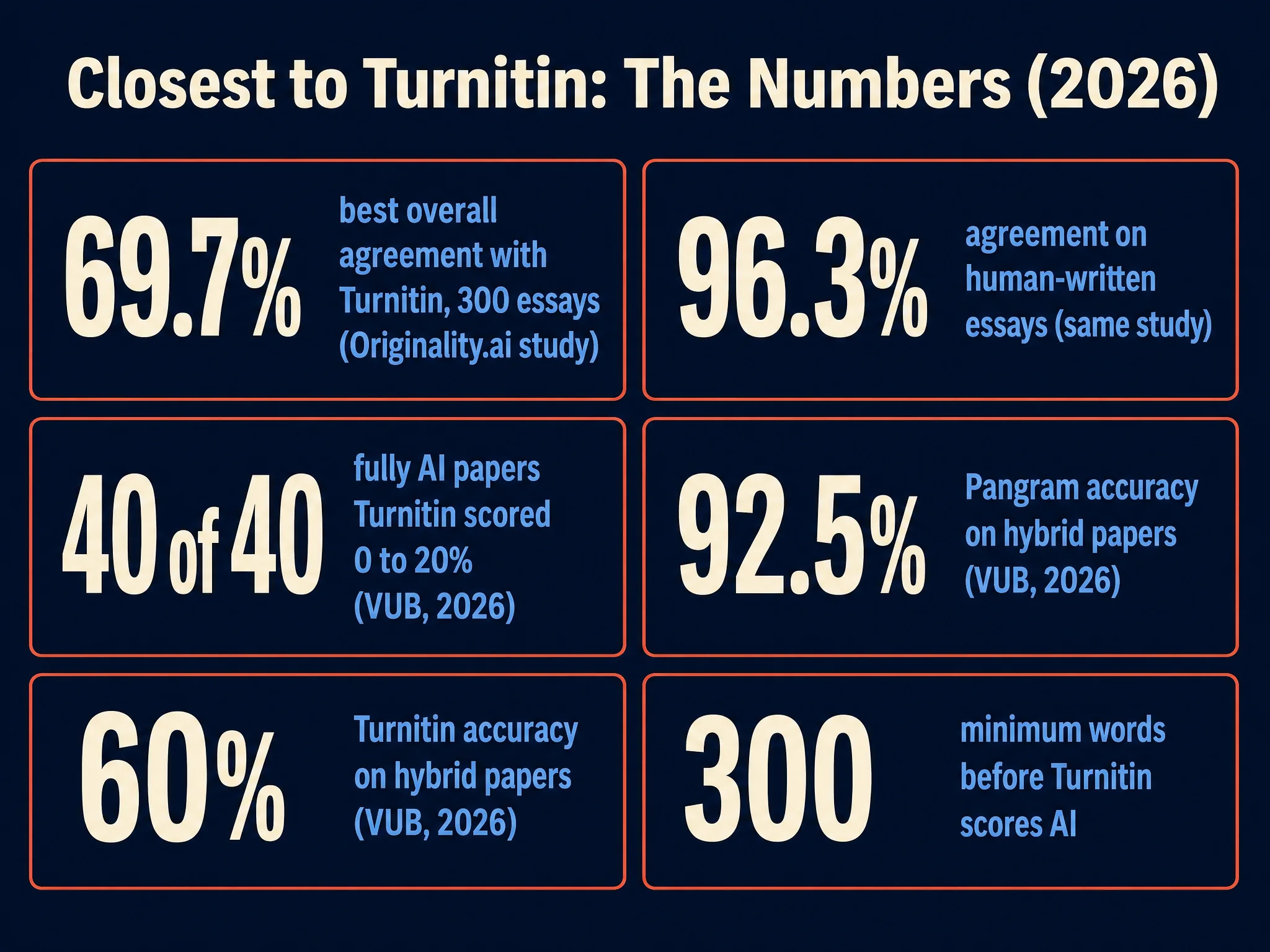
- The best published match to Turnitin is 69.7%: Originality.ai’s most lenient setting agreed with Turnitin on 209 of 300 student essays, in a study Originality.ai ran on its own product (Originality.ai, Oct 2026).
- Agreement was highest on human writing, 96.3%. A “human” result from that setting is a decent sign. A high AI result tells you much less.
- Closest is not the same as most accurate. In a 2026 peer-reviewed study, Turnitin scored 40 of 40 fully AI-written papers in its 0 to 20% band, while Pangram caught most of them (Int. J. Educ. Integrity).
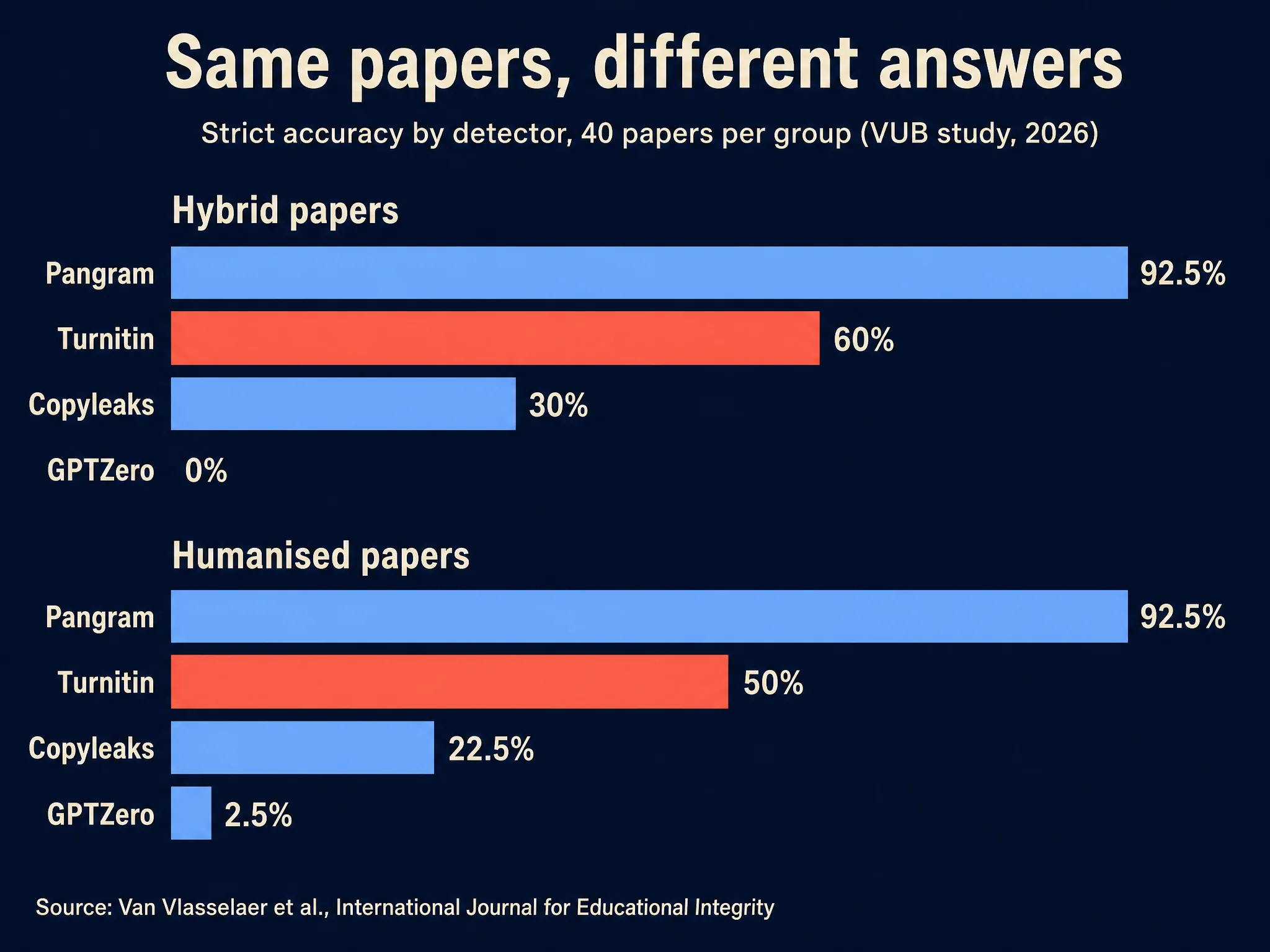
- On mixed human and AI papers, the same study measured Pangram at 92.5%, Turnitin 60%, Copyleaks 30% and GPTZero 0%. Four tools, four different answers on identical text.
- Turnitin hides scores from 1 to 19% behind an asterisk, needs 300 words, and added AI bypasser detection on 27 August 2025. Other checkers share none of those rules.
- Turnitin does not sell individual licenses, so a site with “Turnitin” in its name is either a reseller or an unrelated detector.
Which AI detector is closest to Turnitin?
No detector is close enough to Turnitin to predict your score. The only study that measured agreement directly found the best match at 69.7%, which means roughly three essays in ten got a different verdict.
That study comes from Originality.ai, published on 25 October 2026. It ran 300 essays through Turnitin and through five settings of its own detector. Its most lenient setting, called 40% AI Allowance, matched Turnitin most often. The company’s own conclusion is that 69.7% “is not close enough to call the tools substitutes”.
Every other page that ranks for this question names a favourite without numbers. Most are written by companies selling a detector, a humanizer or Turnitin report access, and most rank their own product first. That is worth knowing before you pay for anything sold as “Turnitin-like”.
How often does any detector agree with Turnitin?
About seven times in ten overall, and much more often on human writing than on AI writing. The figures below come from the Originality.ai study, the only published side-by-side we could find.
The essays came from GEDE, a public research dataset built for educational AI-text detection: 100 human essays, 100 human essays polished by AI, and 100 fully AI-written essays. The study counted a Turnitin score of 50% or more as an AI result. That cut-off is the study’s own choice, not a Turnitin threshold.
| Originality.ai setting | Agreement with Turnitin (300 essays) |
|---|---|
| 40% AI Allowance | 209 of 300, 69.7% |
| 25% AI Allowance | 166 of 300, 55.3% |
| 0%, 5% and 15% settings | Under half the sample |
| 40% setting, human essays only | 96.3% |
| 40% setting, AI-polished essays only | 92.1% |
Two things follow. First, the setting matters more than the brand: the same detector ranged from under 50% to 69.7% agreement depending on one slider. Second, the disagreement sits mostly in AI-heavy text, which is exactly where a worried student wants a reliable answer.
The study has limits its authors state plainly. It covers one dataset, three text types and the detector versions available in October 2026. It was run by a vendor on its own product. Our Originality.ai review covers the tool itself.
Is the detector closest to Turnitin also the most accurate?
No, and the 2026 evidence suggests the two goals pull in opposite directions. A detector that catches more AI text than Turnitin will disagree with Turnitin more often, not less.
A team at Vrije Universiteit Brussel published the clearest comparison in the International Journal for Educational Integrity on 29 June 2026. They built 160 papers with a known share of AI text, 40 in each of four groups, and ran them through Turnitin, GPTZero, Copyleaks and Pangram.
| Paper type (40 each) | Turnitin | Pangram | Copyleaks | GPTZero |
|---|---|---|---|---|
| Fully human | All correct | All correct | All correct | All correct |
| Fully AI (ChatGPT Deep Research) | All scored 0 to 20% | 65% strict, 97.5% inclusive | 75% scored 0 to 20% | 70% scored 0 to 20% |
| Hybrid (human plus AI passages) | 60% | 92.5% | 30% | 0% |
| Humanised AI | 50% | 92.5% | 22.5% | 2.5% |
Read the fully AI row again. Turnitin put every one of those 40 papers in its low band, where it shows an asterisk instead of a number. Pangram flagged most of them. So on that text, the “most accurate” tool and the “closest to Turnitin” tool are different tools. Our Pangram vs GPTZero comparison and Pangram review cover why Pangram scores so differently.
The good news in the same study: all four tools cleared all 40 fully human papers. Older research found more false positives. A 2023 study of 16 detectors by William Walters rated Copyleaks, Turnitin and Originality.ai the most accurate of the group, while a Stanford-led study found detectors flagged non-native English writers far more often. Our false positive statistics page collects the numbers.
Why does an essay pass other detectors and still get flagged by Turnitin?
Because Turnitin runs its own model with its own rules, and a pass elsewhere tells you nothing about those rules. Reddit has a steady stream of this complaint. One r/humanizing poster said every detector they used showed under 10% AI before Turnitin flagged the same essay.
Four Turnitin-specific rules explain most of the gap, all from Turnitin’s AI writing detection model release notes:
- Bypasser detection. Turnitin added detection for text run through AI bypasser and humanizer tools on 27 August 2025. A free checker without that model has no view on it. We track how humanizers fare in humanizers versus Turnitin’s bypasser detection.
- The asterisk. Since July 2024, a score from 1 to 19% shows as *% with no highlights, because Turnitin says false positives are more likely in that range (Turnitin guide). Our asterisk explainer goes deeper.
- Length. Turnitin does not score AI on submissions under 300 words. Many free checkers score any length.
- Model updates. Turnitin ships new versions several times a year. The release notes list updates in February, May and October 2026. A score can move with no edits, as covered in why a Turnitin AI score changes overnight.
Each checker also scores differently. Turnitin describes its percentage as the share of qualifying prose its model thinks is likely AI-generated or AI-paraphrased. Other tools report a probability for the whole document. A 30% on one and a 30% on another are not the same claim.
Are “Turnitin checker” sites showing you the real Turnitin?
Usually not, and you can check this yourself. Turnitin states that it does not sell individual licenses or single-use subscriptions. Any service selling you a Turnitin report is reselling access from an account you cannot see.
Sites in this space fall into two groups. Some are ordinary AI detectors with “Turnitin” in the name. One of the top Google results for this question is a free checker branded “Turnitin AI Detector” whose page carries no statement about any link to Turnitin. Others sell real reports run through someone else’s instructor account, often advertised in subreddits that exist mainly to promote them.
The second group carries a risk the first does not. If the account stores your draft in a repository, your final submission can match against your own earlier upload. Our guide to whether Turnitin pre-checks reduce risk walks through that scenario and calls third-party check services the highest-risk option. For what schools actually pay, see Turnitin AI detection pricing.
Which checker should you use before you submit?
Pick by what you want to learn, not by which tool claims to mirror Turnitin. The table below matches common situations to the evidence above.
| Your situation | What a checker can tell you | Sensible move |
|---|---|---|
| You wrote it yourself and want reassurance | A low result from a lenient setting is a fair sign. It is not a prediction. | One check at most, then save your drafts and version history |
| A free checker gave your own work a high score | Little. Formal writing triggers many tools, and Turnitin may disagree either way. | Do not rewrite good work to chase a number. Keep your evidence |
| You used AI for parts and want to know if it shows | Different tools see AI passages very differently (0% to 92.5% on the same hybrid papers) | Check your course policy and disclose. No checker gives a safe answer here |
| You ran text through a humanizer | Passing other detectors says nothing about Turnitin’s bypasser model | Treat any pass as unproven |
| You are thinking of buying a “real Turnitin” report | It may be genuine, but you cannot see whose account or repository it uses | Read the repository risk first, or ask your instructor about a draft submission |
If you are weighing specific tools, Scribbr’s AI detector is compared head to head in Scribbr vs Turnitin. For Copyleaks, see how reliable Copyleaks is, and for Grammarly, whether Grammarly’s AI detector is accurate.
What protects you better than a matching score?
Evidence of how you wrote the work. A detector score, from Turnitin or anyone else, is a signal your instructor weighs alongside other things. Your drafts are what settle a dispute.
Instructors in the r/WhoWrote_This thread made the same point: a high score from a free checker can worry you without telling you anything, and a low one does not prove the work is yours. Save dated drafts, keep your notes and sources, and use editor version history. Our guide to building an authorship packet before you submit lists what to keep, and this checklist covers what to do if you are flagged anyway.
If you are applying to college, the same logic applies to personal statements. We covered it in should you run your college essay through an AI detector.
How this article was put together. Demand came from four Reddit threads asking which detector is closest to Turnitin, posted between October and November 2026 in r/humanizing, r/BypassAiDetect, r/AskProfessors and r/WhoWrote_This. We reviewed the top 10 Google results for the question on 10 November 2026. The numbers come from the Originality.ai study (300 essays), the Vrije Universiteit Brussel study (160 papers plus 1,163 theses) and Turnitin’s own guides. Detection Drama ran no detector checks of its own for this piece.
Frequently asked questions
What AI detector is most similar to Turnitin?
On the only published agreement data, Originality.ai at its 40% AI Allowance setting, which matched Turnitin on 69.7% of 300 essays. Originality.ai ran that study on its own tool and says the match is not close enough to treat the tools as substitutes.
Can I check my Turnitin AI score before submitting?
Not directly. Turnitin sells only to institutions and many schools do not show students the AI report. Some instructors allow a draft submission. Third-party services that sell Turnitin reports use accounts you cannot see, and your draft may be stored.
Is GPTZero similar to Turnitin?
Not on the 2026 evidence. In the Vrije Universiteit Brussel study, GPTZero scored 0% strict accuracy on hybrid papers where Turnitin scored 60%. Both cleared every fully human paper.
Why did Turnitin flag my essay when other detectors said it was human?
Turnitin uses its own model, scores only text over 300 words, and since 27 August 2025 includes detection aimed at humanizer and bypasser output. Other tools do not share that model, so a pass elsewhere does not carry over.
Is the most accurate AI detector the same as the one closest to Turnitin?
No. In the 2026 study, Turnitin scored all 40 fully AI papers in its 0 to 20% band while Pangram flagged most of them. A detector that catches more than Turnitin will disagree with it more often.
Does a Turnitin score under 20% mean my essay is safe?
It means Turnitin shows an asterisk instead of a number, because it considers that range less reliable. It is not a verdict either way, and your instructor still decides what to do with the report.
Are free “Turnitin AI checker” websites run by Turnitin?
Turnitin says it does not sell individual licenses or single-use subscriptions. A free checker with Turnitin in its name is a separate detector unless it states otherwise and can show it.
Sources
- Studies: Originality.ai, 300-essay agreement study (Oct 2026), Van Vlasselaer et al., Int. J. Educ. Integrity (June 2026), Walters, Open Information Science (2023), Liang et al., Patterns (2023)
- Turnitin: AI writing detection model release notes, How to access the AI Writing Report, Individual license FAQ
- Reddit (claims, unverified): r/humanizing, r/BypassAiDetect, r/AskProfessors, r/WhoWrote_This
Already flagged by a detector your school uses? Start with what to do in the first 24 hours.
