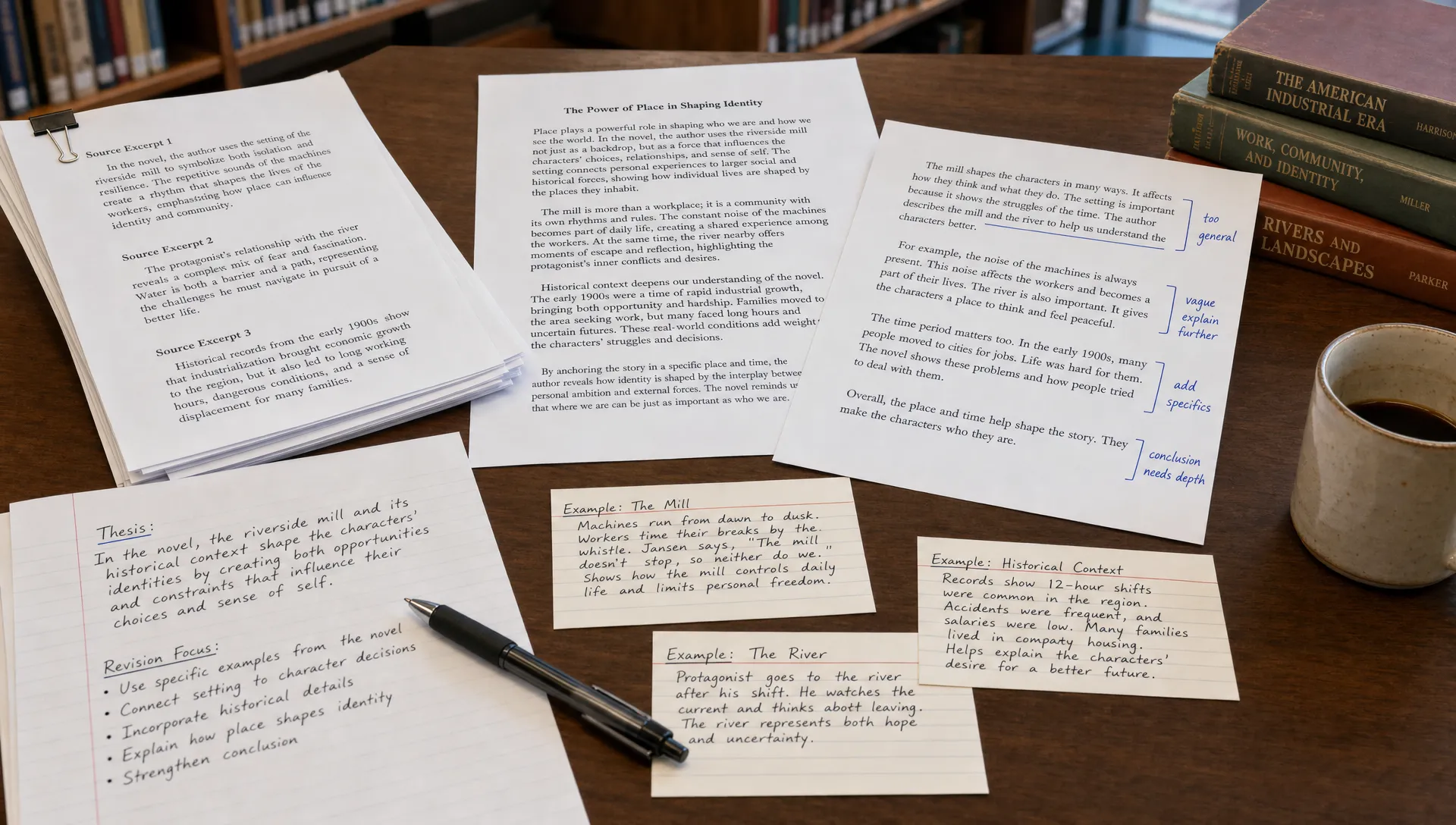
A polished essay is not automatically suspicious. In fact, clear structure, accurate grammar, and careful proofreading are exactly what instructors usually want. The problem starts when an essay becomes polished in a very specific way: smooth, generic, evenly paced, and strangely detached from the student, the assignment, and the sources.
That is the kind of writing people often describe as “too perfect” or “too clean.” It can make a reader wonder whether the paper was heavily generated, over-edited by AI writing tools, or stripped of the natural fingerprints that make academic writing feel authored.
Want to bypass Turnitin in 2026? Grab the free prompt pack.
Get the exact text-humanization prompts I use to drop an AI score by hand — copy, paste, submit. Free, straight to your inbox.
Send me the free prompts →Turnitin does not flag an essay simply because it is good. Its AI writing indicator evaluates patterns in the finished text, and those patterns can overlap with certain kinds of highly polished academic prose. As Turnitin’s AI writing detection information explains, AI detection is intended to support review, not act as a final judgment by itself.
So the real question is not “Should I make my essay worse?” It is “What makes a paper sound polished in the wrong way, and how do I revise it so it still sounds strong, but clearly human?”
What “too polished” usually means in an essay
When students say an essay sounds too polished, they usually do not mean it has good grammar. They mean it has lost the texture of real thinking.
Human academic writing often contains small signs of decision-making. A student emphasizes one source more than another. A paragraph may be a little denser because the idea is difficult. A sentence may be short because the claim matters. The introduction may reveal the student’s actual route into the topic, not just a perfectly balanced summary of the issue.
AI-generated content, on the other hand, often has a different kind of smoothness. It tends to sound broadly competent, but not deeply situated. It may use balanced wording, predictable transitions, and generalized claims that could fit hundreds of essays on the same topic.
That is why normal strong writing and suspiciously polished writing are not the same thing. Strong writing is clear and specific. Suspiciously polished writing is clear but interchangeable.
If you are worried that ordinary academic habits might be misread, Detection Drama has a separate guide on normal writing habits that can trigger Turnitin AI flags. This article focuses more narrowly on the “too polished” effect and how to recognize it.
The main signals that make an essay sound overly polished
1. Every sentence has the same rhythm
One of the biggest giveaways is not vocabulary. It is rhythm.
A paper can sound unnatural when most sentences follow the same pattern: medium length, grammatically complete, balanced, and explanatory. The writing may be technically correct, but it starts to feel machine-paced.
For example, an essay might repeatedly use sentences like this:
The novel explores the relationship between identity and social pressure, showing how individuals struggle to define themselves within restrictive environments.
That sentence is not bad. The problem is repetition. If every paragraph contains several sentences with the same shape, the paper starts to sound produced rather than argued.
Human rhythm is more varied. Some sentences define. Some challenge. Some clarify. Some slow down to examine a quotation. Others are short because the point needs force.
The fix is not to randomly make sentences longer or shorter. The fix is to vary what sentences are doing. A paragraph that only explains will feel flat. A paragraph that explains, tests, contrasts, and concludes will feel more authored.
2. The thesis sounds intelligent but too universal
A polished AI-like thesis often sounds sophisticated at first glance, but it could apply to almost any text, topic, or class.
You might see phrases like:
- “This essay highlights the complex relationship between society and the individual.”
- “The author demonstrates the importance of resilience in the face of adversity.”
- “The text reveals how power structures influence human behavior.”
These claims are grammatically strong, but they are also broad. They do not yet show that the writer has made a specific interpretive choice.
A more human thesis usually contains friction. It names a specific tension, limitation, contradiction, or pattern. It sounds like someone actually had to decide what the essay would argue.
For example:
Rather than presenting resilience as pure strength, the novel shows it as a compromise: the protagonist survives by adapting to social expectations, but that adaptation gradually weakens her sense of self.
That version is still polished, but it is less generic. It has a position. It also gives the rest of the essay something concrete to prove.
3. Transitions are too neat and predictable
Transitions are useful, but too many polished transition phrases can make an essay sound templated.
Common AI-like transitions include “Furthermore,” “Moreover,” “In addition,” “It is important to note,” and “This demonstrates that.” Again, none of these are wrong on their own. The issue is density and predictability.
A human writer often transitions through ideas, not just transition words. Instead of saying “Furthermore,” the writer might connect the next paragraph to a problem left unresolved in the previous one.
Compare these two transitions:
| Transition style | How it sounds | Better direction |
|---|---|---|
| “Furthermore, the author uses symbolism to develop this theme.” | Correct but generic | Name the specific symbol and why it complicates the previous point |
| “This moment complicates the speaker’s confidence because the image of light no longer suggests freedom.” | More specific and analytical | Builds a bridge through the argument itself |
| “In conclusion, this essay has shown…” | Formulaic | Return to the thesis with a sharper final insight |
If your essay uses polished transitions every few sentences, it may sound less like a developing argument and more like a generated template.
4. The essay avoids uncertainty or intellectual struggle
Real academic thinking often includes uncertainty. Not confusion, but honest complexity.
A paper can sound too polished when it presents every interpretation as obvious and settled. The essay moves from claim to evidence to explanation with no sense that the writer had to choose between possible readings.
In many college essays, the strongest moments come when the writer acknowledges tension:
- A source seems persuasive but has a limitation.
- A character appears sympathetic in one scene and troubling in another.
- A policy solves one problem while creating another.
- A quotation supports the thesis, but only if read in context.
These moments make writing sound human because they show judgment. AI-generated writing often prefers safe, balanced statements. Human writing can afford to be more exact.
This does not mean adding “I think” everywhere. It means letting the essay show the work of interpretation.
Why polished writing can overlap with AI detector patterns
AI content detectors do not know your intentions. They do not see your notes, your late-night outline, your marked-up PDF, or the three versions of your introduction. They analyze the submitted text.
That matters because some legitimate writing habits can produce AI-like surface patterns. A student who uses the same sentence structure repeatedly, accepts every grammar-tool suggestion, and removes all personal phrasing may end up with a paper that looks linguistically uniform.
Turnitin’s AI indicator is separate from its plagiarism checker or Similarity Report. A low Similarity score does not mean a low AI score, and an AI flag does not necessarily mean copied text. Similarity tools look for matching or highly similar text. AI detection looks for statistical writing patterns.
This is where “too polished” becomes risky. The paper may be original, but its surface may appear unusually even.
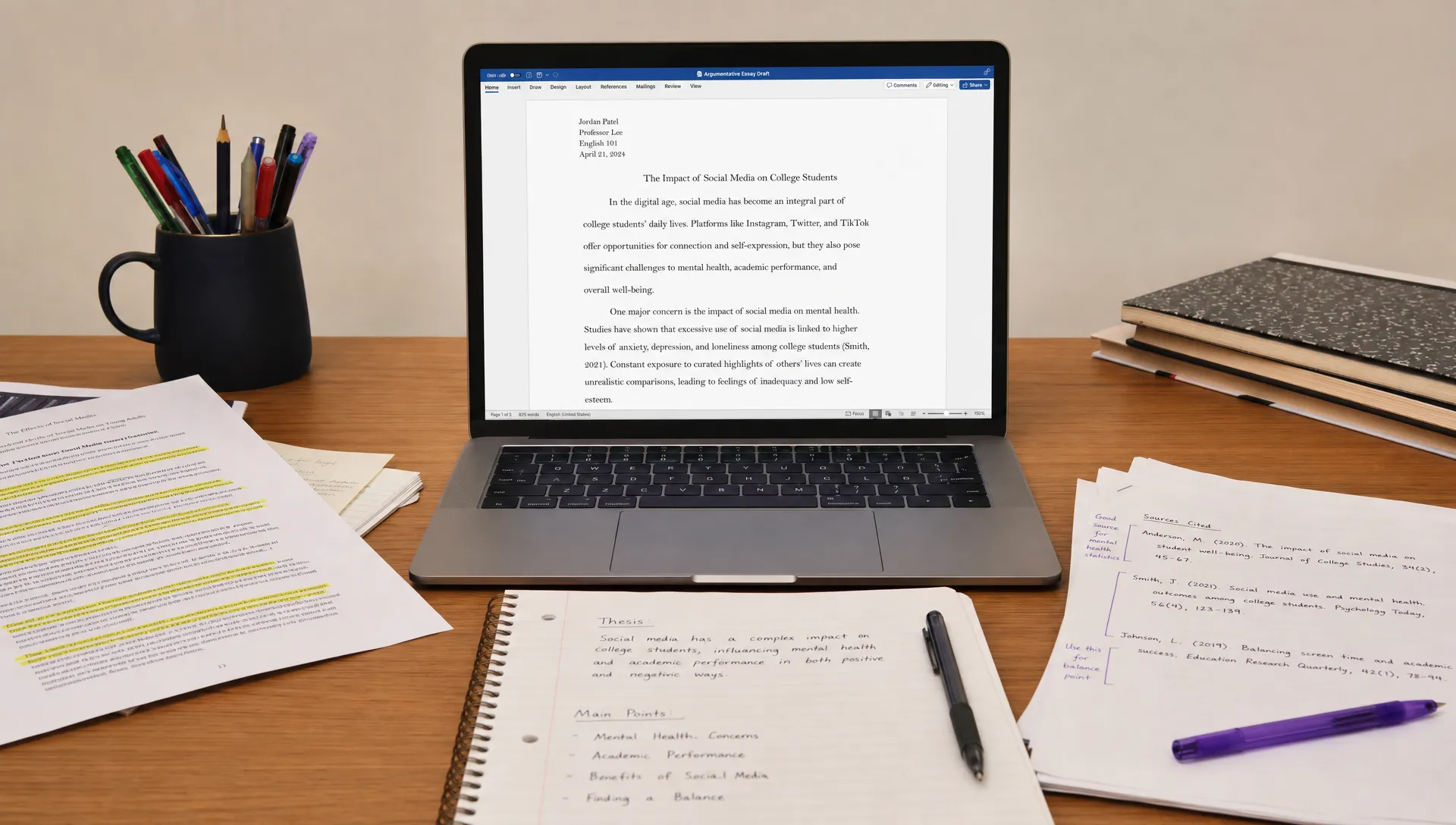
The difference between polished, over-polished, and authentically revised
A useful way to think about this is to separate clean writing from flattened writing. Clean writing helps your reader. Flattened writing removes the features that show authorship.
| Essay quality | What it looks like | How it usually feels to a reader |
|---|---|---|
| Polished | Clear thesis, logical paragraphs, corrected grammar, accurate citations | Strong and academic |
| Over-polished | Uniform rhythm, generic transitions, broad claims, little source-specific analysis | Smooth but impersonal |
| Authentically revised | Clear structure plus specific choices, varied rhythm, assignment details, visible reasoning | Strong, human, and credible |
The goal is not to make your essay messy. The goal is to make your clarity more specific.
A paper can be polished and still sound human when it contains concrete references to the assignment, source details that are not obvious, and sentences that reflect your actual reasoning process.
Common places where an essay becomes too smooth
The introduction
Introductions are especially likely to sound AI-like because many students write them in a broad funnel structure: society, history, theme, thesis. This can create an opening that is polished but vague.
For example:
Throughout history, literature has served as a mirror for society, reflecting the struggles, values, and conflicts of human experience.
This sentence sounds academic, but it does not say much. It could introduce thousands of essays.
A stronger introduction begins closer to the actual problem of the essay. Instead of opening with “throughout history,” start with the text, debate, concept, or contradiction your paper will analyze.
If Turnitin highlights only the beginning of a paper, that does not automatically mean the whole essay is AI-written. Introductions often contain the most generic phrasing because students are trying to sound formal. Detection Drama covers that situation in more detail in its guide on what it usually means when Turnitin AI highlights your intro.
Topic sentences
Topic sentences can also become too polished when they all follow the same formula.
A repeated pattern like “Another important way the author develops this theme is through…” creates a predictable structure. It is clear, but it can feel mechanical.
Better topic sentences usually do more than announce a category. They make a claim.
Instead of:
Another important symbol in the poem is the window.
Try:
The window matters because it promises escape while also reminding the speaker that escape remains out of reach.
The second version is still clean, but it carries interpretation.
Evidence analysis
AI-like essays often quote or paraphrase evidence, then explain it in a broad way. The analysis may sound correct but not especially tied to the exact words in the source.
A warning sign is repeated commentary like:
This shows that the character feels trapped by society.
That may be true, but how does the language show it? Which word, image, statistic, or detail creates that meaning?
Specific analysis is one of the best ways to avoid the too-polished effect. Zoom in on a phrase. Explain why a detail matters. Connect the evidence to the assignment’s central question.
The conclusion
Conclusions often become too polished when they simply restate the thesis with elevated wording. A generated-sounding conclusion may summarize the whole essay without adding any final insight.
A stronger conclusion answers the “so what?” question. It does not need to be dramatic. It just needs to show what the argument helps us understand differently.
How to revise a too-polished essay without making it worse
The worst response to an AI detection worry is to add random typos, awkward slang, or strange phrasing. That does not make an essay sound human. It makes it sound manipulated.
A better revision strategy is to restore authorship signals: specificity, reasoning, source engagement, and natural variation.
Start by reading the essay out loud. Mark any sentence that sounds like it could appear in almost any paper on the same subject. Those are the sentences to revise first.
Then look for places where your argument can become more precise. Replace broad academic phrases with details from your assignment, lecture topic, primary text, data set, or source material.
Here are practical edits that usually help:
- Replace broad claims with specific claims that name the actual tension in your topic.
- Cut filler transitions when the relationship between ideas can be shown through the argument itself.
- Vary sentence rhythm by varying purpose, not by forcing awkward sentence lengths.
- Add close analysis of quoted words, images, methods, or data points.
- Keep a record of drafts, outlines, notes, and source annotations in case your writing process is questioned.
If you used ChatGPT, Grammarly, or another AI writing tool at any stage, pay attention to where the tool may have flattened your voice. Grammar suggestions can make writing cleaner, but accepting too many full-sentence rewrites can create an even, generic tone. If that is your situation, this guide on what to do if Turnitin flags your essay after Grammarly may help you think through next steps.
What not to do when an essay sounds too polished
Do not intentionally make your essay worse. Adding mistakes is not a reliable or honest fix, and it may hurt your grade. Instructors are not looking for bad writing. They are looking for writing that reflects your own thinking.
Do not use a thesaurus to swap normal words for unusual ones. Awkward synonym replacement is one of the easiest ways to make a paper sound less natural. A sentence like “The protagonist endeavors to navigate societal constraints” is not more human than “The protagonist tries to survive social pressure.” It is just heavier.
Do not invent personal experiences, fake citations, or false research steps. Authenticity does not mean adding fictional backstory. It means making the real work behind your essay more visible.
Do not run the same paper through multiple rewriting tools until it becomes unrecognizable. This can create a patchwork tone and may also make it harder to explain your process if an instructor asks how the paper developed.
If you want a more structured pre-submission process, use a careful review rather than panic rewriting. Detection Drama’s guide on how to check if your essay sounds AI written before you submit walks through practical voice and pattern checks.
A quick self-check for the “too polished” problem
Before submitting, ask yourself a few direct questions.
Does the essay sound like it was written for this exact prompt, or could it fit a generic version of the assignment? Does each paragraph add a new step to the argument, or do several paragraphs repeat the same broad point? Are the sources being analyzed closely, or are they mostly used as decoration? Does the introduction begin with a real issue, or with a vague universal statement?
Also check whether your sentences have different jobs. If nearly every sentence explains, the essay may feel flat. Add sentences that compare, question, narrow, qualify, or interpret.
Finally, look for your own decisions. A human essay is not just a clean answer. It is a trail of choices: what you noticed, what you prioritized, how you handled evidence, and why your conclusion follows.
That is what makes polished writing feel authentic.
Frequently Asked Questions
Can Turnitin flag an essay just because it is well written? Turnitin does not flag writing simply because it is good, but highly uniform, generic, or AI-like prose may overlap with patterns associated with AI-generated content. A polished essay with specific analysis and clear authorship signals is less likely to feel suspicious to a human reviewer.
Does perfect grammar make an essay look AI-written? Perfect grammar alone is not the issue. The risk comes when grammar corrections remove your natural rhythm, simplify your claims, and make every sentence sound equally smooth. Strong grammar plus specific reasoning is still a good thing.
Should I add mistakes so my essay sounds more human? No. Adding errors can damage your credibility and does not prove authorship. Instead, revise for specificity, varied sentence purpose, stronger source analysis, and a clearer connection to the assignment.
Why do AI-written essays often sound polished? Many AI writing tools produce balanced, fluent, and formal prose by default. That can create text that sounds competent but generic, especially if it lacks concrete details, personal reasoning, or close engagement with sources.
What is the best way to make a polished essay sound more authentic? Keep the clarity, but add sharper choices. Make the thesis more specific, analyze evidence more closely, remove formulaic transitions, and preserve signs of your actual thinking process.
Make polished writing sound like your writing
An essay should be clean, but it should not feel interchangeable. If your paper sounds too polished to Turnitin, the answer is not to make it sloppy. The answer is to make the writing more specific, more grounded in the assignment, and more clearly shaped by your own reasoning.
Detection Drama offers free resources for understanding AI detection, reviewing AI-like writing patterns, and improving text so it reads more naturally. If you want to compare your essay against common detector concerns before you submit, start with the tools and guides at Detection Drama and revise with authenticity in mind.
