ZeroGPT review, the honest version: everything below is based on hands-on testing, independent benchmark data, and verified user reports — not the marketing page. The short version: ZeroGPT is the free AI detector everyone starts with, it claims 98%+ accuracy, and independent 2026 tests put the real number closer to 67–85%, with a false-positive rate high enough that I would never treat one of its scores as proof of anything. I’ve spent the past few weeks running texts through it alongside the detectors it competes with, and this is everything you should know before you paste your essay in.
Vlad Ivanov — Creator of Words At Scale (26K+ YouTube subscribers). I test AI detectors and humanizers hands-on every week for DetectionDrama, and I don’t take money from the tools I review.
Want to bypass Turnitin in 2026? Grab the free prompt pack.
Get the exact text-humanization prompts I use to drop an AI score by hand — copy, paste, submit. Free, straight to your inbox.
Send me the free prompts →ZeroGPT Review: First Impressions
First, the disambiguation that half the internet gets wrong: ZeroGPT (zerogpt.com) is not GPTZero. GPTZero is the Princeton-born detector that got acquired by Superhuman (Grammarly) in June 2026. ZeroGPT is a separate, ad-supported free tool run by Olive Works LLC out of Wyoming. The near-identical names are great for ZeroGPT’s traffic and terrible for everyone trying to figure out which detector their professor actually used.
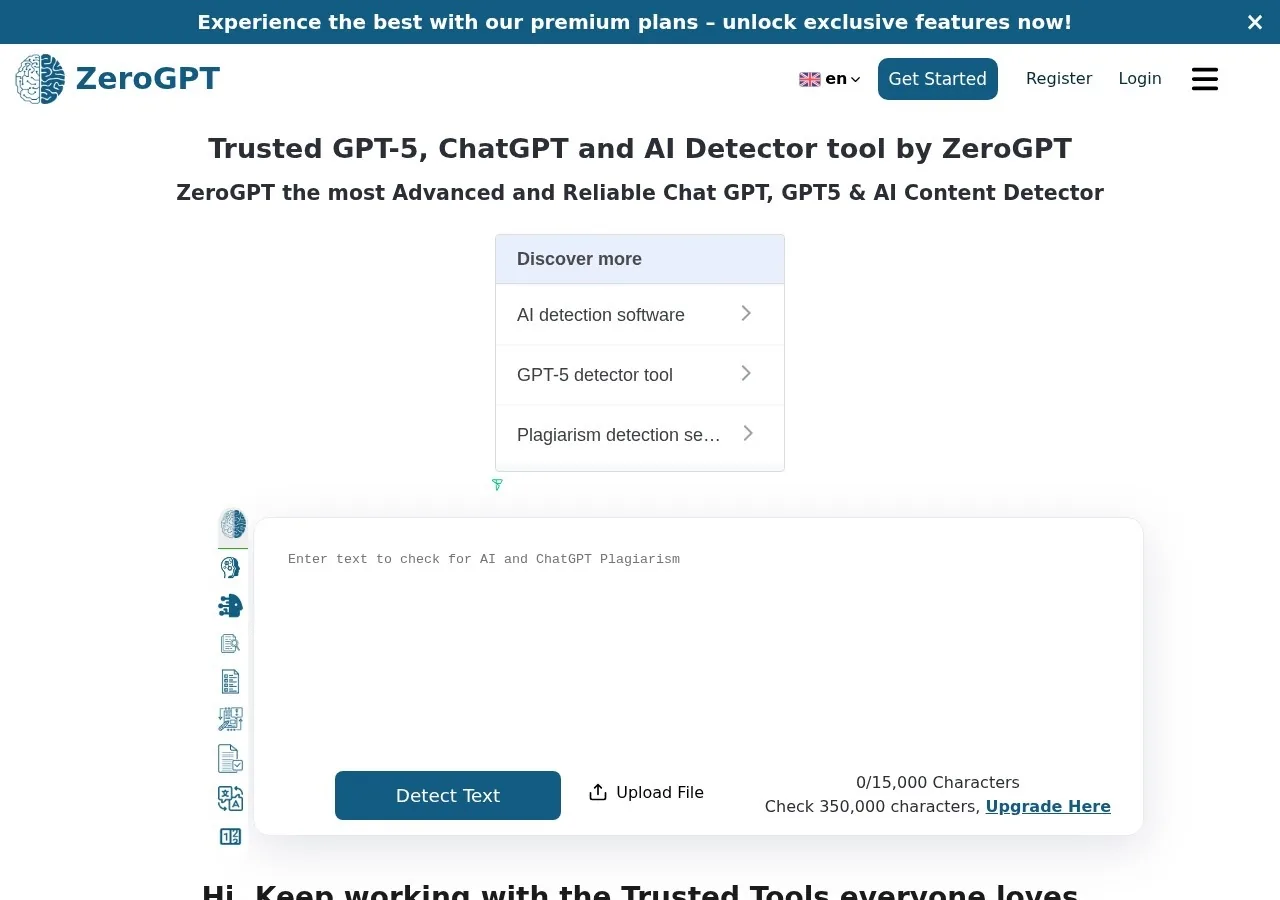
ZeroGPT’s pitch is simple: paste up to 15,000 characters, click Detect Text, get an AI percentage — no registration, no credit card, instantly. That frictionlessness is why millions of students run a pre-submission check here first. The problem is what the number it spits out actually means, and that’s where this review gets uncomfortable.
What ZeroGPT Includes
ZeroGPT has quietly grown from a single detector into a toolbox. Alongside the AI detector you get an AI humanizer, plagiarism checker, paraphraser, summarizer, grammar checker, translator, word counter, an AI image detector, and a chatbot (ZeroCHAT). The detector remains the reason anyone shows up.
| Spec | Detail |
|---|---|
| Free limit | 15,000 characters per scan, no registration required |
| Claimed accuracy | 98%+ (ZeroGPT’s own marketing) |
| Independent accuracy | 67–85% across 2026 third-party tests; 73.8% in a 160-text benchmark |
| Models covered | GPT-3.5/4/5, Gemini, Claude, “human + AI” mixtures |
| Input types | Paste text, Word/PDF upload, batch files (paid) |
| Extras | Humanizer, plagiarism checker, paraphraser, summarizer, grammar, translator, image detector |
| API | Pay-as-you-go business API (paid only) |
Design and Interface
The interface is genuinely easy: one big text box, sentence-level highlighting of “AI” passages, and a percentage verdict. No account wall. The trade-off is ads — free users get banner ads that occasionally crowd the results, which is how a free detector pays for itself. Paid plans remove them.
One thing I like: results come back in seconds even on long texts. One thing I don’t: the report gives you a number and highlighted sentences, but almost no explanation of why — for what detector scores actually mean in practice, see our guide to reading AI detection reports.
Performance: The Accuracy Numbers That Matter
This is the heart of any ZeroGPT review, so let’s be precise about what independent testing shows in 2026:
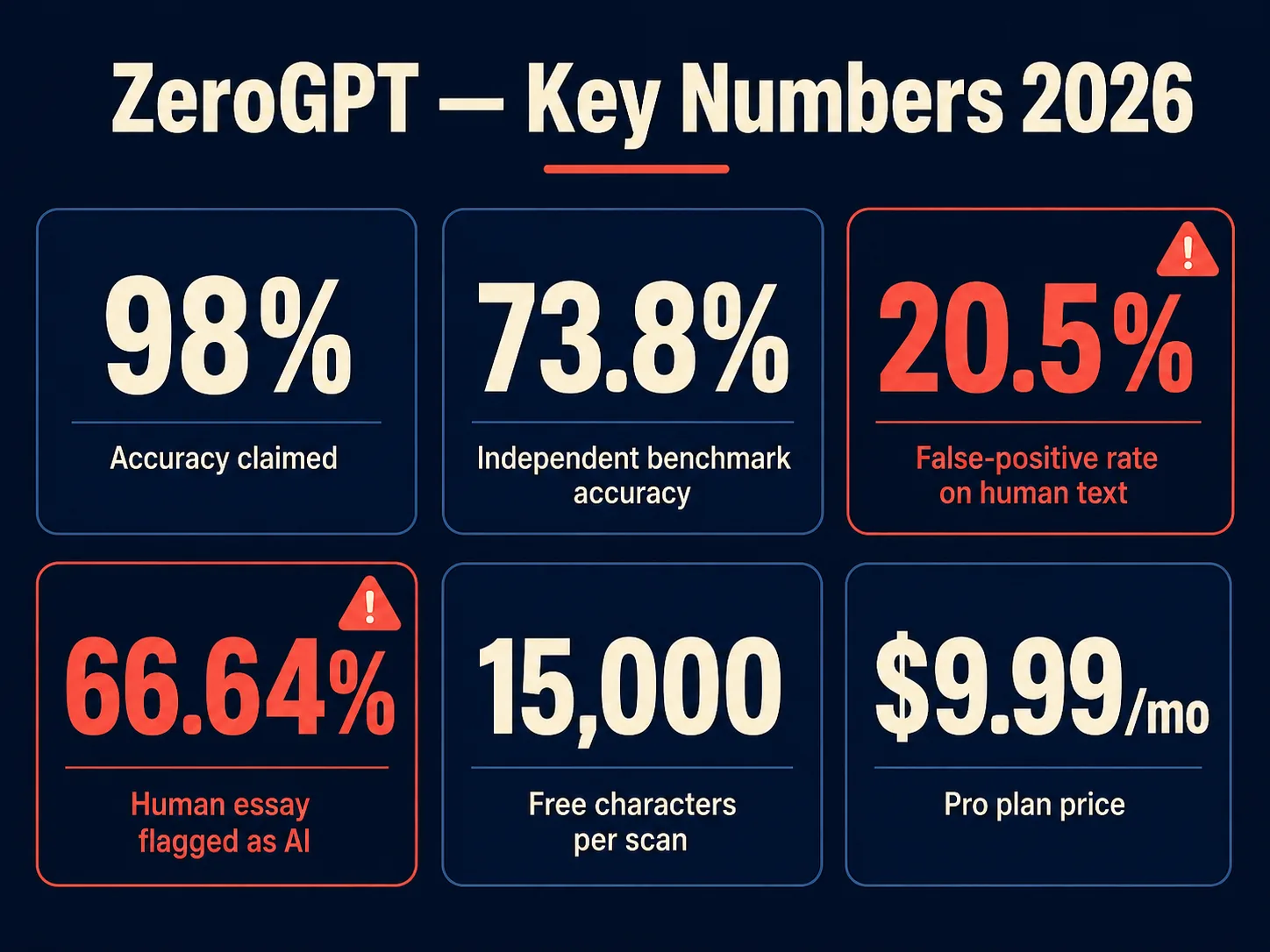
- A 160-text independent benchmark measured 73.8% overall accuracy and a 20.5% false-positive rate on verified human writing (aicheckr.io).
- AcademicHelp’s mystery-shopping test was blunter: a fully human-written personal essay came back “66.64% AI-generated”, while a 100% GPT-4-written essay sailed through as human at just 16.18% (AcademicHelp, A*Help score 50/100).
- Follow-up testing flagged 62.5% of non-native English writing as AI (SupWriter) — the same ESL bias pattern we’ve documented across the industry in our AI detection ESL bias report.
User Experience Day to Day
Setup is nonexistent — that’s the best part. Paste, click, read. Word and PDF uploads work, batch checking needs a paid plan, and there’s a detection history on paid tiers. Support is the weak spot: no live chat, no ticket form, just an email address and FAQs. AcademicHelp scored support 2/7, and after hunting for a bug-report path myself, I understand why.
ZeroGPT vs GPTZero, Turnitin and Originality.ai
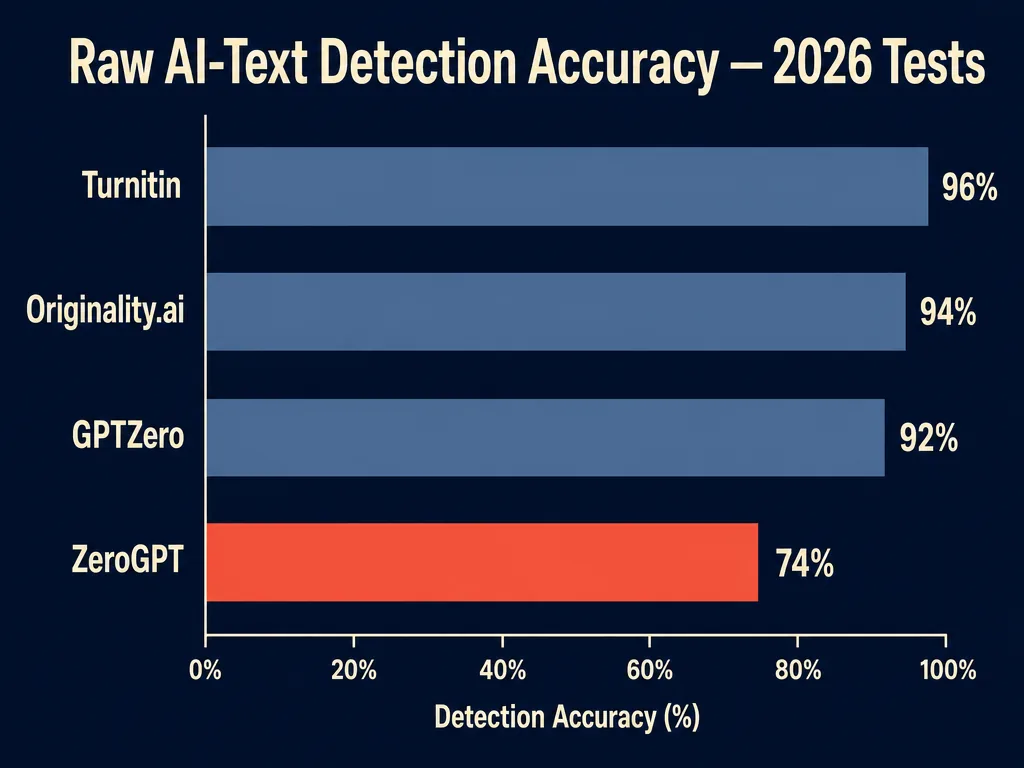
On raw AI text, 2026 comparative tests put the leading detectors meaningfully ahead: Turnitin around 96%, Originality.ai 94%, GPTZero 92% — with ZeroGPT trailing at roughly 74% benchmark accuracy (EyeSift, aicheckr). We keep a running list of detectors that score closest to Turnitin, and ZeroGPT has never made that list.
| ZeroGPT | GPTZero | Turnitin | |
|---|---|---|---|
| Raw-AI accuracy (2026 tests) | ~74% | ~92% | ~96% |
| Free tier | 15,000 chars/scan | ~10,000 words/mo | Institutions only |
| Registration | Not required | Required for full features | Via school |
| Paid from | $9.99/mo ($7.99 annual) | ~$8.33/mo annual | Institutional license |
| Best for | Quick free triage | Serious pre-checks | What your school actually sees |
If your real question is “will my paper pass Turnitin?”, ZeroGPT can’t answer it — the two use different models and disagree constantly, as we showed in Turnitin vs GPTZero. And if a detector and Turnitin give you opposite verdicts, here’s what to do next.
Pros and Cons
Pros
- Genuinely free — 15,000 characters per scan, no registration
- Instant results with sentence-level highlighting
- Handles Word/PDF uploads, plus batch files on paid plans
- Big bundled toolkit (humanizer, plagiarism, paraphraser, translator)
- Cheap paid tiers compared to Originality.ai or Winston
Cons
- 20.5% false-positive rate on human text in benchmark testing
- Flagged a fully human essay as 66.64% AI in mystery-shop testing
- Missed a 100% GPT-4 essay (scored 16.18% AI)
- Strong bias against non-native English writers
- No real customer support; ad-heavy free experience
- Accuracy claim (98%+) is far from independent results
Pricing and What Changed in 2026
| Plan | Monthly | Annual (per month) | Key limits |
|---|---|---|---|
| Free | $0 | $0 | 15,000 chars/scan, ads, no history |
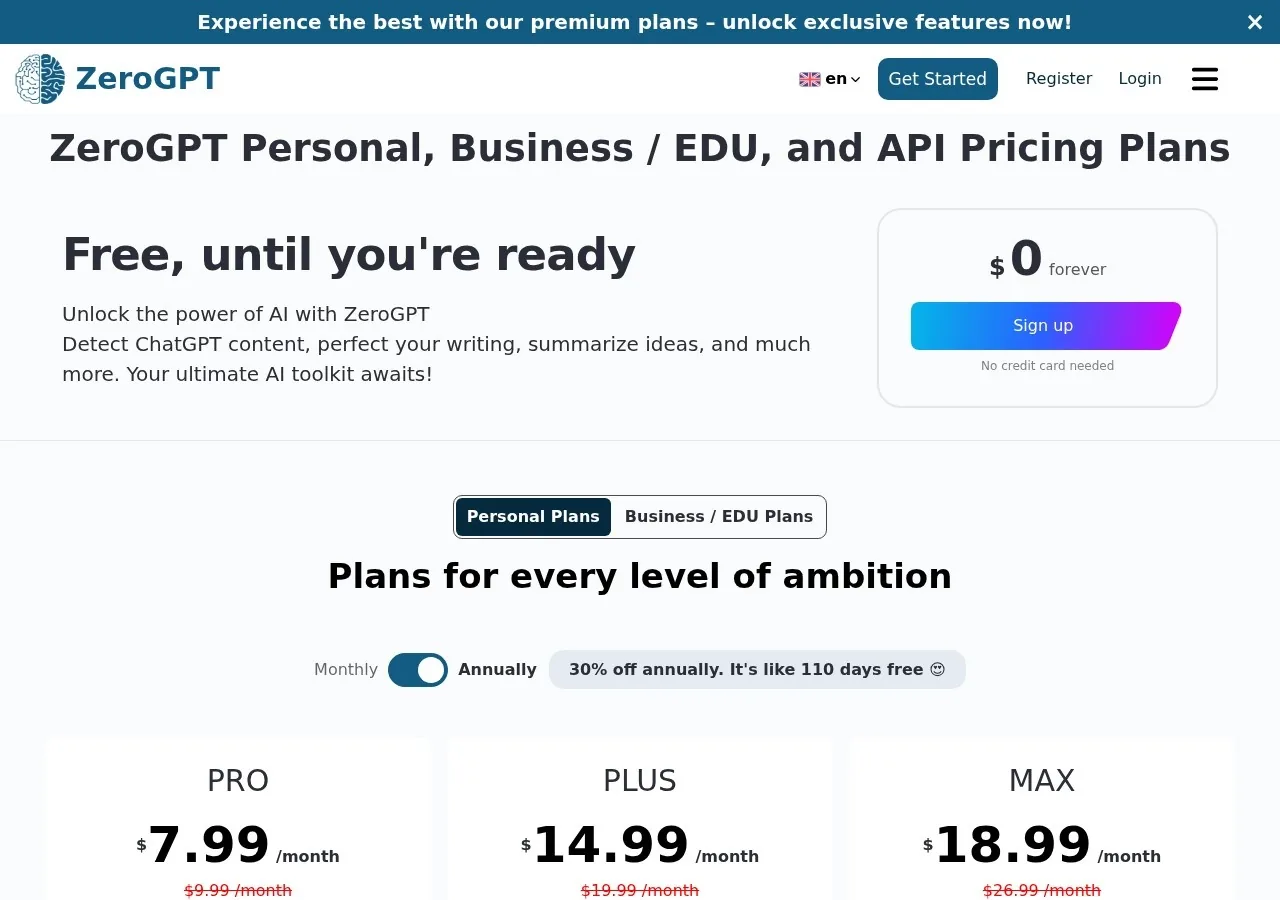
| Pro | $9.99 | $7.99 | 100k chars/scan, 50 batch files, PDF reports, ad-free |
| Plus | $19.99 | $14.99 | 100k chars, 60 batch files, 25k plagiarism words/mo |
| Max | $26.99 | $18.99 | 150k chars, 75 batch files, ZeroCHAT-5, 40k plagiarism words/mo |
Through 2026 ZeroGPT has kept expanding sideways — an AI image detector, background remover, and ZeroCHAT-5 — rather than publishing anything new about detection accuracy. The detector model itself claims coverage of GPT-5-era models, but there’s no public changelog or third-party validation of those claims.
Which Plan Fits You? (30-Second Calculator)
ZeroGPT plan calculator
Should You Buy ZeroGPT?
Best for
- Quick, free, zero-friction first-pass triage of a suspicious text
- Writers who want the bundled paraphraser/summarizer utilities in one cheap subscription
- Checking long documents free — the 15,000-character limit is one of the most generous around
Skip if
- You need a verdict you can defend — a 20.5% false-positive rate disqualifies it as evidence
- You’re a non-native English speaker checking your own writing (62.5% flag rate in testing)
- You’re an educator considering it for grading decisions — please don’t; see what the rules actually say about detectors as proof
Alternatives to consider
For pre-submission checks, GPTZero’s free tier is more accurate; for publishers, Originality.ai leads raw-text benchmarks. If your text keeps failing detectors and you’re exploring rewriting tools instead, our impartial tests of Undetectable AI, WriteHuman and StealthGPT cover what actually survives 2026 detection models — and what doesn’t.
Where to Get It
ZeroGPT is at zerogpt.com — the free tier needs no account. If you upgrade, take the annual toggle (about 30% off, e.g. Pro drops from $9.99 to $7.99/month). There’s no free trial of paid tiers and no published refund policy, so test the free tier thoroughly first. Plans are listed on the pricing page.
Before you decide: this tool rewrites — it cannot tell you whether the result clears both detectors. I send out the exact text-humanization prompts I use to drop an AI score by hand — copy, paste, submit. Get the free prompts →Free · No credit card · Straight to your inbox
Final Verdict
ZeroGPT is a decent free triage tool and a poor judge. Use it as a fast, free smoke alarm — never as a fire investigation. The 15,000 free characters, no-signup access and bundled utilities earn it a permanent bookmark; the 20.5% false-positive rate, the missed GPT-4 essay, and the gap between claimed (98%) and tested (~74%) accuracy mean no score it produces should ever decide anything that matters.
If you’ve already been flagged — by ZeroGPT, Turnitin, or anything else — start with our guide on what to do in the next 24 hours after an AI accusation, and remember that a detector score alone is statistically incapable of proving misconduct.
What Real Users Report
FAQ
Is ZeroGPT accurate?
Not reliably. ZeroGPT claims 98%+ accuracy, but independent 2026 tests measured 67–85%, with a 160-text benchmark landing at 73.8% and a 20.5% false-positive rate on human writing. It both flags human text as AI and passes AI text as human.
Is ZeroGPT the same as GPTZero?
No. GPTZero (gptzero.me) is a separate company, founded at Princeton and acquired by Superhuman (Grammarly) in 2026. ZeroGPT (zerogpt.com) is an ad-supported free tool by Olive Works LLC. They use different detection models and routinely disagree on the same text.
Is ZeroGPT free?
Yes — the core detector is free with a 15,000-character limit per scan and no registration. Paid plans ($9.99–$26.99/month, ~30% less on annual billing) remove ads and raise limits to 100k–150k characters plus batch file checking.
Can ZeroGPT detect GPT-5 or Claude?
ZeroGPT says its model covers GPT-5-era models, Gemini, and Claude. There is no public third-party validation of those specific claims, and 2026 benchmark scores suggest meaningful miss rates on current-generation AI text.
Why did ZeroGPT flag my human-written essay?
False positives are ZeroGPT’s biggest documented weakness — about one in five human texts in benchmark testing. Formulaic structure, short length, polished grammar, and non-native phrasing all raise flag risk. That’s a limitation of the tool, not proof you cheated.
Do universities use ZeroGPT?
Not officially in any documented case we could find — institutions license Turnitin, Copyleaks, or Originality.ai. Individual professors do paste text into free tools like ZeroGPT, which is exactly why students should know its false-positive record.
Is ZeroGPT safe to use?
The site is legitimate and doesn’t require an account for free scans. Standard caveat: anything you paste is processed on their servers, so avoid submitting confidential or unpublished sensitive work to any free online detector.
Should I trust a ZeroGPT score as proof?
No — and that goes for every detector. A probabilistic score with a documented 20.5% false-positive rate can’t prove authorship either way. Use it as a rough signal, keep drafts and version history as real evidence.
