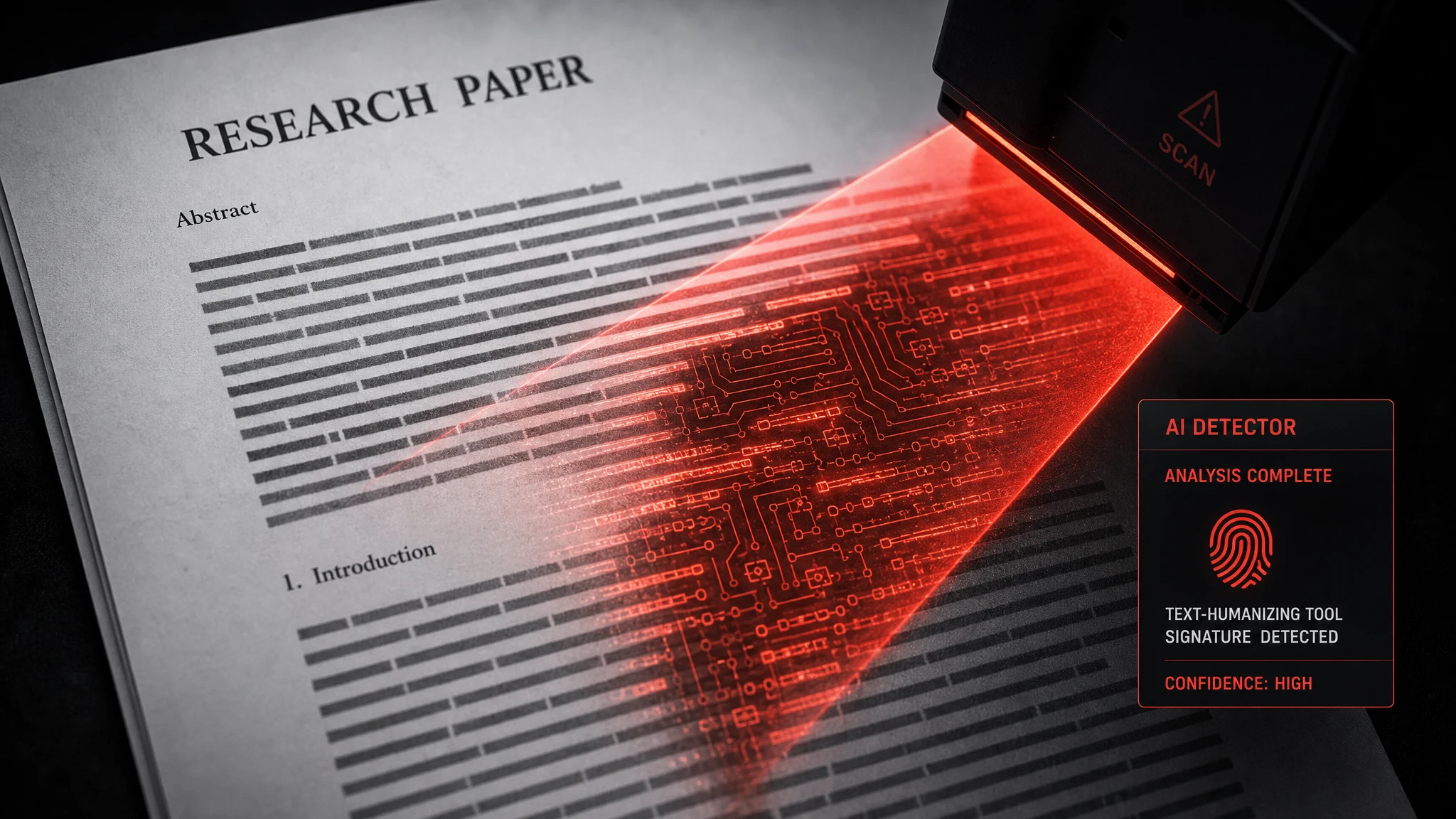
An academic AI humanizer just landed in Nature’s news pages this month — and that’s not a win for the tool. It’s the moment its shelf life started counting down.

Vlad Ivanov — Creator of Words At Scale (26K+ YouTube subscribers). I track AI detectors and humanizers hands-on every week for DetectionDrama, and I don’t take money from the tools I review.
Want to bypass Turnitin in 2026? Grab the free prompt pack.
Get the exact text-humanization prompts I use to drop an AI score by hand — copy, paste, submit. Free, straight to your inbox.
Send me the free prompts →The tool, released June 20 on GitHub by machine-learning researcher Jie Ding of the University of Minnesota, isn’t software you install. It’s an instruction set you paste into an AI system, telling it to strip constructions readers now associate with AI — em dashes, “not just X, but Y” — out of papers and grant text. Nature covered it on July 7, and the coverage itself is the story worth paying attention to.
Here’s why. Max Spero, CEO of the detection platform Pangram, told Nature he ran the humanizer’s output through his system and called the tool “not sophisticated.” Pangram caught most of the humanized text — not all of it, but most. And Spero said upgraded versions of Pangram are already being built specifically to catch humanizer use. A tool went from GitHub obscurity to a named response from a detection-company CEO in under three weeks.
The pushback arrived fast too. Cassidy Sugimoto, an information scientist at Carnegie Mellon, told Nature she’s “worried” the tool will tempt more scientists to skip disclosing AI use altogether — “the use case is harmful for science.” Miguel Angel Blazquez Rodriguez, a plant biologist in Spain, was blunter: “It’s deceiving.” After the criticism landed, Ding quietly edited the tool’s GitHub description — “removes the usual AI tells” became “sharpens clarity and voice” — and added a disclosure note clarifying the tool doesn’t remove an author’s obligation to declare AI assistance.
Ding’s own defense is worth taking seriously: “I’d separate the tool from the behaviour. The ethical issue is the non-disclosure and the intent behind it, not the existence of an editing aid.” That’s a fair distinction in theory. In practice, a tool built to erase the exact patterns a detector flags is going to get used for exactly the thing its README now says it isn’t for.
It also arrives while universities lean harder on AI-detection software, not softer — the same week’s Nature Career Feature on academic-integrity tooling makes that plain. Institutions aren’t backing off detection because bypass tools exist. They’re funding better detection because bypass tools exist.
None of this means humanizers stop working the day a detector CEO comments on them. It means the number you read in a testing roundup this month is a snapshot, not a warranty. If a tool’s bypass rate got measured before its most prominent detector announced a specific countermeasure, that number is already stale — and the gap between “worked in testing” and “works when it matters” is exactly where this niche makes its money.
The honest read for anyone using a humanizer on anything that matters — a thesis chapter, a grant proposal, an essay with a plagiarism policy attached — isn’t “which tool wins today.” It’s that today’s win has an expiration date, and the more attention a bypass method gets, the sooner it arrives.
