Is using AI to check grammar cheating? Usually not, if it only fixes spelling, punctuation and basic grammar in sentences you wrote. It becomes cheating when the tool rewrites your wording, tone or argument, or when your syllabus bans AI outright. That rewrite line is also where detectors start flagging.
Written by Vlad Ivanov
Runs Detection Drama, which covers AI detectors and humanizers. I ran no detector test for this piece and I am not an academic integrity officer. It is based on published sources (Turnitin, Grammarly, Copyleaks and four university policy pages) and reader reports from 5 Reddit threads, all read on 18 November 2026. Reddit comments are people’s claims, not verified facts.
Last updated: 18 November 2026
Key Takeaways
- The policy line and the detection line are the same line. Fixing errors is generally allowed and rarely flagged. Rewriting is restricted and likely flagged.
- Turnitin says Grammarly’s spelling, grammar and punctuation fixes were, in most of its tests, not flagged, but its drafting, paraphrasing and summarizing features “will likely be flagged” (Turnitin FAQ).
- Grammarly’s own support page says rewrites from its 3 agents (Grammarly, Paraphraser, Humanizer) are likely to be flagged by its own detector.
- The University of Birmingham allows Grammarly Free or Pro for spelling, punctuation and basic grammar, and bans it for tone, structure and argument.
- Trent University calls Word and Google Docs spell check “generally acceptable” and Grammarly’s tone and word-choice features a “grey area”.
- Asking ChatGPT to “fix the grammar” usually returns rewritten sentences. Asking it to list the errors and fixing them yourself stays on the safe side.
- In a language class, or any course that grades grammar, even plain spell check can break the rules.
Is using AI to check grammar cheating?
In most courses, no. Correcting typos, commas and verb agreement in your own sentences is treated like the spell check that has sat in Word for decades. The answer changes when the tool stops pointing at errors and starts writing for you.
That is the question students keep asking. In the last 60 days it came up in at least 5 Reddit threads across 4 communities, from a parent on r/raisingkids asking whether AI grammar checks still count as cheating to a student on r/CollegeRant asking if AI for grammar and punctuation is academic dishonesty. The top answer there, from a commenter who said they were a professor, was blunt: follow the syllabus, and if it bans AI, do not use it even for grammar.
So the real answer has two parts. What does the tool do to your text, and what does your course allow? The rest of this page covers both, and what each choice does to an AI detector score.
Which grammar tools and features cross the line?
The line is the moment the tool supplies new wording instead of correcting yours. A comma fix leaves your sentence intact. A “make this clearer” button replaces it with model output. Here is how common tools and features land, based on the university pages and vendor statements cited below.
| Tool or feature | What it does to your text | Policy status (typical) | Detector risk |
|---|---|---|---|
| Word or Google Docs spell and grammar check | Flags errors, you accept fixes | Generally acceptable (Trent) | Low |
| Grammarly corrections (spelling, punctuation, agreement) | Fixes errors in your sentence | Allowed, Free or Pro (Birmingham) | Low: mostly not flagged in Turnitin’s tests |
| Grammarly tone and clarity suggestions | Changes word choice and syntax | Grey area (Trent), not allowed for tone (Birmingham) | Rises with how much is changed |
| Grammarly rewrite, Paraphraser, Humanizer agents | Replaces your sentences with LLM text | Not allowed for assessed work (Birmingham) | High: “likely” flagged by Turnitin and Grammarly |
| ChatGPT “list my grammar errors” | Explains errors, you edit | Grey area, often allowed with disclosure (USC sample) | Low if you type the fixes |
| ChatGPT “fix the grammar in this” | Returns a rewritten version | Restricted where generative AI is banned | High: the output is LLM text |
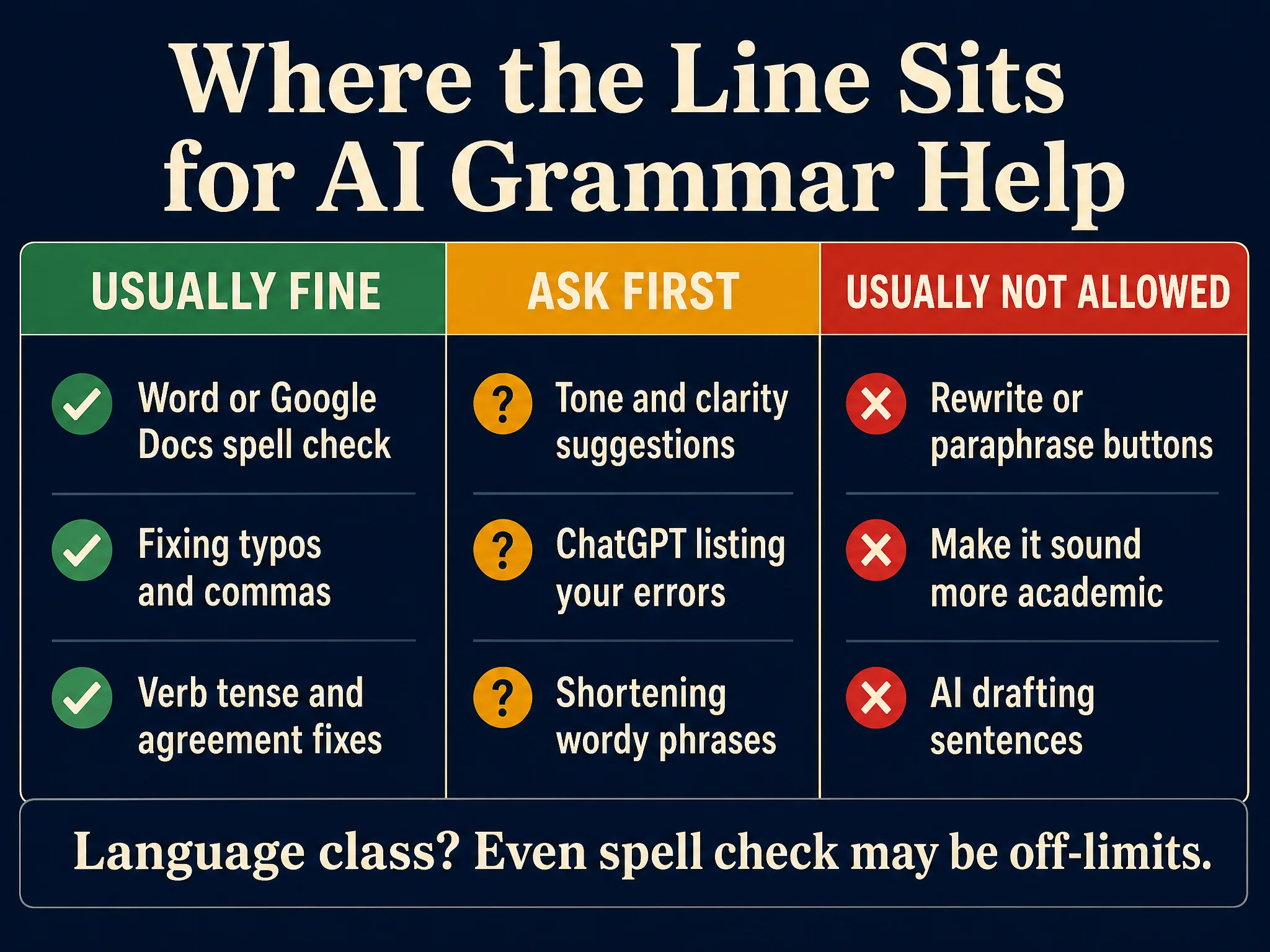
Two features in the middle column cause most of the confusion. UCSD separates the free version of Grammarly that “just checks spelling, grammar and suggests alternate phrasing” from the paid version that is generative and “rewrites (or writes) things for you”, so “I only used Grammarly” can mean very different things. And “shortening wordy phrases” is allowed at Birmingham when the meaning stays the same, but restricted when it reshapes the argument.
What do university policies actually say about AI grammar checks?
They agree on the basics and split on the middle. None of the four pages below bans plain spelling and grammar correction outright, and all four restrict tools that write or rewrite for you.
| University | Allowed | Restricted |
|---|---|---|
| University of Birmingham | Grammarly Free or Pro to fix spelling, punctuation and basic grammar; remove wordy phrases without changing meaning | Rewriting for tone or academic style, restructuring, improving arguments; Grammarly Pro’s advanced features “must not” be used for assessed work |
| Trent University | Grammar and spell checkers in MS Word and Google Docs (“generally acceptable”) | Tools that change tone, word choice or syntax, naming MS Word Editor and Grammarly (“grey area”); prompting AI to create text (“generally not acceptable”) |
| UC San Diego | A spell checker “if spelling … isn’t being assessed” | Grammarly’s generative features that rewrite or write; “Sometimes using Grammarly is fine; other times it might be a violation of integrity” |
| University of South Carolina (sample syllabus) | AI “for brainstorming or grammar checks, but must be cited” | AI that generates full answers or essays; other sample syllabi on the same page ban generative AI entirely |
The USC page matters for a different reason. It shows that one university can publish several syllabus templates, from “grammar checks allowed with citation” to “any generative AI use is plagiarism”. The campus policy sets the floor, and each course picks its own rule. That is why the AI policies at the top 50 universities rarely give a single yes or no.
If your syllabus is silent, do not guess. Our guide on what to do when a syllabus has no AI policy includes a short email you can send to confirm grammar help is fine.
Is ChatGPT a grammar checker or a ghostwriter?
It depends entirely on the prompt. ChatGPT has no “corrections only” mode. If you paste a paragraph and ask it to fix the grammar, it usually returns a smoother version with new word choices, and that output is model text, which is what Turnitin’s detector is trained to find.
Grammarly’s own guidance points to the safer pattern. Its AI Detector user guide says rewrites from its Grammarly, Paraphraser and Humanizer agents “come from our LLM” and will likely be flagged, and suggests using the agents “to receive feedback that you incorporate manually instead of using them to rewrite text directly.” The same logic works in ChatGPT.
Writers on r/WritingWithAI described the same habit. In a thread asking whether it is wrong to use ChatGPT as a proof-editor, one commenter said they ask it to grade their writing “ruthlessly” and then fix the flagged problems on their own. That is feedback, not ghostwriting, and it is also much easier to defend later.
Will a grammar checker trigger an AI detector?
Plain corrections rarely do, according to the vendors. Rewrites often do. Turnitin’s AI writing detection FAQ answers the question directly: “If students use Grammarly for grammar checks, does Turnitin detect it and flag it as AI? No.” In its tests on human-written documents, changes made by Grammarly (free and premium) and other grammar checkers were in most cases not flagged. The same answer excludes Grammarly’s generative features, including draft generation, paraphrasing and summarizing, which “will likely be flagged”.
A vendor test points the same way. In a 2024 Copyleaks analysis, text changed by grammar features that do not use generative AI was not flagged, while text rewritten by Grammarly’s generative option could be, “because, simply put, it is AI-generated.” Copyleaks sells its own grammar checker, so treat that as a company test, not an independent one.
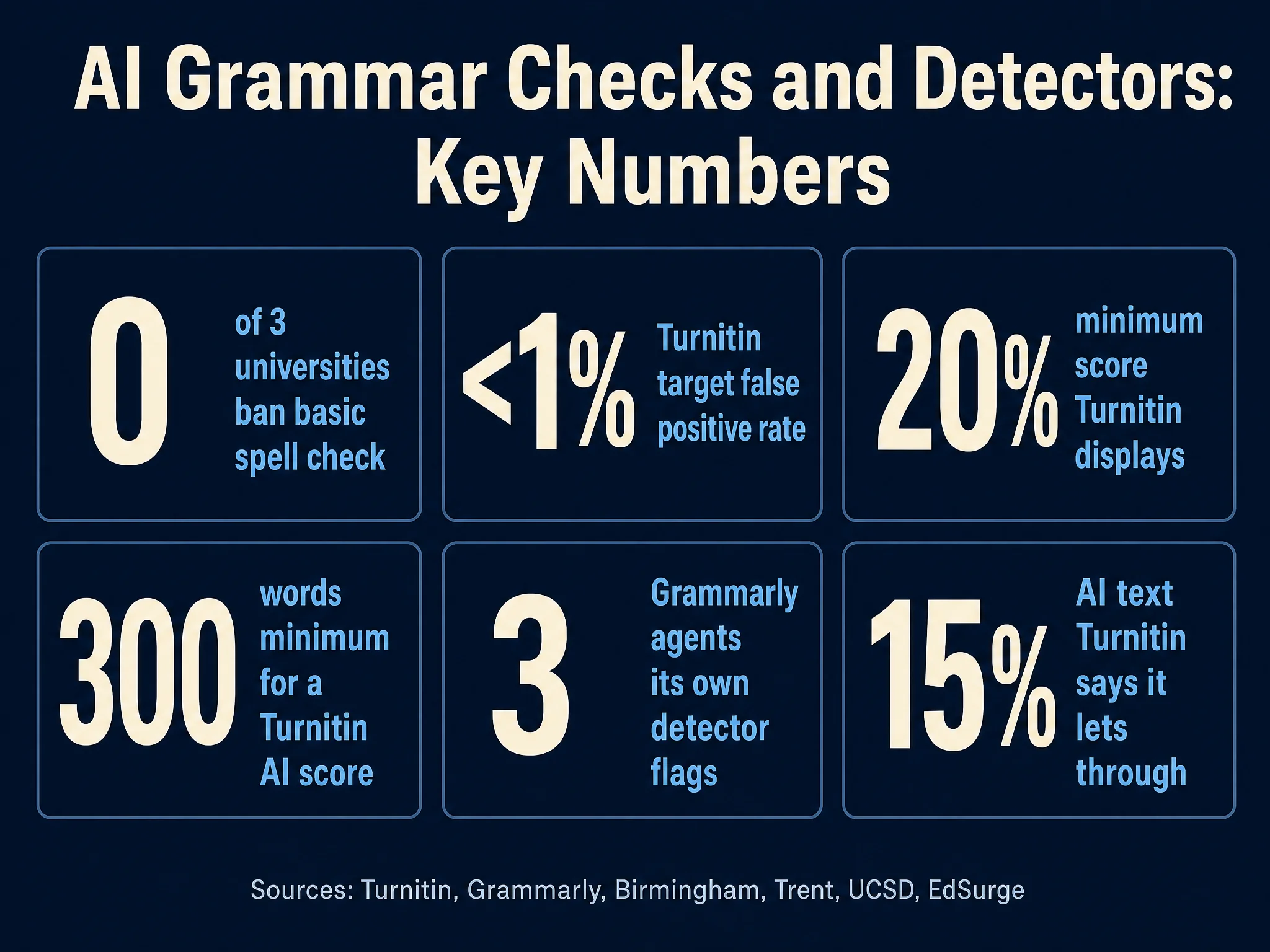
“Rarely” is not “never”. Turnitin targets a false positive rate under 1% for documents with more than 20% AI writing, does not display scores under 20% (they show as an asterisk, explained in what the Turnitin asterisk means), and does not score documents with fewer than 300 words of prose. Its chief product officer told EdSurge in 2024 the tool lets about 15% of AI text through to keep false positives low. Polished, formal writing can still be flagged on its own, which is why essays that sound too polished and short essays draw more flags.
Grammarly’s own detector adds another wrinkle. A WGU student on Reddit reported a high “AI resemblance” score from Grammarly on their own paper, and several replies said they dropped Grammarly and went back to Word. Grammarly says its score “may differ” from Turnitin’s, which we cover in is Grammarly’s AI detector accurate.
When is even spell check off-limits?
When spelling or grammar is the skill being graded. UCSD puts it simply: “If spelling, for example, isn’t being assessed, then you can use a spell checker.” The reverse also holds. In a language course, a grammar quiz or a timed in-class essay, any correction tool can defeat the point of the task.
The r/raisingkids thread is a good example. A parent asked whether their daughter could use AI to check grammar on English homework after the teacher said no AI. The most upvoted replies said yes, that counts, because at that level the grammar is what the teacher is marking. One commenter who said they teach at a university added that their department allows Grammarly for spelling and grammar, then changed their view once they realised the child was still learning English.
Birmingham’s list adds two more edge cases. You may not use Grammarly to translate work into or out of a language you are assessed on, or to shorten your work just to hit a word count. For ESL writers worried about how much correction is too much, see our Turnitin revision tips for ESL writers.
Check your own case: what did the tool do?
Pick the closest match. The answer is a general guide; your syllabus wins.
How do you use a grammar checker without getting into trouble?
Keep the tool in the error-spotting role and keep a record. These five habits cover most courses.
- Read the syllabus line on AI first. If it bans all AI, use only the spell check built into your word processor, or ask.
- Turn off rewrite suggestions. Accept corrections to errors, not whole-sentence rewrites, tone changes or “make it sound academic” suggestions.
- Ask for feedback, not output. With ChatGPT, ask it to list errors and type the fixes yourself.
- Write in a tool with version history. Google Docs or Word history shows small edits over time. Our guide on whether version history is enough as proof explains its limits.
- Disclose in one line when asked. “I used Grammarly for spelling and grammar corrections” is usually enough. See how to disclose AI use without overexplaining.
What should you do if a grammar tool got you flagged?
Explain the exact feature you used, and show the drafts. “Grammarly” covers everything from a comma fix to a full rewrite, so name what you clicked. The University of North Georgia student EdSurge profiled in 2024, Marley Stevens, said she used only standard grammar and spell checking and was still put on academic probation after a Turnitin flag, which shows why evidence matters more than the tool’s name.
Start with our step-by-step guide on what to do if Turnitin flags your essay after Grammarly, then build the file described in how to prove authorship after a Grammarly flag. If the meeting is soon, what to do in the first 24 hours covers the order of steps.
Submitting soon? Put your proof together before anyone asks for it. Our authorship packet guide shows what to save, and our pre-submission check guide compares the ways to test your risk without a Turnitin account.
If you want to know how scores are read once they exist, see Turnitin’s AI score thresholds.
Methodology and limits
For this article I read Turnitin’s AI writing detection FAQ, Grammarly’s AI Detector user guide, Copyleaks’ 2024 grammar checker analysis, EdSurge’s 2024 report, and the academic integrity pages of the University of Birmingham, Trent University, UC San Diego and the University of South Carolina. I also read the top 10 Google US results for this question and 5 Reddit threads from 29 September to 12 November 2026, with their comments. I ran no detector test and submitted nothing to Turnitin, so the detector-risk column reflects what the vendors publish, not my own measurements. Policies change and individual courses set their own rules.
Frequently Asked Questions
Is using Grammarly considered cheating?
Not for basic spelling, punctuation and grammar fixes in most courses. The University of Birmingham allows Grammarly Free or Pro for those corrections but bans its use for tone, structure or argument, and says Pro’s advanced features must not be used for assessed work. Your syllabus decides.
Can Turnitin detect Grammarly?
Turnitin says its detector is not tuned to target Grammarly’s spelling, grammar and punctuation fixes, and in most of its tests those changes were not flagged. Content from Grammarly’s generative features, such as drafting, paraphrasing and summarizing, will likely be flagged.
Is it cheating to use ChatGPT to proofread an essay?
It depends on the course policy and the prompt. Asking ChatGPT to list your errors and fixing them yourself is feedback. Asking it to return a corrected version usually produces rewritten sentences, which many policies treat as generative AI use and which detectors can flag.
Do I need to disclose that I used a grammar checker?
Only if your course asks for AI disclosure or the tool is generative. Some sample syllabi, such as one published by the University of South Carolina, allow AI grammar checks but require them to be cited. A one-line note naming the tool and what it did is usually enough.
Is Microsoft Word spell check considered AI?
Trent University notes that spelling and grammar checkers are a form of AI, yet lists the checkers in Word and Google Docs as generally acceptable for fixing errors in your own writing. It treats tools that change tone, word choice or syntax, including MS Word Editor, as a grey area to clarify with your instructor.
Can I use a grammar checker in a language class?
Often not. When grammar or spelling is the skill being assessed, correction tools can defeat the point of the task. UCSD says you can use a spell checker if spelling is not being assessed, which implies the opposite when it is.
Why did Grammarly’s own AI detector flag my paper?
Grammarly says text rewritten by its Grammarly, Paraphraser and Humanizer agents comes from its LLM and will likely be flagged by its own detector. Fully human writing can also score high on any detector, and Grammarly says its score may differ from Turnitin’s.
