ESL writers face a unique kind of pressure when submitting academic work. You may spend hours making an essay clearer, more grammatical, and more formal, only to worry that a polished final draft could look suspicious to an AI content detector. That anxiety is understandable, especially when Turnitin AI reports are used in classes where the rules around AI writing tools are still changing.
The safest answer is not to make your writing sound artificially imperfect. It is also not to run your paper through a tool that promises to make AI text undetectable. For ESL writers, safer revision means improving clarity while preserving your authorship signals: your drafts, your thinking process, your source notes, your vocabulary choices, and your assignment-specific reasoning.
Want to bypass Turnitin in 2026? Grab the free prompt pack.
Get the exact text-humanization prompts I use to drop an AI score by hand — copy, paste, submit. Free, straight to your inbox.
Send me the free prompts →This guide focuses on practical revision habits that help ESL students write stronger papers and reduce avoidable risk without hiding, faking, or outsourcing authorship.
Why ESL Writing Can Feel More Vulnerable to AI Detection
Turnitin AI detection is designed to identify text patterns that may be associated with AI-generated content. It does not read your intentions, watch your writing process, or know whether English is your first, second, or fifth language. That matters because many innocent ESL writing habits can overlap with features detectors sometimes associate with AI writing.
For example, ESL academic writing may use highly regular sentence structures, cautious claims, repeated transition phrases, and formal but generic wording. A student may also rely on grammar checkers to smooth every sentence, which can make the final draft sound more uniform than the earlier draft. None of these habits prove AI use, but they can make a paper feel less personal or less process-driven when read by a detector or instructor.
This concern is not imaginary. Research published in Patterns found that several GPT detectors showed bias against non-native English writing, with non-native English essays more likely to be misclassified as AI-generated than native English essays in that study. The research was not a Turnitin-specific test, but it highlights a broader issue: AI detection tools can produce false positives, and ESL writers should protect themselves with good documentation and transparent revision habits.
Turnitin also frames its AI writing detection as an indicator, not as a complete academic misconduct decision. Instructors still need context, policy, and evidence. Your goal as an ESL writer is to make that context easy to see.
Start With Policy Before You Start Revising
Before revising an essay, check the course policy on grammar tools, translation tools, AI brainstorming, and AI rewriting. Some instructors allow spelling and grammar correction but prohibit generative rewriting. Others allow AI for brainstorming if you disclose it. Some departments have stricter rules than individual teachers.
If the policy is unclear, ask a short, specific question such as: Can I use a grammar checker to identify errors if I make the final edits myself? This is much better than asking a vague question about whether AI is allowed, because it gives the instructor a concrete scenario.
Good policy awareness also helps you decide what evidence to keep. If you use any digital help, save proof of what the tool did and what you changed afterward. Detection Drama’s guide to a safe AI writing workflow for college explains this larger process in more detail, but the basic principle is simple: do not just submit a final document. Preserve the path that got you there.
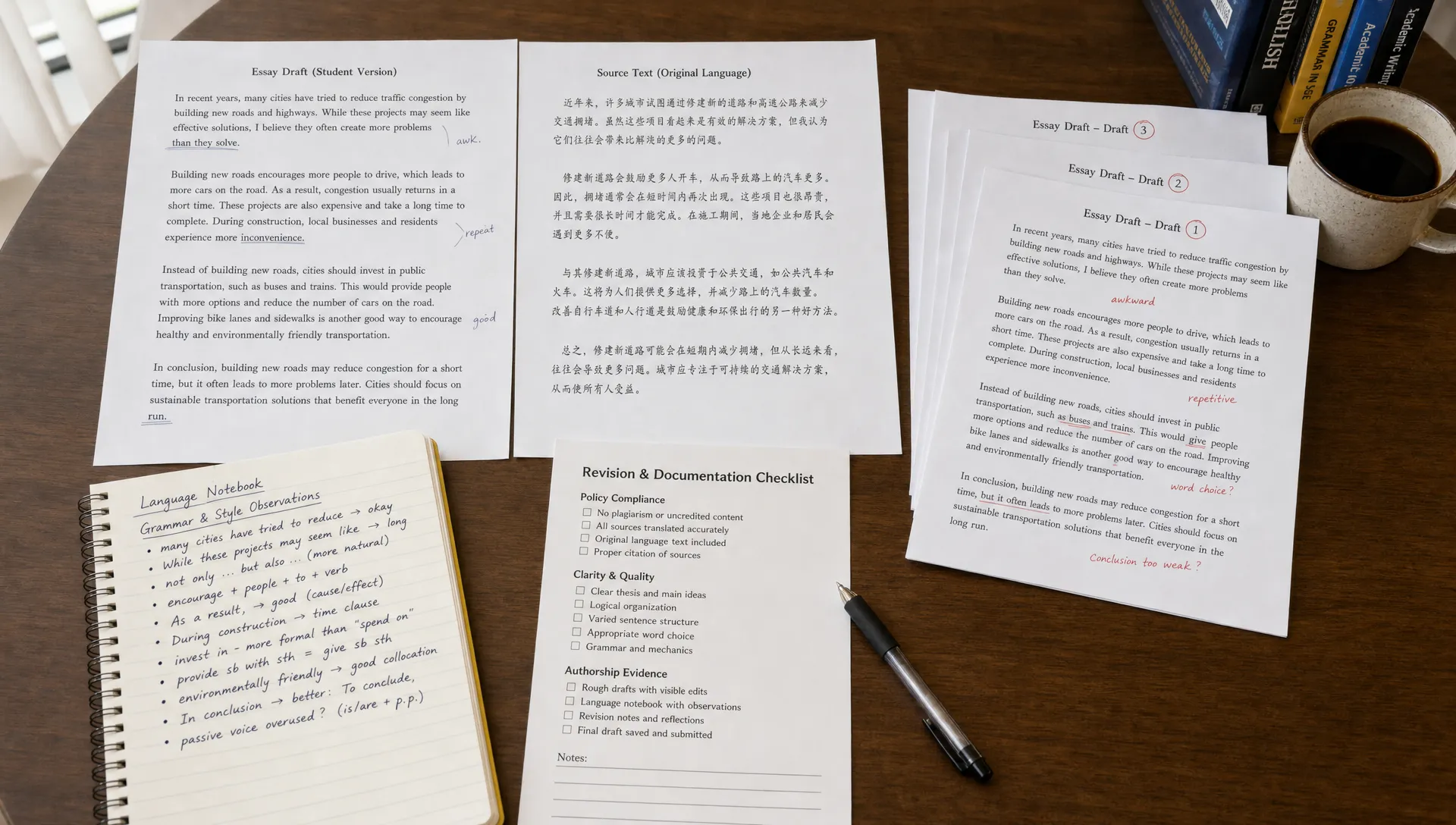
Useful authorship evidence can include your outline, rough draft, source notes, annotated PDFs, professor feedback, writing center comments, and version history from Google Docs or Microsoft Word. For ESL writers, it can also help to keep a vocabulary list or grammar notes showing what you learned during revision.
Revise for Meaning First, Grammar Second
One of the safest revision habits is to separate idea revision from language revision. Many students do the opposite: they paste a rough paragraph into a tool, receive a polished rewrite, and then try to adjust the meaning afterward. That approach is risky because it can replace your sentence-level decisions with a new voice that does not match your drafts.
Start by revising the argument in your own words. Ask whether each paragraph answers the assignment, uses the required readings, and explains your reasoning. Only after the ideas are stable should you edit grammar, word choice, and sentence flow.
A strong ESL revision process usually moves from global to local:
- Clarify the thesis and make sure it directly answers the prompt.
- Add specific references to lectures, readings, lab results, case facts, or class discussions.
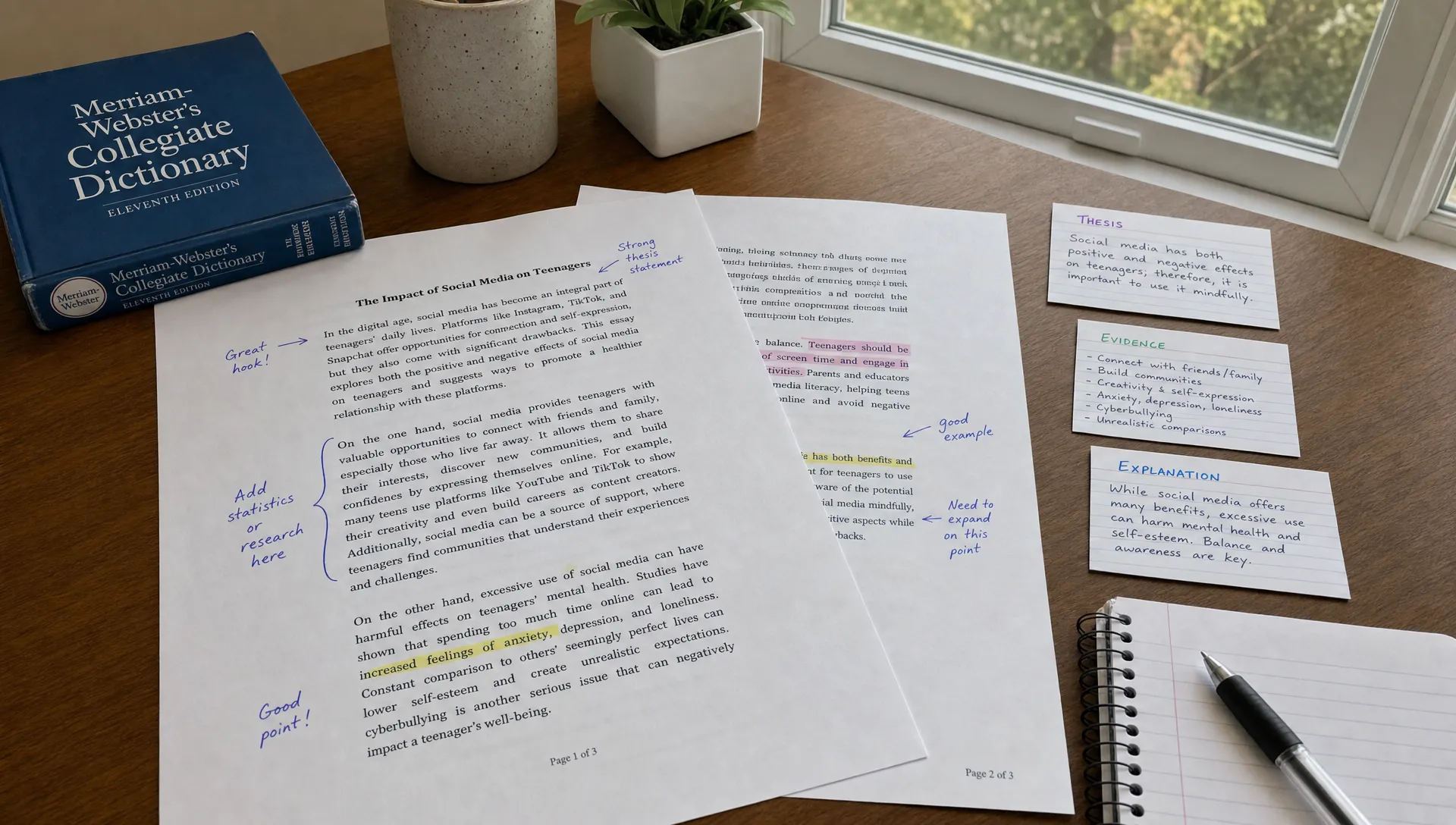
- Check whether each paragraph has a claim, evidence, and explanation.
- Improve grammar and sentence style after the argument is already yours.
- Save a copy before and after major revisions so the development is visible.
This order matters because AI-like writing often feels generic, even when it is grammatically correct. A paper with a few non-native phrasing patterns but strong assignment-specific analysis is usually more credible than a perfectly smooth paper that could apply to any class.
Safer vs. Riskier Revision Choices for ESL Writers
Not all revision help carries the same risk. The issue is not whether a tool is digital. The issue is whether the tool supports your own writing or replaces it.
| Revision choice | Safer approach | Higher-risk approach |
|---|---|---|
| Grammar correction | Review each suggestion and accept only corrections you understand | Accept every rewrite automatically without checking meaning |
| Vocabulary improvement | Replace a word only if you can explain and use it correctly | Add advanced synonyms that sound formal but distort the argument |
| Sentence clarity | Shorten or split your own sentences for readability | Ask a tool to rewrite the whole paragraph in a new style |
| Translation support | Use translation to understand a word or phrase, then write the sentence yourself | Draft in another language and machine-translate the entire essay without review |
| AI assistance | Ask for feedback, error explanations, or questions to consider if allowed | Generate or humanize full sections and submit them as your own |
| Proof of authorship | Keep outlines, drafts, notes, and version history | Work only in copy-paste boxes with no record of your process |
The safest pattern is active revision. You make the final decision, you understand the correction, and your evidence shows how the paper developed.
Keep Your ESL Voice Clear, Not Artificially Native
Many ESL writers try to remove every sign that they are non-native speakers. That can backfire. Your goal is not to imitate a native speaker perfectly. Your goal is to communicate academic ideas clearly, accurately, and honestly.
A natural ESL academic voice may include shorter sentences, careful transitions, and occasional phrasing that reflects your language background. That is not a weakness. In fact, a consistent voice across drafts can be strong evidence that the work is yours.
Be especially careful with vocabulary upgrades. If you replace simple words with complex ones, make sure the meaning is still correct. Words like demonstrate, indicate, suggest, reveal, and emphasize are common in academic writing, but they are not interchangeable in every sentence. A detector is not the only risk here. Over-polished vocabulary can also make an instructor question whether the final paper matches your usual writing.
Instead of asking, How can I make this sound native?, ask, How can I make this easier to understand? That question leads to better academic writing and fewer suspicious style shifts.
Use Grammar and AI Tools With Clear Boundaries
Many ESL students use grammar tools because they are trying to learn, not cheat. The safest use is educational and limited. For example, asking a tool to explain why a verb tense is wrong is very different from asking it to rewrite an entire essay in polished academic English.
If your institution allows AI or grammar assistance, use prompts that keep you in control. For example, you can ask for a list of possible grammar issues, an explanation of article usage, or questions that help you improve clarity. Then make the changes yourself in your document.
Avoid tools or prompts that promise to bypass AI detection. They may change your voice, introduce meaning errors, remove useful ESL authorship patterns, or create a final draft that no longer matches your earlier work. If you are specifically worried about a Turnitin AI score, Detection Drama has a separate guide on how to lower Turnitin AI risk without humanizer tricks, focused on authorship and assignment-specific writing rather than disguise.
A good rule is this: if you could explain the revision to your instructor, it is probably safer. If you would feel uncomfortable showing the tool output, prompt, or before-and-after change, pause before using it.
Add Assignment-Specific Detail Wherever Your Draft Feels Generic
Generic academic writing is a common problem for both ESL and native-English writers. It can also resemble AI-generated content because AI tools often produce broad claims, predictable structure, and safe but unspecific explanations.
To make your writing more clearly yours, add details that only a real student in your course would likely include. This does not mean adding personal stories to every paper. It means grounding your claims in the assignment context.
For example, instead of writing that a policy has many social effects, name the specific effect discussed in the reading and explain how it connects to the prompt. Instead of saying the author uses rhetoric effectively, identify the rhetorical strategy, quote a short phrase, and explain why it matters. Instead of writing a general conclusion that restates the thesis, explain what your analysis changes about how the reader should understand the topic.
This kind of specificity is valuable because it improves the essay while strengthening authorship signals. It shows that you are not merely producing fluent English. You are doing the intellectual work of the course.
Build a Pre-Submission Routine That Protects You
Before submitting, review the paper from two angles: quality and evidence. Quality means the essay is clear, cited, and responsive to the prompt. Evidence means you can show how you created it if questions arise.
A safer pre-submission routine can include reading the paper aloud, checking whether the final draft still sounds like your earlier drafts, reviewing citations, and saving a PDF copy of your version history or draft timeline. If you use a writing center, keep the appointment confirmation and feedback notes. If a classmate reviews your paper, save their comments.
Be careful with repeated pre-checking. Uploading your paper to random detector or plagiarism checker sites can create privacy concerns, and some tools may store text. A pre-check is not a guarantee, especially because different AI content detector systems use different methods. If you do use a checker, treat it as one signal, not as a verdict, and do not keep rewriting solely to satisfy a detector.
For a more structured approach, see Detection Drama’s guide to the best pre-submission check for Turnitin AI risk, which emphasizes policy, drafts, and authorship evidence before detector scores.
What to Do If Your ESL Writing Is Flagged
If your work is questioned, stay calm and respond with evidence. Do not assume that a Turnitin AI flag automatically means you will be punished. Many institutions require an instructor review, and a thoughtful response can make a significant difference.
Start by gathering your drafts, notes, version history, assignment prompt, sources, and any feedback you received. Prepare a simple timeline of your writing process: when you chose the topic, when you drafted, when you revised, and what tools or people helped you. If you used grammar support allowed by policy, be honest and specific about how you used it.
Avoid emotional accusations. A better response is factual: you are an ESL writer, you completed the work yourself, you understand that detection tools can be imperfect, and you can provide evidence of your process. Detection Drama’s Turnitin AI false positives checklist can help you organize that response if you need to defend your work.
Frequently Asked Questions
Can Turnitin AI falsely flag ESL writing? Yes, false positives are possible with AI detection tools. Research on GPT detectors has found that non-native English writing can be misclassified more often in some systems. A Turnitin AI indicator should be reviewed with context, drafts, and course policy.
Should ESL students avoid grammar checkers completely? Not necessarily. If your school allows them, grammar checkers can be useful for learning and proofreading. The safer approach is to review suggestions one by one, understand the correction, and keep your own voice and meaning intact.
Is it safe to use a text humanizer before submitting to Turnitin? It is risky in an academic setting if the tool changes authorship, meaning, or style in ways you cannot explain. A safer strategy is to revise your own ideas, document your process, and use language tools only within your course rules.
How can I make my writing sound less AI-like without pretending to be someone else? Add specific analysis, course details, accurate citations, and your own reasoning. Vary sentences naturally when it improves clarity, but do not intentionally add mistakes or awkward phrasing just to look human.
What evidence should ESL writers keep? Keep outlines, rough drafts, source notes, annotated readings, version history, writing center feedback, grammar notes, and any allowed tool prompts or outputs. This evidence helps show that the final paper developed from your own work.
Safer Revision Is About Authorship, Not Fear
Turnitin AI can be stressful for ESL writers, but the best protection is not panic-editing or trying to hide your writing process. It is building a clear record of authorship and revising in a way that strengthens your ideas without replacing your voice.
If you want more guidance on AI detection risk, Turnitin concerns, and responsible revision habits, explore the practical resources at Detection Drama. Use tools and checklists to understand risk, but let your drafts, notes, and reasoning prove the most important point: the work is yours.
