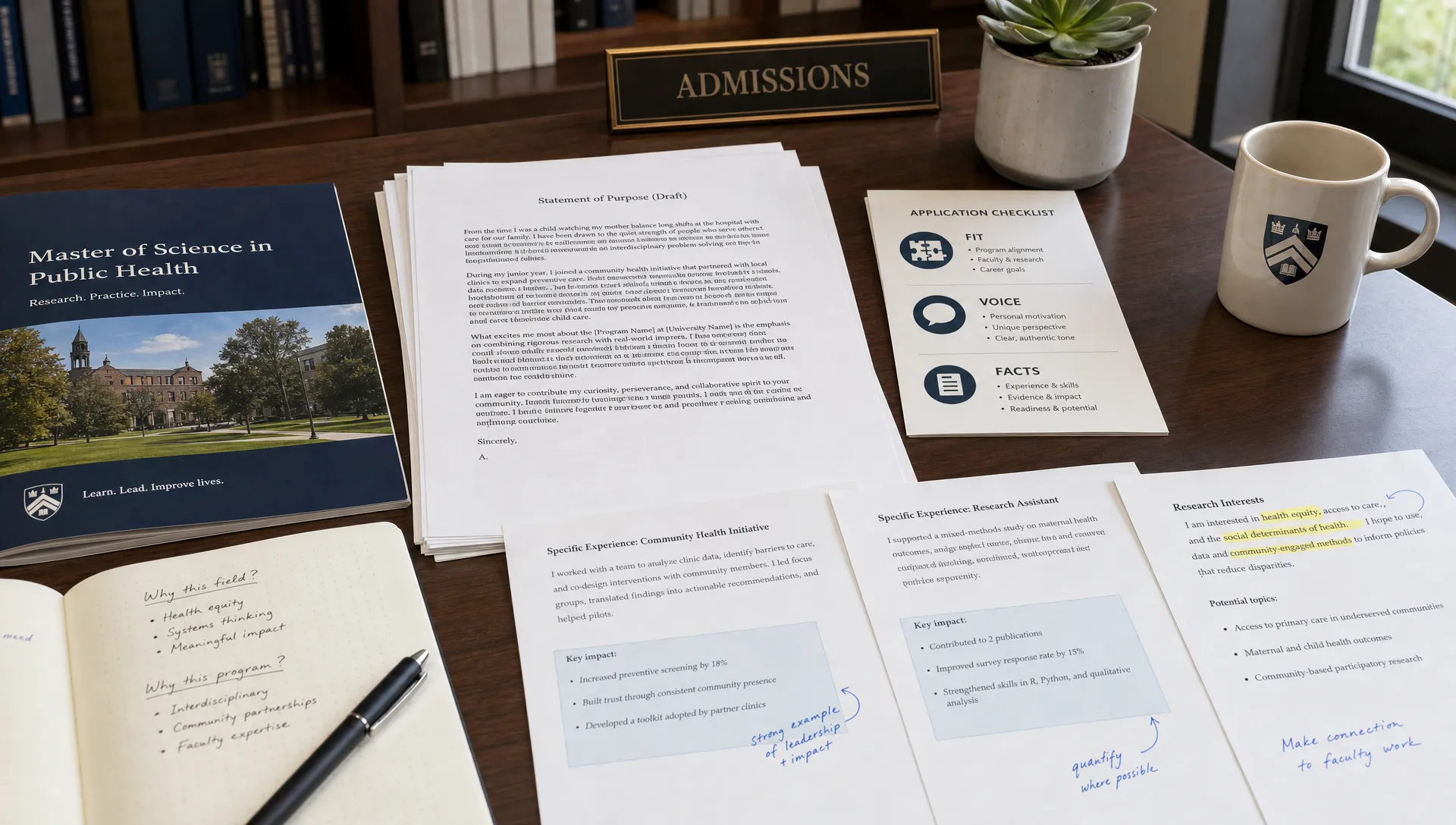
Here, SOP means statement of purpose, the personal application essay used for graduate school, scholarships, fellowships, and some professional programs. It is one of the worst places to let an AI humanizer run wild.
An AI humanizer for SOPs can be useful when your draft sounds stiff, generic, or too obviously machine-polished. It can vary sentence rhythm, remove repetitive phrasing, and make an AI-assisted draft feel more natural. But the goal is not to make your SOP sound like a different person wrote it. The goal is to make it sound like you, only clearer.
Want to bypass Turnitin in 2026? Grab the free prompt pack.
Get the exact text-humanization prompts I use to drop an AI score by hand — copy, paste, submit. Free, straight to your inbox.
Send me the free prompts →That distinction matters. Admissions readers are not looking for the most dramatic essay. They are looking for evidence of fit, maturity, motivation, and direction. If a text humanizer turns your specific story into a smooth but anonymous essay, it has failed, even if an AI content detector gives you a better score.
A strong SOP should still contain your actual interests, your real academic or professional path, your language habits, and your reasons for choosing the program. A humanizer can polish the surface, but it should never replace the substance.
Why SOPs are easy to over-humanize
Most AI-generated content becomes recognizable because it leans on safe patterns: balanced paragraphs, predictable transitions, broad claims, and polished but vague emotion. That is already a problem in blog posts or marketing copy. In a statement of purpose, it is even riskier because the entire document depends on specificity.
An SOP is not just a writing sample. It is a credibility document. The reader wants to know whether your experiences connect logically to your goals. They want to see whether you understand the program. They also want to hear a voice that feels consistent with a real applicant, not a committee-generated ideal student.
Tools such as Turnitin’s AI writing detection and other AI content detector systems may influence how institutions review writing, but detector scores should not be your only concern. A draft can pass a detector and still feel hollow. It can also be human-written and still sound generic if it relies on the same phrases everyone else uses.
For SOPs, the bigger danger is voice drift. You start with a truthful draft, run it through a humanize AI text tool, then get back a version that sounds elegant but unfamiliar. It may add emotional language you would never use, remove the awkward detail that made your story believable, or blur your research interests into generic ambition.
What an AI humanizer should do for an SOP
A good AI humanizer for SOPs should make the writing more readable without changing your application identity. Think of it as a careful editor, not a ghostwriter.
Here is the difference between helpful and risky humanization:
| SOP element | Helpful humanizer edit | Risky humanizer edit |
|---|---|---|
| Opening paragraph | Reduces stiffness and gets to the point faster | Adds a dramatic hook that never happened |
| Academic interests | Clarifies your focus in plain language | Replaces your field-specific goals with broad passion statements |
| Experience descriptions | Improves flow and removes repetition | Exaggerates responsibility, impact, or technical skill |
| Program fit | Makes the connection more concise | Invents faculty interests, labs, courses, or outcomes |
| Personal tone | Keeps your natural level of formality | Makes you sound overly poetic, sentimental, or corporate |
| Closing paragraph | Strengthens your forward-looking goal | Turns your goal into an inflated promise |
The best edits are usually small. They improve transitions, reduce robotic repetition, and vary sentence length. They do not rewrite your life story.
If you want a broader framework for preserving personal style, Detection Drama’s guide on rewriting AI text without losing your original voice pairs well with SOP editing because it focuses on intention, not just wording.
Build a voice profile before using a humanizer
Before you paste an SOP into any AI writing tools, take ten minutes to define what your voice actually sounds like. This prevents the tool from replacing your style with a generic admissions tone.
Your SOP voice profile should answer a few practical questions. Are you direct or reflective? Do you write in short, clear sentences or longer analytical ones? Do you use vivid personal scenes, or do you prefer evidence-based explanation? Do you sound naturally formal, conversational, or somewhere between the two?
A voice profile does not need to be complicated. It can be a short note like this:
My SOP should sound calm, specific, and analytical. I do not want dramatic language. I use concrete examples before making big claims. I am comfortable sounding reflective, but not sentimental. Keep my research interests precise and do not make my background sound more impressive than it is.
That simple note gives you a standard for judging the output. If the humanized version sounds more impressive but less like you, reject it or revise it manually.
You should also identify words and phrases that belong to you. Maybe you often use straightforward transitions such as because, over time, and this led me to. Maybe you avoid words like transformative, profound, deeply passionate, or unwavering. Those preferences matter. Admissions essays often become forgettable because they all borrow the same polished vocabulary.
Lock the meaning before you edit
An SOP contains facts that should not move. If a humanizer changes them, the essay may become inaccurate or misleading.
Before using a text humanizer, create a meaning lock. This is a list of details the tool is not allowed to alter: degree names, dates, research topics, project outcomes, faculty names, career goals, personal experiences, and any limitations you intentionally included.
This is especially important for program fit. A humanizer may try to make a sentence smoother by simplifying it, but in the process it can remove the exact course, lab, method, or faculty connection that made your fit credible. Smooth writing is not worth losing evidence.
For a safer editing process, review the principles in using an AI humanizer without changing meaning before you revise a high-stakes SOP. The same meaning-first approach applies to admissions writing, scholarship essays, and academic statements.
A safe workflow for humanizing an SOP
The safest way to use an AI humanizer for SOPs is to work in sections, not all at once. Full-document rewriting makes it harder to see where the tool changed tone, facts, or emphasis.
- Clean the draft first: Remove prompt residue, placeholders, fake citations, repeated AI phrases, and comments that do not belong in the final essay. If you are unsure what to delete, use this checklist on what to remove before using an AI humanizer.
- Mark non-negotiable details: Highlight faculty names, program names, research interests, dates, awards, project descriptions, and personal experiences that must remain unchanged.
- Humanize one paragraph at a time: Start with the stiffest sections, usually the introduction, transitions, and conclusion. Avoid rewriting your most personal paragraph too aggressively.
- Compare line by line: Put the original and revised paragraphs side by side. Check whether the new version changed meaning, inflated claims, or removed specificity.
- Reinsert your natural phrasing: If the output is clearer but too polished, bring back your own sentence rhythm. A slightly imperfect sentence can feel more authentic than a flawless generic one.
- Run a final voice check: Read the SOP aloud. If you would feel strange saying a sentence in an interview, rewrite it.
This workflow is slower than one-click rewriting, but SOPs deserve the extra care. A statement of purpose is not a place to optimize only for AI detection. It is a place to show judgment.
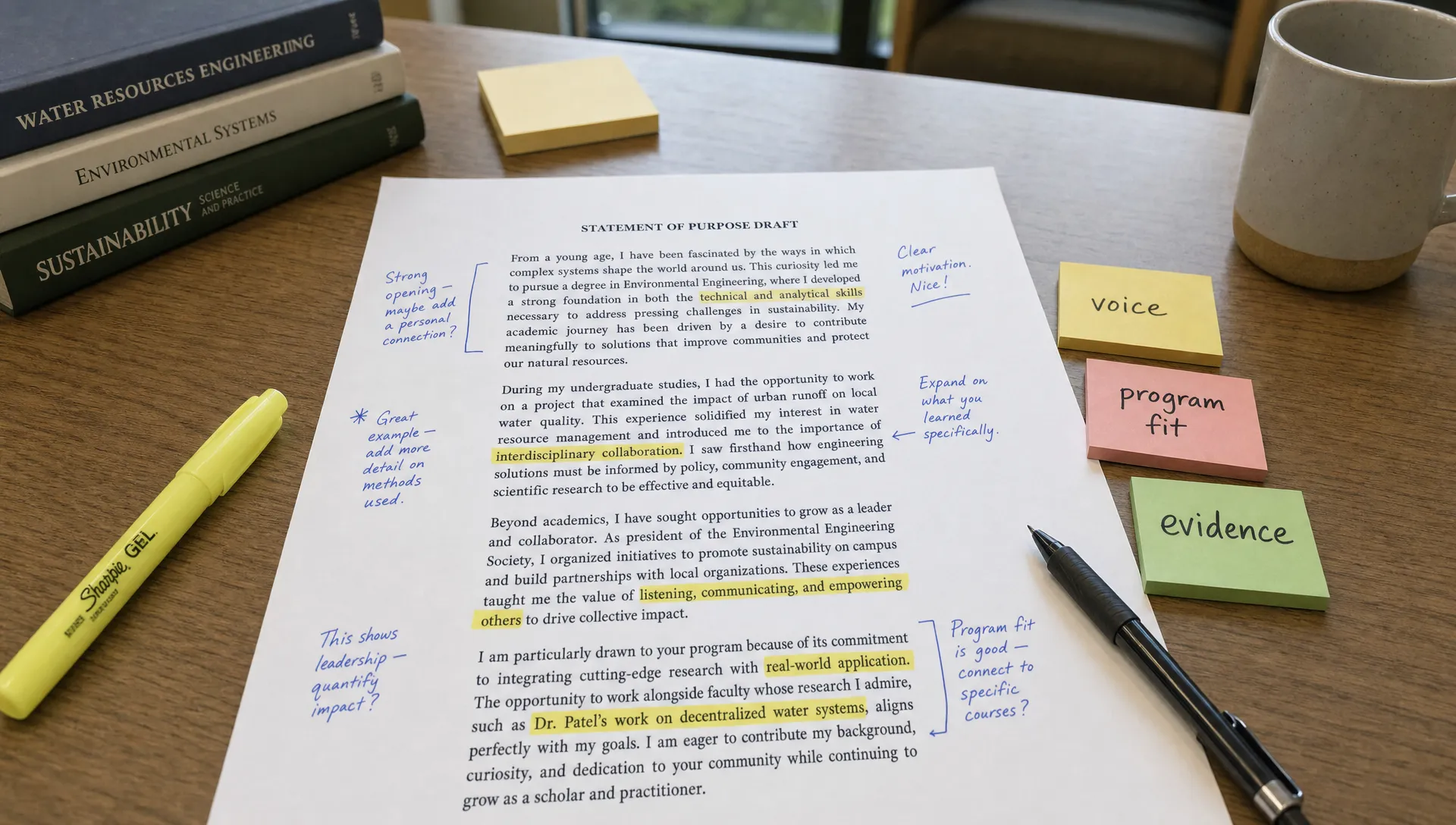
Before and after: humanized SOP example
Here is a simplified example of what usually goes wrong, followed by a better revision.
Original AI-heavy version:
My academic journey has been shaped by a profound passion for public health and a desire to create meaningful change in underserved communities. Through various experiences, I have developed strong skills and a deep commitment to advancing health equity.
The problem is not that the paragraph is grammatically wrong. The problem is that it could belong to thousands of applicants. It uses broad nouns, passion, change, communities, skills, commitment, without giving the reader anything concrete.
Over-humanized version:
Public health found me in the quiet urgency of waiting rooms, in the stories behind every statistic, and in the realization that equity is not an abstract dream but a calling I can no longer ignore.
This is more human-sounding, but it may not be your voice. It is dramatic, poetic, and vague. If the rest of your SOP is analytical, this opening will feel inconsistent.
Better humanized version:
I became interested in public health while volunteering at a county clinic where missed appointments were often treated as a patient behavior problem. After helping staff review intake notes and bus-route data, I began to see how transportation, shift work, and clinic hours shaped access long before a patient met a provider.
This version is stronger because it uses a real scene, a specific observation, and a clear intellectual turn. It does not try to sound impressive. It gives the admissions reader evidence.
That is the standard you want from an SOP humanizer. It should help you move from generic claims to precise, believable writing.
How to choose an AI humanizer for SOPs
Not every humanizer is suitable for admissions writing. Some tools are built for speed, SEO content, or casual paraphrasing. SOPs require more control.
Look for a tool or workflow that lets you preserve meaning, adjust tone, and review changes before accepting them. Instant rewriting is convenient, but blind acceptance is risky. A good AI humanizer should let you compare the revised version against your original and keep the details that matter.
Privacy also matters. Your SOP may include personal history, academic records, immigration context, health experiences, family background, or sensitive career information. Before uploading, remove information the tool does not need. You can often test a paragraph without including your full name, application ID, address, or other private details.
Finally, remember that a plagiarism checker and an AI detector measure different risks. A plagiarism checker looks for overlap with existing sources. An AI detector estimates whether the writing resembles AI-generated content. A humanizer cannot fix copied material, fake citations, or dishonest claims. Those need to be removed or corrected before polishing.
Red flags that your SOP no longer sounds like you
After humanizing your SOP, step away for a few hours and reread it as if you were preparing for an admissions interview. If a reviewer asked you about any sentence, could you explain it naturally?
Watch for these warning signs:
- The essay uses words you would never say, such as profound, transformative, tapestry, unwavering, or indelible.
- Your concrete experiences have been replaced by broad claims about passion, excellence, leadership, or impact.
- The draft sounds more emotional than you intended.
- Your research interests became less precise after rewriting.
- Every paragraph has the same polished rhythm.
- The essay makes you sound like a finished expert instead of a developing student with direction.
- You feel impressed by the writing but disconnected from the person it describes.
That last point is the most important. If the SOP no longer feels like a document you could defend in an interview, it is not ready.
Use AI detection as a diagnostic, not a writing strategy
It is understandable to worry about AI detection, especially when admissions policies are unclear or vary by institution. Some applicants use AI for brainstorming, outlining, grammar correction, or translation support, then worry that the final draft may be flagged as AI-generated content.
Still, writing only to beat a detector is a weak strategy. AI detection tools look for patterns, and those patterns can shift as detectors update. Over-optimizing for detection can make your SOP choppy, unnatural, or full of unnecessary quirks.
A better approach is to use detection feedback as one signal. If a paragraph is flagged, ask why it might feel machine-like. Is it too vague? Are the sentences the same length? Does it rely on generic transitions? Does it lack personal evidence? Fix those writing problems first. The detector score may improve, but more importantly, the SOP will become stronger for human readers.
The core question is not simply whether your SOP can bypass AI detection. The better question is whether your statement sounds specific, truthful, and recognizably yours.
Final SOP review checklist
Before submitting, read your SOP through four separate lenses: accuracy, voice, fit, and policy.
For accuracy, confirm that every date, title, institution, professor, course, lab, and project detail is correct. Do not assume the humanized version preserved them.
For voice, read the essay aloud and mark every sentence that feels too polished, too sentimental, or too unlike you. Replace those lines with simpler wording.
For fit, check whether the SOP explains why this program makes sense for your goals. Strong program fit is specific without becoming a list of faculty names copied from a website.
For policy, review the application instructions. Some programs allow AI assistance for grammar or brainstorming, while others may restrict it. If a school gives explicit rules, follow them.
The best SOPs do not hide the applicant behind perfect prose. They make the applicant easier to understand.
Frequently Asked Questions
Can I use an AI humanizer for an SOP? Yes, but use it as an editing aid, not as a replacement for your own writing. Your experiences, goals, program fit, and personal reasoning should come from you.
Will a humanizer guarantee that my SOP passes AI detection? No tool can honestly guarantee that. AI content detector systems vary, and their results can change. Focus on making the SOP specific, accurate, and natural rather than chasing a perfect score.
What parts of an SOP should I avoid humanizing heavily? Be careful with personal stories, research interests, faculty fit, and any sentence involving facts. These sections are easy to distort if a tool prioritizes smoother language over meaning.
How do I know if the SOP still sounds like me? Read it aloud and imagine discussing it in an interview. If the wording feels too dramatic, too corporate, or too different from how you normally explain your goals, revise it manually.
Can a humanizer fix a generic SOP? Only partly. A humanizer can improve style, but it cannot invent authentic substance. If your SOP lacks specific examples, program fit, or clear motivation, add those before polishing.
Keep your SOP human without guessing
If your SOP sounds too robotic, Detection Drama can help you test and refine AI-assisted writing with free humanizer resources, instant tool access, and AI authenticity analysis. Start with your real draft, lock your facts, protect your voice, then use the tool to polish what is already true.
Your goal is not to sound less like AI at any cost. Your goal is to sound more like yourself on your clearest day. Try the free resources at Detection Drama and make your final SOP both readable and recognizably yours.
