Want to bypass Turnitin in 2026? Grab the free prompt pack.
Get the exact text-humanization prompts I use to drop an AI score by hand — copy, paste, submit. Free, straight to your inbox.
Send me the free prompts →Key Takeaways
- 100 cases of AI-related plagiarism drew a penalty in summer 2025, up from 85 in summer 2024 (Ofqual, Table 4).
- By board in 2025: AQA 45, Pearson 30, Cambridge OCR 20, WJEC 5 (Ofqual, Table 4).
- The AI category did not exist before 2024 — 2022 and 2023 are marked “not available”, so no long-run trend can be sourced to Ofqual (Ofqual, Background information).
- Mobile phones produced 2,225 cases in the same series — 44.3% of all student malpractice and 22x the AI figure (Ofqual, summer 2025 release).
- Ofqual’s Chief Regulator wrote to exam boards in March 2026 that detected AI cases “remain relatively low” while concern about the real extent “is significant” (Ofqual letter, 2 March 2026).
- The March 2026 school-leader briefing pack on AI quotes 1,125 whole-qualification losses — an all-malpractice figure, not an AI one (Ofqual, SLT briefing pack).
- Scotland’s SQA logged 31 AI cases inside 92 plagiarism cases in 2024, its first year of separate AI reporting (Tes, reporting SQA data).
GCSE and A level AI malpractice statistics are published once a year by the exam regulator, and almost nobody reads them. Every August two things arrive together in the UK: results day, and a fresh round of headlines about students cheating their way through coursework with ChatGPT. What almost never arrives with them is a number.
There is one. Ofqual publishes it annually, buried in a 28 KB spreadsheet attached to a statistical release whose summary page never mentions artificial intelligence at all. This page pulls that figure out, breaks it down by exam board and year, sets it against the other things students get caught doing, and — just as importantly — explains what it can and cannot tell you.
Want to bypass Turnitin in 2026? Grab the free prompt pack.
Get the exact text-humanization prompts I use to drop an AI score by hand — copy, paste, submit. Free, straight to your inbox.
Send me the free prompts →1How many students were penalised for AI in GCSEs and A levels?
100 cases of AI-related plagiarism resulted in a penalty across GCSE, AS and A level qualifications in England in the summer 2025 exam series, up from 85 in summer 2024. Those are the only two years of data that exist.
| Metric | Value | Source |
|---|---|---|
| AI-plagiarism cases penalised, summer 2025 | 100 | Ofqual, Table 4 |
| AI-plagiarism cases penalised, summer 2024 | 85 | Ofqual, Table 4 |
| Change year on year | +17.6% | Calculated from Table 4 |
| Total component entries, summer 2025 | 17,523,265 | Ofqual, Table 1 |
| Students with results issued, summer 2025 | 1,376,480 | Ofqual, summer 2025 release |
| Students with any malpractice penalty | 4,735 (0.3%) | Ofqual, summer 2025 release |
| Source: Ofqual, Malpractice in GCSE, AS and A level: summer 2025 exam series | ||
That ratio is the single most useful thing on this page, and it needs handling with care in both directions. It is not evidence that AI cheating is rare. It is evidence that proven, penalised AI cheating is rare, which is a materially different claim. The distinction runs through everything below.
It is also worth being clear about which population this covers. Almost all published UK reporting on AI misconduct concerns universities, where the numbers are an order of magnitude larger — the figures behind how many students actually get caught using AI come from Freedom of Information requests to higher education institutions, not from exam boards. School-level data is a separate collection with a separate methodology, and the two should never be added together. The picture in American schools is different again, as the K-12 AI detection adoption and spending data shows.
2Which exam board recorded the most AI cases?
AQA recorded 45 AI-plagiarism cases in summer 2025, ahead of Pearson on 30, Cambridge OCR on 20 and WJEC on 5. AQA is also the largest board, with 10.3 million of the 17.5 million total entries.
| Exam board | 2024 cases | 2025 cases | 2025 entries |
|---|---|---|---|
| AQA | 40 | 45 | 10,302,565 |
| Pearson | 20 | 30 | 4,465,195 |
| Cambridge OCR | 20 | 20 | 1,526,525 |
| WJEC | 5 | 5 | 1,228,975 |
| Total | 85 | 100 | 17,523,265 |
| Source: Ofqual data tables (.ods), Tables 1 and 4. All figures rounded to the nearest 5 by Ofqual. | |||
Ofqual publishes entry counts alongside case counts, and it is tempting to divide one by the other to produce a per-board detection rate. Ofqual explicitly asks readers not to, and the reason is structural rather than pedantic: entries are counted per student per component, while a single malpractice case can span several components, several qualifications and sometimes several students. A ratio built from those two columns divides two things that count different objects. The table above therefore shows raw counts and entry totals side by side, and stops there.
Pearson accounts for the only meaningful movement between the two years, rising from 20 cases to 30. Read that carefully before drawing conclusions: because Ofqual rounds every figure to the nearest 5, a change of 10 in a base of 20 could reflect anything from a genuine enforcement shift to a handful of individual investigations landing before rather than after the data cut-off. With counts this small, board-to-board comparison is close to meaningless — and comparing detection rates between boards would additionally require knowing what each one actually screens for, which is not published. Vendor-published detection figures do not fill that gap either; as the published Turnitin detection statistics show, tool-side numbers describe flags raised, not misconduct proven.
3AI is 2% of exam cheating. Phones are 44%.
Mobile phones and other communication devices produced 2,225 penalised cases in summer 2025 — 44.3% of all student malpractice, and 22 times the AI figure. Phones have been the most common offence type every summer since 2018.
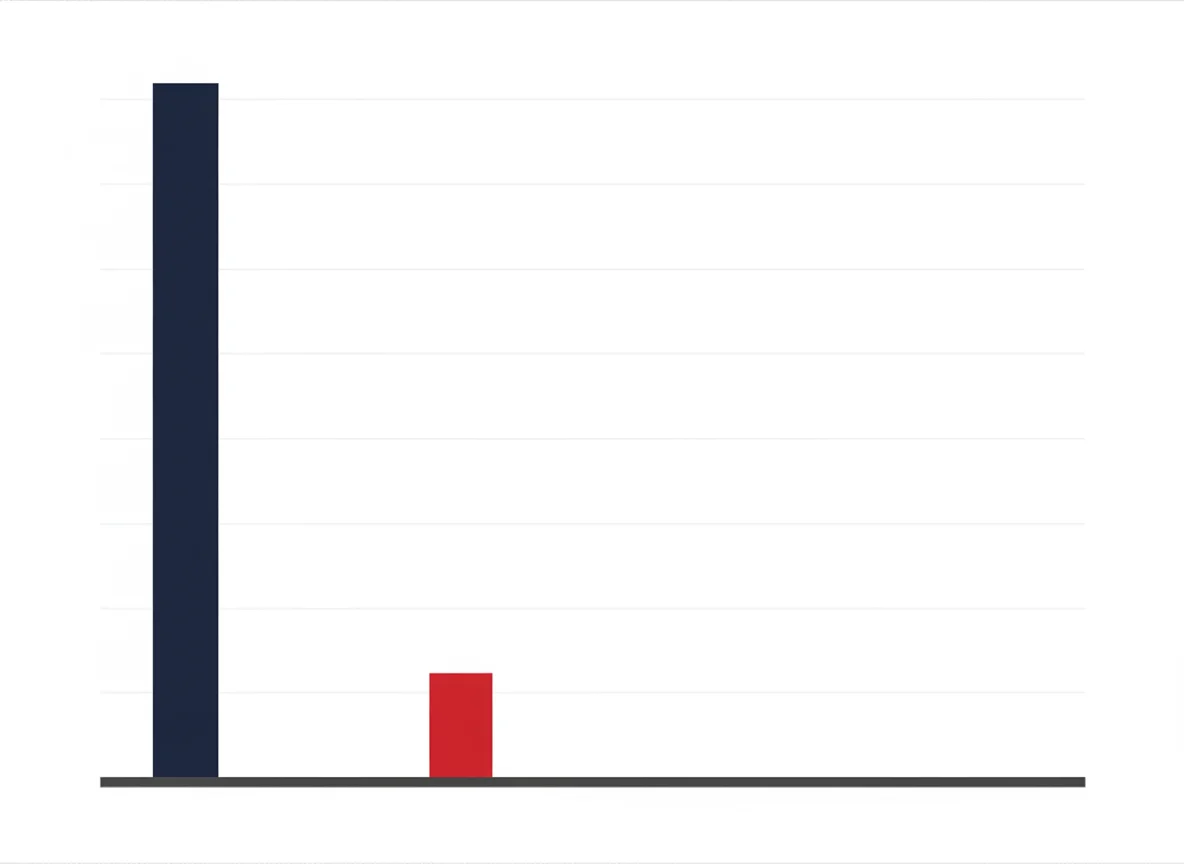
The asymmetry has an obvious mechanical explanation. A phone in an exam hall is caught by an invigilator standing in the room, in real time, with the device in hand as evidence — a detection method with a near-perfect evidentiary chain. AI use in coursework happens weeks earlier, off-site, unsupervised, and leaves behind only a finished document. One offence is caught by watching; the other has to be inferred after the fact from the text itself, which is precisely the inference every published evaluation of detection tools has found to be unreliable. Comparing the two counts tells you far more about the difficulty of detection than about the frequency of the behaviour.
None of this means the concern is misplaced — an offence committed at home in coursework is structurally harder to catch than a phone found in an exam hall, and the two categories are not comparable as measures of behaviour. It does mean that any claim that AI has become the defining integrity problem of school assessment is, on the published English evidence, not yet demonstrable. The consequences when a case is proven are a separate question, and one where the outcome data on AI cheating penalties is considerably richer at university level. Where cases have been contested formally, the record of AI detection lawsuits shows how much weight institutions have struggled to place on detector output alone.
4Why there is no AI trend line before 2024
Ofqual split plagiarism into “including the misuse of AI” and “excluding the misuse of AI” for the first time in 2024. Summer 2022 and 2023 are recorded as “[z] — not available”. Any percentage-rise claim about AI cheating in English schools cannot be sourced to Ofqual.
| Offence category | 2022 | 2023 | 2024 | 2025 |
|---|---|---|---|---|
| Plagiarism — misuse of AI | n/a | n/a | 85 | 100 |
| Plagiarism — excluding AI | n/a | n/a | 80 | 40 |
| Plagiarism — combined (old category) | 85 | 90 | n/a | n/a |
| Plagiarism, all forms | 85 | 90 | 165 | 140 |
| Source: Ofqual data tables, Table 4. “n/a” is Ofqual’s [z] marker: the offence was not available to report against that year. | ||||
That bottom row deserves more attention than it has had. Combined plagiarism did not explode when generative AI arrived — it went from 85 in 2022 to 90 in 2023 to 165 in 2024 and back down to 140 in 2025. Part of the 2024 jump is a reporting artefact: a single split category becomes two, and the act of creating an “AI” box gives markers somewhere specific to put suspicions they previously filed elsewhere. Some of what is being counted as a rise in AI cheating is at least partly a migration between boxes, and the honest version of this statistic says so.
5The regulator’s own letter contradicts the campaign material
In March 2026 Ofqual launched a coordinated push on AI in coursework: a letter to every exam board CEO and a briefing pack for school leaders. The letter concedes detected cases are low. The briefing pack quotes penalty numbers that are overwhelmingly not about AI.
On 2 March 2026, Chief Regulator Sir Ian Bauckham wrote to the chief executives of AQA, Cambridge OCR, Pearson and WJEC. On AI he was direct about the evidentiary position:
“Although the number of detected cases reported to Ofqual remains relatively low, there is significant concern among teachers, leaders and others about the real extent of AI misuse.”
He asked boards to strengthen “deterrence, detection and prevention measures”, specifically including “a more rigorous approach to candidate and teacher authentication of work”, and requested written responses by the end of March. That is a regulator being straight about the gap between what is measured and what is suspected.
The briefing pack sent to senior leadership teams tells heads to audit which qualifications carry non-examined assessment, brief staff on JCQ policy, and script conversations with students and parents. Its only quantitative claim is that in 2025 “penalties included 1,125 cases when students lost a whole GCSE or A level, and nearly 2,000 cases in which marks were deducted”. Both are true. Neither is an AI figure. A document about AI is carrying its persuasive weight on numbers that are, on Ofqual’s own data, about 98% not AI.
This is the same evidentiary problem that has played out in higher education, where policies written on the assumption that detection is reliable have repeatedly collided with what detectors can actually support — the reason a growing number of universities have dropped AI detectors entirely. It is also why the question of whether a detector score can be used as proof has become the pivot of almost every contested case.
6What the number does not measure
The 100 counts cases where a penalty was issued before the 12 November 2025 cut-off. Ongoing cases and cases closed without penalty are excluded. It is a floor on detected-and-proven misconduct, not an estimate of how much AI cheating happens.
| Methodological limit | Effect on the figure | Source |
|---|---|---|
| Data cut-off 12 November 2025 | Cases open at cut-off excluded (1.6% of reported cases) | Ofqual, Background information |
| No-penalty cases excluded | Investigations that cleared the student are not counted | Ofqual, Background information |
| Prior-year revisions discontinued from 2025 | The 2024 figure of 85 will not be updated | Ofqual, Background information |
| All values rounded to nearest 5 | Small board-level changes may be rounding | Ofqual, rounding policy |
| England only | Wales, Scotland and Northern Ireland reported separately | Ofqual, Scope of the release |
| Cases, not students | One case can involve several students or qualifications | Ofqual, Methods |
| Source: Ofqual, Background information for malpractice, summer 2025 exam series | ||
There is a second population this dataset cannot see at all: students who were accused, investigated and cleared, or accused informally by a teacher and never referred to a board. Nothing in the Ofqual collection records them, and their experience is the one that dominates student forums each August. If you are in that position, the evidence that carries weight is the record of how the work was produced — which is why document version history as proof of authorship and assembling an authorship packet before you submit matter far more than any detector percentage you can produce in your own defence.
Two further published findings bear on how much confidence a school-level accusation deserves. Detectors misfire, and they do not misfire randomly: the measured false positive rates across the major tools are non-trivial at the thresholds institutions actually use, and the misfires concentrate on writing by students whose first language is not English. In a national picture of 100 proven cases, the number of contested accusations that never reached an exam board is almost certainly the larger figure — and it is entirely unmeasured.
When the summer 2026 figures land in December, there are three ways to read them, and only one of them is sound. If the count rises sharply, the tempting story is that AI cheating has surged; the more likely driver is that the March 2026 push worked and boards are now looking harder, which raises detection without telling you anything about behaviour. If it stays flat, that is not reassurance either — flat detection under increased scrutiny is genuinely ambiguous. The only clean reading comes from watching the AI and non-AI plagiarism lines together: if the combined total moves while the split stays proportional, something real has changed. If the split shifts while the total holds, the change is in classification.
7What the national rate means for one school
Methodology
Every figure on this page was taken from Ofqual’s official statistics release Malpractice in GCSE, AS and A level: summer 2025 exam series, published 11 December 2025, and from the accompanying OpenDocument data tables. The AI-specific figures come from Table 4 (student malpractice cases by exam board and offence type), entry counts from Table 1, case totals from Table 3, and penalty types from Table 5. Derived values — the year-on-year change, the per-student ratio, the phone-to-AI multiple and the 2.0% share — are calculated from those published figures and labelled as calculations wherever they appear.
- Primary sources: Ofqual official statistics, Ofqual data tables (.ods), Ofqual Chief Regulator correspondence, Ofqual SLT briefing pack, Tes reporting of SQA data
- Data range: summer 2022 to summer 2025 exam series; policy documents to March 2026
- Geographic scope: England (GCSE, AS and A level). Scottish figures shown separately and are not additive
- Last verified: August 8, 2026
- Update schedule: refreshed when Ofqual publishes the summer 2026 series, expected around December 2026
- Known limitation: figures count penalised cases only, are rounded to the nearest 5, and exclude investigations that were ongoing or closed without penalty at the 12 November 2025 cut-off
Frequently Asked Questions
How many students were caught using AI in GCSEs and A levels?
100 cases of AI-related plagiarism resulted in a penalty across GCSE, AS and A level qualifications in England in summer 2025, up from 85 in summer 2024. That is out of 17,523,265 entries and 1,376,480 students with results issued.
Which exam board catches the most AI cheating?
AQA recorded the most in summer 2025 with 45 cases, followed by Pearson with 30, Cambridge OCR with 20 and WJEC with 5. AQA is also the largest board by a wide margin, with 10.3 million of the 17.5 million total entries, so the ranking largely tracks size rather than enforcement intensity.
Has AI cheating in UK schools gone up?
Confirmed penalised cases rose from 85 to 100 between summer 2024 and summer 2025. No longer trend can be sourced to Ofqual, because the AI category was only created in 2024 — summer 2022 and 2023 are recorded as not available.
What is the penalty for using AI in coursework?
Exam boards can issue a warning, deduct marks, or disqualify a student from a whole qualification. Across all offence types in summer 2025 there were 1,115 whole-qualification disqualifications, 1,925 component mark losses and 1,970 warnings. If you have been accused, the first 24 hours after an AI accusation matter more than any later stage.
Does 100 cases mean AI cheating is rare?
No. It means 100 cases were detected, proven and penalised before the November 2025 cut-off. Ofqual’s own Chief Regulator states that detected cases remain relatively low while concern about the real extent of misuse is significant. Treat the figure as a floor on proven misconduct, not as a prevalence estimate.
How does Scotland compare?
The SQA recorded 173 candidate malpractice breaches in 2024, up from 141 in 2023, of which 92 were plagiarism and 31 involved AI. It was the first year SQA reported AI separately, and the order of magnitude matches England’s — tens of cases, not thousands.
Is AI the most common form of exam cheating?
Not close. Mobile phones and other communication devices accounted for 2,225 cases in summer 2025, 44.3% of all student malpractice and 22 times the AI figure. Phones have been the most common offence type every summer since 2018.
When is the next set of figures published?
Around December 2026. The summer 2025 statistics were published on 11 December 2025, and the summer 2026 release will be the first able to show a genuine multi-year AI trend rather than a two-point comparison.
Sources & References
- Ofqual. “Malpractice in GCSE, AS and A level: summer 2025 exam series.” gov.uk. Published 11 December 2025. Accessed August 8, 2026.
- Ofqual. “Data tables for malpractice in GCSE, AS and A level: summer 2025 exam series” (ODS). assets.publishing.service.gov.uk. Accessed August 8, 2026.
- Ofqual. “Background information for malpractice in GCSE, AS and A level: summer 2025 exam series.” gov.uk. Accessed August 8, 2026.
- Sir Ian Bauckham CBE, Chief Regulator, Ofqual. “Letter to Exam Board CEOs, March 2026” (PDF). assets.publishing.service.gov.uk. Dated 2 March 2026. Accessed August 8, 2026.
- Ofqual. “SLT briefing pack: AI and coursework integrity v2.5” (PDF). assets.publishing.service.gov.uk. Accessed August 8, 2026.
- Tes. “SQA publishes first AI student plagiarism data.” tes.com. Accessed August 8, 2026.
- Ofqual. “Statistics: malpractice in GCSE, AS and A level” (collection). gov.uk. Accessed August 8, 2026.
- Joint Council for Qualifications. “AI Use in Assessments: Your role in protecting the integrity of qualifications.” jcq.org.uk. Accessed August 8, 2026.
Last updated: August 8, 2026. Next scheduled update: on publication of Ofqual’s summer 2026 malpractice statistics, expected December 2026.
