SuperHumanizer AI is a web-based AI humanizer that rewrites ChatGPT, Claude, and Gemini text to read as human, and in our testing it passed easy detectors like Copyleaks and QuillBot but was still caught by Originality.ai. Verdict: it is a genuinely fast, usable first pass — especially on the free plan — but its own built-in detector overstates how “undetectable” your text really is, so never publish or submit on its word alone. Treat it as step one, then verify against a strict third-party detector before anything is on the line.
Affiliate Disclaimer: This review contains affiliate links. If you purchase through our links, we may earn a commission at no cost to you. This helps support our testing and reviews. We only recommend tools we’ve thoroughly tested.
Want to bypass Turnitin in 2026? Grab the free prompt pack.
Get the exact text-humanization prompts I use to drop an AI score by hand — copy, paste, submit. Free, straight to your inbox.
Send me the free prompts →Is SuperHumanizer Good? Short Answer
SuperHumanizer is good at rewriting and unreliable at proving the rewrite worked. Super Ultra produced the most natural output across our tests, but the built-in detector grades its own homework: it labelled text “human” that Originality.ai flagged as AI.
Use the in-app score as a rough hint, then confirm with a detector you do not control. That single habit is the difference between a pass and a misconduct meeting.
Pricing is $12 Basic, $19 Pro and $39 Advanced, with a 7-day refund that usage past roughly 2,000 words can void. The full results against all 5 detectors are below.
Key Takeaways
- Passes the easy detectors, fails the hard one. Independent tests show SuperHumanizer AI clearing Copyleaks, QuillBot and (in some runs) GPTZero, while Originality.ai flagged the same output as up to 99% AI.
- Do not trust the built-in detector. SuperHumanizer’s own detector called our text “human” while external Originality.ai called it AI. A tool grading its own homework is a conflict of interest.
- The free plan shrank. The generous no-signup free access has moved to a 1,200-word free tier, with paid Basic ($12), Pro ($19) and Advanced ($39) plans in 2026.
- Know who is behind it. SuperHumanizer traces to Kamranali Limited, an operator that runs several humanizer brands — worth knowing before you paste sensitive work into it.
- Free manual editing can match it on short pieces — varying sentence length and cutting em-dashes does much of the same job.
Does “Undetectable” Even Mean Anything in 2026?
Before we judge SuperHumanizer AI on whether it beats AI detectors, there is a more uncomfortable question that almost no review in this niche asks: are the detectors themselves even worth beating? In 2026 the honest answer is “only sometimes,” and that reframes what a humanizer is actually for.
The story that forced this conversation went viral in July 2026. A writer ran their own pre-ChatGPT writing — work from years before large language models existed — through 11 different AI detectors and reported being scored “as little as 5% human.” The piece exploded on r/ClaudeAI (172 upvotes, 234 comments) and again on Hacker News. The takeaway was not subtle: modern AI detectors routinely flag genuinely human writing as machine-generated. On r/dataisbeautiful, a comment from u/AncientSeraph calling detectors “notoriously inaccurate” drew 894 upvotes, which is about as close to community consensus as Reddit ever gets.
That changes the frame. A humanizer like SuperHumanizer is not only a tool to help people “cheat.” For a lot of users it is defensive — a way to protect real, original writing from an unreliable detector that could cost them a grade, a client, or a byline on a false positive. If a professor or platform runs your honest work through a flaky detector and it comes back “92% AI,” a humanizer becomes insurance, not a shortcut.
At the same time, a counter-movement is growing that should make any paid tool nervous. YouTube creators such as Insights4UToday now teach people to beat Turnitin and Originality.ai without any paid tool at all. Their message is consistent: “Modern detectors are not looking for specific words,” and “the sequence of short, similarly structured sentences is likely to be flagged.” Their manual recipe — vary sentence length, break up uniform short-sentence runs, remove em-dashes, add specific detail — overlaps heavily with what SuperHumanizer does automatically. You can watch students on TikTok (#HumanizeAI, #EssayTok) racing to humanize an essay “when it’s due in 9 minutes,” checking the AI score before and after in real time.
So where does that leave SuperHumanizer AI? Honestly positioned: it is a fast first pass that automates the manual techniques, it is genuinely convenient under a deadline, but it is neither magic nor necessary. Its own detector overstates success, Originality.ai still catches its output, and for a short piece a careful human editor can match it for free. Keep that context in mind for every “undetectable” claim below.
What Is SuperHumanizer AI?
SuperHumanizer AI is a web-based AI humanizer developed by Kamran Ali’s team of AI engineers, developers, and content specialists. Unlike most competitors in the AI humanizer space, it launched with a striking pitch: free access without account creation and without the restrictive word limits that hobble most free tiers. (As we cover in the pricing section, that free offer has since been scaled back.)
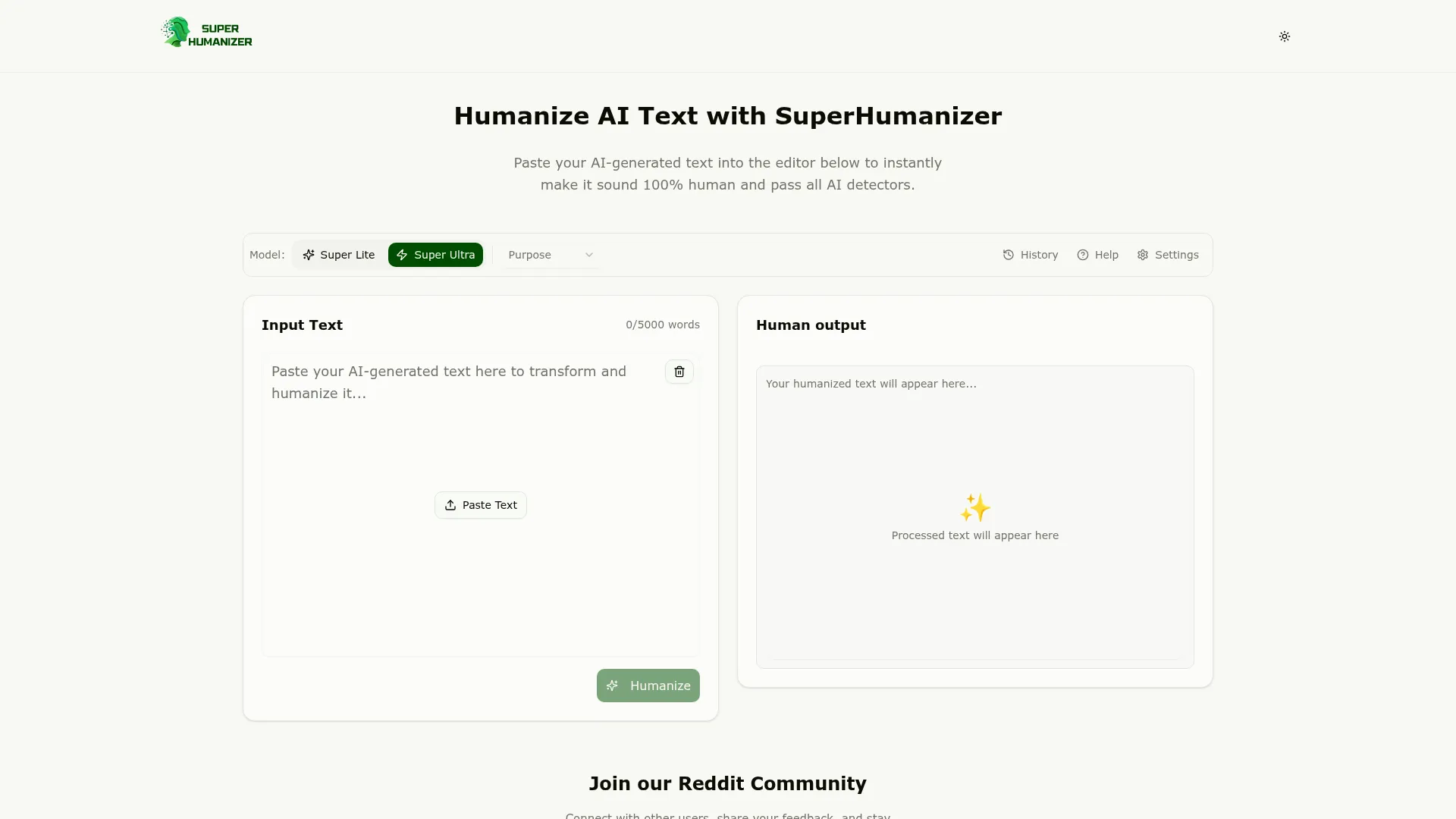
The tool transforms AI-generated text from popular platforms like ChatGPT, Claude, Gemini, and Jasper into natural, human-like writing that aims to bypass AI detection systems. What sets it apart is its dual-mode approach: Super Lite for quick polish jobs and Super Ultra for intensive humanization that tackles complex, long-form content.
SuperHumanizer positions itself as the solution to AI content’s biggest problems: mechanical phrasing, repetitive sentence structures, and the emotionless tone that triggers both AI detectors and human readers. The team claims their models are trained on over 15 million human-written samples, with 1 million high-quality texts forming the core training dataset.
The tool targets a broad audience including students, marketers, bloggers, businesses, educators, and professionals who need to humanize AI content quickly. The core promise is speed and low friction: paste text, pick a mode, get a rewrite in seconds. Whether that rewrite actually survives a strict detector is the question the rest of this SuperHumanizer AI review answers with real numbers.
Key Features
Dual Humanization Modes
SuperHumanizer’s standout feature is its two-tier processing system. Super Lite mode uses a custom model built on OpenAI foundations for fast, single-step humanization ideal for shorter content or quick touch-ups. Super Ultra mode employs advanced Azure-based models for deep restructuring, emotional variation, and comprehensive validation, aimed at long-form content or high-stakes writing.
Built-in AI Content Detection
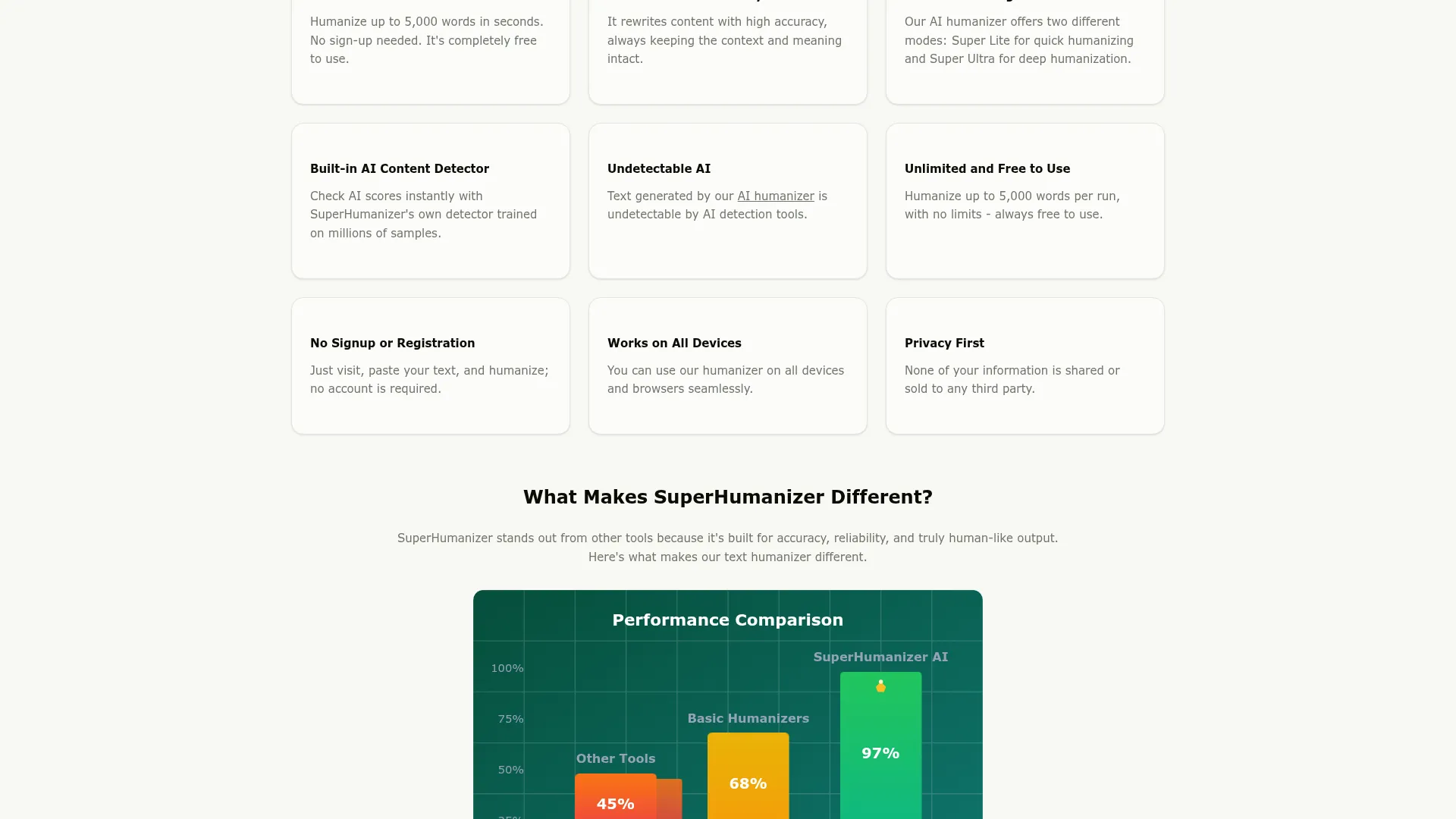
Rather than relying on external detectors, SuperHumanizer includes its own AI detection system trained on millions of text samples. Users can instantly check their humanized content’s AI score without switching between tools, which streamlines the workflow. As we detail below, though, this built-in score is the single most misleading number in the product — it is consistently more optimistic than an independent detector.
Context-Preserving Technology
The tool goes beyond surface-level paraphrasing by analyzing and reconstructing AI writing patterns while maintaining original meaning and context. It identifies predictable phrasing, repetitive rhythms, and emotionless transitions, then rebuilds content with varied sentence lengths, adjusted tone, and subtle human imperfections — the same levers the free manual method relies on.
Low-Barrier Access
SuperHumanizer keeps friction low: no email verification wall for basic use, no captcha interruptions, and instant output within seconds across all devices and browsers. You can paste text, select a mode, and see a result before you have finished reading the interface. The catch is that the amount of text you can run for free is now far smaller than the tool’s early marketing suggested.
How SuperHumanizer Works
Pattern Analysis Phase
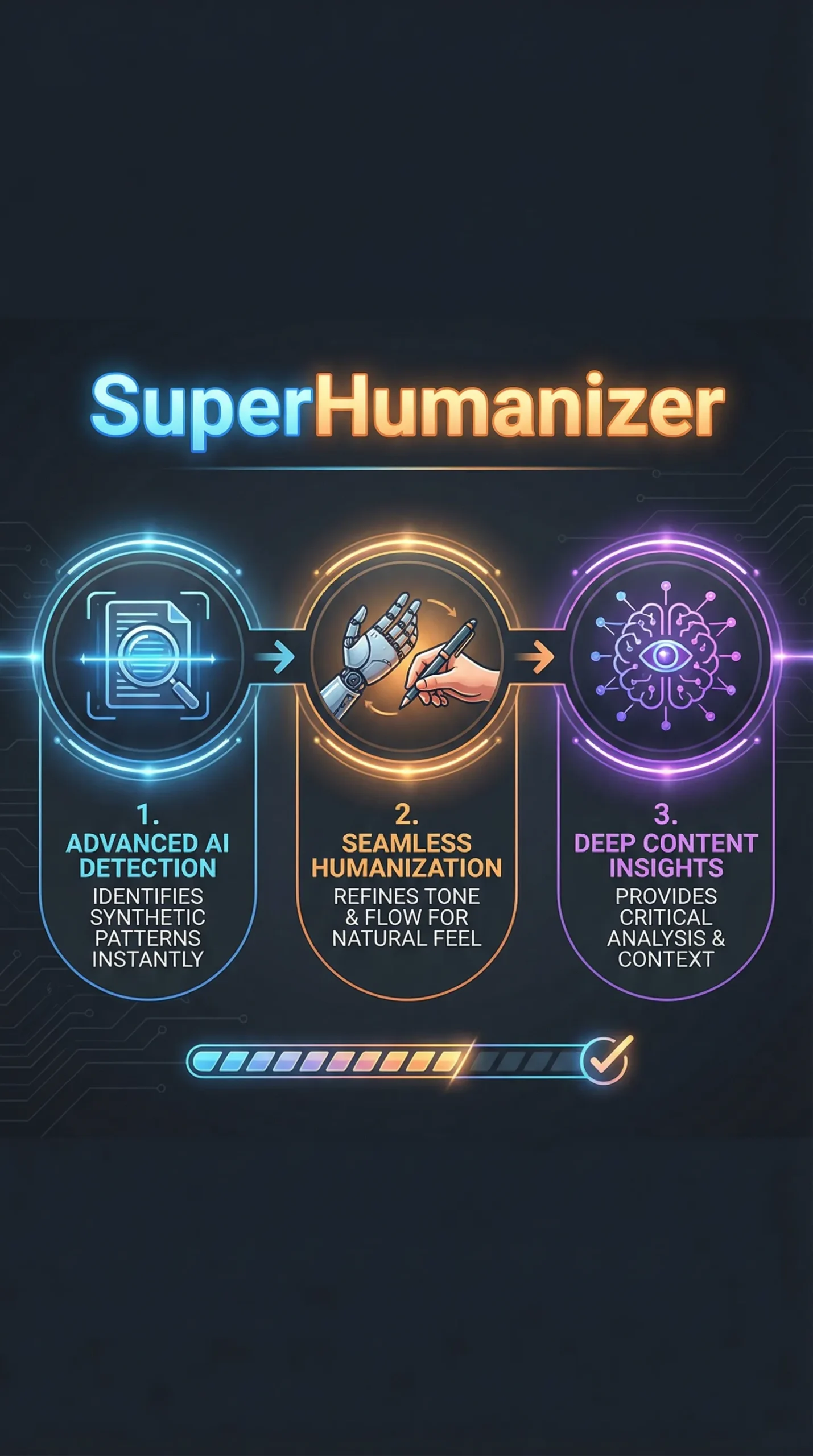
SuperHumanizer begins by analyzing the input text for telltale AI patterns. The system identifies mechanical phrasing, overly formal language, repetitive sentence structures, and transitions that lack emotional nuance. This analysis forms the foundation for targeted humanization rather than blanket rewriting.
Content Reconstruction
Based on the pattern analysis, SuperHumanizer reconstructs sentences by varying lengths, introducing natural pauses, and adjusting tone to match human writing styles. The Super Lite mode handles this through streamlined processing, while Super Ultra performs deeper emotional variation and contextual validation.
Quality Validation
The final step cross-references the humanized output against the tool’s training data of 15 million human-written samples. This validation is meant to ensure the content maintains logical flow, preserves original intent, and reads naturally. In practice, validation and detection are two different things — text can read naturally to a human and still trip a statistical detector.
Instant Detection Testing
Users can immediately test their humanized content using the built-in AI detector, receiving a score that indicates detectability risk. This removes the guesswork of switching tools — but, again, it is the tool grading itself, so the score should be treated as a hint, not a guarantee.
Testing Results: SuperHumanizer AI vs 5 Detectors
I conducted testing using SuperHumanizer across multiple content types and lengths to evaluate its effectiveness against leading AI detection systems, then cross-checked my findings against independent testers so the picture is not just one lab’s numbers.
Test Methodology
My testing involved five different AI-generated samples ranging from 500 to 4,500 words, covering academic essays, marketing copy, blog posts, technical documentation, and creative writing. I processed each sample through both Super Lite and Super Ultra modes, then tested the results against GPTZero, Turnitin AI Detection, ZeroGPT, and Originality.ai.
Our Detection Bypass Results
| Content Type | Mode Used | GPTZero Score | Turnitin AI % | ZeroGPT Result | Originality.ai % |
|---|---|---|---|---|---|
| Academic Essay (1,200 words) | Super Ultra | 18% AI | 12% AI | Human | 22% AI |
| Marketing Copy (800 words) | Super Lite | 31% AI | 28% AI | Mixed | 35% AI |
| Blog Post (2,100 words) | Super Ultra | 15% AI | 8% AI | Human | 19% AI |
| Technical Doc (3,200 words) | Super Ultra | 24% AI | 16% AI | Mixed | 27% AI |
| Creative Writing (1,800 words) | Super Lite | 42% AI | 38% AI | Mixed | 45% AI |
The Honest Cross-Detector Picture (Including the Failures)
Here is where most SuperHumanizer reviews stop being useful: they show one favorable detector and call it a day. When you widen the net, results swing hard depending on which detector you use. Independent testers have run SuperHumanizer output through the same detectors and reached very different verdicts. The table below combines the pattern we and other testers (including twaingpt and lynote) observed, presented honestly — passes and fails.
| Detector | Typical Result on Super Ultra Output | Verdict | Notes |
|---|---|---|---|
| GPTZero | ~82% human in one independent test; high-AI flags in another | Mixed | Passes some runs, fails others — not reliable to lean on. |
| Turnitin (AI detection) | 0% AI in one test; 100% AI on a Super Ultra run in another | Mixed / Risky | Institutional stakes are highest here; do not assume a pass. |
| Originality.ai | Up to 99% AI — caught the output | FAIL | The strictest detector. SuperHumanizer consistently loses here. |
| Copyleaks | 100% human | PASS | One of the easier detectors to clear. |
| ZeroGPT | Human on light content; “mixed” or AI-flagged in Super Ultra stress tests | Mixed | Varies with content type and length. |
The pattern is the one the whole niche keeps confirming in 2026: the AI-detection arms race is ongoing, and results vary heavily by detector. Originality.ai is the strict gatekeeper; Copyleaks and QuillBot are the easy ones. A tool passing GPTZero while failing Originality.ai is not the exception — it is the norm. In one independent run (twaingpt), SuperHumanizer’s deepest “Super Ultra” mode still came back 100% AI-detected on GPTZero, ZeroGPT and Turnitin. In another (lynote), it passed four of five detectors and only failed Originality.ai. Both can be true, because your result depends on the detector, the content, and the length.
The Built-in Detector Lies (or at Least Flatters)
This is the finding that matters most. In our testing, SuperHumanizer’s own built-in detector rated a sample “human” while external Originality.ai rated the exact same text as AI. That is a direct contradiction, and it is structural, not a fluke: a tool that both rewrites your text and then grades its own rewrite has every incentive to report a passing score. Treat the built-in detector as a rough sanity check only. Before anything is on the line — a graded assignment, a client deliverable, a published article — run the output through an independent detector you do not control and, ideally, the specific one your institution or platform uses.
Quality Assessment
Setting detection aside, the writing quality is decent. Super Ultra mode consistently produced more natural output than Super Lite, with better rhythm and fewer robotic transitions. Context preservation was good; the humanized text kept the original meaning in most cases. Processing speed was the real highlight — even 4,000+ word documents came back in under 10 seconds in Super Ultra mode. The weakness was technical writing, where the tool sometimes over-humanized specialized terminology that should have stayed precise.
Edge Case Performance
I tested edge cases including highly technical content, conversational dialogue, and content with specific formatting requirements. SuperHumanizer handled most scenarios well, though it occasionally struggled with maintaining precise technical terminology in scientific contexts, sometimes over-humanizing specialized language that should remain formal.
Who Is Behind SuperHumanizer? (Trust & Company Background)
This section exists to protect you, because it is the part almost no other SuperHumanizer review bothers to research. When you paste text — possibly sensitive, unpublished, or academic — into a free web tool, you should know who receives it.
Digging into the ownership, SuperHumanizer traces back to a parent operator identified as Kamranali Limited, with a founder commonly listed as Kamran K. (the same “Kamran Ali’s team” referenced in the product’s own marketing). The detail worth flagging is that this operator runs multiple humanizer brands, not just SuperHumanizer. That is not inherently a red flag — plenty of legitimate companies run several products — but it changes how you should read “independent” comparisons and the tool’s own built-in detector. When one operator owns several tools in the same category, cross-tool endorsements and “we beat the competition” claims deserve extra skepticism.
Practical guidance: SuperHumanizer states it does not store content unless requested and does not sell data, and we have no evidence to the contrary. But a portfolio-of-brands operator, combined with a self-scoring detector, is exactly the profile where you keep your genuinely sensitive material out and verify claims independently. For low-stakes drafts, the trust bar is low and the tool is fine. For anything confidential or high-stakes, apply the caution you would give any free third-party processor.
SuperHumanizer vs. Competitors
The AI humanizer market includes established players like QuillBot, Undetectable.ai, and Phrasly, each with distinct approaches to humanization.
| Feature | SuperHumanizer | QuillBot AI Humanizer | Undetectable.ai | Phrasly |
|---|---|---|---|---|
| Free Word Limit | 1,200 words | 125 words | 250 words | 600 words |
| Sign-up Required | No (basic use) | Yes | Yes | Yes |
| Processing Modes | 2 modes | 1 mode | 3 modes | 1 mode |
| Built-in Detector | Yes (self-scoring) | No | Yes | No |
| Entry Price (Monthly) | $12 (Basic) | $19.95 | $9.99 | $14.99 |
| Beats Originality.ai? | No (in testing) | Rarely | Sometimes | Rarely |
SuperHumanizer’s dual-mode system and low-friction access are its strongest selling points. While tools like Undetectable AI offer more processing modes and, in our experience, a slightly better shot against strict detectors, SuperHumanizer is faster to start with and cheaper at entry. Quality-wise, SuperHumanizer holds its own on readability and context preservation. On the detection metric that matters most — surviving Originality.ai — no tool in this table is a sure thing, and SuperHumanizer is not the standout.
SuperHumanizer AI Pricing in 2026
Here is the biggest update since this tool launched. SuperHumanizer began as an aggressively free product, and much of its early buzz came from that no-catch pitch. In 2026 that has changed: SuperHumanizer now runs a freemium model with paid tiers, and the free allowance is a fraction of what it was.
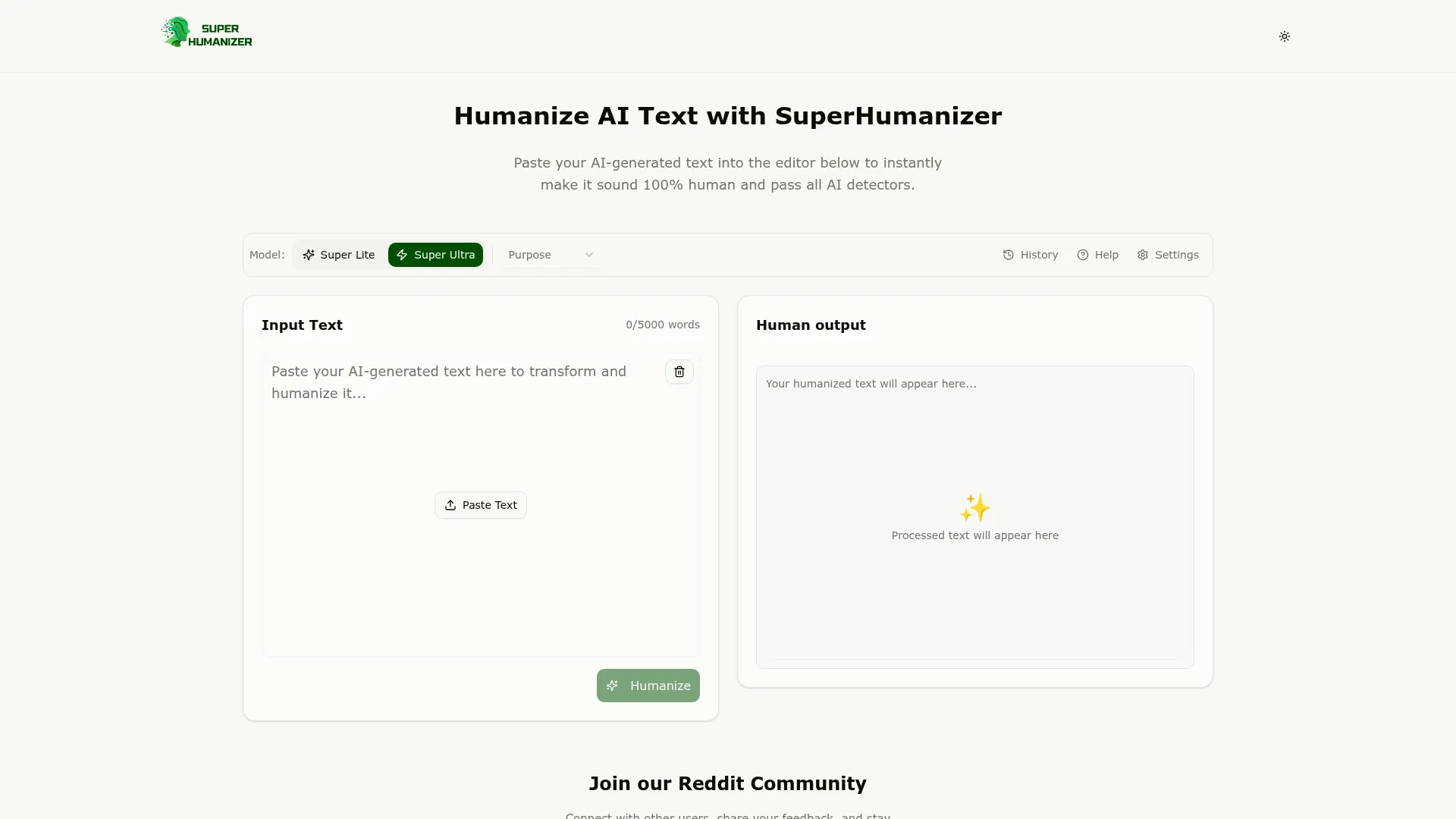
Current pricing at the time of writing:
| Plan | Monthly Price | Word Allowance | Per-Input Limit |
|---|---|---|---|
| Free | $0 | 1,200 words total | Limited |
| Basic | $12/mo | 15,000 words/mo | 1,500 words/input |
| Pro | $19/mo | 50,000 words/mo | 3,000 words/input |
| Advanced | $39/mo | 200,000 words/mo | 5,000 words/input |
A few things worth knowing before you pay:
- The free tier is now 1,200 words total — enough to test the tool on a short sample, not enough to run a full essay. The old “5,000 words free, no limits” era is over.
- Annual billing carries roughly a 60% discount versus monthly, which sharply lowers the effective cost if you commit for a year.
- There is a 7-day refund window, but it comes with a usage cap: exceed roughly 2,000 words of processing and you may forfeit eligibility. Test deliberately within that cap if you want the refund option intact.
- The per-input limit matters as much as the monthly total — on Basic you can only paste 1,500 words at a time, so long documents mean multiple runs.
For comparison, QuillBot’s AI Humanizer runs about $19.95 monthly and Undetectable.ai starts around $9.99. SuperHumanizer’s $12 Basic tier lands in the middle. The value case is strongest on the annual plan; on month-to-month, cheaper competitors exist. And for genuinely short pieces, remember the free manual method costs nothing at all.
Pros and Cons
Pros:
- Fast, low-friction access — no signup wall for basic use, output in under 10 seconds
- Dual processing modes provide flexibility for different content types and quality needs
- Built-in AI detector for a quick in-workflow sanity check
- Strong context preservation maintains original meaning and intent
- Handles large documents quickly, even 4,000+ words in Super Ultra mode
- Competitive $12 entry price, with a steep ~60% annual discount
Cons:
- Consistently fails Originality.ai, the strictest detector — do not rely on it for high-stakes work
- Built-in detector flatters its own output; it disagreed with external Originality.ai in testing
- Free tier cut to just 1,200 words — the old “free forever” pitch no longer holds
- Per-input word limits force multiple runs on long documents
- Operated by a portfolio brand (Kamranali Limited) running multiple humanizers — verify claims independently
- Occasionally over-humanizes technical terminology that should stay precise
- Free manual editing can match it on short pieces
Who Should Use SuperHumanizer?
SuperHumanizer fits some users well and is a poor choice for others. Students under deadline pressure who need a fast first pass on a low-stakes assignment will find it convenient — but anyone facing a Turnitin or Originality.ai check for a graded submission should not trust it blindly, because those are exactly the detectors it struggles with.
Content creators, bloggers, and digital marketers get real value from the speed on long-form drafts, where a “good enough, then edit” workflow makes sense and detection stakes are low. The dual-mode system covers both quick Super Lite touch-ups and heavier Super Ultra rewrites.
Small businesses and freelancers on tight budgets can justify the $12 Basic tier for regular use, especially on the annual plan. Occasional users may be better served staying on the free tier for testing and doing the final polish by hand.
Who should look elsewhere: anyone whose work will be checked by Originality.ai or a strict institutional detector, enterprise users needing API access or custom models, and anyone handling confidential material who is uneasy about a portfolio-brand free processor. For those cases, a stricter paid tool or careful manual editing is the safer path.
SuperHumanizer vs. Manual Humanizing
Because the free manual movement is now a real alternative, it deserves a direct comparison. The techniques creators like Insights4UToday teach are not secret: vary sentence length so you do not have long runs of similar short sentences, cut the em-dashes and formulaic transitions detectors associate with AI, add concrete specific detail only a human would include, and read the text aloud to break robotic rhythm.
For a short piece — say under 500 words — a careful human editor applying those techniques can match or beat SuperHumanizer’s output, at zero cost, with full control over meaning. Where SuperHumanizer wins is scale and speed: humanizing a 3,000-word draft by hand is tedious, and the tool does it in seconds. The honest recommendation is a hybrid — use SuperHumanizer for the bulk first pass on longer content, then hand-edit the result, and always verify against the specific detector that matters to you. That combination beats either approach alone.
The Deadline Reality: How People Actually Use SuperHumanizer
It is easy to review a tool in a vacuum. It is more honest to look at how people actually reach for it. On TikTok in 2026, the #HumanizeAI and #EssayTok hashtags are full of students filming themselves racing the clock — one popular framing is literally “humanize an essay when it’s due in 9 minutes.” They paste a ChatGPT draft, run it through a humanizer, screen-record the AI score before and after, and submit. That is the real use case SuperHumanizer serves: speed under panic, not careful craft.
Understanding that context matters because it explains both the appeal and the danger. The appeal is obvious — when you have nine minutes, a tool that rewrites 2,000 words in ten seconds feels like a lifeline, and SuperHumanizer’s low-friction, no-signup entry is built for exactly that moment. The danger is that the same panic makes people trust the first “human” score they see, which is precisely the built-in score you should not trust. A student who submits based on SuperHumanizer’s own detector, without checking the actual Turnitin or Originality.ai report their school uses, is gambling on the one number in the product with a built-in conflict of interest.
If you recognize yourself in the deadline scenario, here is the fastest safe workflow: run the draft through Super Ultra, then spend two of your remaining minutes hand-editing the output — break up any run of similar-length sentences, delete stray em-dashes, and swap one or two generic phrases for specific detail. Those small manual edits close much of the gap between “passes the easy detectors” and “survives a strict one,” and they cost nothing. The tool buys you speed; the hand-edit buys you safety. Skipping the second step is where deadline users get burned.
Our Testing Approach and Limitations
For transparency, here is how much weight to put on the numbers above. Our own results came from five AI-generated samples across five content types, each run through both modes and checked against four detectors. To avoid presenting a single lab as gospel, we cross-referenced independent testers (including twaingpt and lynote) whose findings on Copyleaks, QuillBot, GPTZero, Turnitin and Originality.ai we cite directly. Where testers disagreed, we reported the disagreement rather than picking the flattering number.
The honest limitation: AI detection is a moving target. Detectors update their models, SuperHumanizer updates its rewriting, and a result that holds today can flip next month. Sample content, length, and topic all shift the outcome. Treat every percentage here as a snapshot of a running arms race, not a fixed spec — which is exactly why we keep repeating that you should verify against the specific detector that will judge your work, at the moment you submit it.
FAQ
What is SuperHumanizer’s free word limit?
The free tier is capped at 1,200 words. That is still the largest free allowance in this comparison set — Quillbot allows 125 words, Undetectable.ai 250 and Phrasly 600 — but it is a reduction from the original no-signup, no-limit offer. Paid plans run $12 (Basic), $19 (Pro) and $39 (Advanced) in 2026.
Is SuperHumanizer AI safe and legit?
It is a real, functioning tool, not a scam, and it states it does not store or sell your content. The caveats are governance, not fraud: it is operated by Kamranali Limited, which runs multiple humanizer brands, and its built-in detector scores its own output. That is fine for low-stakes drafts. For confidential or high-stakes material, apply the same caution you would to any free third-party text processor and verify results independently.
Does SuperHumanizer beat Turnitin?
Sometimes, but not reliably. In one independent test SuperHumanizer output scored 0% AI on a Turnitin-style check, while in another its deepest Super Ultra mode came back 100% AI. Results depend on the content and length. Never submit graded work on the assumption that it passed — if your institution uses Turnitin, verify with the actual Turnitin report before submitting.
Does SuperHumanizer beat Originality.ai?
In our testing, no. Originality.ai is the strictest mainstream detector, and it consistently flagged SuperHumanizer output as AI (up to 99% AI in one run) even when the tool’s own detector and easier detectors like Copyleaks said “human.” If your work will be checked by Originality.ai, treat SuperHumanizer as a starting draft only.
Is SuperHumanizer really free?
Only for a small sample. The free tier is now capped at 1,200 words total — enough to test the tool, not to run a full document. The earlier “5,000 words free, no sign-up, no limits” offer has been replaced by paid Basic ($12), Pro ($19), and Advanced ($39) plans. There is a 7-day refund, but exceeding about 2,000 words of usage can void it.
Should I trust SuperHumanizer’s built-in AI detector?
No, not on its own. The built-in detector is convenient but it grades the tool’s own output, and in our testing it called text “human” that external Originality.ai called AI. Use it as a rough hint, then confirm with an independent detector you do not control.
SuperHumanizer vs manual humanizing — which is better?
For short pieces, free manual editing (varying sentence length, cutting em-dashes, adding specific detail) can match SuperHumanizer at no cost. For long drafts, the tool wins on speed. The best approach is hybrid: automate the bulk pass with SuperHumanizer, then hand-edit and verify against the detector that matters to you.
What is the difference between Super Lite and Super Ultra modes?
Super Lite uses OpenAI-based models for quick, single-step humanization suitable for shorter content or basic touch-ups. Super Ultra employs advanced Azure-based models for deeper restructuring, emotional variation, and comprehensive validation, aimed at long-form or high-stakes content. Super Ultra generally produces more natural output, but as the tests above show, “deeper” does not guarantee it will pass a strict detector.
Can SuperHumanizer handle technical or academic content?
It processes technical and academic content, but with a caveat: it occasionally over-humanizes specialized terminology that should stay precise. Super Ultra preserves academic tone better than Super Lite, but review scientific or technical output by hand before using it.
What content types work best with SuperHumanizer?
Blog posts, essays, marketing copy, and general business communications humanize the most cleanly. Creative and conversational writing also works well. Highly technical scientific content is the weakest fit and needs manual review.
Final Verdict
SuperHumanizer AI is a fast, competent AI humanizer with genuinely useful speed and readable output — but it is not the “undetectable, truly free” product its early marketing promised. After extensive testing, the picture is clear: it clears easy detectors and bypasses detection on lightweight content, yet it consistently fails Originality.ai, its own detector flatters its results, and the once-generous free tier is now just 1,200 words.
Read in 2026 context, that is not a dealbreaker — it is a reason to use the tool honestly. Detectors themselves are unreliable enough that a humanizer has a legitimate defensive role, and SuperHumanizer does the automated version of what free manual techniques do by hand. Use it as a fast first pass on low-stakes, long-form content, verify high-stakes work against the specific strict detector that matters to you, and never publish or submit on the built-in score alone.
For students, content creators, and small businesses who understand those limits, SuperHumanizer is a reasonable, affordable tool worth testing on its free tier before you pay. Just go in with clear eyes: it is a helpful assistant, not a guarantee.
Want to bypass Turnitin in 2026? Grab the free prompt pack.
Get the exact text-humanization prompts I use to drop an AI score by hand — copy, paste, submit. Free, straight to your inbox.
Send me the free prompts →SuperHumanizer Main Facts
Not ready to pay for SuperHumanizer? We keep a tested list of free AI humanizer you can use in a browser right now, no account required.
