Literary Prizes and AI: Every Award Pulled, Cleared or Questioned (2026)
Source: Originality.ai (2026)
KEY TAKEAWAYS
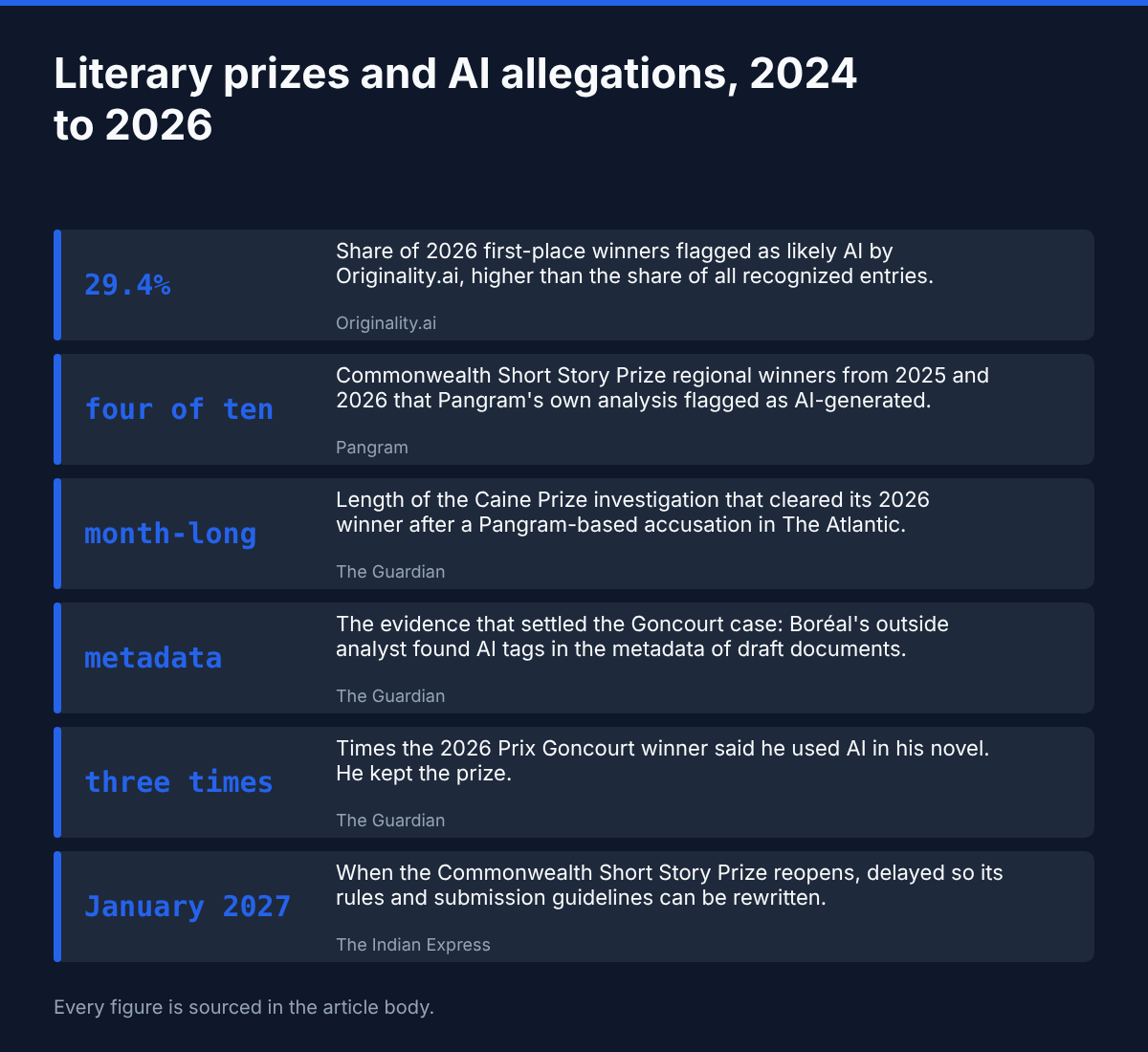
- → 29.4% Share of 2026 first-place winners flagged as likely AI by Originality.ai, higher than the share of all recognized entries. (Originality.ai, 2026)
- → four of ten Commonwealth Short Story Prize regional winners from 2025 and 2026 that Pangram's own analysis flagged as AI-generated. (Pangram, 2026)
- → month-long Length of the Caine Prize investigation that cleared its 2026 winner after a Pangram-based accusation in The Atlantic. (The Guardian, 2026)
- → metadata The evidence that settled the Goncourt case: Boréal's outside analyst found AI tags in the metadata of draft documents. (The Guardian, 2026)
- → three times Times the 2026 Prix Goncourt winner said he used AI in his novel. He kept the prize. (The Guardian, 2026)
- → January 2027 When the Commonwealth Short Story Prize reopens, delayed so its rules and submission guidelines can be rewritten. (The Indian Express, 2026)
This was the year the AI detector walked into the prize ceremony. A short story crowned by the Commonwealth Foundation, the winner of Africa’s best known short fiction award and a bestselling longlisted novel in France were all accused of being machine-written within months of each other. In almost every case the accusation did not come from the judges. It came from a reader, a journalist or a detector vendor who pasted the published text into a tool and posted the score.
The scale of the suspicion is now measurable. 26.5% of the stories and essays recognized by 20 writing competitions in 2026 were flagged as likely AI-written by Originality.ai's own detector, up from zero in 2020. (Originality.ai, 2026) That is a vendor running its own product, so it is a signal rather than a verdict, but it explains why every prize administrator in fiction is now asking the same question: when a score says a winner is AI, what counts as proof either way?
This page answers that with a case register. It lists every prize and contest we could document where a winner or finalist was pulled, cleared or questioned over AI, records which detector started it, and shows what evidence actually closed each case. The short version: detector scores opened every file, and drafts closed them.
1 How Many Award-Winning Entries Get Flagged as AI? About One in Four
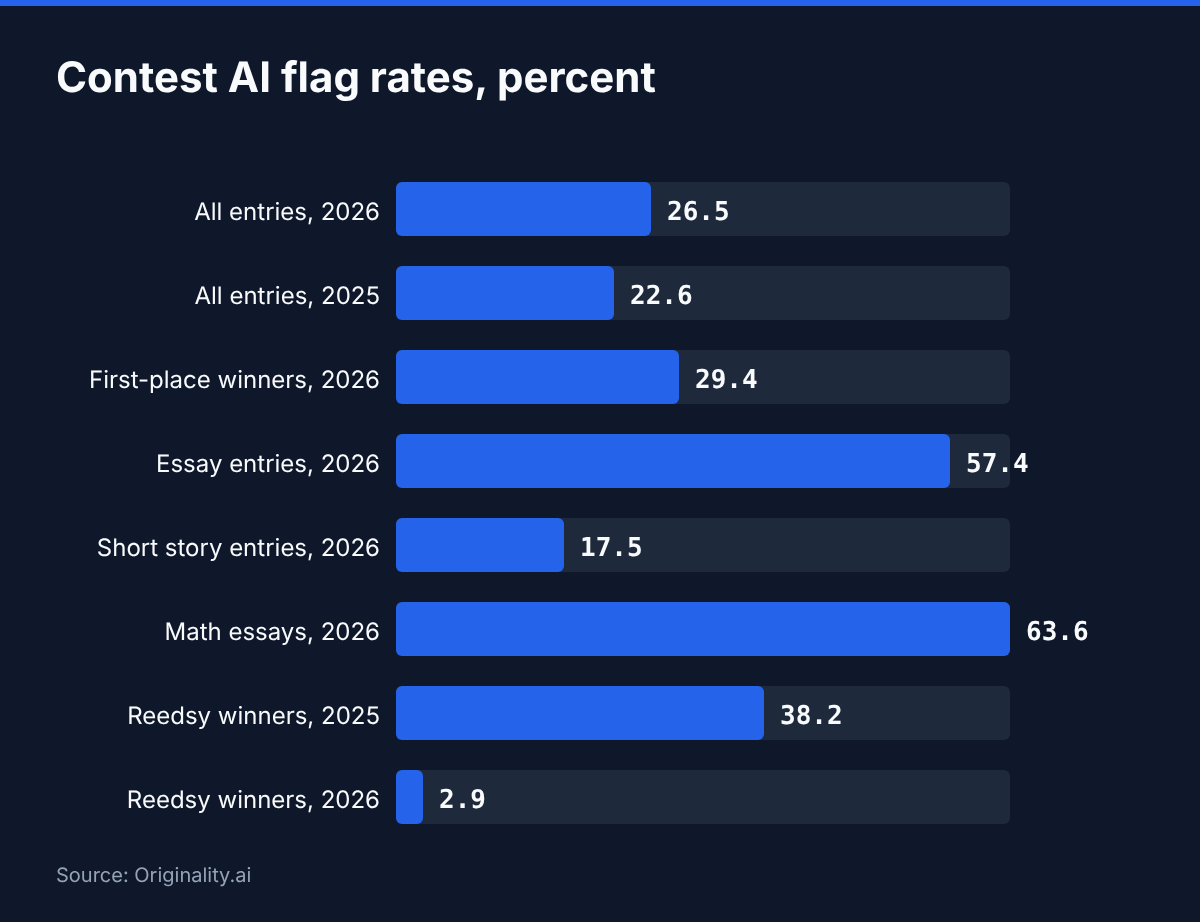
Originality.ai scanned 1,493 recognized stories and essays from twenty competitions and flagged 26.5% of this year’s entries as likely AI, up from 22.6% the year before. First-place winners were flagged more often, at 29.4%. Essays were flagged at 57.4%, short fiction at 17.5%. (Originality.ai, 2026)
| METRIC | VALUE | SOURCE |
|---|---|---|
| Recognized entries flagged, this year | 26.5% | Originality.ai |
| Recognized entries flagged, last year | 22.6% | Originality.ai |
| First-place winners flagged, this year | 29.4% | Originality.ai |
| Essay competition entries flagged | 57.4% | Originality.ai |
| Short story competition entries flagged | 17.5% | Originality.ai |
| Association for Women in Mathematics essays flagged | 63.6% | Originality.ai |
| Entries scanned in the study | 1,493 | Originality.ai |
Two things make these figures worth reading carefully. The first is who produced them. Originality.ai sells the detector it used, counted any text scoring at its fifty percent confidence line as likely AI, and did not contact a single author. The second is where the flags cluster. The Jane Austen Society of North America drew 675 essay submissions this year, and the vendor flagged most of its published winners. Student essay contests, where the writers are teenagers and the prose is formal and tidy, are exactly where detector false positives are most often reported.
The study also shows that rules can move the numbers. Reedsy, which bans generative AI for drafting or revising its weekly contest entries, went from 38.2% of winners flagged in the first eight months of last year to 2.9% in the same stretch this year (Originality.ai, 2026). The opposite case is Kingsmead’s Young Writers’ Competition in South Africa, which says it disqualified entries that failed its AI tests and still had 19.1% of its recognized entries flagged. Two vendors, two detectors and two methods rarely agree, which is the point our Pangram versus Originality.ai comparison keeps coming back to.
2 Which Prizes Faced AI Allegations, and What Happened to Each Winner?
Six prizes faced public AI controversies over a winner or finalist since the Akutagawa disclosure. Only the Prix Goncourt removed a book over its writing. Most accused winners kept their awards, and two winners who admitted using AI, at the Akutagawa and the Goncourt, kept theirs too. (The Guardian, 2026)
| METRIC | VALUE | SOURCE |
|---|---|---|
| Commonwealth regional winners Pangram flagged, two years | four of ten | Pangram |
| Commonwealth winners suspected by readers this year | Three of five | WIRED |
| Pangram score on the Commonwealth Caribbean winner | 100 percent | WIRED |
| Pangram AI fraction on the previous overall Commonwealth winner | 88% | Pangram |
| Date the Goncourt allegation appeared on X | 21 September | The Guardian |
| Pangram probability reported for the withdrawn Goncourt novel | 100% | The Guardian |
| Caine Prize winner announced | 6 October | The Guardian |
| AI share disclosed by the Akutagawa winner | 5% | CNN |
| Times the Goncourt winner says he used AI | three times | The Guardian |
| AlphaPolis award kept while deals were cancelled | Grand Prize | Dexerto |
Read down the register and a pattern appears. The Commonwealth Short Story Prize case started when a writer on X quoted the opening of The Serpent in the Grove and another user ran it through Pangram, which scored it 100 percent AI (WIRED, 2026). Pangram then ran the prize’s whole archive and reported that four of ten recent regional winners showed strong signs of AI, including the previous year’s overall winner at 88%. The Caine Prize case began the same way: its winner was announced on 6 October, and five days later The Atlantic published a piece built on a Pangram result. If you want to understand why one tool keeps appearing, our Pangram review covers how it scores and where it has been tested.
The outcomes split by what happened next. The Goncourt academy removed Thélyson Orélien’s novel after the allegation surfaced on 21 September and separate plagiarism findings landed in French media. Japan’s AlphaPolis left its Grand Prize winner on the list but cancelled the book and manga deals once it judged the novel largely AI-generated (Dexerto, 2026). Meanwhile Rie Qudan disclosed that about 5% of her Akutagawa winner was generated word for word (CNN, 2024), and this year’s Goncourt winner told French radio he used AI three times. Both kept their prizes. Disclosure, it turns out, has protected writers far better than denial.
3 What Evidence Actually Decided Each Case? Drafts, Not Scores
None of the prizes in the register says it acted on a detector score alone. The Commonwealth Foundation reviewed drafts, time-stamped documents and notes from all five regional winners. The Caine Prize ran a month-long investigation with expert metadata analysis. Boréal confirmed AI use only after an outside analyst found AI tags in draft metadata. (The Guardian, 2026)
| METRIC | VALUE | SOURCE |
|---|---|---|
| Writers who entered the Commonwealth prize | 7,800 | Commonwealth Foundation |
| Readers per winning Commonwealth story | at least seven people | Commonwealth Foundation |
| Drafts the Commonwealth winner says he wrote | six or seven drafts | The Guardian |
| Length of the Caine Prize investigation | month-long | The Guardian |
| Evidence Boréal cited to confirm AI use | metadata | The Guardian |
The Commonwealth Foundation, which received entries from more than 7,800 writers and has every winning story read by at least seven people, said it would not run unpublished work through AI tools at all, and that such tools cannot provide conclusive evidence on their own (Commonwealth Foundation, 2026). Instead it interviewed the winners and examined their working files. Jamir Nazir described writing six or seven drafts of his story on a phone with speech-to-text software, perfecting a few lines at a time, which he said is why it reads as highly polished (The Guardian, 2026). That is the kind of process record our guide to what writing-process trackers actually prove argues is worth more than any single score.
The Goncourt file shows the same principle working in the other direction. Orélien denied using AI, and his Canadian publisher initially stood by him. It then gathered every working version of the novel and hired an outside party, whose analysis found traces of AI tags in the document metadata (The Guardian, 2026). Boréal ended its relationship with the author while admitting it would likely never know how much AI was used. Across the register, two of the three draft-level investigations cleared the writer and one confirmed AI use, while the detector had called all three cases the same way. Writers who expect scrutiny can get ahead of it by keeping an authorship packet before they ever submit.
4 Who Gets Accused? The Pattern Prize Bodies Are Now Naming
The three most publicised detector-based challenges this year targeted writers from Trinidad, Zimbabwe and Haiti, though sleuths also flagged Maltese and Indian-origin Commonwealth winners. The Commonwealth Foundation’s director-general said writers outside the expected mould are suspected first. The French winner who openly used AI three times kept the Goncourt. (The Guardian, 2026)
| METRIC | VALUE | SOURCE |
|---|---|---|
| Commonwealth winners suspected by readers | Three of five | WIRED |
| Pangram score on the Commonwealth Caribbean winner | 100 percent | WIRED |
| Caine Prize award | £10,000 | The Guardian |
| Times the Goncourt winner says he used AI | three times | The Guardian |
This is the part of the story the detector numbers cannot see. The Commonwealth Foundation’s director-general, Razmi Farook, told The Guardian that the machine’s default voice is the metropolitan one, so a writer from Kingston or Kigali who does not sound like it is the first to be suspected (The Guardian, 2026). When the Caine Prize winner Simbarashe Kundizeza was accused, a Zimbabwean novelist called it literary stop-and-frisk, a Nigerian publisher said such allegations were targeting Black and African writers, and the prize chair criticised The Atlantic for publishing before any human investigation (The Guardian, 2026). Those are claims about a pattern, not a measured bias rate, and nobody has yet published one for fiction.
There is research on the underlying mechanism, though, and it points the same way. Detectors trained mostly on standard English have repeatedly scored non-native and stylistically distinctive writing as machine-like, which we track in our research summary on detector bias against ESL writers. A lyrical Caribbean narrator, a Haitian Creole rhythm or a heavily revised voice can trip the same statistical wires. The irony the register records is that the only winner this year who said plainly that he used AI was a Paris novelist, and his prize was never in doubt.
5 What Is at Stake: Prize Money, Book Deals and Translation Rights
The awards themselves are modest, from £2,500 for a Commonwealth regional win to £10,000 for the Caine. The real losses sit downstream: the withdrawn Goncourt novel had sold about 35,000 copies with rights sold to more than 20 countries, and Hachette pulled Shy Girl from shelves entirely. (The Guardian, 2026)
| METRIC | VALUE | SOURCE |
|---|---|---|
| Commonwealth regional prize | £2,500 | WIRED |
| Commonwealth overall prize | £5,000 | WIRED |
| Caine Prize award | £10,000 | The Guardian |
| Caine Prize award in US dollars | $13,000 | BBC News |
| Copies sold by the withdrawn Goncourt novel | 35,000 | The Guardian |
| Translation rights sold for that novel | more than 20 countries | The Guardian |
| Ockham fiction prize two books were disqualified from | NZ$65,000 | The Guardian |
| UK print copies of Shy Girl before withdrawal | 1,800 | The Guardian |
| Views on the video calling Shy Girl AI slop | 1.2m | The Guardian |
Prize money is rarely the point. A Commonwealth regional winner receives £2,500 and the overall winner a further £5,000 (WIRED, 2026). What an accusation threatens is the career that follows. Orélien’s novel had won the Fnac prize and was due out in more than twenty languages before the academy acted, and its publisher has since dropped him. In New Zealand the Ockham awards ruled two acclaimed books out of a NZ$65,000 fiction prize because their publisher’s designers had used AI on the covers, a rule the organisers amended in August, after, the publisher said, the covers had already been designed (The Guardian, 2025). The ban on those two books was later relaxed, but the story the authors were asked about for weeks was the cover, not the writing.
Commercial publishing has moved faster than the prizes. Hachette withdrew Mia Ballard’s Shy Girl after readers on Goodreads, Reddit and YouTube argued its prose looked machine-made; the book had sold about 1,800 print copies in the UK, while one video calling it AI slop passed 1.2m views (The Guardian, 2026). Ballard said someone she hired for an earlier self-published edition used AI tools. The same crowd-sourced dynamic now runs on blogging platforms, which is why we documented how Substack's Pangram check works, and in visual art, where image detectors misfire on human work.
6 How Contests Are Rewriting Their AI Rules for Next Year
Prize bodies are responding in three ways: pausing to rewrite rules, as the Commonwealth prize did until January 2027; cutting ties, as Granta did by ending external publishing partnerships; and opening separate lanes, like the new Prix Pascal for AI co-written manuscripts of between 10,000 and 50,000 words. (The Indian Express, 2026)
| METRIC | VALUE | SOURCE |
|---|---|---|
| Commonwealth prize reopens | January 2027 | The Indian Express |
| Granta had published Commonwealth winners | since 2012 | WIRED |
| What Granta stopped doing | external publishing partnerships | The Guardian |
| Prix Pascal manuscript length | 10,000 and 50,000 words | The Guardian |
| Reedsy weekly winners flagged after its AI ban, this year | 2.9% | Originality.ai |
The Commonwealth Foundation upheld its winners but conceded the episode showed staff, entrants, readers and judges needed to be better equipped, and pushed the next prize opening back to January 2027 so it could review its processes, entry rules and submission guidelines (The Indian Express, 2026). Granta, which had hosted the winning stories since 2012, decided it would no longer take part in external publishing partnerships where it had no editorial control (The Guardian, 2026). In France the response went the other way: tech entrepreneurs launched the Prix Pascal, which asks entrants to name the model and prompt they used (The Guardian, 2026).
For writers, the practical lesson from the register is consistent. Read the contest’s AI clause before you enter, because some now ban AI for revision as well as drafting. Keep dated drafts and notes, because they are what every investigation asked for. And if a detector score is posted about your work, respond with process evidence rather than a counter-score; our step-by-step guide to what to do in the first day after an AI accusation applies to prize entrants as much as students. For a sense of how other institutions are writing enforcement rules, see how publishers and literary agents use AI detectors and how Wikipedia enforces its AI rules.
Explore every figure in this article
Methodology
We built this register from news reporting, prize statements and two detector-vendor studies published between January 2024 and November 2026, opening every source and checking each figure against the page. A case enters the register only when a named prize, contest or publisher took a documented action or issued a statement after a public AI allegation. Detector percentages come from Pangram and Originality.ai testing their own products and are reported as detector signals, never as proof of AI use. The Atlantic’s Caine Prize article and The Bookseller’s Ink Book Prize report could not be read in full and are described only through outlets that quoted them; the Ink case is therefore left out of the table. Demand for this page was measured from Reddit threads in writing and books communities, which we treat as evidence of interest, not as fact. In the research pipeline, DataForSEO returned redirect links for search results, so result pages were re-read through a second search provider, and the existence check against this site returned NEAR on word collisions and was cleared by a human editor.
- Sources consulted: 31
- Sources cited: 17
- Data freshness: current year: 15, last year: 1, older: 1
- Data range: 2024-01-19 to 2026-11-23
- Research date: 2026-11-23
- Update schedule: Monthly while prize cases are open
- Limitations: Detector flag rates come from two detector vendors (Originality.ai, Pangram) testing their own products; they are signals, not findings of AI use. The Bookseller's Ink Book Prize report and The Atlantic's Caine Prize article were paywalled or blocked and are described only through outlets that quoted them. Cases are limited to those reported in English-language media.
Frequently Asked Questions
Has a literary prize ever been taken away because of AI?
Yes, in a few forms. The Académie Goncourt removed Thélyson Orélien's novel from its 2026 longlist after a Pangram scan and plagiarism findings, and Japan's AlphaPolis kept its Grand Prize winner on the list but cancelled the book and manga deals. Most other accused winners, including at the Commonwealth and Caine prizes, kept their awards after reviews. (Dexerto, 2026)
How many writing competition winners are flagged as AI?
Originality.ai scanned 1,493 recognized stories and essays from 20 competitions and flagged 26.5% of the 2026 entries as likely AI, with essays flagged far more often than fiction. It is a vendor study using its own detector at a 50% confidence threshold, so treat it as a detector signal, not a count of proven cases. (Originality.ai, 2026)
Do literary prizes use AI detectors on entries?
The Commonwealth Foundation says it does not run AI tools on unpublished entries because of ownership and consent concerns, and that detectors cannot provide conclusive evidence on their own. In the 2026 cases, detector scans were run by outside readers, journalists and the vendors themselves after winners were announced. (Commonwealth Foundation, 2026)
What evidence clears a writer accused of using AI in a prize?
Working drafts, time-stamped documents, notes and interviews. The Commonwealth Foundation reviewed all five 2026 regional winners that way and upheld them, and the Caine Prize cleared its winner after a month-long investigation that included expert-led metadata analysis of his drafts. (The Guardian, 2026)
Did the Goncourt winner use AI?
Philippe Jaenada, who won the 2026 Prix Goncourt, told France Inter he used AI three times while writing his novel, including one ChatGPT sentence placed to play with the reader. He kept the prize, weeks after the same academy removed another novel from its longlist over suspected AI use. (The Guardian, 2026)
Is it allowed to use AI in a writing contest?
It depends on the rules, and they are changing fast. Reedsy bans generative AI for drafting or revising, Japan's AlphaPolis updated its rules to prohibit AI-generated submissions, and a new French prize, the Prix Pascal, accepts only manuscripts co-written with AI of between 10,000 and 50,000 words. (The Guardian, 2026)
Sources & References
- Originality.ai. “Over 25% of Top Entries in 2026 Writing Competitions Flagged as Likely AI.” originality.ai/blog/writing-competition-entries-likely-ai. Accessed 2026-11-23.
- Pangram. “AI is Writing Prize-Winning Fiction.” pangram.com/blog/ai-is-writing-prize-winning-fiction. Accessed 2026-11-23.
- WIRED. “Literary Prizewinners Are Facing AI Allegations. It Feels Like the New Normal.” wired.com/story/commonwealth-short-story-prize-ai-allegations/. Accessed 2026-11-23.
- Commonwealth Foundation. “2026 Commonwealth Short Story Prize Update.” commonwealthfoundation.com/2026-cw-prize-update/. Accessed 2026-11-23.
- The Guardian. “Short story accused of being AI-written wins overall Commonwealth prize.” theguardian.com/books/2026/jul/01/judges-claims-ai-use-commonwealth-short-story-. Accessed 2026-11-23.
- The Guardian. “Zimbabwean author Simbarashe Kundizeza cleared of using AI to write prize-winning story.” theguardian.com/books/2026/nov/12/zimbabwean-author-simbarashe-kundizeza-cleared. Accessed 2026-11-23.
- The Guardian. “Novelist accused of using AI to write book removed from French prize list.” theguardian.com/books/2026/sep/25/thelyson-orelien-goncourt-prize-france. Accessed 2026-11-23.
- The Guardian. “Canadian publisher Boréal ends relationship with novelist Thélyson Orélien over alleged use of AI.” theguardian.com/culture/2026/oct/22/canadian-publisher-boreal-ends-relationship-. Accessed 2026-11-23.
- The Guardian. “Winner of the Prix Goncourt literary prize admits to using AI.” theguardian.com/books/2026/nov/05/winner-of-the-prix-goncourt-literary-prize-adm. Accessed 2026-11-23.
- BBC News. “Zimbabwean author denies using AI to write award-winning story.” bbc.com/news/articles/cm4g1rekpgnjo. Accessed 2026-11-23.
- The Indian Express. “AI scandal fallout: Commonwealth short story prize postponed to 2027.” indianexpress.com/article/books-and-literature/ai-scandal-fallout-commonwealth-s. Accessed 2026-11-23.
- The Guardian. “Authors dumped from New Zealand's top book prize after AI used in cover designs.” theguardian.com/world/2025/nov/18/authors-dumped-from-new-zealands-top-book-priz. Accessed 2026-11-23.
- Dexerto. “AI novel that won literature contest has awards taken away.” dexerto.com/entertainment/ai-novel-that-won-literature-contest-has-awards-taken-. Accessed 2026-11-23.
- The Guardian. “Hachette pulls horror novel Shy Girl after suspected AI use.” theguardian.com/books/2026/mar/20/hachette-horror-novel-shy-girl-suspected-ai-us. Accessed 2026-11-23.
- CNN. “The winner of a prestigious Japanese literary award has confirmed AI helped write her book.” cnn.com/2024/01/19/style/rie-kudan-akutagawa-prize-chatgpt. Accessed 2026-11-23.
- The Guardian. “New prize launches for books co-written with AI.” theguardian.com/books/2026/oct/21/new-prize-launches-books-co-written-with-ai-fr. Accessed 2026-11-23.
- The Guardian. “Granta stops publishing short story award winners over AI controversy.” theguardian.com/books/2026/jun/20/granta-magazine-commonwealth-short-story-prize. Accessed 2026-11-23.
Last updated:
