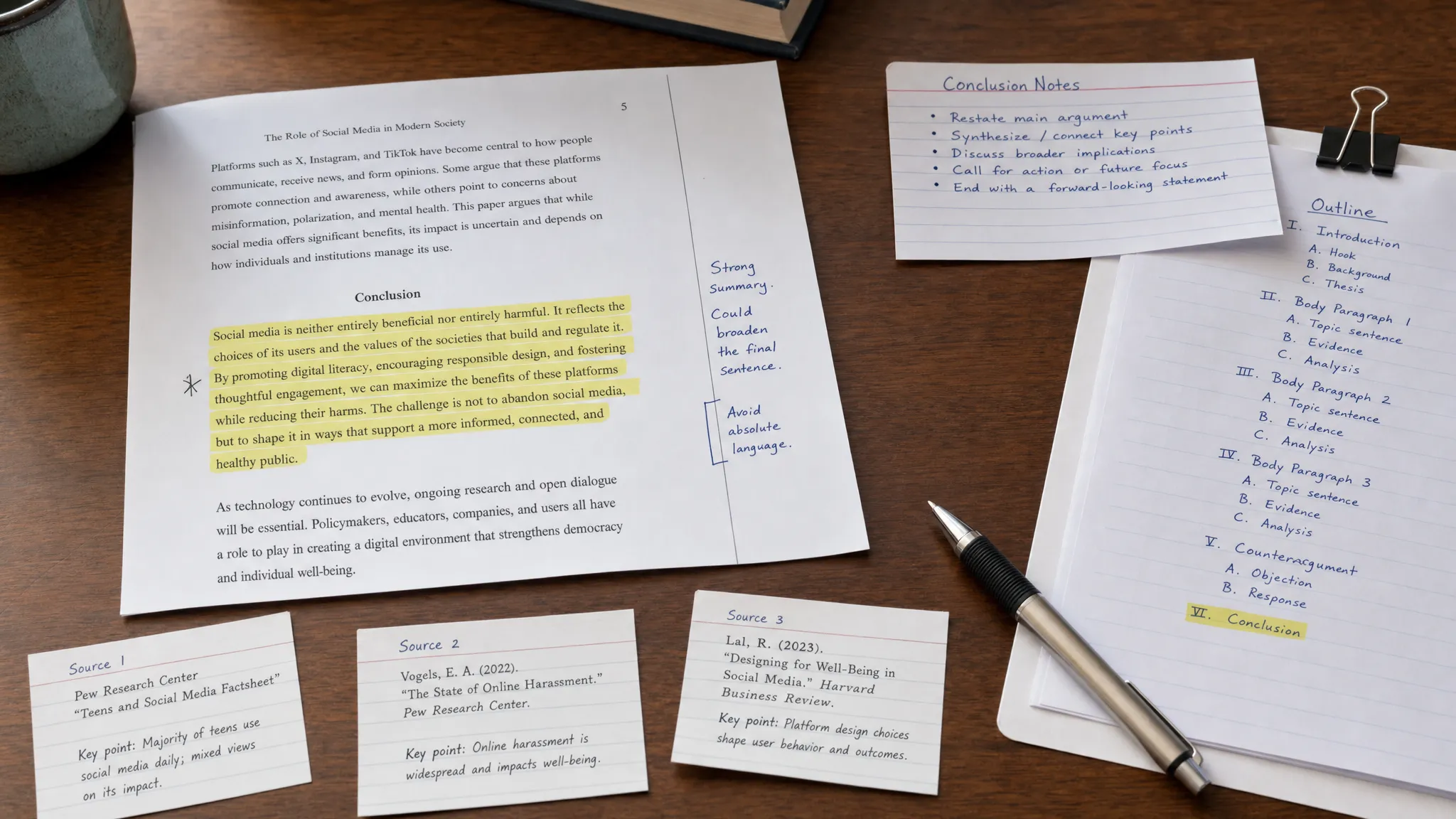
Yes, Turnitin can flag your conclusion more than the body. More precisely, Turnitin is not usually “targeting” the conclusion as a special section, but its AI detection highlights can cluster there because conclusions often contain the exact writing patterns AI content detectors are trained to notice: broad summary language, smooth transitions, repeated thesis wording, and generic final claims.
Want to bypass Turnitin in 2026? Grab the free prompt pack.
Get the exact text-humanization prompts I use to drop an AI score by hand — copy, paste, submit. Free, straight to your inbox.
Send me the free prompts →That can feel alarming, especially if the body of your essay contains your evidence, citations, and original analysis. But a highlighted conclusion does not automatically prove that the conclusion was AI-generated, and it does not mean the entire paper is plagiarized. It means the tool found patterns in that section that it considers statistically more AI-like than the rest of the document.
The key is to understand what Turnitin may be reacting to, what kind of report you are looking at, and how to respond with evidence and better revision choices.
Short answer: yes, but Turnitin is not grading sections separately
Turnitin’s AI writing report is designed to estimate how much qualifying prose may have been generated by AI. According to Turnitin’s own AI writing detection guidance, the score and highlights are indicators that require human review, not final proof of misconduct.
So when your conclusion appears more highlighted than your body, it usually means one of two things:
- The conclusion contains a denser concentration of AI-like patterns than the body.
- The body contains more specific, varied, source-based writing, while the conclusion becomes more generic and polished.
That distinction matters. A five-sentence conclusion where three sentences are highlighted can look dramatic, even if the overall AI percentage is low. A short section can appear “more flagged” visually because there is less text around it to balance out the highlights.
It is also important to separate Turnitin’s AI detection from its similarity report. The similarity report is closer to what people think of as a plagiarism checker, matching text against sources. The AI report is different: it evaluates linguistic patterns. A conclusion can be clean for similarity while still being flagged by AI detection, or vice versa.
Why conclusions get flagged more often than body paragraphs
Conclusions are naturally formulaic. Many students are taught to restate the thesis, summarize key points, and end with a broad implication. That structure is not wrong, but it can produce writing that sounds smooth, generalized, and predictable.
Those qualities overlap with common AI-generated content patterns. AI writing tools tend to produce balanced, tidy, non-specific summaries unless prompted with detailed evidence and a distinctive voice. Unfortunately, human writers under deadline pressure often do the same thing.
| Conclusion pattern | Why it may look AI-like | Stronger alternative |
|---|---|---|
| “In conclusion” followed by a broad recap | Highly predictable academic phrasing | Start with the specific insight your paper proved |
| Repeating the thesis with synonyms | Can sound mechanically paraphrased | Reframe the argument in light of the evidence you analyzed |
| Vague final claims like “this issue is important” | Low detail and low authorship signal | Explain what your findings change, limit, or complicate |
| Sudden polished tone | Style shift from the rest of the essay | Keep sentence rhythm and word choice consistent |
| No references to actual evidence | Reads like a detachable summary | Mention the strongest example, source, or case from the body |
| Overly balanced wording | AI often produces safe, neutral closure | State your own conclusion clearly, including nuance |
For example, a body paragraph might include a quotation, a page number, a specific concept from class, and your own interpretation. The conclusion may drop all of that and say something like, “Overall, this demonstrates the importance of understanding both sides of the debate.” That sentence is not necessarily AI-written, but it is generic enough to resemble AI-generated prose.
The body often has “human signals” the conclusion lacks
Body paragraphs usually show the messy, specific work of writing. They contain transitions that respond to the previous paragraph, citations that anchor claims, examples chosen by the student, and moments where the argument develops imperfectly but authentically.
A conclusion often removes that texture. It compresses the argument into a polished summary. If you wrote it last, you may also have been tired, rushing, or trying to sound more formal than usual. That can create a style mismatch between the body and the ending.
This mismatch is especially common when students use editing tools unevenly. If you only ran the final paragraph through Grammarly, ChatGPT, a paraphraser, or another AI writing assistant, the conclusion may become smoother than the rest of the essay. If that sounds familiar, the next step is not to panic, but to document what tool you used and how you used it. This is similar to what happens when Turnitin flags an essay after Grammarly: the issue is often the visible difference between your drafting voice and the edited final text.
The same pattern can happen at the beginning of a paper. If your introduction is highlighted too, it may be because intros and conclusions share the same formulaic features. For a closer comparison, see this explanation of why Turnitin may highlight an introduction.
First, confirm what kind of Turnitin flag you are seeing
Before revising or responding, identify whether you are looking at an AI writing highlight, a similarity match, or instructor feedback. Students often use “flagged” to mean several different things, but each one requires a different response.
If the conclusion is highlighted in the AI writing report, Turnitin is making a prediction about authorship patterns. If it is highlighted in the similarity report, it may be matching common wording, a source, another student submission, or even your own repeated thesis. If your instructor manually marked the conclusion, then the concern may be about argument quality rather than AI detection.
A conclusion can trigger similarity for innocent reasons. Common phrases like “in conclusion,” “this essay has demonstrated,” and “future research should explore” appear across countless papers. That does not make them strong writing, but it also does not automatically make them plagiarism.
For AI detection, the bigger question is whether the highlighted conclusion is consistent with your writing process. Can you show earlier drafts? Did the conclusion exist in your outline? Did you revise it in stages? Do your notes explain how you reached the final claim? These are often more persuasive than arguing with the percentage alone.
What it means if only the conclusion is highlighted
If only the conclusion is highlighted, the most reasonable interpretation is usually localized concern, not a judgment on the entire essay. It may mean the ending is more generic, more polished, or more detached from the evidence than the rest of the paper.
It can also mean the conclusion was written differently. Maybe you drafted the body over several days but wrote the conclusion in one sitting. Maybe you copied your thesis into the ending and quickly paraphrased it. Maybe you asked an AI tool for “a stronger final paragraph” and then edited the result. Each of those workflows can produce a conclusion that looks different from the body.
What you should not do is treat the highlighted conclusion as a signal to simply disguise the text. Trying to bypass AI detection by swapping words, adding random errors, or using a text humanizer without understanding the issue can make the writing less coherent and harder to defend. A better approach is to revise the conclusion so it genuinely reflects your argument, your evidence, and your normal writing style.
How to revise a conclusion that looks too AI-like
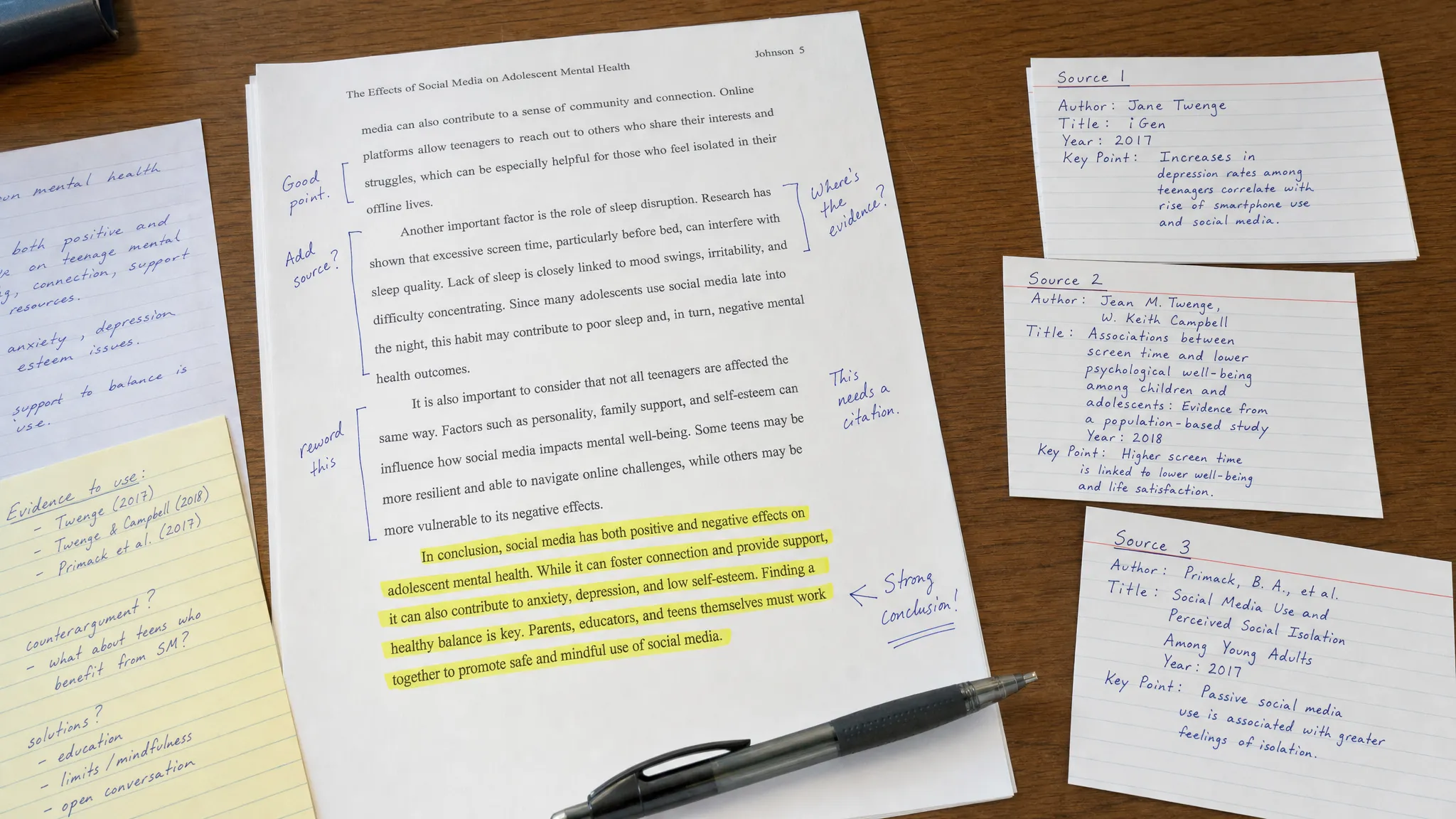
The goal is not to make your conclusion “sound less AI” in a superficial way. The goal is to make it more specific, more accountable to the essay, and more clearly yours.
Start by removing any sentence that could fit almost any paper. If the sentence would work for an essay on climate policy, social media, literature, or business ethics, it is probably too generic. Replace it with a claim that depends on your actual body paragraphs.
Weak conclusion sentence:
“Overall, this topic shows that technology has both positive and negative effects on society, and it is important to consider these issues carefully.”
Stronger conclusion sentence:
“The strongest pattern in the sources is not that technology is simply helpful or harmful, but that its effects depend on who controls access, how data is collected, and whether users can realistically opt out.”
The second version is better because it gives the reader something specific to take away. It also sounds more connected to an argument that was actually developed in the paper.
Use these revision moves if your conclusion feels too generic:
- Refer back to the most important evidence from the body.
- Name the tension your essay resolved or complicated.
- Avoid empty closing phrases like “in today’s society” or “this is a very important issue.”
- Keep your vocabulary consistent with the rest of the paper.
- Add one limitation or implication that follows directly from your analysis.
- Do not introduce a completely new argument in the final paragraph.
A good conclusion does not need to be dramatic. It needs to make the ending feel earned. If the body did the hard work, the conclusion should show what that work adds up to.
When a flagged conclusion is more concerning
A highlighted conclusion becomes more concerning when it does not match the rest of the essay in content, tone, or process.
For example, if the body is written in short, direct sentences but the conclusion suddenly uses abstract phrases like “multifaceted implications,” “underscores the necessity,” and “serves as a testament,” an instructor may notice the shift even without Turnitin. The same is true if the conclusion introduces ideas that were never discussed in the body. AI-generated endings often create broad implications that sound impressive but are not supported by the essay.
It is also more concerning if there is no drafting trail. If your version history jumps from no conclusion to a polished final paragraph, you may still have written it yourself, but it is harder to prove. That is why preserving process evidence matters. Drafts, outlines, comments, notes, source annotations, and document history can all help show how the conclusion developed.
If you believe the flag is a false positive, organize your evidence before responding. Detection Drama has a practical Turnitin AI false positives checklist that covers the kinds of documentation students can use when a detector’s prediction does not match their actual writing process.
How to explain the issue to an instructor
If your instructor asks about the conclusion, stay factual. Do not lead with “Turnitin is wrong” or “AI detectors never work.” A better response is to explain your process and offer evidence.
You might say that the conclusion was written after the body, that you revised it separately, and that you can provide drafts, notes, or version history showing how your argument developed. If you used grammar software or an AI tool in any way, be honest and specific. There is a big difference between using a tool to check punctuation, using it to suggest phrasing, and using it to generate a paragraph.
The strongest defense is usually a combination of three things: a clear explanation, supporting documents, and a willingness to discuss the actual content of the paper. If you can explain why your conclusion follows from your evidence, that helps demonstrate authorship in a way a detector score cannot.
Frequently Asked Questions
Can Turnitin flag only my conclusion as AI? Yes. Turnitin highlights can cluster in one section if that section contains more AI-like patterns than the rest of the paper. A short conclusion can look heavily flagged even when the overall percentage is not high.
Does a flagged conclusion mean my whole essay is AI-generated? No. A localized highlight does not prove the whole essay was AI-generated. It means the conclusion should be reviewed in context with your drafts, sources, writing style, and instructor’s policy.
Why would my conclusion be flagged if I wrote it myself? Human-written conclusions can sound formulaic, especially when they restate the thesis, use broad claims, and avoid specific evidence. These patterns can overlap with AI-generated content.
Should I rewrite my conclusion if Turnitin highlights it? If you are allowed to revise, rewrite it for clarity and specificity, not just to evade detection. Tie the ending to your evidence, remove generic phrasing, and keep the style consistent with the body.
Is Turnitin’s AI report the same as a plagiarism checker? No. Turnitin’s similarity report matches text against sources, while its AI writing report predicts whether prose resembles AI-generated writing. They are related to academic integrity, but they measure different things.
Need a clearer read on AI detection issues?
A flagged conclusion can be stressful, but it is not the end of the conversation. The best next step is to understand what the detector may be reacting to, preserve your writing evidence, and revise in a way that genuinely strengthens your argument.
For more practical guidance on AI detection, Turnitin reports, and human-like writing patterns, explore Detection Drama.
