rel=nofollow citations. Separately, the promoted call-to-action above is a StealthWriter affiliate placement carrying its own disclosure; StealthWriter is a WriteHuman competitor, and it had no involvement in this review.Does WriteHuman bypass Turnitin? No published evidence says so — and the strongest witness against the claim is WriteHuman’s own contract.
Want to bypass Turnitin in 2026? Grab the free prompt pack.
Get the exact text-humanization prompts I use to drop an AI score by hand — copy, paste, submit. Free, straight to your inbox.
Send me the free prompts →Key Takeaways
- WriteHuman’s blog advertises “guaranteed AI bypass”. Its Terms of Service say “We do not guarantee that any content processed through the Services will bypass third-party AI-detection systems or achieve specific detection scores.”
- Its Terms also prohibit the use case it markets: the first banned activity is anything that “enables users to mislead educational institutions.” Turnitin exists only inside educational institutions.
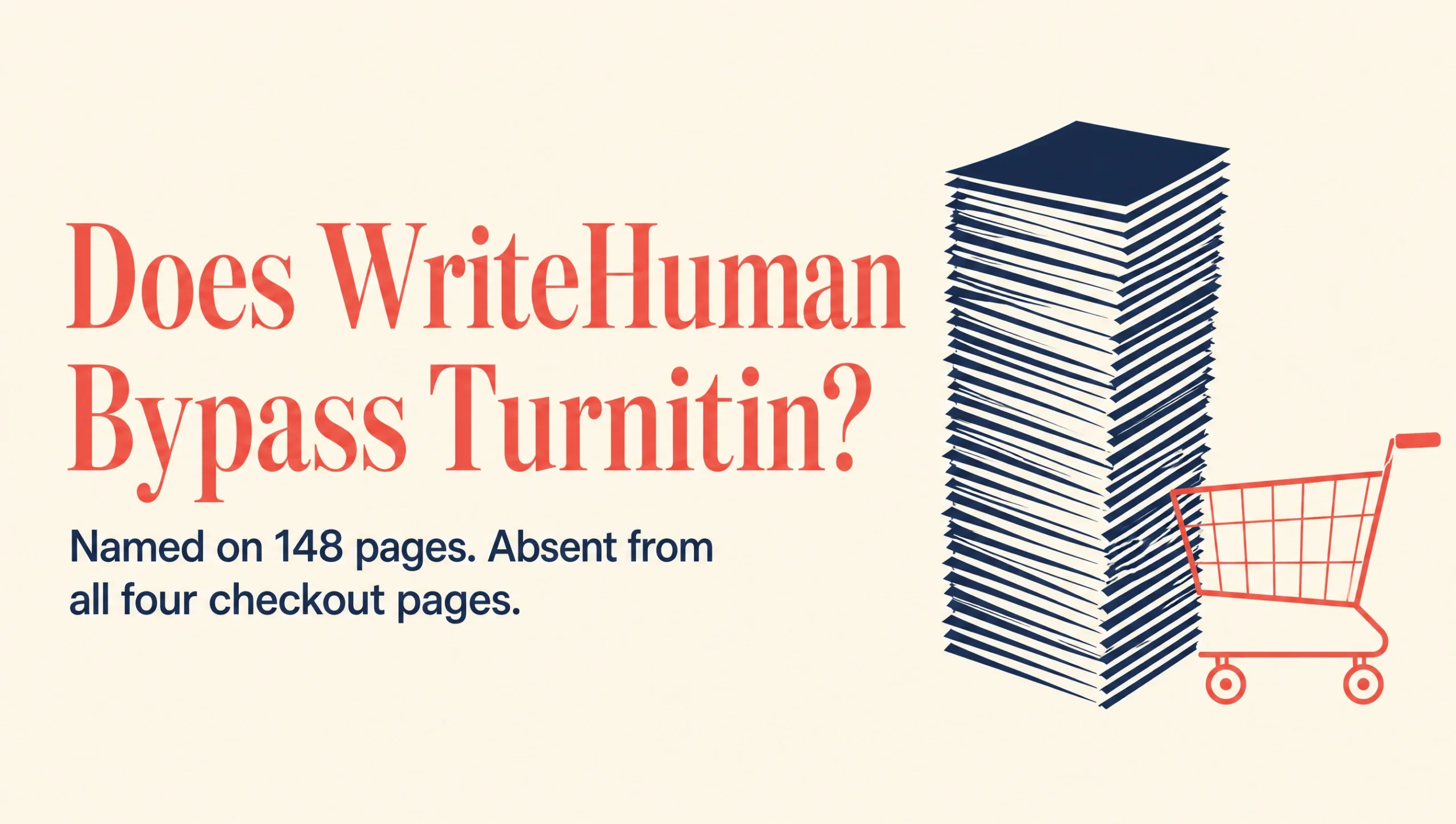
- Turnitin is named on 148 of 227 pages — and zero times on the pricing, detector, extension and API pages. The claim recruits, then vanishes at checkout.
- The one Turnitin number on the site is “97%”, captioned as a human score. Turnitin does not issue a human score. It issues an AI-writing percentage.
- WriteHuman cites the “independent” HumanizerBench on 15 pages. HumanizerBench’s own footer reads “Operated by WriteHuman” — and it does not test Turnitin at all.
- It publishes genuinely detailed methodology — 400 inputs, best-of-three, disclosed limits. For GPTZero. Never for Turnitin.
- Pangram’s DAMAGE paper names WriteHuman.ai and rates it L3, the worst of three quality tiers — though the paper judges fluency, not evasion, and says so.

Does WriteHuman bypass Turnitin?
Nobody has published evidence either way, and that includes WriteHuman. This page does not assert that the tool fails against Turnitin. It reports something narrower and more checkable: WriteHuman has never published evidence that it succeeds, and its own Terms of Service say it is not promising to.
We crawled all 227 URLs in its sitemap on 31 August 2026. Turnitin is named on 148 of them, about two-thirds of the site. A number is attached to it exactly once.

And note where the name stops. /pricing, /ai-detector, /extension and /api contain zero occurrences of “Turnitin”. The claim does its work across the blog and the homepage, then goes quiet on every page where money changes hands.
What does the contract say?

The blog says “New to our AI humanizer is built-in AI detection, with guaranteed AI bypass”, and elsewhere “Incorporating Humanizer for Guaranteed Bypass… guaranteeing authenticity and reliability.”
Section 1 of the Terms of Service, last updated 26 April 2024, says: “We do not guarantee that any content processed through the Services will bypass third-party AI-detection systems or achieve specific detection scores.”
Turnitin has no function outside educational institutions. A tool that markets Turnitin evasion while banning the misleading of educational institutions is selling something its own contract forbids you to do with it.
What is the 97%, exactly?
The homepage carries a band headed “Natural writing quality, verified by leading platforms”, showing a ring reading 97% beside the Turnitin logo, captioned “Human score per platform after WriteHuman processing.”
Two problems, both checkable without leaving the page.
First, Turnitin does not issue a “human score.” Its AI writing report returns an AI-writing percentage. And per Turnitin’s own documentation, “no score or highlights are attributed for AI detection scores in the 1% to 19% range” — below 20% the indicator shows an asterisk and no number at all. A 97% human score is not a shape Turnitin’s output takes.
Second, there is no method. No sample size, no corpus, no test date, no model, no repeat trials, no link. And the ring is not a screenshot — it is an inline SVG rendered in HTML next to a 7.6KB logo file. Across 237 catalogued images on the site, there is not one Turnitin screenshot.
This is not a site that cannot show its working. It demonstrably can, which is what makes the omission conspicuous.
| Where the Turnitin claim lives | What it says | Evidence attached |
|---|---|---|
| Homepage score band | 97%, “human score per platform” | None — and Turnitin issues no human score |
| Blog (multiple posts) | “guaranteed AI bypass” | None |
| Comparison pages | “Strong scores on Turnitin in independent tests” | No citation — while rivals’ rows are sourced |
| Terms of Service §1 | No guarantee of bypass or specific detection scores | — |
| Terms of Service §4 | Prohibits misleading educational institutions | — |
| Pricing, detector, extension, API pages | Turnitin not mentioned at all | — |
It publishes real methodology — for a different detector
Credit where it is due. WriteHuman’s GPTZero study is more transparent than almost anything else in this market. Verbatim: “We took 400 real AI-generated inputs from our platform (English, 100–300 words, last 30 days), ran each through our humanizer to generate 3 variations per input, then scored every version… with GPTZero. For each input we took the best of three… because that’s what the product surfaces to users.” Raw 73.7% AI, humanized best-of-three 4.0%.
It even discloses the cherry-pick and justifies it. That is a real standard.
Turnitin is not in that study, or any other. Meanwhile the site publishes precise Turnitin figures for competitors — “Phrasly AI output still scored 100% AI on Turnitin”, “38% of Walter Writes output still flagged” — each sourced to a named third party. Its own comparison-table row reads “Strong scores on Turnitin in independent tests” with a tick and no citation.
Precision for rivals, adjectives for itself.
Is the “independent benchmark” independent?
No, and WriteHuman knows it. The site cites HumanizerBench as its evidence base on 15 pages, calling it “the independent HumanizerBench benchmark”, “neutral, repeatable evidence”, “third-party scores” and “the kind of outside measurement [the rival] doesn’t have.”
HumanizerBench‘s own footer reads: “© 2026 HumanizerBench. Operated by WriteHuman.” Its domain was registered on 26 May 2026 — three months old.
Exactly one WriteHuman page discloses this, in an FAQ: “Is HumanizerBench independent?” — “No, and we do not describe it that way. WriteHuman operates HumanizerBench.” Fifteen other pages on the same domain describe it exactly that way.
And for this article’s purposes, the decisive fact is narrower: HumanizerBench does not test Turnitin. Its published detector set is GPTZero, Originality.ai, Copyleaks, Winston AI and ZeroGPT. Turnitin appears zero times on its methodology and leaderboard pages. The benchmark WriteHuman leans on for its number-one ranking is silent on the detector students actually face.
In fairness: the raw data, scoring code and a reproducibility script are published, and the benchmark states it takes no payment for placement. The failure here is labelling and scope, not fabrication.
What does Pangram’s audit say?
WriteHuman is one of the few tools in this cluster that a detector company has actually named. The DAMAGE paper (Masrour, Emi and Spero, January 2025) audits 19 humanizers and classifies WriteHuman.ai as L3 — the worst of three tiers — describing its output verbatim as “Poorly written text at an elementary school level. Occasionally includes incomplete sentences.” L3 tools averaged a 2.67% fluency win rate against 26.0% for L1.
Two caveats have to travel with that, or the citation is unfair. The paper states plainly that it classifies tools “based on faithfulness and fluency, not on their effectiveness at bypassing AI detectors”. And it separately observes that more fluent humanizers are more detectable — so a low quality rating is not evidence of poor evasion. It is evidence about the writing you would be submitting.
WriteHuman is also absent from Pangram’s August 2025 twenty-tool accuracy table. The DAMAGE paper does not test any humanizer against Turnitin.
What do users report?
Very little that is organic, and nothing positive about Turnitin specifically. Searches for WriteHuman output against Turnitin return no first-hand success reports. The two “reviews” that rank are competitor funnels — one pivoting to AIDetectPlus, one to Grubby.ai — and both concede the point: “AI detectors like Turnitin still flag it as AI-generated”, and “It did lower the detection rate compared to raw ChatGPT text, but not enough to make me confident turning it in.”
Treat both as what they are: interested parties. But note that no uninterested party has published anything better in either direction.
What should you take from this?
The honest answer is that this question is unanswerable from outside Turnitin’s licensing, and WriteHuman has not tried to answer it. It has built real measurement infrastructure and pointed it at GPTZero. Against Turnitin it offers one uncited number describing a metric Turnitin does not emit, on a site whose contract disclaims the outcome and forbids the use case.
The independent picture is not reassuring in either direction. The most recent peer-reviewed test of Turnitin by name, Hadra, Cambridge and Mesbah (February 2026), measured it at 0.61 overall accuracy and found it performed poorly on exactly the hybrid text humanizers produce. Turnitin’s own guidance says its model “may misidentify human-written, AI-generated, and AI-paraphrased text, so it should not be used as the sole basis for adverse actions against a student.” Betting a submission on either side of that is a bad trade.
If your real worry is being wrongly flagged on your own writing, keep your drafting history — it costs nothing and it is the one defence that survives a detector being wrong. It matters most for the writers detectors treat worst: ESL writers and AI detection and false positives for neurodivergent students. Check before you submit with the best pre-submission check and the Turnitin self-check, and strip the obvious tells by hand first via what to remove before using an AI humanizer.
For the product itself see our WriteHuman review, and for the same question against Pangram, does WriteHuman bypass Pangram. Other Turnitin cells: Clarity Bubble, Undetectable AI, StealthGPT, GPTHuman and SuperHumanizer.
Get the free text-humanization prompts
Get the exact text-humanization prompts I use to drop an AI score by hand — copy, paste, submit. Free, straight to your inbox.
Free · No credit card · Straight to your inbox
Frequently asked questions
Does WriteHuman bypass Turnitin?
Nobody has published evidence either way, including WriteHuman. It names Turnitin on 148 of its 227 pages but attaches a figure to it exactly once, with no method. Its Terms of Service state it does not guarantee content will bypass third-party AI-detection systems or achieve specific detection scores. And no independent test of the pair exists that explains how it obtained a Turnitin AI score — because there is no consumer path to one.
What is wrong with the 97% figure?
Two things. It has no sample size, no date, no model and no trial count behind it. And it is captioned “human score per platform” — but Turnitin does not issue a human score. Turnitin’s AI writing report returns an AI-writing percentage, and suppresses any value between 1% and 19% behind an asterisk. A 97% human score is not an output Turnitin produces.
Doesn’t WriteHuman publish real testing?
Yes, and it deserves credit for it — just not here. Its GPTZero study discloses 400 real inputs of 100 to 300 words, three variations each, best-of-three scoring, and says openly that best-of-three is what the product surfaces. That is more methodology than most of this market publishes. Turnitin is not in it.
Is HumanizerBench independent?
No. WriteHuman describes it as “independent”, “neutral” and “third-party” across 15 pages, while HumanizerBench’s own footer reads “Operated by WriteHuman”. One WriteHuman page does disclose this, and says “we do not describe it that way” — a statement the other fifteen pages contradict. It also does not test Turnitin: its published detector set is GPTZero, Originality.ai, Copyleaks, Winston AI and ZeroGPT.
What does the DAMAGE paper say about WriteHuman?
Pangram’s DAMAGE paper audits 19 tools and rates WriteHuman.ai “L3”, the worst of three tiers, describing its output as “poorly written text at an elementary school level” with “incomplete sentences.” Two caveats matter for fairness: the paper explicitly rates faithfulness and fluency “not… effectiveness at bypassing AI detectors”, and it separately observes that less fluent output can be harder to detect. It is not a Turnitin verdict.
Why can’t anyone test this properly?
Turnitin does not sell individual licences, and its AI writing report is instructor-facing — students cannot see it even at their own institution. Draft Coach, the only student-facing Turnitin product, has no AI detection. So no vendor and no reviewer can lawfully obtain a genuine Turnitin AI score, which is why every “Turnitin test” in this market comes from a reseller account, a forgery, or a similarity report relabelled.
What does it cost, and can I get a refund?
Free gives 3 requests of 250 words, per its pricing page. Basic is $20 a month or $12 billed annually, Pro $29 or $19, Ultra $59 or $39, with 80, 200 and unlimited requests. There is no refund at all: the pricing FAQ says “We do not offer refunds” and the Terms say “All purchases are non-refundable.” No window, no conditions.
Who operates WriteHuman?
Write Human, LLC, in Virginia, with Ivan Jackson named as CEO and founder. Three official surfaces give three different addresses — Arlington in the Terms, Midlothian in the Privacy Policy, Midlothian on the Chrome Web Store — and the entity name is spelled three ways. No registration number is published and /contact returns a 404.
