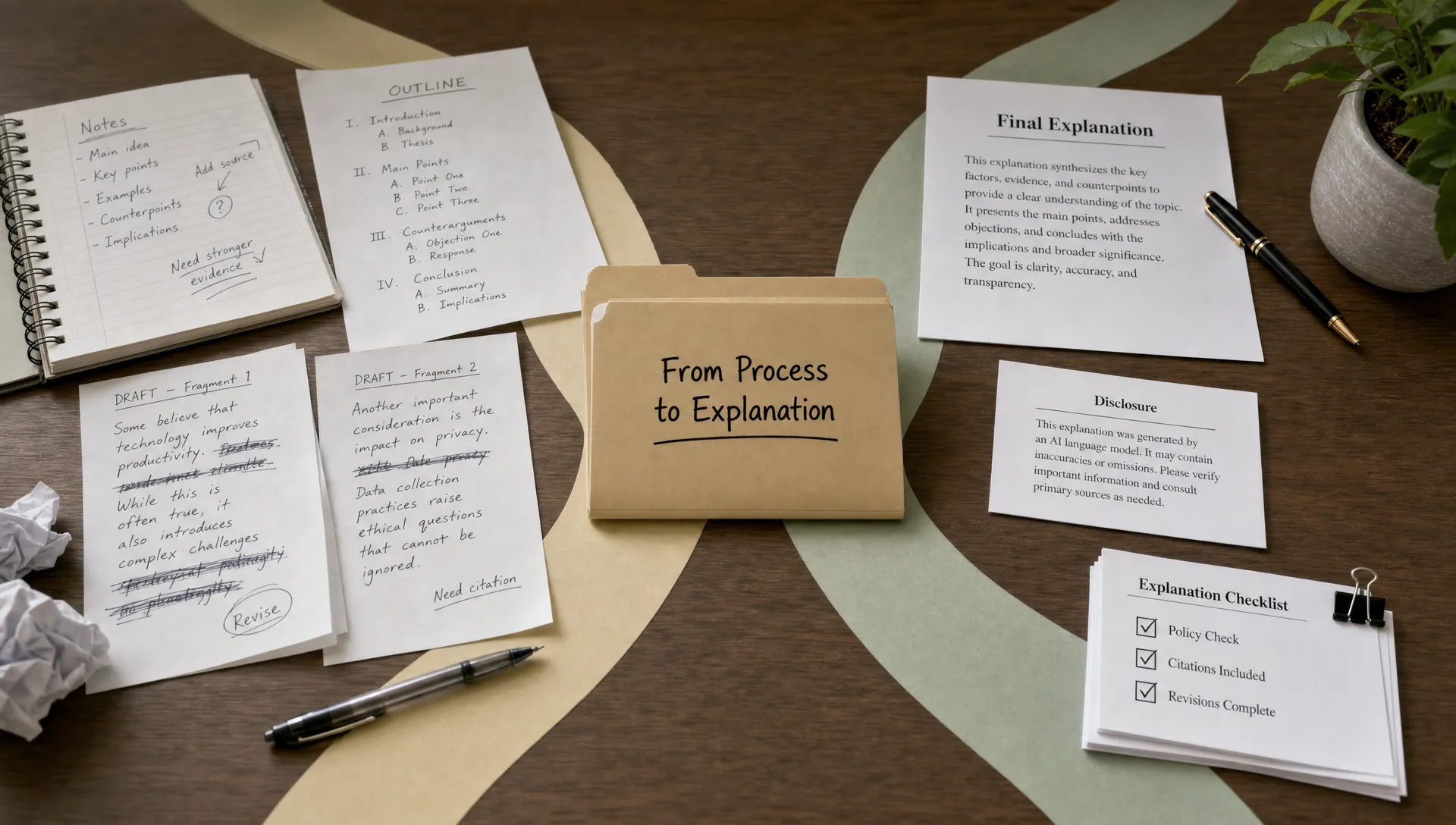
An AI authorship meeting with your professor can feel personal, especially if the concern started with an AI content detector or Turnitin report. The safest way to approach it is not to argue in the abstract about whether detectors are perfect. Your goal is to show how the work was created, clarify any tool use and leave the meeting with a clear record of what happens next.
This guide focuses on practical preparation: what to collect, how to explain your writing process, what questions to ask and how to follow up after the meeting.
Want to bypass Turnitin in 2026? Grab the free prompt pack.
Get the exact text-humanization prompts I use to drop an AI score by hand — copy, paste, submit. Free, straight to your inbox.
Send me the free prompts →Understand what the meeting is really about
An AI authorship meeting is usually not just about a percentage score. Your professor may be trying to answer several questions at once:
- Did you write the submitted work yourself?
- Did you use AI writing tools in a way allowed by the course policy?
- Does the paper match your past writing, class participation or drafting process?
- Are there citation, plagiarism checker or source use concerns mixed into the AI concern?
- Is the AI detection result being treated as a clue or as proof?
That distinction matters. AI detectors can be part of a review, but they are not the same as direct evidence of misconduct. Turnitin describes its AI writing detection feature as a tool that supports educator review, not a replacement for judgment. Vanderbilt University also publicly disabled Turnitin’s AI detection tool in 2023 because of concerns about false positives, transparency and student impact.
You do not need to become a technical expert before the meeting. You do need to be ready to explain your process clearly and support it with evidence.
Reply to the meeting request calmly
If your professor emailed you about AI authorship, respond quickly and neutrally. Do not send a long defense before you know what the concern is. Do not accuse the professor of relying on bad technology. A short response keeps the conversation professional.
You can write something like:
Thank you for letting me know. I am available to meet and discuss the authorship concern. Before the meeting, could you please share which assignment, passages or evidence I should be prepared to discuss? I will bring my drafts, notes and source materials so I can explain my writing process clearly.
If the meeting is with an academic integrity office rather than only your professor, ask whether you may bring an adviser, student advocate or support person. Policies vary by institution, so use your school’s actual procedure rather than guessing.
If the accusation just arrived and you are not sure what to do first, Detection Drama’s guide on what to do in the next 24 hours after being accused of AI use gives a more urgent checklist for preserving files and avoiding rushed mistakes.
Build a compact authorship packet
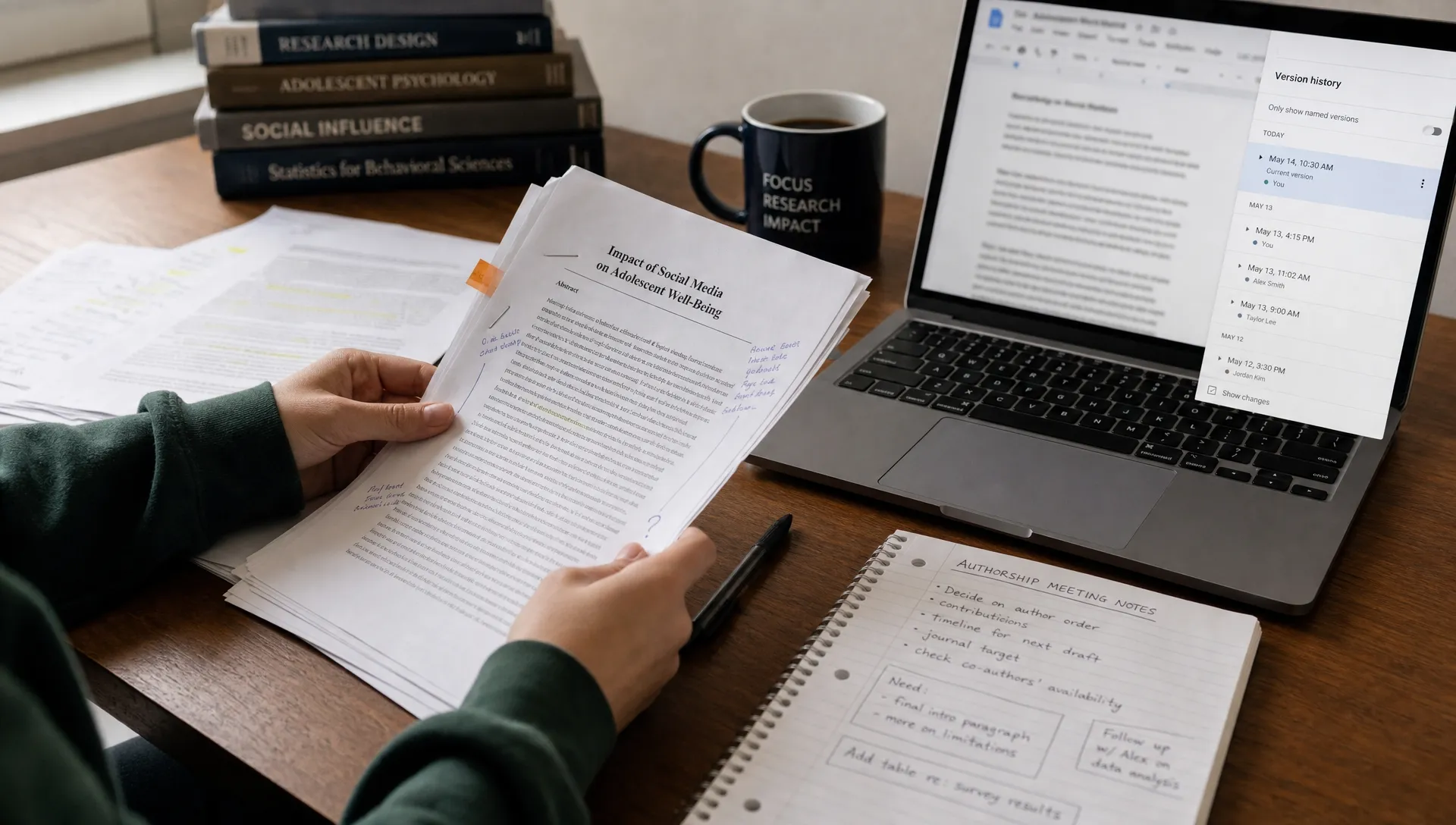
The best preparation is a small, organized folder that shows the evolution of the assignment. Do not overwhelm your professor with hundreds of screenshots unless requested. Bring enough material to make your process visible.
A strong authorship packet may include:
- Early outlines, brainstorms or thesis notes
- Draft versions with timestamps or version history
- Google Docs, Word or Overleaf revision history
- Research notes, annotated PDFs or database searches
- Source list showing when and why you used each source
- Assignment prompt, rubric and course AI policy
- Any permitted AI prompts and outputs, if you used AI and disclosure was required
- Notes from office hours, peer review or writing center sessions
- A short timeline of when you worked on the assignment
If you want a more detailed pre-submission version of this system, use the guide to build an authorship packet before you submit. For this meeting, the same idea applies, but your packet should be focused on the disputed assignment.
Audit your actual tool use before the meeting
Before you explain anything to your professor, be honest with yourself. Many authorship disputes become worse because a student gives a broad denial and later remembers using a tool that the professor considers relevant.
Make a private list of every tool or person involved in the assignment. Include obvious AI writing tools, but also grammar checkers, paraphrasers, citation generators, translators, editing extensions, tutoring help and peer feedback. Then compare that list to the course policy.
Your audit should separate three categories:
| Category | Examples | How to discuss it |
|---|---|---|
| Clearly allowed support | Spellcheck, required citation manager, writing center feedback allowed by syllabus | Mention briefly if relevant and show that you stayed within policy |
| Ambiguous support | Grammarly rewrites, translation tools, AI brainstorming, AI outline feedback | Explain exactly what happened and ask how the policy applies |
| Likely prohibited use | Submitting AI-generated paragraphs as your own, hiding AI drafting when disclosure was required | Be honest, take responsibility and ask about corrective options |
This audit is not about creating a perfect story. It is about preventing contradictions. If you used AI for brainstorming but not drafting, say that. If you used a text humanizer or paraphrasing tool after generating text, do not pretend the draft was entirely manual. The meeting will go better if your explanation is specific, consistent and tied to the policy.
Prepare a simple timeline of your writing process
Professors often look for process details because genuine authors can usually explain how a paper came together. A timeline helps you avoid rambling under pressure.
Keep it short. For example:
| Date or stage | What happened | Evidence you can show |
|---|---|---|
| First reading | Read assignment prompt, chose topic, saved three possible sources | Notes file, library search history |
| Planning | Created outline and working thesis | Outline draft, handwritten notes |
| Drafting | Wrote introduction and body sections over two sessions | Version history, document timestamps |
| Revision | Reorganized paragraphs, added citations, changed conclusion | Tracked changes, comments, final draft |
| Final check | Ran spellcheck, reviewed citations, submitted | File metadata, LMS timestamp |
You do not need perfect documentation for every hour. The timeline simply helps your professor see that the submission has a human history.
Know how to explain suspicious writing signals
Some writing gets flagged because it sounds unusually polished, generic or different from earlier work. That does not automatically mean misconduct. It does mean you should be ready to explain why the paper reads that way.
Common issues professors may point to include vague topic sentences, repetitive structure, unusually formal vocabulary, missing personal voice, perfect surface grammar or citations that look decorative rather than used. If those patterns exist in your paper, prepare an honest explanation.
Maybe you wrote in a more formal style because the rubric rewarded academic tone. Maybe you relied heavily on a template from class. Maybe you revised with Grammarly and accepted too many sentence rewrites. Maybe English is not your first language and you used a translation or grammar tool. Each of these explanations is different, so avoid a blanket statement like, “I did not use AI at all,” unless it is fully true.
If you used grammar software and the concern involves Turnitin AI detection, you may also want to review how to respond when Grammarly triggered Turnitin AI concerns so you can separate proofreading support from outsourced authorship.
Decide what you need to ask in the meeting
Do not treat the meeting as a one-way interrogation. You are allowed to ask clear, respectful questions that help you understand the concern and your options.
Useful questions include:
- Which assignment, passages or sections raised the concern?
- Was the concern based on an AI detector, a plagiarism checker, writing style, citation issues or a combination?
- If an AI content detector was used, what tool was used and what did the report actually say?
- How does the course policy define prohibited AI use?
- Is the detector result being treated as evidence, a starting point for review or a final decision?
- What evidence would help resolve the concern?
- Will there be a written summary of the meeting and any next steps?
These questions do two things. They show that you take the concern seriously and they prevent the conversation from staying vague.
What to say if you did not use AI
If you genuinely did not use AI writing tools, keep your explanation direct. Avoid sounding like you are giving a speech about all AI detectors being useless. Focus on your process.
You might say:
I understand why you want to review the assignment. I did not use AI to write or rewrite this paper. I brought my outline, drafts, source notes and version history so I can show how I developed it. If there are specific passages that seem inconsistent with my usual writing, I can walk through how I wrote or revised them.
Then stop and let your professor respond. Overexplaining can make a truthful answer sound rehearsed. If the professor points to a specific paragraph, discuss that paragraph. If they show a report, ask what part of the report they find meaningful.
What to say if you used AI within the rules
If the course allowed limited AI use, your job is to show that your use stayed within the allowed boundary. Be precise.
A good explanation sounds like:
The syllabus allowed AI for brainstorming but not for drafting final prose. I used ChatGPT to generate possible research questions, but I did not use its wording in the paper. I brought the prompt log and my outline so you can see how I moved from the brainstorm to my own draft.
If you disclosed AI use in the assignment, bring that disclosure. If you forgot to disclose but the use was allowed, say so plainly and ask whether you can correct the disclosure record.
What to say if you crossed the policy line
If you used AI in a way that likely violated the assignment rules, the meeting is still worth preparing for. Preparation does not mean hiding what happened. It means being accurate, taking responsibility and understanding the process.
Do not make the situation worse by inventing drafts, deleting files or blaming a tool for choices you made. Instead, identify exactly what happened: which sections were AI-generated, whether you edited them, whether you cited sources yourself and why you misunderstood or ignored the policy.
A responsible response might be:
I reviewed the policy again and I understand that my use went beyond what was allowed. I used AI to help draft part of the assignment, and I should have asked for clarification before submitting. I want to be honest about what happened and understand whether there is a way to revise, resubmit or complete an alternative assignment under the course rules.
This does not guarantee a mild outcome. It does show maturity, which can matter when instructors or conduct offices consider intent, cooperation and remediation.
Behaviors that make the meeting harder
Certain reactions can damage your credibility even when you have a strong case. Avoid these if you can.
| Avoid | Better approach |
|---|---|
| “AI detectors are fake, so this meeting is unfair.” | “I understand the concern. Can we review the evidence and my drafting process together?” |
| “I swear I wrote it,” with no documents | “I brought version history, notes and drafts that show how the paper developed.” |
| Deleting drafts or tool history | Preserve everything, even if it feels embarrassing or incomplete |
| Claiming no tools were used when you accepted rewriting suggestions | Explain the specific tool, feature and level of editing |
| Arguing about punishment before understanding the evidence | Ask what raised the concern and what procedure applies |
The tone you want is calm, factual and cooperative. You can defend yourself without attacking the professor.
Bring the right materials to the meeting
If the meeting is in person, bring your laptop and a small PDF or folder of evidence. If it is online, have the documents open and ready to screen share. Do not rely on memory while nervous.
A practical meeting folder can be organized like this:
- Assignment prompt and syllabus AI policy
- Final submitted paper
- Drafts and version history screenshots
- Research notes and sources
- Tool use notes or AI disclosure, if relevant
- One-page timeline
- Questions you want answered
If your version history is in Google Docs, make sure you know how to open it before the meeting. If your work was done in Microsoft Word, check whether AutoSave, OneDrive version history or file metadata can support your timeline. If you wrote in multiple places, such as notes apps and pasted into a final document, gather those fragments too.
During the meeting, listen first
Start by asking your professor to explain the concern. Take notes. Do not interrupt every point with a defense. You will respond more effectively once you know whether the issue is the detector score, suspicious phrasing, missing citations, a sudden style change or something else.
When it is your turn, walk through your process in order. Use your timeline as a guide. Show evidence only when it answers the concern. A professor does not need to see every keystroke. They need enough context to make a fair judgment.
If you do not know an answer, say that you need to check rather than guessing. For example, “I do not remember the exact time I made that revision, but I can check the document history after this meeting and send it to you.”
After the meeting, send a follow-up email
A follow-up email protects both sides by creating a written record. Send it the same day if possible.
You can write:
Thank you for meeting with me today about the authorship concern for [assignment name]. My understanding is that the concern involved [brief summary]. During the meeting, I shared [drafts, version history, notes or other evidence]. The next step is [what they said will happen]. Please let me know if I misunderstood anything or if you need additional materials from me.
Keep the tone neutral. Do not use the email to reargue every point unless you were asked to provide more evidence.
If the issue escalates beyond the professor
Sometimes the professor cannot resolve the concern alone and must refer it to an academic integrity office. If that happens, ask for the formal policy, deadline and evidence packet. Follow the process exactly.
At that stage, it may help to review whether your school treats AI detector results as standalone proof or as one piece of evidence. Detection Drama covers that question in more detail in Can Professors Use AI Detectors as Proof?, including why detector scores should be challenged through evidence rather than panic.
If your school offers a student ombudsperson, academic adviser, student union representative or writing center consultant, consider asking for procedural guidance. You are not trying to pressure the professor. You are trying to understand the rules that apply to you.
Frequently Asked Questions
Should I bring printed drafts or digital version history? Digital version history is usually stronger because it can show timestamps and revisions. Printed drafts can still help, especially if they include handwritten notes, comments or peer feedback.
What if my professor will not show me the AI detection report? Ask politely whether the concern is based on a report, writing style or another source of evidence. If the matter becomes formal, request the evidence through the procedure your school provides.
Can I record the meeting? Only record if your school policy and local law allow it, and tell the professor before recording. A written follow-up email is often safer and less confrontational.
Should I run my paper through more AI detectors before the meeting? You can, but do not rely on detector scores as your main defense. Different AI detection tools can disagree. Drafts, notes, source work and version history are usually more useful.
What if I used AI for brainstorming but not writing? Explain the exact use, bring prompt logs if you have them and connect your explanation to the course policy. If disclosure was required and you missed it, ask how to correct the record.
What if I panic during the meeting? Bring a one-page timeline and a short list of questions. If you forget something important, send a calm follow-up email with the missing information.
Use preparation to make the conversation fair
An AI authorship meeting is stressful, but it is also a chance to replace suspicion with evidence. Your strongest position comes from a clear timeline, honest tool audit, organized drafts and respectful questions about the specific concern.
If you are trying to understand AI detection reports, authorship evidence and how detector disputes unfold, Detection Drama offers free guides and resources to help you prepare without guessing. Use the meeting to show your real process, correct misunderstandings and protect your academic record with facts.
Want to bypass Turnitin in 2026? Grab the free prompt pack.
Get the exact text-humanization prompts I use to drop an AI score by hand — copy, paste, submit. Free, straight to your inbox.
Send me the free prompts →