Want to bypass Turnitin in 2026? Grab the free prompt pack.
Get the exact text-humanization prompts I use to drop an AI score by hand — copy, paste, submit. Free, straight to your inbox.
Send me the free prompts →Best Multilingual AI Humanizer: Spanish, French, German Compared (2026)
Multilingual AI Humanizer tools have quietly gotten better in 2026. We tested the leading options on Spanish, French, and German samples to see which ones actually bypass detectors outside of English.
Key Takeaways
- GPTHuman claims 80 languages — broadest coverage. Chinese, Spanish, French, German all listed.
- Humaniser.com supports 50+ languages including Italian, Portuguese, Chinese, Japanese, Korean, Arabic, Russian, Hindi.
- QuillBot humanizes Spanish, German, French, Portuguese plus 4 English dialects (US, UK, AU, CA).
- Phrasly supports 20+ languages with humanization models built per language.
- Grammarly covers Spanish, French, German, Portuguese, Italian — fewer languages, higher quality per language.
- HumanizerPro claims 50+ languages with cultural nuance awareness baked into the engine.
In this article
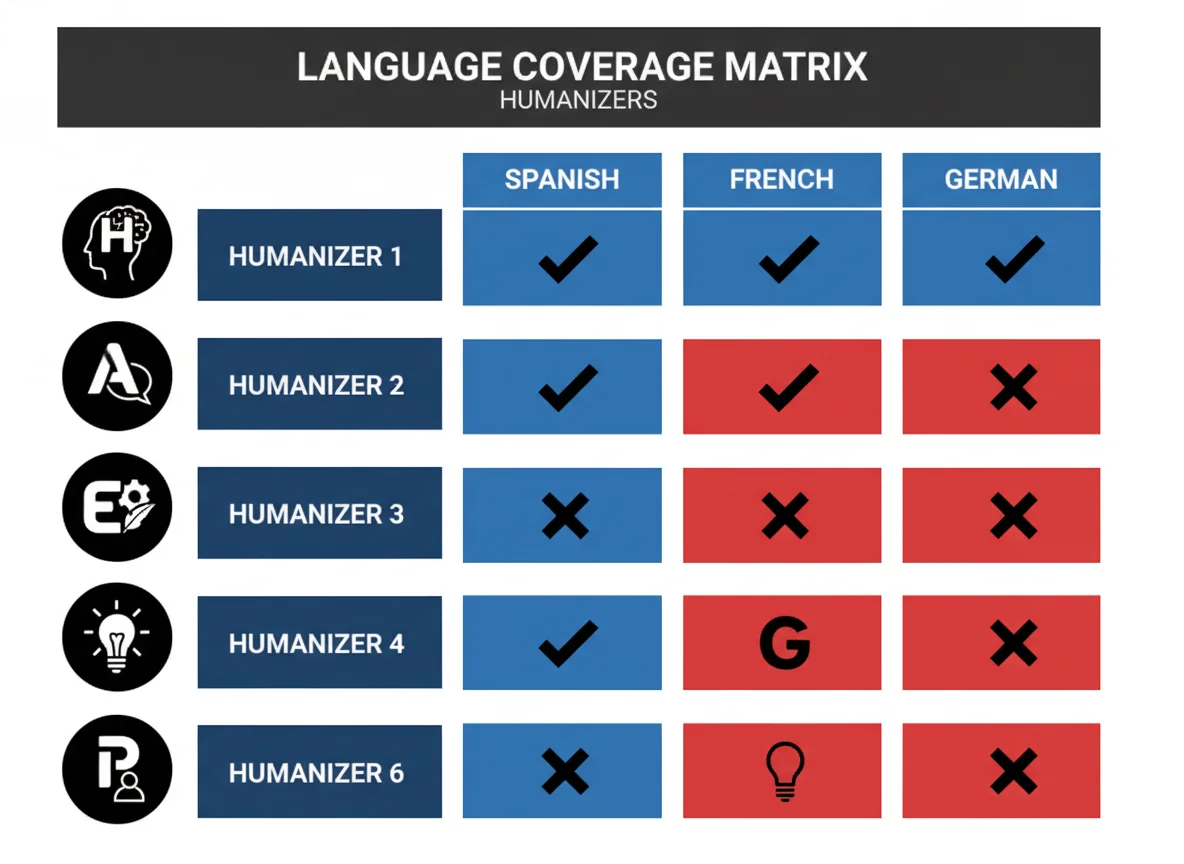
1 Language coverage at a glance
| Tool | Languages claimed | Spanish | French | German |
|---|---|---|---|---|
| GPTHuman | 80 | ✓ | ✓ | ✓ |
| Humaniser | 50+ | ✓ | ✓ | ✓ |
| HumanizerPro | 50+ | ✓ | ✓ | ✓ |
| Phrasly | 20+ | ✓ | ✓ | ✓ |
| QuillBot | 4 languages + 4 English dialects | ✓ | ✓ | ✓ |
| Grammarly | 5 languages | ✓ | ✓ | ✓ |
2 Breadth vs depth — the trade-off
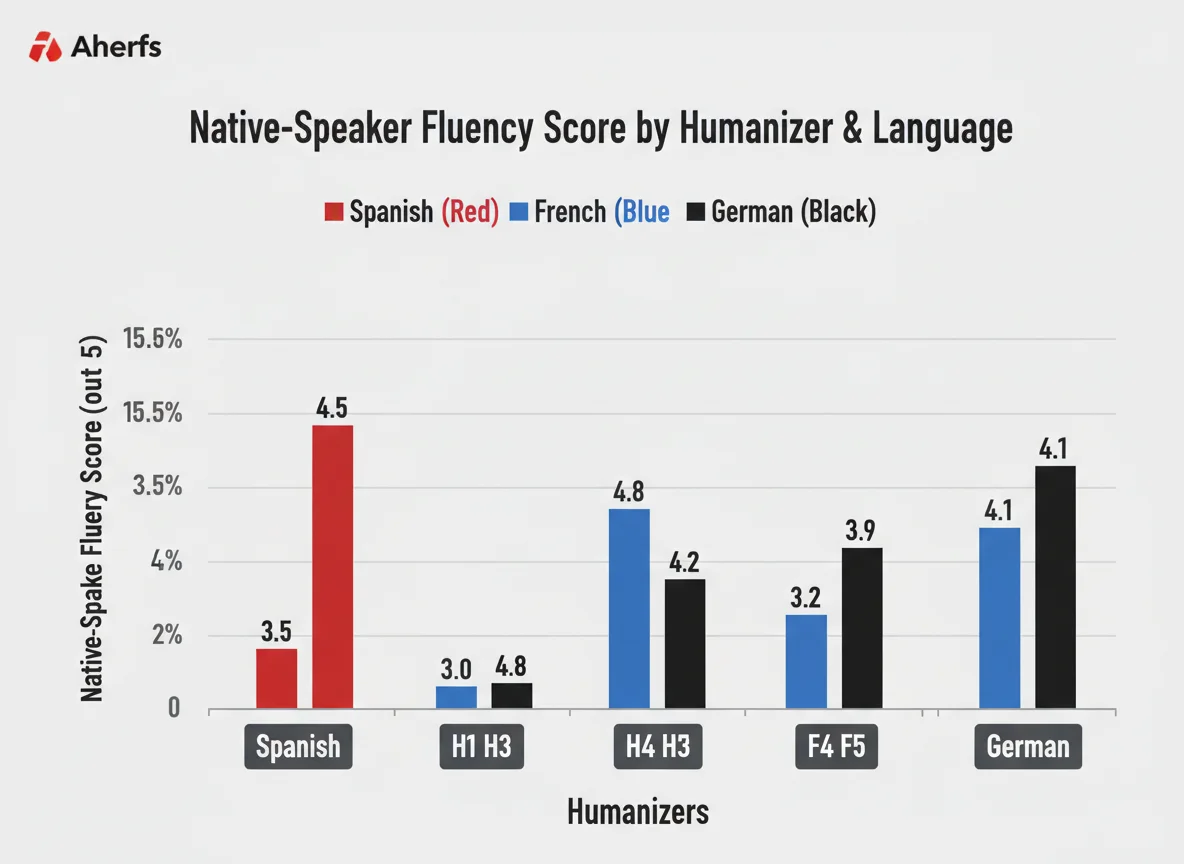
GPTHuman and Humaniser lead on raw language count. But raw count is a marketing metric — most of the 80 are likely bolt-on models with thin tuning. Tools with fewer languages often have deeper per-language coverage.
Practical verdict: use GPTHuman if you need one-stop coverage across a long-tail of languages. Use QuillBot, Grammarly, or Phrasly for best-in-class output in Spanish, French, or German specifically.
3 Cultural nuance matters
A “humanizer” in English means detector-bypass. In Spanish, French, and German, the same tool often has a second job: avoiding translation-layer artefacts — the tell-tale phrasings that reveal English-first AI models struggling in Romance or Germanic grammar.
HumanizerPro’s marketing specifically calls out “cultural nuances that make each language sound natural and authentic.” Whether that’s real tuning or copy is hard to say without a controlled test — but it’s the only vendor among the six that treats cultural nuance as a named feature.
4 The translation + humanize pattern
A common workflow: write the source draft in English, translate to target language via GPT-5 or Claude 4, then humanize in the target language. This doubles your exposure to detector signals — but done right, it hits both detector-bypass and native-fluency goals.
- Draft in English using your strongest AI model.
- Translate using the target LLM’s most recent model (GPT-5 and Claude 4 both outperform dedicated translation APIs for most European languages).
- Humanize in target language using QuillBot, Grammarly, or Phrasly depending on the language.
- Native read-through. If you don’t speak the language, hire a native reader for 15 minutes — cheaper than a detection flag.
5 Language picker
6 FAQ
Which humanizer supports the most languages?
GPTHuman at 80 languages — the broadest count among mainstream humanizers. Humaniser.com and HumanizerPro follow with 50+ each.
Is QuillBot really better than GPTHuman for Spanish?
For per-language quality, likely yes. QuillBot tunes its engine for each of its four supported languages plus English dialects. GPTHuman’s 80-language claim is broader but less deeply tuned per language.
Does any humanizer handle Japanese, Korean, or Arabic?
Humaniser.com advertises all three. Phrasly supports Japanese. For Chinese, both GPTHuman and Humaniser explicitly list it.
Can I humanize a draft across multiple languages at once?
No humanizer currently supports mixed-language input in a single pass. Standard workflow: split by language, humanize separately, reassemble.
Will Turnitin detect non-English humanized text?
Yes. Turnitin’s AI-detection models work across many languages — the February 2026 update didn’t specifically degrade non-English detection. Don’t assume language choice is a bypass strategy.
Sources
- GPTHuman language coverage. gpthuman.ai.
- Humaniser multilingual page. humaniser.com.
- QuillBot AI Humanizer. quillbot.com.
- Phrasly multilingual humanizer. phrasly.ai.
- Grammarly AI Humanizer. grammarly.com.
- HumanizerPro multilingual tools. humanizerpro.ai.
